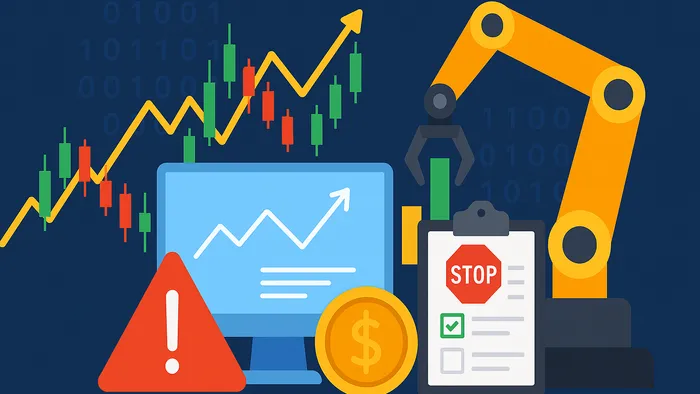
This article will discuss the Critical Risk Rules pertaining to High-Frequency FX Algo Trading. While high-speed algorithmic trading in the forex market can be incredibly profitable, it comes with a high degree of risk.
The importance of risk rules such as latency management, pre-trade risk controls, kill switches, and dynamic limits are in protecting your capital, as well as ensuring execution and compliance reliability so traders can take advantages of the volatile nature of the markets.
Why Critical Risk Rules for High-Frequency FX Algo Trading
Protecting Capital – Risk rules stop catastrophic losses (drawdowns) from occuring because high-frequency FX algorithms could add to a trader’s losses in a matter of milliseconds.
Accuracy of Execution – Rules are in place to optimize and validate simultaneous data execution trades at target levels. Errors that could be expensive can be avoided.
Market Volatility Management – In a rapid changing market the Circult breaker could put a trade on hold that could save a losing trade in a rapidly changing market.
Operational Failure Prevention – Kill switches, pre trade analytics, and automated analytics, greatly reduce risk of system failures.
Regulatory Compliance – Filters and control lose trade protection to keep the firm from incurring fines.
Key Point & Critical Risk Rules for High-Frequency FX Algo Trading
| Risk Management Rule | Key Point |
|---|---|
| Latency Risk Control | Minimize delays in order execution to avoid losses due to market timing. |
| Pre‑Trade Risk Checks | Verify trades meet risk parameters before execution to prevent breaches. |
| Kill Switch Protocols | Automated shutdown of trading systems to prevent catastrophic losses. |
| Dynamic Position Limits | Adjust trade size limits based on market conditions and portfolio exposure. |
| Real‑Time Market Data Validation | Ensure incoming data is accurate and consistent to prevent false signals. |
| Slippage & Spread Monitoring | Track execution differences and spreads to control unexpected trading costs. |
| Liquidity Risk Management | Assess market liquidity to avoid trades that cannot be executed efficiently. |
| Volatility Circuit Breakers | Temporarily halt trading during extreme volatility to protect capital. |
| Counterparty Risk Controls | Monitor counterparties’ credit and execution risk to reduce default exposure. |
| Regulatory Compliance Filters | Enforce trade rules and legal compliance automatically to avoid penalties. |
1. Latency Risk Control
Control for latency risk can be developed by improving network setup, programming for reduced delay, and using colocated exchange servers. Response delay and abnormal delay should trigger an automated response.

A trader should be alerted to delays to protect the integrity of the strategy and prevent a loss, as the strategy may be dependent upon a narrow window of time to execute and may result in significant losses in a highly volatile market. The primary goal of all of your latency risk controls should be to protect your position and maintain your market advantage.
Latency Risk Control Features, Pros & Cons
Features:
- Network infrastructure optimization
- Algorithm coding for low latency
- Collocation with exchange server proximity
- Monitoring executions as they occur
- Latency alerting automated
Pros:
- The execution of trades can happen faster
- Improvement of price fills
- Competitive advantage over traders who are slower
- Missed opportunities are reduced
- The reliability of a strategy is improved
Cons:
- Costs associated with the setup are high
- The maintenance of infrastructure is complex
- The system will need to be updated on a continuous basis
- Software and hardware failures are at risk
- A high technical proficiency is necessary
2. Pre‑Trade Risk Checks
Pre-trade risk checks are critical for protecting your firm from potential losses from to risk exposures, and ensuring your trade on the losing side of an event.

Before logging a trade, a trader must verify and confirm the position size, margin risk/requirements, and the strategy used to execute the trade to mitigate the risk of an unintended large trade, significant leverage, or violation of any internal.
For your firm to be protected, valid trades should be limited and policies should be in place to impede trade actions to lose the firm’s reputation in the volatile FX market.
Pre-Trade Risk Checks Features, Pros & Cons
Features:
- Validation of orders that are automated
- Checks of the requirements of the margin
- Verifications of limits of exposure
- Verifications of the compliance
- Stop-trade on rule breach
Pros:
- Trades that are unsafe can be prevented
- The human error factor is reduced
- Capital is protected
- Compliance is ensured
- Trading discipline is maintained
Cons:
- There may be a slight delay in execution
- Updates are needed frequently
- Legitimate Trades can be blocked
- The rules may be complex
- A strong control is necessary to implement
3. Kill Switch Protocols
Kill switch protocols are designed to halt all trading activities in an emergency. Given the speed at which high-frequency FX algorithms operate, losses can increase almost instantaneously, creating favorable conditions for total losses.
These systems are designed to respond to certain risks, errors, and events in the marketplace, and provide for upward adjustments to halt trading fully, or only in certain defined segments of the market.

Moreover, an appropriately designed kill switch in the middle of a paragraph means that in-flight trades are fully canceled or, at a minimum, paused, meaning that without trading activities, market shocks are hedged.
Clear redundancy and routine checks are the hallmarks of an effective kill switch. By implementing this rule, traders and firms are able to manage the risks of losses without eliminating the ability to fully restore their operations.
Kill Switch Protocols Features, Pros & Cons
Features:
- Trading that is automated is stopped
- Detection of anomalies and errors
- Triggers that are based on thresholds
- A system shutdown that is partial or complete
- Operator alerts
Pros:
- Losses that are catastrophic are stopped
- The volatile market can protect the portfolio
- The operational risk is reduced
- The time to analyze issues has been provided
- The safety of the system is increased
Cons:
- Trades that are profitable may be stopped
- There is a risk of the system being tested frequently
- There will be a risk of false alarms
- Strategies that are automated may be interrupted
- A setup for redundancy is required
4. Dynamic Position Limits
Market volatility, liquidity, and account exposure determine the maximum permissible trade size, which, in the case of dynamic position limits, are updated continually. In contrast to static limits, dynamic limits are programmed to adjust in order to minimize the possibility of an account taking on excessive exposure to a single currency or exceeding the risk tolerance of a portfolio.

These limits serve to minimize the risk of significant losses from an account being overexposed to a currency or a risk during periods of rapid price changes or in reaction to sudden market events. Additionally, these limits are designed to ensure adherence to both internal and external risk management guidelines.
Automated position monitoring and limit adjustments allow high-frequency FX algos to find an optimal equilibrium between capital efficiency and risk management so that they can trade consistently across a wide range of market conditions.
Dynamic Position Limits Features, Pros & Cons
Features:
- Adjustments to real-time exposure
- Limits on trading size from volatility
- Control of concentration by currency
- Scaling risk via algorithm
- Thresholds of risk that are adaptive
Pros:
- Overt exposure is prevented
- Changes with condition of market
- Balance of portfolio is maintained
- Capital is protected with volatility
- Flexibility of risk management is enhanced
Cons:
- Profit potential is limited
- Implementation is complex
- Monitoring is a constant requirement
- Unintended blocks of orders could occur
- Logical integration with your strategy is required
5. Real‑Time Market Data Validation
The basis of any high-frequency FX algorithm is high-quality market data. Validating real-time market data confirms accuracy of the price feeds volumes, and liquidity data without anomalous or erroneous spikes. During mid-validation, and sources cross-validation, and data execution.
Algorithms can provide erroneous control, and execute poor-level algorithmic trades, which would result in financial loss imposed by the algorithms. False signal errors, and redundant data. Millisecond magnification pose significant risks, and the rapid magnification of errors pose significant risks. Millisecond magnification of errors is rapidly magnified in millisecond magnification of errors.
Validation of Market Data in Real Time Features, Pros & Cons
Features:
- Data from multiple sources are cross-checked
- Sanitary checks and checks of anomalies
- Monitoring of redundant feeds
- Algorithms in error detection
- Rejection of data automatically
Pros:
- Assures that signals for trading are correct
- Trades that are in error are prevented
- Reliability of the strategy is improved
- Market feed errors are protected from the strategy
- Unpredicted losses are lowered
Cons:
- Execution latency may increase
- Infrastructure that is strong is required
- Maintenance is complex
- Validation of data sources is continuous
- Operational expenses may increase
6. Slippage & Spread Monitoring
Monitoring slippage and spread is the tracking of differences between expected and actual prices of trade execution. High-frequency FX trading is especially at risk as prices change instantly and increases the cost of trading and lowers profitability.

Because of this risk, middle-paragraph, constant monitoring helps algorithms change the strategy of where to place the order, when to cancel the order, and how to execute the order to lose the least to slippage.
It also spots times when the spread is not normal and thus trading in that time will lose efficiency. A trader can combine risk thresholds with slippage so that the trade is bound to be executed at an acceptable risk. Good monitoring increases execution ability in the market, and decreases the risk loss of capital in an unstable market.
Monitoring of Slippage and Spread Features, Pros & Cons
Features:
- Trading prices are expected and actual prices are compared
- Changes in the measure of spread are reported
- Orders are placed adaptively
- Slippage that is abnormal will cause an alert
- Analysis of costs is done automatically
Pros:
- Trading costs that were unexpected are reduced
- Quality of execution is improved
- Execution leads to increase in profitability
- Market inefficiencies are detected
- Trading that is risk adjusted is better allowed
Cons:
- Implementation is complex
- Execution of the trade may be delayed
- Monitoring is required on a high frequency
- Analytics that are robust are required
- The need for trade cancellation could be triggered
7. Liquidity Risk Management
Market conditions may create liquidity risks if a market is unable to process trades at anticipated prices. If market conditions are ‘thin’, certain high-frequency FX trading algorithms could trigger significant price changes or leave orders unfilled.
Within the process, liquidity risk is mitigated by estimating market depth and adjusting either the order size or timing to strike a balance with the venue being traded. Additionally, liquidity risk management is improved by employing algorithms designed to optimize order allocation among different liquidity providers.
By understanding the nature of liquidity risks in a market, negative price changes before a trade are avoided and the risk of contingent loss are minimized. The need for liquidity risk management increases to help manage the risk of loss and unanticipated trading during adverse conditions and low trading activity in the Foreign Exchange markets.
Liquidity Risk Management Features, Pros & Cons
Features:
- Evaluation of the depth of the market
- Routing of smart orders
- Adjusting trade size according to liquidity
- Execution across multiple venues
- Automated notifications for low liquidity markets
Pros:
- Impacts prices positively
- Fulfills execution of trades
- Provides availability to trade without manipulation
- Avoids risk of illiquid markets
- Improves liquidity trading
Cons:
- Less availability to trade in low liquidity
- More liquidity sources needed
- Difficulty in integration
- Less potential gain
- More active monitoring of trades needed
8. Volatility Circuit Breakers
When trading prices fluctuate drastically, volatility circuit breakers temporarily halt trading for set periods. Rapid trading in foreign exchange markets increases the impacts of unexpected volatility, resulting in potentially large systematic losses.
Circuit breakers mitigate the impacts of unexpected volatility by temporarily halting trading to assess current market conditions, setting new trading algorithms, and/or stopping auto trading.
breakers mitigate the impacts of unexpected volatility in the overall market and the trading account of individual traders by reducing the possibility of a domino effect from large positions during extreme volatility. By implementing circuit breakers, traders effectively manage their risk, without being exposed to extreme losses during periods of unpredictable volatility.
Volatility Circuit Breakers Features, Pros & Cons
Features:
- Pauses in trading if thresholds are met
- Automated order pauses
- Operator notifications
- Monitors large fluctuations of prices
- Restarts protocols after price review
Pros:
- Protection of assets in case of volatility
- Avoiding loss from a chain reaction
- Time is provided to evaluate the situation
- Less operational burden
- Market stability is improved
Cons:
- Trades that could profit might be stopped
- Regular adjustments for thresholds
- Normal trading might be impacted
- Risk of adjustments not triggering the trade
- Adjusting configurations is needed
9. Counterparty Risk Controls
Counterparty risk is the possibility of a broker or liquidity provider not meeting their obligations. High-frequency trading algorithms in FX markets typically carry out a large number of trades with multiple counterparties, thus increasing their exposure to risk.
Counterparty risk control measures typically involve assessing the credit ratings, financial stability, and transaction history of counterparties and establishing a limit on risk exposure to each.
Automated systems can be configured to alert stakeholders or limit their ability to develop excessive dependencies on a single counterparty. In addition to streghtening a trader’s ability to sustain their counterparty relationship, risk control measures can limit the trader’s exposure to risk of financial loss, and the disruption of their trading algorithms. Control measures preserve a trader’s capital and ability to trade in the face of counterparty liquidity risk.
Counterparty Risk Controls Features, Pros & Cons
Features
- Temporarily halt trades based on predetermined thresholds
- Automated order pausing
- Notifications to market operators
- Monitoring of violent price fluctuation
- Post monitoring enables market to resume trading
Pros
- Safeguard your capital in volatile market conditions
- Cascading losses = Loss prevention
- Time for assessment
- Operational workload = Reduced
- Overall market stability = Up
Cons
- May halt your losing trades
- Set thresholds = Constant adjustment
- Trading behavior might be affected
- Triggers can be set, and a risk of fakes out there
- Configuration
10. Regulatory Compliance Filters
Regulatory compliance filters mitigate the risk of automated trading strategies violating applicable laws, exchange policies, and in-house risk strategies. Algorithmic high-frequency FX trading is particularly sensitive to regulations that prevent and punish market manipulation, impose mandatory reporting, and impose trading caps.

Throughout the compliance process, in-trade compliance filters review trade conditions, manage compliance, and document for audits. Breaches of compliance can lead to trade bans, monetary fines, and loss of trading privileges.
By incorporating compliance filters, traders are protected from legal repercussions and trading transparency is maintained. To protect from the repercussions of trading algorithms at high speeds in the FX market, filters must be updated regularly.
Regulatory Compliance Filters Features, Pros & Cons
Features:
- Automated risk assessment of trade actions
- Enforcement based on established guidelines.
- Compliance regulations alerts
- Echno-legality (changes break trading laws).
Pros
- Fines and penalties can be avoided
- Transparency is ensured
- Integrity in the market is maintained
- Reputation of the firm is protected
- Compliance processes can be automated
Cons
- Regulation reviews/changes may cause frequent updates
- Legitimate trades may be rejected
- Strategy complexity may be added
- Integration with trading systems is needed
- Operational costs may increase
Conclusion
Critical rules of risk management like pre-trade checks, latency control, kill switches, dynamic position limits, and real time data checks, allow traders to have losses under control while optimizing performance.
In addition, implementing real time data checks while managing slippage, volatility, counterparty exposure, and regulatory compliance offers a more comprehensive approach to the unpredictable and ever changing marketplace.
Integrated risk measures not only provide more comprehensive measures to protect your capital MID paragraph, and protect and enhance the precision and reliability of your algorithms. In FX trading, the only way to ensure security and long term profitability is by following the top ten risk rules.
FAQ
What are critical risk rules in high-frequency FX trading?
Critical risk rules are predefined strategies and controls that protect capital, ensure compliance, and manage market, operational, and counterparty risks in high-speed algorithmic FX trading. They help prevent catastrophic losses during volatile market conditions.
Why is latency risk control important?
Latency risk control minimizes delays in trade execution, ensuring algorithms react instantly to market changes. Even milliseconds can impact profitability in high-frequency FX trading.
What are pre-trade risk checks?
Pre-trade risk checks validate orders before execution, verifying position sizes, exposure, and compliance with internal and regulatory limits to prevent unsafe trades.
How do kill switch protocols work?
Kill switches automatically halt all trading activity when abnormal conditions, errors, or extreme market events occur, preventing uncontrolled losses.