



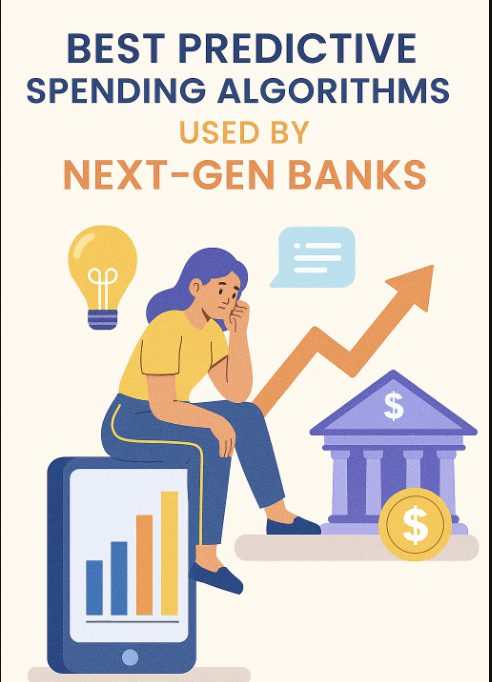
In this article would produce talking about the Best Predictive Spending Algorithms Used by Next-Gen Banks to analyze customer behavior and refine services.
For the most part, predictive algorithms work with specialized digital banks to design the best cash-forecasting, transaction predictive, and spending recommendation services through the implementation of Artificial Intelligence and Machine Learning.
Some even use financial deep learning components such as Temporal Fusion Transformers and Amazon DeepAR alongside ARIMA and Prophet. Fintech predictive algorithms allow digital banks greater accuracy in cash forecasting, customer experience, and risk management.
Key Points Table – 10 Best Predictive Spending Algorithms
| Algorithm | Key Point (What It Does Best) |
|---|---|
| Temporal Fusion Transformer (TFT) | Excels at multi-horizon spending forecasts with built-in interpretability through attention and variable selection. |
| Amazon DeepAR | Provides probabilistic spending predictions using RNNs, ideal for uncertainty ranges and large-scale multi-user forecasting. |
| N-BEATS | Delivers highly accurate trend and seasonality decomposition for pure time-series spending prediction. |
| Gradient-Boosted Decision Trees (GBDT) | Handles complex tabular financial features for high-accuracy spending propensity and risk predictions. |
| LightGBM / CatBoost | Fast, scalable boosters that outperform on high-volume, categorical-rich banking datasets for real-time predictions. |
| LSTM / GRU Models | Capture long-term spending patterns and user behavior from sequential transaction histories. |
| Prophet / ARIMA / ETS | Offer transparent, interpretable forecasts ideal for predictable monthly spending or regulatory explainability. |
| TCN / 1-D CNNs | Enable fast, real-time spending trend analysis using dilated convolutions for long sequence modeling. |
| Transformer-Based Models | Use self-attention to detect complex behavioral patterns across long transaction sequences with high accuracy. |
| Hybrid / Ensemble Stacks | Combine multiple models for maximum reliability, stability, and accuracy across diverse spending scenarios. |
1. Temporal Fusion Transformer (TFT)
Few algorithms are as complex and cutting-edge as TFT. The model combines structures like attention layers, gating mechanisms, and variable selection for optimal results across the board. When running, TFT checks both static and time-varying features mid-workflow to account for seasonality, personalized spending cycles, and optimal financial signals.

Next-gen financial institutions appreciate the model for the user-level explainability and insight at a more granular attribution level, allowing compliance teams to explain and justify predictive models at an unprecedented level. The algorithm also boasts the ability to work for tens of millions of end-users.
Temporal Fusion Transformer (TFT)
Pros:
- Provides accurate forecasts over various horizons.
- Helps explain its workings with attention and variable importance.
- Net and time varying elements are captured simultaneously.
- Can operate at the level of millions and very expansive datasets.
Cons:
- Demands an unreasonable level of computational power for training.
- Tuning hyperparameters requires significant skill.
- Small datasets may lead to overfitting.
- For real-time scenarios, deployment may become very difficult.
2. Amazon DeepAR
Amazon DeepAR is a probabilistic forecasting framework that utilizes recurrent neural networks trained on large datasets of time series. Among deep learning applications, DeepAR stands out during the forecasting step because it forecasts probabilities and not point forecasts, which allows banks to assess expected spendings in best and worst scenarios.

DeepAR detects seasonal spending trends, regular monthly bills, and personalized anomalies. Nxt-gen banks rely on DeepAR because it works well on sparse datasets, cold-start users, and aggregat-level forecasting. Its distributed training ability on millions of customer sequences offsets the value of accurate forecasts, risk scores, budgetary guidance, and spend alerts in real-time.
Amazon DeepAR
Pros:
- Forecasts probabilistically while providing confidence intervals.
- Learns from multiple time series at the same time.
- Sparse or missing data is not a problem.
- Grows efficiently with large datasets of transactions.
Cons:
- Needs a lot of data from a series in the past.
- Tuning hyperparameters is not easy.
- Compared to a simple model, there is not enough interpretability.
- There are a lot of users and sequences, the training time becomes excessive.
3. N-BEATS
N-BEATS is a neural basis expansion model that forecasts time series in a completely unsupervised manner with no engineering of features to suit a problem domain. N-BEATS is able to produce forecasts, in its prediction phase, using backward and forward basis stacks which, through the decomposition of the series, capture the underlying seasonal and trend components.
This aids banks to explain changes in their customers’ spends and the underlying reasons thereto. Its architecture is interpretable, and it is the best-performing model in consumer finance time series.
Nxt-gen banks use N-BEATS for granular forecasting, adjusted for external macro factors, behavioral spends prediction for multiple time periods, and forecasting spend for multiple periods. It is also lightweight, which allows real-time updates that are helpful for budgeting and spend dashboards in mobile applications.
N-BEATS
Pros:
- There is very good decomposition of seasonality and trends.
- For time-bound forecasts, it’s really accurate.
- Compared to a lot of black box hypotheticals, it’s a lot more interpretable.
- Good for multi-step forecasts.
Cons:
- There needs to be a lot of data for complete precision.
- More compute requirements than classical approaches.
- Limited processing of categorical variables.
- Unsuitable for real-time streaming data unless adjusted.
4. GBDTs
GBDTs are popular in the banking industry for their ability to work with complex tabular financial data. GBDT models create trees in the middle of their work in order to minimize the error of their predictions.

This allows them to capture the more complex non-linear relationships in patterns of spending. These models are especially good at taking in multiple features at once such as income flow, merchant category, spending velocity, seasonality, and demographics.
New age banks use these models to create scores for predictions of spending, bills, possible overdrafts, and for monitoring financial health. The transparency, speed, and ability to explain other than just the data makes these models optimal for use in systems where the decisions need to be auditable.
Gradient Boosted Decision Trees (GBDT)
Pros:
- Exceptional performance with tabular data within banking.
- Can also incorporate various features, both numerical and categorical.
- Missing data is not a problem.
- Inference only requires a little time after training.
Cons:
- Trees might overfit if not shallow enough.
- Feature engineering is a requisite.
- Alternative methods might be required for time-sequenced and time-series data.
- No inherent probabilistic characteristics.
5. LightGBM and CatBoost
LightGBM and CatBoost are the newest in a line of optimized and improved algorithms for boosted trees. These algorithms are optimized for speed and large data sets, especially ones with lots of categorical data.
While in the middle of their work, LightGBM and CatBoost use a form of ordered boosting with leaf-wise tree growth to avoid overfitting and capture more micro spending behaviors across the millions of users.

LightGBM and CatBoost are more scalable and more efficient than the older GBDT algorithms which is a must for banks that handle billions of transactions.
New age banks use these algorithms for real time predictions of spending, customized recommendations based on the predictions and other data, analysis of spending behaviors with fraud detection, and more refined decisions in the world of credit. The speed of these algorithms is vital for their integration into the newer banks.
6. LSTM / GRU Sequence Models
LSTMs and GRUs are pioneer deep learning structures that are able to remember and predict long-term dependencies in sequential data. In transaction histories, there’s a lot of repeating sequential data and these networks exhibit stellar performance in characterizing them.
In the mid-sequence, **LSTM / GRU ** cells partition customer behavior spanning several months and years mid-sequence, calibrating and storing behavior-specific memory states. This allows the bank to repeat models on spending cycle behavior, inflow salaries, subscription-driven expenses, and lifestyle charge expenses.
LSTMs and GRUs stand out in the responsibilities of next-gen banks on individual spending prediction, cash-flow forecasts, risk scoring, financial risk scoring, and financial autonomy aids. In hybrid models, they also capture the sequential behavior well in combination with tree-based algorithms.
LightGBM / CatBoost
Pros:
- Very fast and consumes minimal memory.
- Can process categorical variables without preprocessing (CatBoost).
- Very large datasets are no problem.
- Requires little preprocessing of features for accurate predictions.
Cons:
- Hyperparameter values are complex and require careful selection.
- More complex than basic models which can also be an issue for regulatory audits.
- Small datasets tend to increase the chance of overfitting.
- Time-series models are not within the intended scope.
7. Prophet / ARIMA / ETS
Prophet, ARIMA and ETS are traditional statistical forecasting techniques. These models are highly stable, transparent, and interpretable. In the forecasting process, Prophet / ARIMA / ETS breaks a time series into trend, seasonality and error components, providing understanding into the spending behavior of the banks.

These models work best for easily predictable patterns such as bills on a monthly basis, expenses during salary credit, spending around holidays etc.
Next-gen banks use these models as baseline models, regulatory-friendly explainable models, and fallback engines in case of insufficient data for deep learning models. These models are critical in the field of predictive finance due to their simplicity, and precision in stable environments.
Prophet / ARIMA / ETS
Pros:
- Understandable and transparent.
- Seasonal, repeatable spending behaviors are easily predicted.
- Straightforward to use and adjust.
- Small datasets are no issue.
Cons:
- Highly non-linear spending behaviors are not predicted accurately.
- Sudden changes and gaps are not predicted.
- Missing data can make your predictions worse.
- Not a good choice for problems with a lot of features.
8. Temporal Convolutional Networks (TCN) / 1-D CNNs
TCNs and 1-D CNNs are able to model long sequences and, unlike recurrent neural networks, are able to do so using only convolutional layers, leading to a faster training and inference process. During the feature extraction stage, TCNs / 1-D CNNs perform dilated convolution to capture spending behaviors over long periods of time at a lower computational cost.
This makes performing real-time stream financial analysis (e.g. spend detection, cash-flow adjustments) perfect for these networks. Banks implement TCNs for continuous spent trend monitoring, anomaly detection, budgeting tools, and instant fraud detection and spend predictions.
Their high throughput processing capabilities make them suitable to serve the millions of concurrent users typical at large-scale digital banks.
Temporal Convolutional Networks (TCN) / 1-D CNNs
Pros:
- Good at capturing longer-term time-related patterns.
- Trains faster than RNNs.
- Works with live, streaming data.
- Can easily split tasks for faster processing.
Cons:
- Not as clear as other options.
- Needs a lot of processing power.
- Large datasets are necessary to prevent overfitting.
- Predictions created are more of a guess, as a lot of facts are missed.
9. Transformer-Based Sequence Models
These transformer models do not implement recurrence in their architecture, instead using self-attention to learn long-range dependencies and relationships over sequences of past transactions.
Middle of the attention, these transformer models determine the contribution of each of the past transactions to the prediction of future spend and thus enable a more accurate prediction than many other models.

These models are able to learn both macro financial cycles and micro behaviors of sudden changes in spending. Next-gen banks rely on transformer models for spend behavioral scoring, customer segmentation, real-time spend prediction, and income-flow modeling.
Transformers on large volumes of data are only limited by the data set’s size, and the data’s nature (i.e. text, merchants, categories, events) makes them essential to AI-native financial forecasting and smart digital banking.
Transformer-Based Sequence Models
Pros:
- Good at identifying odd behaviors in a long set of data.
- Can keep track of more than one thing at the same time.
- Good for a lot of data and a lot of people.
- Can be customized to a degree.
Cons:
- Needs a lot of time and memory.
- Needs a lot of setup and adjustments.
- Small datasets can easily cause overfitting.
- Less explainability without further work on attention visualizations.
10. Hybrid / Ensemble Stacks
Stacking several models like TFT, DeepAR, XGBoost, Prophet & Transformers, hybrid ensemble stacks aim to achieve a desirable combination of accuracy, stability, and regulatory compliance. Middle of the stacks, ensemble models combine forecasts and provide more accurate predictions of spending by using weighted average, stacking, or meta-learner techniques.

This reduces risk of model drift and sustains unexpected behavior financially. These models are crucial for next-gen banks for cash-flow forecasting, risk-loss mitigation, overdraft prevention, and tailored financial advice.
They are consistent and provide enterprise-grade accuracy for fast-changing consumer finance environments. They are especially useful in times of market volatility.
Hybrid / Ensemble Stacks
Pros:
- Incorporating several different models works to create the optimal accuracy.
- Mitigates the impact of single model mistakes.
- Ensures stability across varying spending patterns.
- Versatile to other models, including classical, tree based, and neural.
Cons:
- Challenging to put together and sustain.
- Significant additional costs associated with computing and storage.
- Less explainable than simpler models in isolation.
- Needs deliberate fine-tuning and supervision over time.
Conclusion
Advanced algorithms that predict spending habits are being utilized in next-gen banks to fine-tune financial analytics to deal with financial risk, adjust cash flow accordingly, and offer financial advice in a personalized manner.
Companies, like Amazon, are employing deep learning models along the lines of Temporal Fusion Transformer, DeepAR, and N-Beats. But statistical approaches, too, like ARIMA, Prophet, and ETS are commonly deployed. Each has their pros and cons, for example, ETs are great for heterogeneous customer data, whereas ARIMA and Prophet are useful for temporal profriling like fraud detection.
In the predictive modeling Industry, hybrid approaches are gaining popularity, offering banks a fast and flexible predictive modeling solution. The ability to predict customer behavior and tailor financial services accordingly that makes these banks in the digital transformation of the banking sector, truly market leaders.
FAQ
What are predictive spending algorithms?
Predictive spending algorithms are machine learning and statistical models that analyze historical transaction data to forecast future spending behavior, identify trends, and provide actionable insights for banks and customers.
Why do next-gen banks use predictive spending algorithms?
They enable personalized financial recommendations, cash-flow forecasts, risk management, fraud detection, and improved customer experience by anticipating spending patterns before they occur.
Which algorithms are most commonly used?
Common algorithms include Temporal Fusion Transformer (TFT), Amazon DeepAR, N-BEATS, Gradient-Boosted Decision Trees, LightGBM, CatBoost, LSTM/GRU, Prophet, ARIMA, ETS, TCN/1-D CNNs, Transformer-based models, and hybrid/ensemble approaches.
How do deep-learning models like TFT and DeepAR help?
They capture complex patterns in sequential data, provide multi-horizon forecasts, and handle large-scale customer datasets while offering probabilistic or interpretable predictions.
Are classical models like ARIMA and Prophet still relevant?
Yes. They are simple, transparent, and effective for stable or seasonal spending patterns, making them useful for regulatory compliance and explainable forecasting.