
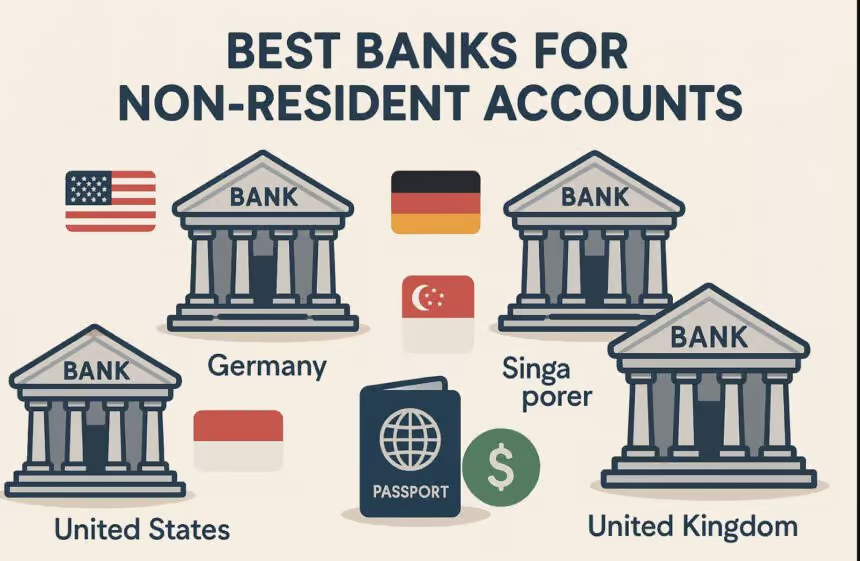
Cross-border financial management can be difficult, but selecting the appropriate organization is crucial. The Best Banks for Non-Resident Accounts offer secure digital platforms designed for foreign professionals, investors, and expatriates, as well as worldwide accessibility and multi-currency compatibility.
These banks combine compliance, ease, and global reach, from UBS’s Swiss wealth management to HSBC’s expat-focused services, guaranteeing non-residents may handle savings, transfers, and investments with confidence wherever life takes them.
Criteria for Selecting the Best Banks for Non-Resident Accounts
The following are guidelines for choosing banks that support non-resident accounts.
Global Reach
Look for banks with a large global footprint. This will help non-resident account holders get easy access to branches and ATMs while traveling.

Multi-Currency Support
Foreign exchange and cross border transactions are easier to manage with multi-currency accounts. Look for banks that support transactions in several different currencies.
Minimum Balance Requirements
Global banks should be fairly accessible to most expats. That said, minimum balance requirements should be in alignment with account privileges and global service levels.
Interest Rates
For non-resident accounts, it is best to keep savings in a highly liquid state. Look for banks that offer slightly competitive interest rates.
Digital Banking Services
Non-residents should be able to manage their accounts digitally. Look for banks that offer contemporary digital solutions for account management and good digital security.
Compliance & Security
Look for global banks that offer non-resident accounts. To protect customers and avoid data leaks, they should follow international money laundering regulations.
Ease of Account Opening
Remote expats shouldn’t have to rely on their physical presence to manage accounts. Look for banks that have simple requirements for account opening.
Wealth Management Options
Choose the ones that provide investment options, advisory services, and customized wealth management plans, especially high-net-worth non-residents who want global diversification and financial growth.
Transfer & FX Fees
Analyze the fees for overseas wire transfers and the markup for currency exchange. Non-residents managing funds across several countries and currencies need to make cross-border transactions.
Customer Support
Pick banks with 24/7 support that is multilingual, so non-residents can get help on account problems, transactions, and financial services worldwide.
Top 10 Banks for Non-Resident Accounts
| Bank | Key Features for Non-Residents |
|---|---|
| HSBC Expat | Tailored for expats; multi-currency accounts; global investment access; strong digital banking |
| Barclays International Banking | Offshore accounts; wealth management; remote account opening; strong UK/EU presence |
| Standard Bank Offshore | Focus on Africa-linked expats; multi-currency; secure offshore services |
| Caye International Bank | Easy account opening; USD accounts; privacy-friendly jurisdiction |
| Swissquote Bank | Online banking; investment accounts; Swiss financial stability |
| DBS Treasures | Premier Asian hub; strong digital banking; multi-currency support |
| Butterfield Bank | Offshore banking; private banking services; trusted Caribbean option |
| Bank of Singapore | Wealth management focus; strong expat services; global investment access |
| UBS | Global private banking leader; strong compliance; multi-currency accounts |
| Emirates NBD | Popular in Dubai; easy expat onboarding; strong Middle East coverage |
1. HSBC
Currently, HSBC is the best bank choice for non-resident accounts. They are headquartered in London and have been providing rich banking services and global account access since 1865.
Along with compliance and coverage, they are also known for their global digital banking. Tax-efficient access is available, along with account options for international expatriates.
An annual interest rate of 0.01% – 0.1% is applicable, with account hold on balance between $5,000 – $10,000.
HSBC Features
- Founded: 1865, HQ: London, UK
- Features:
- Specialised expat accounts with USD, GBP, EUR and HKD multi currency accounts.
- Global presence with over 60+ local branch offices.
- Proven and strong online banking with e-wealth management.
- Account structures will pass through local tax compliance and be tax efficient.
- Minimum balance: $5,000-10,000
HSBC Pros & Cons
Pros
- Operations are in over 60 countries.
- Expat accounts are tailored for expats and include accounts in multiple currencies.
- Good global digital banking options.
- Solid account management digital banking options.
Cons
- Account minimums are high ($5,000–10,000).
- Very low account interest ($0.01–$0.10 per annum).
- International account transfers may have higher fees than region account transfers.
2. Citibank
Since 1812, Citibank has been providing banking services and has the hold on the founding of the first non-resident account. They provide account services in the US and now have 399 Park Ave in New York for headquarters.
They offer accounts with online banking access, along with credit card use and ATMs internationally. To have an account, you must maintain an account hold of between USD $2,500 – $10,000, with an interest of 0.01% – 0.05% and US savings.
Best Bank for Non-Resident Accounts – Citibank is great for expats who want reliable U.S. dollar accounts and easy cross border money transfers.
Citibank Features
- Founded: 1812, HQ: New York, USA
- Features:
- Excellent liquidity in USD and situation in most EU and USD bank ATM’s.
- Low cost international bank transfers with and foreign exchange.
- Integrated credit card, investments and banking all in one.
- Accounts can be opened remote banking for expats.
- Minimum balance: $2,500-10,000
Citibank Pros & Cons
Pros
- World-wide cash circulation in US dollars.
- US banking on a world-wide basis (ATM’s and branches).
- International banking on a world-wide basis.
- banking/ investment/ credit cards systems in a single service.
Cons
- Citibank account minimums are not insubstantial ($2,500–10,000).
- Very low account interest ($0.01–$0.05 per annum).
- International banking with less privacy than other banks (such as Swiss banks).
3. Standard Chartered
Standard Chartered was founded in 1853, and its global headquarters is in London, UK. It has substantial business in Asia, Africa, and the Middle East. It provides multi-currency accounts, as well as remote opening for some accounts.

Interest rates are modest and range between 0.01%–0.05% per annum, depending on the region. Most of their accounts have a minimum balance requirement of between USD 1,000–5,000. For expats, Standard Chartered is known for being more accessible compared to Swiss banks.
Therefore, Standard Chartered is a well known choice for banks among expats in Africa and Asia. Best Bank for Non-Resident Accounts – Standard Chartered is well regarded among Asian and African expats for its reliability in international banking.
Standard Chartered Features
- Founded: 1853, HQ: London, UK
- Features:
- Services for expats from Asia, Africa, and the Middle East.
- Multi-currency services and no restrictions on online banking.
- Non-resident remote account opening.
- Other services: Wealth management, corporate banking.
- Minimum balance: $1,000-5,000.
Standard Chartered Pros & Cons
Pros
- Well-established in Asia, Africa, and the Middle East.
- Multi-currency wallets with no video conferencing to set up.
- Expats are less of a target in the developing world.
Cons
- No or little coverage in North America.
- Very low account interest ($0.01–0.05 % per annum).
- Less Swiss account-like wealth management.
4. Barclays
Barclays was founded in 1690, and incorporated in 1896. It is located at 1 Churchill Place, London, UK. Barclays also provides offshore banking for non-residents, and offers top tier services in both wealth management and investment.

Interest rates vary between 0.01% to 0.10% per annum, and is largely dependent on the type of account. Barclays happens to have the highest minimum balance requirements, and are usually between GBP 5,000–25,000.
Barclays is extremely reputable for their offshore banking, especially for clear offshore banking in the UK and the EU. Best for Non Resident Accounts – Barclays is the best for expats in Europe and those who need wealth management solutions.
Barclays Features
- Founded: 1690, HQ: London, UK
- Features:
- Non-resident offshore bank accounts.
- Excellent UK then EU coverage and banking and wealth management services.
- Online banking with safe transactions.
- Banking services for investments and wealth management.
- Minimum balance: GBP 5,000–25,000.
Barclays Pros & Cons
Pros
- EU banking dating over several decades.
- Wealth management offshore accounts.
- Digital banking and transfers are secure.
- Investment services are solid.
Cons
- Extremely high minimum balance (GBP 5,000–25,000).
- Interest rates are fairly low (0.01%–0.10% per annum).
- More high-net-worth expats than average users.
5. Deutsche Bank
Deutsche Bank was established in 1870 in Berlin and is currently located in Frankfurt, Germany. It offers strong coverage in Europe for non-resident accounts and corporate banking services.
It also has modest interest rates at 0.01%–0.05% per annum, which is standard for the EU savings. Required account minimums are EUR 2,000–10,000 for certain types of accounts.
Deutsche Bank is very well recognized for corporate banking and has a strong international presence. For European expats and corporate clients who need cross-border financial services, Deutsche Bank is the best choice for non-resident accounts.
Deutsche Bank Features
- Established: 1870, Headquarters: Frankfurt, Germany
- Accounts friendly to European expatriates.
- Strength in corporate and investment banking.
- Support for multiple currencies (EUR, USD, GBP).
- Strong EU laws and regulatory reliance.
- Minimum balance: EUR 2,000–10,000.
Deutsche Bank Pros & Cons
Pros
- Coverage in Europe is great.
- Good in corporate and investment banking.
- Supports multiple currencies (EUR, USD, GBP).
- Good compliance within the EU.
Cons
- Minimum balance (EUR 2,000–10,000) can be restrictive.
- Interest rates are low (0.01%–0.05% per annum).
- More focused on corporate clients than individual expats.
6. BNP Paribas
BNP Paribas is located in Paris, France and was formed in 2000 after a merger, but the company has been around since 1848. It offers offshore, non-resident accounts and specializes in investment and wealth management services.

Again, interest rates are low, and minimum balances are high, typically of EUR 50,000-100,000, which are burdens for most and are better suited for high net-worth individuals. BNP Paribas is also very recognized, especially in European banking.
Best Bank for Non-Resident Accounts – Expats with large amounts of capital will find financial refuge in the European stability offered by BNP Paribas.
BNP Paribas Features
- Offshore banking for expatriates of high net worth.
- Services for investment and management of wealth.
- Strong presence in Europe.
- Compliant and stable financially.
- Minimum balance: EUR 50,000–100,000.
BNP Paribas Pros & Cons
Pros
- The most solid European bank.
- Offshore accounts available for high-net-worth expats.
- Investment and Wealth management services.
- Compliance and security are strong.
Cons
- Extremely high minimum balance (EUR 50,000–100,000).
- Interest rates are low (0.01%–0.05% per annum).
- Not available for regular expats or small investors.
7. UBS
UBS provides premier non-resident accounts and is globally considered to be the largest private bank in the world. Founded in 1862, the bank is headquartered in Zurich, Switzerland. UBS offers modest interest rates which range from 0.01%-0.05% per year.
These rates comply with the standards in Switzerland. Depending on the type of account, the bank can have minimum balance restrictions of anywhere from CHF 10,000 to CH 3,000,000.
The bank is well-known for global investment solutions, asset management, and corporate compliance. Best Bank for Non-Resident Accounts – UBS is often considered the gold standard in Swiss banking for High Net Worth Individuals (HNWI).
UBS Features
- Established: 1862, HQ: Zurich, Switzerland
- Swiss private banking at its best.
- Global investment opportunities with multi-currency accounts.
- Robust compliance and confidentiality.
- Wealth management for expatriates.
- Minimum balance: CHF 10,000–3,000,000.
UBS Pros & Cons
Pros
- The best private banking in Switzerland.
- Global investment access and multi-currency accounts.
- Strong compliance and confidentiality.
- Wealth management services.
Cons
- Extremely high minimum balance (CHF 10,000–3,000,000).
- Interest rates do not earn much money (0.01% to 0.05% yearly).
- Only a high net worth individual can take advantage of this.
8. Credit Suisse
Founded in 1856, Credit Suisse is located in Zurich, Switzerland. Credit Suisse and UBS have merged in recent years but Credit Suisse is able to offer legacy account services. Credit Suisse, like most of its competitors provides low interest which range from 0.01%-0.05% per annum on most account types.
In total, there are 4 different account types which will have minimum balance restrictions of CHF 10,000 to CHF 1,000,000.
They provide financial stability and offer banking and asset management services. For expats that are looking for Swiss offshore accounts, Best Bank for Non-Resident Accounts – Credit Suisse is a reliable option that continues to serve expats.
Credit Suisse Features
- Established: 1856, HQ: Zurich, Switzerland
- Swiss private banking from the legacy provider.
- Investment services with multi-currency accounts.
- Wealth management focus.
- Robust compliance and stability in financing.
- Minimum balance: CHF 10,000–1,000,000.
Credit Suisse Pros & Cons
Pros
- Traditional legacy Swiss private banking services.
- Investment options with multi-currency accounts.
- Wealth management is a high strength.
- Financial stability among the Swiss.
Cons
- Minimum balances can range from 10,000 to 1,000,000 (CHF).
- Banking interest is low (0.01% to 0.05% yearly).
- Less independence because of the recent merger with UBS.
9. Santander
Founded in 1857, Santander Bank also provides European and Latin American accounts. Interest rates start at an extremely low level, between 0.01% and 0.05%. A minimum balance of 1,000-5,000 euros is needed, which is easy to meet for the average expat.
Because of their international reach especially with Spanish speakers, they have strong presence in digital banking. Santander is the best option for non-resident accounts in Spain and other Latin American countries.
Santander Features
- Established: 1857, HQ: Madrid, Spain
- Features:
- Extensive presence in Europe and Latin America.
- Accessible accounts for most international expats.
- Digital banking and mobile app accessibility.
- Cross-border transfers with competitive foreign exchange rates.
- Minimum balance: EUR 1,000–5,000.
Santander Pros & Cons
Pros
- Large presence in Latin America and Europe.
- Minimum Balance is relatively accessible (1,000-5,000 Euros.)
- Offers mobile apps and online banking.
- Transfers with competitive rates.
Cons
- Banking interest is low (0.01% to 0.05% per annum).
- Compared to Citibank and HSB, Santander has little presence around the globe.
- The services focus largely on banking, and little is optimized for privacy.
10. JPMorgan Chase
The company began in 2000, after the merger of Chase Manhattan Bank and J.P. Morgan & Co. Their accounts for non-residents emphasize liquidity in United States dollars. They also give access to international investments.

Interest rates are low, between 0.01 and 0.02 percent. For a balance of 1,500 to 10,000 dollars, depending on the account, minimum balances are required.
They have huge unillustrated investments in international banking and in the U.S. JPMorgan Chase is also the best for non-resident accounts for expats with U.S. dollar accounts and investments.
JPMorgan Chase Features
- Established: 2000( with merger roots 1799), Headquarters: New York, USA
- Highly liquid in the U.S. dollar.
- Services in the world’s investment banking and asset management.
- Online banking and international transfers.
- Banking and asset management of the wealth for expats and corporations.
- Minimum balance: USD 1,500–10,000.
JPMorgan Chase Pros & Cons
Pros
- Global investment banking and liquidity on the dollar is immense.
- Online banking as well as secure international transfers.
- Offers wealth management for corporations and expats.
Cons
- Can be very restrictive with a minimum balance of 1,500-10,000 (USD).
- Banking interest is low (0.01% to 0.02% per annum).
- Not much direct engagement with expats.
- Most of the relationships with direct clients tend to be corporate or investment clients.
Conclusion
In conclusion, HSBC, Citibank, Standard Chartered, Barclays, Deutsche Bank, BNP Paribas, UBS, Credit Suisse, Santander, and JPMorgan Chase are among the top banks for non-resident accounts because of their global presence, support for many currencies, and services tailored to foreigners.
Banks like HSBC, Citibank, Standard Chartered, and Santander offer more accessible options for regular expats with lower minimum balances and robust digital platforms, while Swiss institutions like UBS and Credit Suisse excel in wealth management and confidentiality for high-net-worth individuals.
Strong corporate and investment banking services are provided by Barclays, Deutsche Bank, BNP Paribas, and JPMorgan Chase. When combined, these banks provide non-residents with a safe, legal, and globally integrated method of handling money worldwide.
FAQ
What is a non-resident account?
A non-resident account is a bank account designed for individuals living outside their country of origin. It allows expats, foreign workers, and international investors to manage funds, make transfers, and hold multi-currency balances securely across borders.
Which banks are best for non-resident accounts?
The top global banks include: HSBC, Citibank, Standard Chartered, Barclays, Deutsche Bank, BNP Paribas, UBS, Credit Suisse, Santander, and JPMorgan Chase. These institutions are known for their international reach, compliance, and expat-friendly services.
What are the typical interest rates for non-resident accounts?
Interest rates are generally low, ranging from 0.01%–0.10% per annum, depending on the bank and jurisdiction. Swiss banks like UBS and Credit Suisse focus more on wealth management than high interest returns.
Can I open a non-resident account remotely?
Yes. Many banks like HSBC, Citibank, and Standard Chartered allow remote account opening online. Swiss banks often require stricter documentation and sometimes in-person verification.
Which banks are best for everyday expats?
HSBC, Citibank, Standard Chartered, and Santander are most accessible, offering lower minimum balances and strong digital platforms.