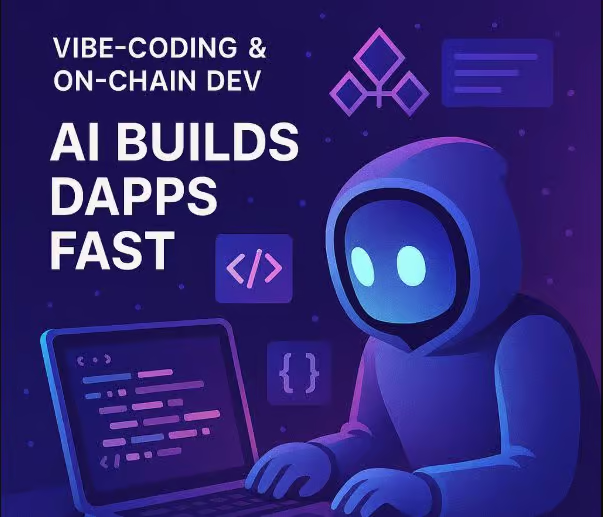
AI is changing the way we do on-chain development with the creation of Vibe-coding. Developers no longer write the code. Instead, developers can describe the functions and features of the dApp to the AI tool, and the AI tool handles the creation of the smart contracts, front end, and deployment process.
Combining intuition and automation for the process speeds development, minimizes mistakes. With rapid advancement in AI, the development of dApps will continue to become quicker and allow for boundless creativity.
What is Vibe-Coding?
Instead of closely adhering to rigorous plans or frameworks, developers that use the intuitive, creative method known as “vibe-coding” concentrate on the overall feel and flow of a project.
Vibe-coding promotes experimentation, quick prototyping, and modifying code according to what feels appropriate at the time rather than overanalyzing every technical element up front.

To quickly bring ideas to life, it frequently entails the use of contemporary tools like AI assistants, adaptable frameworks, and live testing environments. Maintaining momentum, inventiveness, and delight while developing useful software is the aim.
Why speed is becoming the biggest competitive advantage in Web3?
First-Mover Advantage
Getting into the Web3 ecosystem first gets you liquidity, users, and ecosystem builders. Projects create sustained interest in a market, and recruit, before others get a chance to enter.
Ever-Changing Trends
At any moment, the focus of the crypto industry could be on DeFi, NFTs, or AI. Those projects that deploy quickly are the ones that get to steer the direction of the market.
Take Advantage of Competition
In Web3, your users and your devs and your liquidity are your greatest assets. Projects that are first to launch will solidify an ecosystem and will be ahead of the rest.
Open Source
Most of the Web3 world operates on an open-source model. Because of this, if a project is moving slow a competitor can fork from that project, improve it, and launch it.
Trust in the Community
In the Web3 world, the community expects constant updates. If you are perceived to have slow shipping, your users will burn you. If you are seen to be shipping quickly, you will build trust.
Rapid liquidity
In the crypto world, money is very liquid. Investors and users quickly move money to where it is most innovative. Projects that launch quickly are the ones that get money the most.
Global Builder Ecosystem
Developers all around the world are building in the Web3 space. In this outrageously competitive arena, a slow Web3 builder team is likely to lose their Web3 competitive building. International competitors can deploy the same ideas faster than any team.
The Evolution of Coding Paradigms
Procedural Programming
Coding used to be done linearly and executed step by step. Each command would be handled by the developers ensuring efficiency.
Object-Oriented Programming
OOP handled the complexity of using abstraction and inheritance. THe modular design offered by classes and functions helped with code reusability and encapsulation.
Functional Programming
Event driven focused on user interactions. This paradigm is esssential in web apps, GUIs, and real-time systems to use responsive and scalable applications.
AI-Assisted & Vibe-Coding
Modern approaches balance the AI automation with human design. The focus of developers is on the outcome, design, and collaboration rather than the coding details.
AI’s Role in On-Chain Development
AI is changing on-chain development by improving how smart contracts are developed, safety, and smart contracts improvement. AI helps developers write, review, and audit their code which increases efficiency and decreases code vulnerabilities.
AI tools also help with analyzing different blockchains to ethically hack, forecast trends, and optimize gas metrics. On top of this, AI assists in the automated testing and simulation of decentralized applications pre-deployment.
AI accelerates development and creates safer environments which increases the ability to develop on-chain solutions in decentralized ecosystems.
Why dApps Can Now Be Built in Hours?
Development with AI
From descriptions that developers provide in plain text, AI coding assistants create smart contracts, front end parts, and scripts for deployment, cutting down the time to code manually, and providing a huge boost to the development of decentralized applications.
Automated Smart Contracts
Developers can use smart contracts that have already been audited for tokens NFTs, DAOs, and DeFi. Instead of coding from scratch, developers can customize these smart contracts, and deploy them in a matter of minutes.
No-Code and Low-Code Solutions
There are numerous modern blockchain no-code and simple-code solutions. These include drag-and-drop solutions, visual engineering methods, and more, allowing the world to create decentralized applications without complex blockchain programming skills.
Development in Plain View
Hurdles to completing the entire development lifecycle are minimized through integrated development frameworks, such as Hardhat and Foundry. These frameworks simplify development, testing, debugging, and deployment.
Layer 2 and Cloud Solutions
Use of layer 2 solutions and the cloud for blockchain as a service provide the ability to create decentralized applications without having to go through the lengthy processes of configuring different blockchains.
Benefits of AI-Assisted Web3 Development?
Rapid Smart Contract Creation
Even with simple prompts, AI creates, edits, and improves the smart contract coding process, helping speed development with contract updates while still having decent structure and readability. This is especially useful for smart contracts in Web3 projects due to the large amount of best practice coding.
Security and Audits
AI tools can identify weaknesses in smart contracts and show potential vulnerabilities before deployment. This shows a large increase in the trust in decentralized applications by lowering the risks while also changing the way we think about smart contract development.
Testing and Debugging
AI can allow for better and more frequent testing by automating the testing of the smart contracts. This frees up a lot of time for the developers as the framework can test and find bugs while suggesting corrections.
Data Based Decision Making
AI can break down large amounts of on-chain data to show patterns of how the users operated in order to allow for developers to better build up the structures of tokenomics, governance, and performance of dApp as a whole.
Increased Productivity
With the help of AI with things like world flows and automating processes, it lowers the amount of work put in to allow the more experienced developers, as well as the newer ones to construct the Web3 apps with a lot more ease and improved speed.
Challenges & Risks
Vulnerabilities in Smart Contracts.
Exploits, financial loss, and damaging on-chain injury can be caused by AI-generated code and without human review to investigate hidden bugs or logical problems.
Risk of Automation.
Automated AI tools help integrate lots of code and if there is no human cognition, in-depth automation will lead to insufficient assessments as to how the blockchain works and cause errors in areas of the blockchain that may be defensible.
Leak of Sensitive Personal Data.
If there is no secure private environment where the data, sensitive project information and/or private keys are securely protected, then AI-based platforms will leak sensitive data to the public.
Obsolete Improvements and Wrong Logic.
Inefficient Contracts will result from AI-based platforms based on the outdated logic of blockchain and the AI model given to the blockchain for the purpose of maximizing improvements.
Risk of Regulation.
AI-based platforms of rapid development may be found to be in violation of prevailing crypto regulations by introducing automation into procedures in such a way that it could lead to automated governance and undesirably biased decentralized decision-making.
The Future of Vibe-Coding in Web3?
Collaborative Creation Aided by AI. Developers will brainstorm web3 projects with prototypes, incorporating intuitive reasoning along with AI, as human… AI collaboration will further evolve from vibe coding.
Feedback Provided Instantly On-Chain. In future, smart contracts will be able to be tested, providing developers with real-time feedback on gas, security, and performance to adjust on the go.
Modular dApp Builders That Are Adaptive. Vibe coding will use shift or adaptable modular templates allowing developers to customize decentralized apps while keeping structures that are secure and scalable.
Development Of Web3 Become Democratized. Those with no technical skills will be able to use AI and visual builders for dApps, DAOs, and tokens, creating further opportunities for innovation for those not highly trained in coding.
More Automation That Is Smarter And Safer. AI will provide developers with automated audits, governance checks, and optimizations to minimize risk and safely speed up the process in web3 coding.
Conclusion
Data-Driven Vibe-Coding Is Transforming On-Chain Development By Allowing AI To Quickly Create, Evaluate, And Release dApps. AI And Smart Contract Templates, Along With Auto Auditing And In Development Itself Real-Time Optimizing, Allow AI To Complete Development In Hours Instead Of Weeks.
This Change In Development Will Increase Innovation, Lower Barriers To Entry And Allow More People To Create Decentralized Applications. The Evolving AI Tools Will Allow More Fusions Of Human Creative Work And Intelligent Automation In Future Web3 Development.
FAQ
What is vibe-coding in Web3?
Vibe-coding is a creative, intuitive approach to development where AI assists in generating code quickly based on ideas, vibes, and prototypes rather than strict planning.
How does AI speed up dApp development?
AI accelerates development by generating smart contracts, frontend code, deployment scripts, and testing routines automatically, reducing manual work and enabling rapid iterations.
Are AI-generated smart contracts safe?
AI can produce secure code, but risks remain. Smart contracts should still undergo audits, testing, and manual review to prevent vulnerabilities and exploits.
Can non-developers build dApps using AI?
Yes. With AI and low-code tools, non-technical users can create basic dApps, tokens, or DAOs using prompts and templates, lowering entry barriers.
Will AI replace Web3 developers?
AI will not replace developers but will enhance productivity. Developers will focus more on architecture, strategy, and innovation while AI handles routine coding tasks.