
In this piece, I’ll talk about KYA (Know Your Agent), a new security framework created for a future in which artificial intelligence (AI) agents serve as merchants, consumers, and decision-makers.
Conventional verification approaches are inadequate as autonomous systems start to carry out transactions and communicate on their own. KYA presents identification, accountability, and trust procedures designed especially for the quickly changing digital economy powered by artificial intelligence.
What is KYA (Know Your Agent)?
An developing security and compliance architecture called KYA (Know Your Agent) was created for a digital economy in which self-governing AI agents—rather than people—initiate transactions, manage wallets, negotiate contracts, and communicate with services.
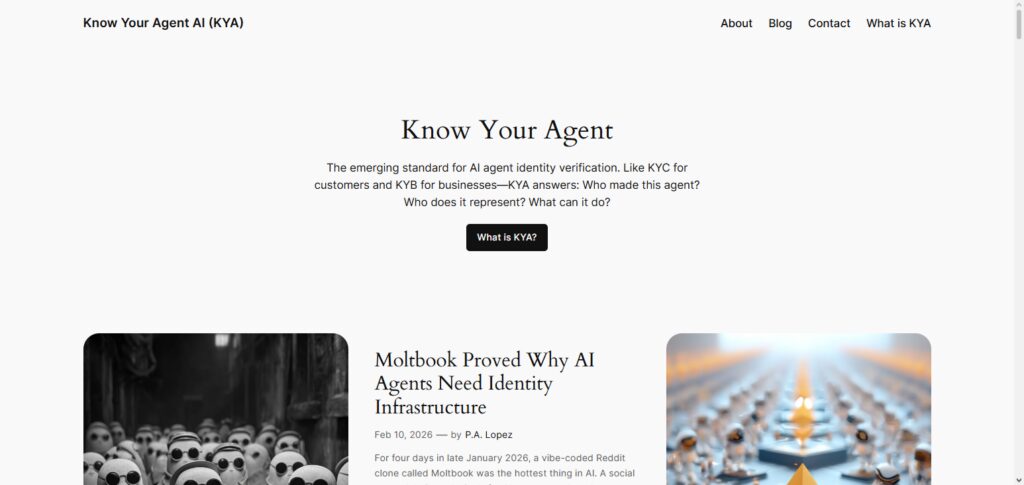
KYA focuses on authenticating, authorizing, and monitoring AI agents, as opposed to standard KYC (Know Your Customer), which confirms human identity. Through the use of cryptographic keys, decentralized IDs, behavioral profiling, and audit trails, it creates digital identities that can be verified.

Additionally, KYA ensures accountability by assigning ownership and obligation to appropriate entities. KYA lowers fraud, market manipulation, and regulatory risks in AI-driven financial and digital ecosystems by fostering trust in machine-to-machine interactions.
Why KYA is Necessary
Autonomous Transactions: An AI agent can make payments, trades, contracts, and service requests without human supervision. This creates an issue of financial activities without human oversight.
Malicious AI Activity Prevention: If an AI agent has not been verified, it can trick/behave in a rogue way which can result in fraudulent actions, spamming, and exploiting system weaknesses.
Growing M2M Economy: Machine-to-machine transactions facilitated by AI require a trust layer to determine the legitimacy and authorisation of the transactions.
Manipulation of Market Risks: Autonomous trading bots pose a huge financial risk due to their unpredictable actions.
Liability and Accountability: KYA provides clarity on ownership, control and responsibility of an AI agent.
Compliance with Regulations: Automatised agents require a risk assessment and audit trail due to traceability requirements from the financial institutions.
Malicious AI Growth: The rapid AI growth and the deployment of simultaenous agents will require standardised verification.
Confidence in Digital Ecosystems: Users and businesses require verified and safe AI agents to interact with.
Core Components of KYA Framework
Agent Identity Verification
Every AI agent should contain identity secured through crypto, decentralized identifiers (DIDs), or blockchain-based credentials.
Authentication Mechanisms
Safeguarded authentication processes ensure the AI agent accessing a system is the genuine product, and that impersonation, cloning, or tampering has not occurred.
Authorization Controls
AI agents have defined permission layers that grant them the ability to conduct or perform actions such as execute a contract, access certain data, or conduct a specified number of transactions.
Ownership & Liability Mapping
To ensure accountability for an agent’s actions, each agent is assigned to a liable individual, organization, or entity.
Behavioral Monitoring & Risk Profiling
Agent activities are analyzed to target certain behaviors that may be of an anomalous, suspicious, or deviant nature.
Audit Trails & Transparency Logs
Compliance, billable disputes, and regulatory oversight require the traceability that is supplied by immutable records.
Reputation & Trust Scoring
History of engagements, compliance, and reliability may contribute to the trust scores that are assigned to AI agents.
Use Cases of KYA
Autonomous Transaction Growth
AI agents are capable of creating and executing financial activities without human involvement. These include payment, trading, and contract/service request execution.
Malicious AI Activity Prevention
Unverified AI agents can commit scams, spam, and exploit maliciously. These activities can be sustained and done massively.
Growth of Machine-to-Machine (M2M) Economy
As AI systems begin to trade with each other, there will need to be a trust layer to authenticate and authorize transactions.
Market Manipulation Risk
Autonomous trading bots can act in an unpredictable coordinated manner to increase financial volatility and pose systemic financial dangers.
Accountability and Liability
With KYA, a person can be traced to an AI agent to be responsible for its activities.
Compliance with Regulatory Frameworks
Automated entities are required to provide traceability, audit trails, and risk analysis in order to meet the requirements of government and financial entities.
Verified AI Systems
Standardized KYA will allow for secure and rapid adoption of AI technology at scale.
Interacting AI agents
People and businesses need to trust that the AI agents they are designed to interact with are verified and secure.
Technologies Powering KYA

Blockchain Technology: Offers immutability, formal audit trails, and permanent records of tampered activity of AI agents.
Decentralized Identifiers (DIDs): Allow AI agents to Obtaining self-verifiable and self-sovereign digital identities without dependence on a third party.
Cryptographic Key Infrastructure: Public and private keys authenticate agents, secure communication, and provide transactional signatures to avoid impersonation.
Zero-Knowledge Proofs (ZKPs): Allow agents to prove they are authorized and/or compliant without exposure of sensitive information.
Smart Contracts: Govern and execute AI agent actions.
AI Behavior Analytics: Malicious activity, fraud, and anomalies are detected through the observation of agent activity patterns using defined machine learning models.
Reputation & Trust Scoring Systems: Performance and policy compliance history on and off the chain determines dynamic compliance and performance trust score.
Secure API Gateways: The validated and authorized interaction to enterprise systems of AI agents is regulated and monitored.
Identity & Access Management (IAM) Systems: Controls and Governance frameworks related to AI agents inside organizations are set by role definitions.
Regulatory Implications
Potential KYC Frameworks Expansion: Regulators can adapt traditional KYC processes to include verification of self-sufficient AI agents performing economic or business activities.
Liability Standards: Jurisdictions will have to clarify the liability of an AI agent’s activities—whether it is the developer, the owner, the operator, or the deploying organization.
Auditing, Reporting, and AI Decision Making Accountability: Regulators may demand AI systems and the decisions and actions they execute to be documented and reported in a manner that is accessible and immutable.
AI Classification: AI agents that are classified as high risk, particularly with respect to trading, lending, or healthcare, may be subject to additional compliance, licensing, or oversight requirements.
Defiance of Laws: AI agents that are used in multiple jurisdictions may be subject to conflicting laws and an increase in the regulatory burden.
KYA and Data Protection Laws: KYC laws, including KYA, will need to be in harmony with the GDPR, as KYC laws will include identity verification processes that may conflict with privacy measures.
AI Wallets and Payment Systems: AI Wallet and Payment Systems may be subject to additional regulatory scrutiny to prevent financial crime and to monitor the systems for illicit financial transactions.
Security and Governance Standards: AI agents may be subject to government Security and Governance Standards and may be required to undergo certification to ensure compliance with these Standards.
Opportunities in the KYA Ecosystem
AI Identity Ecosystem Builders
Startups developing self-sufficient AI solutions can build systems for decentralized identity (DID) and tools for cryptographic verification at the level of individual AI agents.
KYA-as-a-Service Provider
Businesses in the field of compliance can offer KYA verification, monitoring, and risk-assessment services, as well as provide KYA-compliant AI agents and services.
Marketplace of AI Agent Reputations
AI agents can earn and trade trust scores, certifications, and other forms of verification to enhance their status and reputation in various digital marketplaces.
AI Compliance and Auditing
Collection of rules and related methodologies (including) starting from measuring, documenting, and reporting, for the purposes of compliance, the activity of KYA-compliant AI agents.
API Security and Access Control
Providers of cybersecurity solutions can build sophisticated IAM systems (including) for machine-to-machine authentication.
Blockchain-Based Governance
Web3 solutions can implement KYA-compliant governance frameworks as part of the KYA in the form of smart contracts for autonomous transactions.
Corporate AI Governance
Governance of AI systems in the form of solutions for the management, supervision, and governance of multiple AI agents inside Enterprises.
Autonomous Agent Insurance
Insurance products designed to cover the economic risks created by malfunctioning or compromised AI agents.
Challenges and Concerns
Attribution & Liability Complexity: Determining accountability (whether the developer, owner, deployer, or user) has legal ambiguities and complexities.
Privacy vs Transparency Trade-Off: Strong monitoring with audit trails could run afoul of privacy concerns and data protection regulations.
Scalability Issues: Real-time monitoring and verification of millions of autonomous AI agents could lead to infrastructural strain and increased operational costs.
Evolving Threat Landscape: Bad actors could create advanced rogue AI agents that circumvent identity verification or behave legitimately.
Regulatory Fragmentation: Inconsistent compliance AI regulations across jurisdictions may impede international distribution.
Technical Standardization Gaps: Absence of standardized KYA protocols may hamper technological progress and create adoption hurdles.
False Positives in Risk Detection: Monitoring systems may be overly cautious and classify non-suspicious AI agents as problematic.
Ethical & Governance Concerns: Increased surveillance of AI systems may impede development, and raise concerns regarding algorithmic control and autonomy.
Future Outlook

Know Your Agent (KYA) will probably change in the future as autonomous AI systems in digital infrastructure, finance, and commerce grow at a rapid pace. Standardized KYA standards may become just as important as KYC is now when AI agents start managing assets, negotiating contracts, and carrying out machine-to-machine transactions at scale.
As identity and reputation systems based on blockchain technology develop to provide trustless verification, governments may implement official compliance frameworks.
Businesses will use governance platforms more frequently in order to safely manage AI agent fleets. In the end, KYA may serve as the AI economy’s fundamental trust layer, facilitating safe, responsible, and expandable autonomous interactions on a global scale.
Conclusion
In an economy increasingly driven by self-governing AI systems, KYA (Know Your Agent) is the next step in the evolution of digital trust. Traditional human-centric verification approaches are insufficient as AI agents start to hold wallets, carry out contracts, and communicate autonomously across financial and enterprise networks.
Specifically designed for machine-driven interactions, KYA offers an organized framework for identity verification, accountability, monitoring, and compliance. The establishment of safe and uniform KYA procedures will be crucial, even though issues with regulation, privacy, and scalability still exist. In the end, KYA is positioned to become the fundamental security layer that makes possible a trustworthy, transparent, and safe global economy driven by AI.
FAQ
What is KYA (Know Your Agent)?
KYA stands for Know Your Agent, a process used by businesses, clients, or platforms to verify the identity, credentials, and legitimacy of an agent, broker, or representative before engaging in transactions.
Why is KYA important?
KYA helps prevent fraud, scams, and unauthorized activities, ensuring that agents are trustworthy and compliant with legal and regulatory standards.
Who needs to perform KYA?
Companies, financial institutions, and customers interacting with agents, brokers, or sales representatives typically conduct KYA to ensure transparency and safety.
What information is collected during KYA?
Commonly collected data includes full name, ID documents, licenses, contact info, employment history, and professional credentials.
How is KYA different from KYC (Know Your Customer)?
While KYC verifies the customer, KYA verifies the agent. Both processes aim to reduce risk and ensure compliance, but focus on different parties.