
I will explore the Best Forex Indicators for Smarter Trading Decisions. Forex Indicators are crucial for helping traders evaluate the market’s momentum, trends, and volatility.
Indicators such as Ichimoku Cloud, RSI, Bollinger Bands, Stochastic Oscillator, and Fibonacci Retracement enable traders to make educated decisions regarding market entries and exits, risk management, and trading performance.
What Are Forex Indicators?
Forex indicators derive, through mathematical processes, historical data on price, volume, and occasionally, data on market sentiment, so traders can study the currency market. They guide traders in recognizing trends, momentum, volatility, and possible reversal points.
Indicators are generally categorized as leading or lagging, where leading indicators predict potential movements in price and lagging indicators validate trends.

They are used to optimize entry and exit points, control risk, and improve trading strategies. Examples are Moving Averages, RSI, MACD, Bollinger Bands, and Fibonacci retracements. Indicators can improve a trader’s decision-making and trading efficiency.
Combining Indicators for Smarter Decisions
Relying on Forex indicators one at a time can lead to incomplete signals. Multiple indicators combined can aid traders in confirming trends, reducing misleading indicators, and making better decisions. A few things to keep in mind are:
Trend + Momentum Combination – When using a trend indicator such as Moving Averages and a momentum indicator such as RSI, you are confirming both the direction and strength of your trend.
Volatility + Trend Confirmation – Using Bollinger Bands with MACD allows you to spot breakouts and confirm the continuation of a trend.
Support & Resistance + Oscillators – Using the Fibonacci retracement levels and a Stochastic Oscillator can help you find ideal exits and entry points.
Avoid Overloading – Limit your indicators to avoid confusion and conflicting signals.
Top 5 Forex Indicators for Smart Trading
1. Ichimoku Cloud
The Ichimoku Cloud is a multi-faceted Forex indicator that, in one snapshot, reveals the trend direction, momentum, and support/resistance levels. It has five parts: the Tenkan-sen, Kijun-sen, Senkou Span A, Senkou Span B, and the Chikou Span.

Traders utilize them to engage in the respective bullish or bearish movements of the market, to spot reversals, and to determine strategic positions to get in and out of the market.
A price that sits above the cloud is described to be in a bullish trend, while a price that sits below is a bearish trend. Opportunities to open and/or close positions can arise from crossovers of the Tenkan-sen and Kijun-sen. The visual “cloud” of the indicator helps the trader make quick assessments about the strength of the market.
Ichimoku Cloud Features, Pros & Cons
Features:
- Displays trend, momentum, and support/resistance all-in-one.
- Uses five lines: Chikou Span, Senkou Span A & B, Kijun-sen, and Tenkan-sen.
- Pulls the visual “cloud” to indicate either bullish or bearish markets.
Pros:
- Market insight is accessible to multiple view lines.
- Reversals and current trends can be identified.
- Both short and long-term traders can benefit.
- Dynamic support and resistance can be used.
Cons:
- Beginners may struggle.
- Market sideways, the reliance becomes ineffective.
- Time to practice multiple components to be mastered.
- Low volatility = delayed.
2. RSI (Relative Strength Index)
The Relative Strength Index (RSI) is an indicator that analyzes the rate of changes in price movements where the output is shown in values ranging from 0 – 100. Most of the time, values above 70 meant that the market is overbought, and those below 30 meant that the market is oversold.
Traders use RSI to forecast price reversals and abrupt changes in price trends and. Oversold and overbought are terms that measure RSI divergence where the price is moving towards the opposite direction of where the RSI is moving.
RSI (Relative Strength Index) Features, Pros & Cons
Features:
- 0 – 100 momentum oscillator.
- Oversold = below 30. Overbought = above 70.
- Detects trend reversal divergences.
Pros:
- Easy use and understand.
- Market reversal is spot.
- Market reversals spot.
- Mixes well with other indicators.
Cons:
- Strong trends = false signals.
- Low volatility = ineffective.
- Other tools are confirmations needed.
- Too much reliance can cause premature decisions
This signals that trends are weak. RSI also provides better entry and exit points when used alongside other indicators like Moving Averages. Because of how effective and easy RSI is to use, it has gained popularity among Forex Traders.
3. Bollinger Bands
Bollinger Bands are indicators based on market volatility where two standard deviations lie above and below a moving average – known as the middle band. When there is increased volatility, the bands will expand.
Conversely, when the market is calm, the standard deviations will contract. This can assist traders in figuring out breakout moments in the market or consolidation periods. If the price hits the upper band, it may be overbought.

Conversely, if it hits the lower band, it may be oversold. Traders can use a Bollinger Band squeeze to identify a significant price change in the market.
When used in conjunction with other trend indicators or momentum indicators, they can improve the accuracy of your trade. Overall, Bollinger Bands can give you a lot of information about price trends, the strength of the price trend, and the possible direction of the market.
Bollinger Bands Features, Pros & Cons
Features:
- A moving average and two bands of standard deviations.
- Band width increases and decreases depending on consolidation and volatility.
- Breakouts and reversals can be anticipated.
Pros:
- Market volatility can be graphically represented.
- Helps find overbought and oversold conditions.
- Breakout and range trading strategies can be used.
- Points of trend continuations and reversals can be indicated.
Cons:
- In strong trends, signals can be delayed.
- Markets can be choppy and give false signals.
- A confirmation indicator is needed.
- Strong market moves can be preceded by no strong moves for squeezes.
4. Stochastic Oscillator
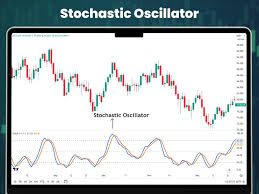
The Stochastic Oscillator is a momentum indicator that helps traders understand where a security is closed compared to the price range over a given time period. Stochastic Oscillator values range from 0 to 100, where values above 80 are considered overbought and values below 20 are considered oversold. Some traders use this indicator to predict possible trend reversals and to confirm the momentum of a price change.

Crossovers of the %K and %D lines are said to generate buy or sell signals, while divergence with price can indicate a trend is weakening. It is not uncommon to see the Stochastic Oscillator used in conjunction with the RSI or Moving Averages for confirmation. The Stochastic Oscillator works pratsicualrly well in range bound markets to determine entry and exit points.
Stochastic Oscillator Features, Pros & Cons
Features:
- Momentum indicator to compare closing price to price range.
- Ranges from 0-100, 80 and above = overbought, 20 and below = oversold.
- Buy/sell signals are created by the crossing of the %K and %D lines.
Pros:
- Good for determining when to enter and exit and providing the market.
- Markets can be tightly bound.
- A divergence can be used to find trend weakening.
- Easily combined with trend or volatility indicators.
Cons:
- Strong trends give less reliability.
- High volatility can give many false signals
- Other tools are needed to confirm a signal.
- New traders are more likely to be confused when overused.
5. Fibonacci Retracement Levels
Fibonacci retracement levels are considered to be potential support and resistance levels and are based on the key Fibonacci ratios: 23.6%, 38.2%, 50%, 61.8%, and 78.6%. These levels help traders determine where the price pullbacks will end.

In an uptrend, an example, a price pulling back to a 61.8% Fibonacci level may be a strong buy. The best levels work best with a combination of other indicators which may provide confirmations, for example, an RSI or trendlines.
Identifying reversal points makes Fibonacci retracement a strong tool to plan entry and exit levels, and also define the stop-loss levels, and is a strong instrument for smart Forex trading strategies.
Fibonacci Retracement Levels Features, Pros & Cons
Features:
- Potential support/resistance levels are represented with horizontal lines.
- Ratios based on key Fibonacci numbers: 23.6%, 38.2%, 50%, 61.8%, 78.6%.
- Help visualize when and where to execute trades and place stop-loss orders.
Pros:
- Better reversal zone detection.
- Application is simple on any timeframe.
- Entry and exit point detection is more precise.
- Used with other indicators gives better confirmation.
Cons:
- There are times when levels are broken during trends and this is a strong trending move.
- Every one trades the levels differently as it is very subjective.
- This indicator does take time to master its effectiveness.
- Other indicators need to be used for better accuracy.
Tips for Using Forex Indicators Effectively
Combine Indicators
Using complementary indicators such as trend and momentum should help you confirm signals and get you a lesser number of false entries.
Set Limits
Using too many indicators can present you with too many conflicting signals. Stick with 2-3 indicators that are reliable, are in accordance with your strategy, and present you with the best chances of success.
Backtest
Before you do any live trading, history should be on your side and you should have your strategy tested on historical data.
Market Conditions
Indicators should be calibrated dependent on whether the market is displaying a trend or is simply ranging. This means you will need to adjust your indicators dependent on the market.
Stop-Loss
Even though Indicators and your logic should help you make the best decisions for your trades, you can still lose. Always protect your position.
Common Mistakes to Avoid

Using Only One Indicator
Solo indicators are often misleading; be certain to use other supportive indicators.
Condescend Market Context
Market indicators are best used alongside other analytical techniques such as trend analysis and support & resistance levels as well as combined with current market news.
Over-Simplifying Strategies
Overuse of indicators leads to confusion and in modern parlance “analysis paralysis.”
Unjustified Signals
Some signals are justified; for example being a less than justified entry or exit due to misunderstanding the workings of the indicator.
Loss of Risk Control
Forex indicators are a guide to positioning of trades and should be used in conjunction with stop-losses and position sizes.
Conclusion
Forex indicators are invaluable in helping traders debug problems in the market, understand what the trends are, and helping traders make better trading decisions. Indicators such as Bollinger Bands, Stochastic Oscillator, Fibonacci Retracement Levels, Ichimoku Cloud, and RSI give traders an idea of the momentum, volatility, and possible points of reversals in prices. Indicators should always be used in tandem with other non-indicator tools.
It is also important to utilize strategies that have been proven to be effective, to use adequate risk management, and backtest. Indicators are used effectively, traders are able to improve their decision making, confidence, and performance in trading whether the market is trending or range bound.
FAQ
What are Forex indicators?
Forex indicators are tools or calculations based on price, volume, or market data that help traders identify trends, momentum, volatility, and potential entry or exit points. They assist in making more informed trading decisions.
Which Forex indicator is best for beginners?
For beginners, RSI (Relative Strength Index) and Moving Averages are simple yet effective indicators to understand market trends and identify overbought or oversold conditions.
Can indicators predict market reversals accurately?
Indicators provide signals and probabilities, not guarantees. Using multiple indicators together and considering market context improves accuracy but cannot predict reversals with 100% certainty.
How many indicators should I use at once?
Using 2–3 complementary indicators is ideal. Overloading with too many indicators can create conflicting signals and confusion.
Are Forex indicators effective in all market conditions?
No. Some indicators perform better in trending markets, while others are more suitable for range-bound or volatile markets. Adjusting strategies to market conditions is essential.