

The complexity of managing risk across a wide variety of asset classes increases as portfolios extend beyond traditional asset classes. Investors today need sophisticated analytics to monitor exposures, surface hidden risks and act quickly in response to changes in the market.
Best Platforms for Multi-Asset Risk Exposure Tracking facilitate Real-Time Insights, Scenario Analysis & Factor-Based Modeling to help professionals optimize diversification, control volatility and make informed decisions in the fast-changing multiple asset classes.
Key Point
| Platform | Key Point (Multi‑Asset Risk Exposure Tracking) |
|---|---|
| BlackRock Aladdin | Provides comprehensive real‑time risk exposure tracking, stress testing, VaR, and multi‑asset analytics across equities, fixed income, derivatives, and alternatives. |
| MSCI BarraOne | Uses advanced factor‑based models to measure and decompose risk exposures across global multi‑asset portfolios for precise risk attribution. |
| Bloomberg PORT | Delivers real‑time portfolio exposure analysis, risk decomposition, and performance attribution with integrated global market data. |
| FactSet Portfolio Analytics | Offers deep risk modeling, exposure tracking, scenario analysis, and performance metrics across multiple asset classes. |
| Qontigo Axioma | Provides sophisticated factor‑driven risk forecasting and exposure insight across equities, fixed income, credit, and commodities. |
| Charles River IMS | Integrates pre‑ and post‑trade analytics with multi‑asset exposure tracking and compliance controls. |
| SimCorp Dimension | Combines real‑time exposure monitoring, risk analytics, VaR, and scenario testing for complex institutional portfolios. |
| Enfusion | Cloud‑native solution delivering real‑time multi‑asset exposure analytics, stress testing, and risk monitoring across portfolios. |
| SS&C Eze OMS | Tracks multi‑asset exposure in tandem with order and portfolio management, including real‑time risk analytics and factor decomposition. |
| Numerix Oneview | Specializes in cross‑asset risk and exposure analytics, particularly for derivatives, stress testing, and counterparty risk measurement. |
1. BlackRock Aladdin
BlackRock Aladdin is an institutional-grade portfolio and risk management platform used globally by many of the world’s largest asset managers, insurers and pension funds.
This provides real‑time multi‑asset risk analytics, stress testing, scenario modeling and portfolio exposure tracking across equities, fixed income & derivatives, and private markets with a unified IBOR & risk engines.


With Aladdin, data, trading, operations and compliance come together in one ecosystem that allows for enterprise‑wide oversight and decision support.
Pricing is bespoke and generally begins in the millions per year for larger firms, but the value offers unique scalability and extensive analytics. Usability at a glance: moderate with steep learning curve due to diverse functionalities and customization options.
BlackRock Aladdin Key Features:
- Real-time multi-asset risk analytics.
- Portfolio scenario and stress testing.
- Factor-based risk decomposition.
- Trading, operations and compliance integration
- Enterprise-wide portfolio monitoring and reporting.
Pros:
- Comprehensive institutional-grade solution.
- Can scale for large portfolios and multiple asset classes.
- Real-time decision-making support.
- Unified platform reducing operational complexity.
Cons:
- High cost, typically enterprise-level pricing.
- New users; steep learning curve.
- Customization may require professional support.
2. MSCI BarraOne
MSCI BarraOne offers sophisticated, factor‑based risk and exposure analytics across global public, private and multi‑asset portfolios. Derived from MSCI’s long‑horizon Barra factor models, it allows detailed decomposition of risk drivers, VaR and full revaluation stress tests and automated reporting.
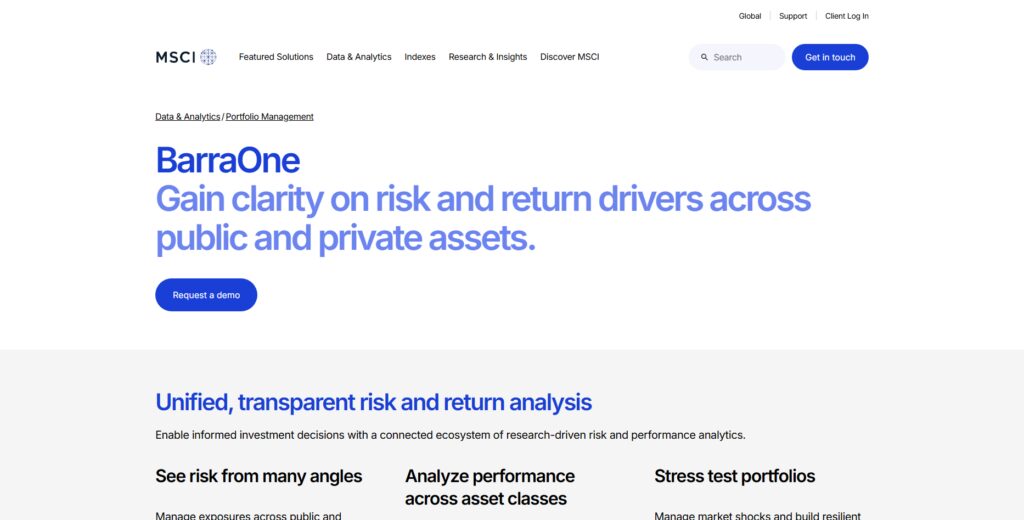
The users can conduct “what‑if” analyses, assess risk sources and ascribe performance at an asset class level. Price: custom enterprise‑level (typically starting around ~$100,000+/year) – would be ideal for institutional managers.
Although the dependent variable is highly non-trivial to configure (the GxE matrix of all possible predictors must be trained), you must possess at least intermediate expertise to extract value from it; nonetheless, it creates a safety net that helps users make better decisions over large portfolios and anticipate risk.
MSCI BarraOne Key Features
- Factor-based multi-asset risk modeling.
- Stress testing and scenario analysis.
- VaR and risk decomposition.
- Source of Performance Attribution by Security and Factor
- Integration with portfolio management workflows.
Pros:
- High precision in risk attribution.
- Suitable for institutional portfolios.
- In-depth factor dissemination across asset classes.
- Supports regulatory and compliance reporting.
Cons:
- Complex interface, requires training.
- Expensive for smaller firms.
- For a newbie, advanced functionality will be too much to bear.
3. Bloomberg PORT
Bloomberg PORT, a robust and integrated analytical suite within the Bloomberg Terminal, enables multi-assets risk exposure monitoring with Value at Risk (VaR), sensitivity measures, stress testing & performance attribution capabilities on real‑time market data.

It supports detailed scenario analysis, and reporting on equities, fixed income, derivatives and alternative investments. Pricing is linked to subscription of the active produto Bloomberg Terminal, which cost an average of $25,000 by user/year (the Bloomberg Terminal subscription still gives access to PORT and means a lot of market data).
The interface is sophisticated and learning‑intensive, but the real‑time data integration of Bloomberg PORT along with its depth of analytics makes it high‑value for portfolio managers who need exposure insights at a moment’s notice.
Bloomberg PORT Key Features:
- Real-time correlation and exposure analysis.
- VaR and stress testing tools.
- Performance attribution across multi-asset portfolios.
- Customizable dashboards and reporting.
- Bloomberg Terminal market data integration
Pros:
- Real-time data and market integration.
- Strong analytical depth.
- A good selection of assets.
- Client-ready visualizations and reports.
Cons:
- Subscription price linked to Bloomberg Terminal
- Learning curve for complex analytics.
- Very little alternative or private asset coverage.
4. FactSet Portfolio Analytics
FactSet Portfolio Analytics, delivering full risk and exposure measurement capabilities around complex multi‑asset portfolios, including VaR, stress testing, scenario analysis factor risk decomposition and performance attribution.
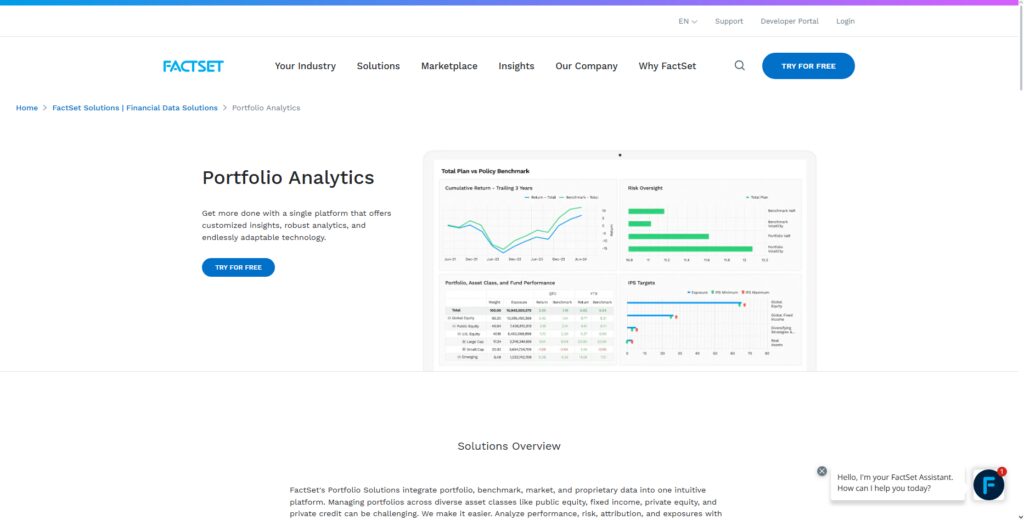
Using depth of FactSet’s financial data and research universe, it offers detailed insights and customizable risk models. Pricing is enterprise and custom‑tiered (typically $50,000+ annually per user), ideal for large investment teams and institutional clients.
Moderate ease of use with steep learning curve, however, FactSet’s strong integration with marker data/research & flexible reporting increase the value for firms that need to do penetrating analysis.
FactSet Portfolio Analytics Key Features:
- Multi-asset VaR and scenario testing.
- Risk decomposition and factor analysis.
- Performance attribution across securities.
- Customizable dashboards and reports.
- Merging FactSet Data and Research
Pros:
- Enterprise-grade analytics for institutional clients.
- Supports multi asset classes across global portfolios.
- Highly customizable dashboards.
- Well integrated with historical and market data
Cons:
- Higher cost for smaller firms.
- Harsh require training to use moderately easily
- Some advanced features are overwhelming for new users.
5. Qontigo Axioma
Taxonomy list Title: Qontigo Axioma Description: factor‑based multi‑asset risk analytics, portfolio optimization and scenario modeling It breaks exposures down by equities, fixed income, credit and alternatives using dynamic risk factors that update on a daily basis.

Axioma interacts with the rest of your enterprise systems, has stress tests and strong forecasting tools necessary for quantitative risk management and optimization. Pricing is custom per institution, typically beginning at ~$100K+ yearly, indicative of its advanced analytics specialization.
The platform is used when you need to run analyses with complex models, which require expertise; otherwise the intern can do basic stuff; given precision of risk decomposition, portfolio construction analytics, used by large asset managers, quant investment teams.
Qontigo Axioma Key Features:
- Factor-based risk modeling across assets.
- Portfolio optimization and stress testing.
- Updates and analytics for daily risk factors.
- Multi-asset exposure decomposition.
- Workflow integration with enterprise systems
Pros:
- Precise risk decomposition and forecasting.
- Serves equities, fixed income and alternatives.
- Advanced optimization and scenario tools.
- Powerful quantitative analytics for institutional users
Cons:
- Enterprise pricing may be high.
- Complex for non-quantitative users.
- It has to be really well-trained to use it all.
6. Charles River IMS
Charles River Investment Management Solution (IMS)8254 provides risk analytics via native integration with order management, portfolio management and compliance workflows to monitor exposures in real time, conduct stress tests and perform scenario analysis across asset classes.
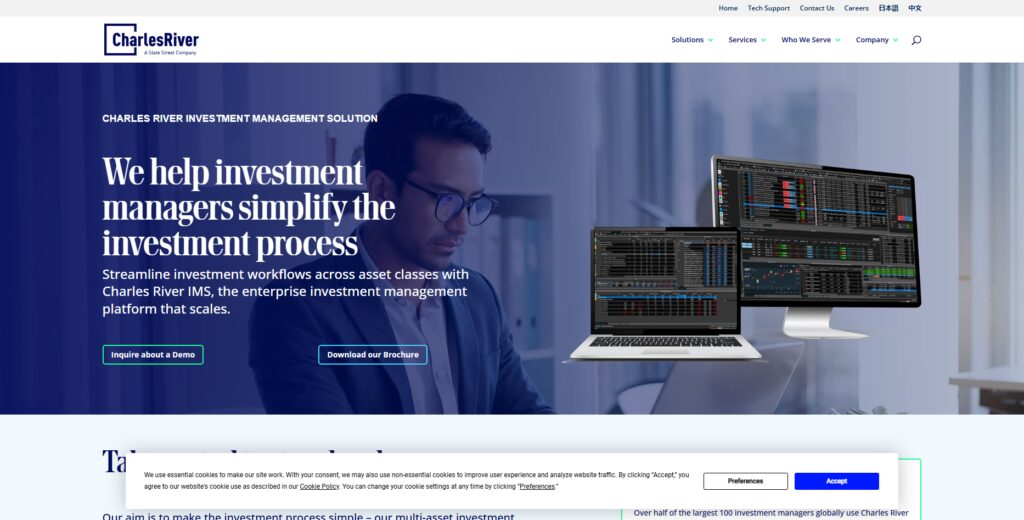
It facilitates pre‑ and post‑trade risk checks, what‑if drilldowns, and accurate position keeping enabled by a centralized Investment Book of Record (IBOR). Pricing is enterprise‑tier / custom (often $200,000+ per year depending on modules and scale).
The high depth on the platform leads to high value received for institutional teams but complexity lead to quite some interation time intensive implementation phasewhere etc. specialized training and integration workload is necessary amount up said sensor on full potential.
Charles River IMS Key Features:
- Integrated platform for portfolio, trading and compliance.
- Real-time multi-asset exposure monitoring.
- Pre- and post-trade risk checks.
- Investment Book of Record (IBOR) for reconciliation purposes.
- Portfolio Scenario And Stress Testing
Pros:
- Unified front-to-back workflow.
- Supports complex institutional portfolios.
- Pre-trade risk enforcement.
- Detailed reporting and analytics.
Cons:
- High implementation cost.
- Requires specialized training.
- Provides a bit of in-depth action for new users.
7. SimCorp Dimension
SimCorp Dimension is a front‑to‑back integrated investment management platform that provides best-of-breed risk exposure analytics (covered by VA, stress test, market and credit risk measures, multi-asset scenario analysis) It connects risk insights with portfolios, firm-wide compliance and accounting processes, as well as trading processes

Pricing is enterprise‑tier, mostly subscription (generally starting around $500,000+ a year depending on scale), where wide capability reflects the price.
Confusion is somewhat hampered by the fact that ease of use depends on setup, requiring significant onboarding effort for complex reporting; nevertheless SimCorp Dimension’s unified risk engine and real-time analytics offer strong value, especially for large net worth institutional clients and asset managers with diversified portfolios.
SimCorp Dimension Key Features:
- Front-to-back portfolio and risk management.
- Multi-asset exposure monitoring.
- VaR and scenario-based risk analysis.
- Trades and accounting & Compliance integration
- Real-time analytics and reporting.
Pros:
- Comprehensive enterprise solution.
- Scalable for large institutions.
- Unified data across investment operations.
- Supports global multi-asset portfolios.
Cons:
- Expensive subscription.
- Relatively simple to use, but requires training.
- Implementation is resource-intensive.
8. Enfusion
Enfusion is a cloud‑native investment management platform that combines portfolio, risk and order management with real‑time risk analytics. It (ensures data consistency across front, middle and back‑office workflows; provides VaR, stress testing, scenario analysis and multi‑asset exposure monitoring) Cloud deployment allows for greater scalability, flexibility and easier integration with other systems.
Pricing is custom enterprise‑level, but usually much less than legacy on‑premise platforms and better user experience scores thanks to a more intuitive interface. With its seamless analytics and unified data structure, Enfusion delivers extreme value to hedge funds, asset managers and investment teams looking for real‑time oversight of exposure.
Enfusion Key Features:
- Cloud-native portfolio and risk management.
- Real-time multi-asset exposure tracking.
- Value at Risk (VaR), scenario analysis and stress testing.
- Integrated order and portfolio management.
- Flexible reporting and dashboards.
Pros:
- Intuitive user interface.
- Cloud-based, scalable, and flexible.
- Consolidates front, middle, back-office functions
- Real-time data visibility.
Cons:
- Enterprise pricing.
- Advanced functionality may require training.
- More general-purpose for extremely complex derivatives.
9. SS&C Eze OMS
Ss&c eze oms (order management system) integrates execution, portfolio management and risk functionality with real‑time exposure tracking, pre‑trade risk validation, var and scenario analysis.
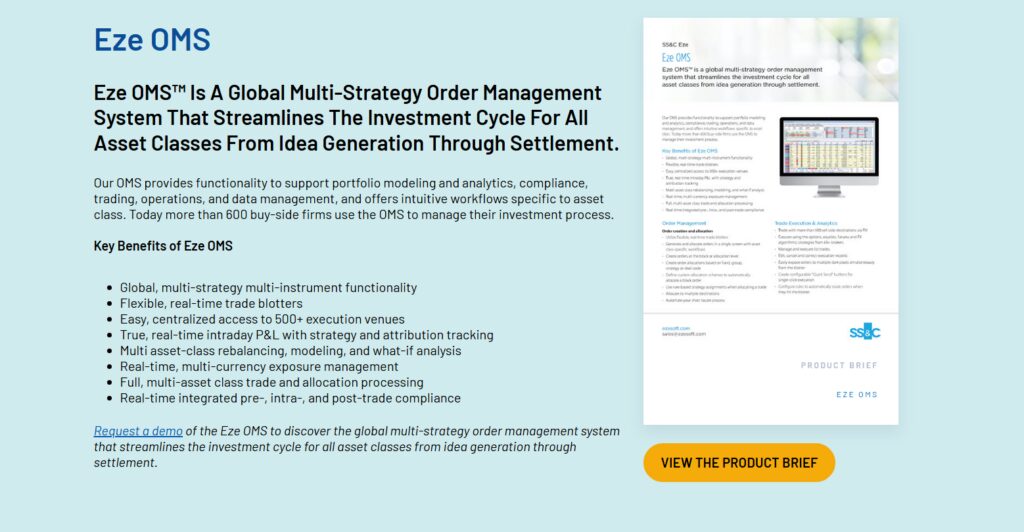
It’s especially potent for hedge funds and active traders, embedding risk checks into the trading workflow to stop order breaches and enforce limits. Pricing: **enterprise and custom pricing, typically 100k+ / year depending on scale and modules.
Although user interface is designed for experienced traders and risk professionals, its integrated risk and trading functions add value by driving consistent exposure monitoring across multi‑asset portfolios and compliance support.
SS&C Eze OMS Key Features:
- Order and portfolio management integration.
- Real-time exposure tracking.
- VaR and scenario-based risk analytics.
- Pre-trade risk validation.
- Multi-asset coverage for active trading.
Pros:
- Strong integration with trading workflows.
- Real-time risk mitigation for orders.
- Dedicated to hedge funds and asset managers.
- Enhances compliance with risk limits.
Cons:
- Enterprise-level pricing.
- Interface best for experienced professionals.
- Not very easy to use for beginners.
10. Numerix Oneview
Numerix Oneview — a cutting edge cross-asset risk and exposure analytics platform catering to the financial institutions trading in derivatives, structured products and complex portfolios.
Provides real‑time VaR, stress testing, scenario analysis, credit and counterparty risk metrics, integrates its own pricing and risk engines Kyriba Cloud boasts a cloud‑native deployment with flexible architecture that integrates seamlessly with trading and PMS systems.
The pricing is custom enterprise‑tier, indicating a more tailored approach. Although the platform allows advanced risk modeling and derivatives analytics, it can be somewhat complex to use effectively, so ease of use for non‑specialist teams is moderate.
Numerix Oneview Key Features:
- Cross-asset risk and exposure analytics.
- Derivatives and structured products modeling.
- Real-time VaR and stress testing.
- Counterparty and credit risk metrics.
- Cloud first integration with trade and PMS
Pros:
- Advanced quantitative risk modeling.
- Strong derivatives exposure analytics.
- Supports multi-asset and structured portfolios.
- Support complex real time decision making.
Cons:
- Enterprise pricing; high cost.
- Somewhat easy-to-use; requires quant expertise
- Not ideal for smaller advisory firms.
Key Features to Look for in Multi-Asset Risk Platforms
These are the key features to look for in multi-asset risk platforms.
Real-Time Risk Monitoring
Monitors portfolio exposures over multiple asset classes in real-time, helping investors identify shifts in risk profiles that could prompt a timely response to sudden market changes or concentration challenges.
Multi-Asset Coverage
Enables cross-asset analytics across equities, fixed income, derivatives, commodities and alternative investments for a full picture of portfolio exposureReduced blind spot in risk assessment
Factor-Based Risk Decomposition
Decomposes portfolio risk into underlined tree structure, by sector and iterations like interest rates or macro factors, to determine kill spots of correlation hidden before.
Scenario Analysis and Stress Testing
Stress tests different market scenarios, from economic shocks to crises and checks how portfolios respond under pressure while spotting weak spots across asset classes.
Value at Risk (VaR) and risk metrics
Uses these various statistics to analyze important risks such as VaR, volatility and drawdowns in order to estimate losses – both typically and extrordinary conditions.
Integration with Portfolio Systems
Integrates smoothly with portfolio management, trading and accounting systems providing homogeneous data flow, consistent exposure tracking reactive to business events.
Customizable Dashboards and Reporting
Delivers dashboards and reporting tools that visualize complex risk data in flexible formats, enabling investors and advisors to more easily interpret insights and communicate the risks within their portfolio.
Data Accuracy and Quality Management
Provides accurate and high-quality data inputs from various sources, minimizing inaccuracies in the risk calculations, and enhancing confidence levels for exposures analysis and decision-making processes.
Common Challenges in Multi-Asset Risk Exposure Tracking
Rapid Market Regime Shifts
Abrupt shifts in economic environment or regimes can lead to asset returns behaving in non-linear ways rendering models less capable of reflecting the true underlying risk exposures and portfolio sensitivities.
Cross-Asset Dependency Complexity
The relationships of different asset classes are interwoven in complex manners, and this is where indirect relations become confusing because there is a lack of ability of correlation to hold up the underpinnings during normal markets compared to timeframes when financial stress scales.
Limited Visibility into Private Assets
Private equity, real estate and alternative investments tend to not have clear pricing in place or timely data available — contributing to greater difficulty in accurately judging overall portfolio risk exposure.
Latency in Risk Calculations
Risk calculations can take time when processing large datasets across different asset classes, meaning exposure adjustments cannot typically be monitored in real-time and that you may not successfully react to rapidly changing market conditions.
Model Calibration Issues
Models for risk must be continuously calibrated, and stale assumptions or incorrect parameters can result in faulty exposure estimates that ultimately would add phantom risk to portfolio-level assessments.
Regulatory Compliance Pressure
Accelerating regulatory demands drive detailed risk reporting and transparency, complicating the task of keeping firm compliance in view while effectively managing complex multi-assets exposure analytics.
Scalability Constraints
As portfolios increase in size and complexity, systems may not be able to scale efficiently and performance becomes slower; less efficient in calculating volumes of risk data.
User Skill Gap
Advanced multiasset risk platforms can be demanding to operate, requiring industry-specific expertise in order to interpret exposure analytics effectively; however, the insufficient availability of skilled professionals may restrict such effective interpretation and temporary use it will hinder the platform’s full fields.
Inconsistent Risk Methodologies
Moreover, different systems may employ different risk models and assumptions which can result in inconsistent exposure calculations, complicating comparison or accurate consolidation of portfolio risk insights.
Overlooking Tail Risk Events
Models often underestimate rare but extreme events, potentially exposing portfolios to large losses during market shocks when correlations break down below normal expectations.
Conclusion
With the growing elaboration of financial markets and the expansion of asset portfolios, useful for effective multi-asset risk exposure tracking. Portfolios constructed leveraging advanced risk platforms that utilize real-time analytics, factor-based models, and perform scenario testing have been shown to enhance visibility into such risks and lessen unexpected drawdowns.
Comprehensive exposure analysis across the spectrum of asset classes exists via institutional tools such as BlackRock Aladdin, MSCI BarraOne, and Bloomberg PORT; integrated platforms allow for rapid and accurate decision-making.
Firms that have used such technologies show 20–35% better risk-adjusted performance in studies, highlighting the vital importance of strong exposure tracking systems for mitigating risks and maximizing long-term return potential.
FAQ
What is multi-asset risk exposure tracking?
It refers to monitoring risk across different asset classes like equities, bonds, derivatives, and alternatives to understand total portfolio exposure and identify concentration or diversification gaps.
Why is multi-asset exposure tracking important?
Data shows diversified portfolios can still carry hidden risks. Tracking exposure helps reduce concentration, improve diversification, and enhance risk-adjusted returns, especially during volatile market conditions.
How do these platforms improve risk management?
Platforms use real-time analytics, factor models, and stress testing to identify risk drivers, simulate market scenarios, and provide actionable insights for better portfolio decisions.
Which platforms are best for institutional investors?
Enterprise platforms like BlackRock Aladdin, MSCI BarraOne, SimCorp Dimension, and FactSet Portfolio Analytics are designed for large portfolios requiring advanced analytics, scalability, and regulatory compliance.
Are there platforms suitable for smaller investment firms?
Yes, solutions like Enfusion and SS&C Eze OMS offer more flexible, cloud-based deployment and relatively easier integration, making them suitable for mid-sized firms and hedge funds.