Here I will be talking about the Best AI Systems for business process optimization to optimize workflows, improve operational efficiency, and enhance decision-making using Artificial Intelligence.
They integrate automation, analytics and machine learning to facilitate more efficient business operations, minimize manual work, improve productivity and enable digital transformation in today’s enterprises.
Why AI Systems for Business Process Optimization
Improves Operational Efficiency
AI takes care of mundane tasks, thus decreasing manual force and giving workers time to devote to strategic or high-billing jobs.
Reduces Operational Costs
Automation reduces human errors, saves on labor costs, and optimizes resource usage throughout business operations.

Enhances Decision-Making
AI analyzes both real-time and historical data to offer insights, prediction, along with intelligent business decisions.
Increases Process Accuracy
They enhance data entry, reporting and workflow execution by minimizing errors.
Accelerates Workflow Automation
Customer service responses as well as operational processes are sped up by automated workflows driven by AI.
Improves Customer Experience
By delivering services quicker with personalized interactions and automated support, organizations experience greater customer satisfaction.
Enables Scalability
Businesses can scale easily without outsized growth in resources/workforce or operational complexity.
Provides Real-Time Monitoring
AI platforms monitor performance in real time and detect inefficiencies or risks immediately.
Supports Digital Transformation
AI-powered automation modernizes legacy systems and enables businesses to transition towards data-driven operations.
Strengthens Compliance and Governance
Continuous monitoring, audit trails, and compliance checks ensure adherence to regulatory requirements with an ease.
Key Point & Best AI Systems for Business Process Optimization
| AI System | Key Points |
|---|---|
| UiPath AI-Powered RPA | Combines robotic process automation with AI decision-making, supports self-healing bots, strong governance controls, and enterprise-scale automation deployment. |
| Automation Anywhere + AI | Cloud-native automation platform with intelligent bots, process analytics, cognitive automation, and strong scalability for digital workforce management. |
| Blue Prism Intelligent Automation | Enterprise-grade secure automation platform focused on governance, compliance, scalable digital workers, and AI-integrated process execution. |
| IBM Watson Orchestrate | Uses conversational AI and automation orchestration to automate repetitive knowledge work, integrates easily with enterprise applications and workflows. |
| Microsoft Power Automate + Copilot | Low-code automation platform enhanced with AI Copilot for workflow creation, smart recommendations, and seamless Microsoft ecosystem integration. |
| SAP Business Technology Platform (BTP) AI | Unifies data, analytics, AI, and automation to optimize SAP business processes with intelligent workflow automation and enterprise integration. |
| Oracle Fusion Cloud + AI | AI-driven enterprise applications delivering automated finance, HR, and supply-chain workflows with predictive insights and process optimization. |
| Workday AI | Focuses on HR and finance automation using machine learning for workforce planning, intelligent recommendations, and operational efficiency. |
| ServiceNow AI Workflow | Automates IT, HR, and service operations using AI-driven workflows, predictive automation, and intelligent service management capabilities. |
| Appian AI Process Automation | Low-code automation platform combining AI, BPM, and RPA to rapidly design, deploy, and optimize end-to-end business processes. |
1. UiPath AI-Powered RPA
UiPath AI-Powered RPA, which couples robotic process automation with artificial intelligence, automates mundane enterprise workflows like invoice processing, customer onboarding and compliance reporting. The platform leverages computer vision, machine learning and intelligent document processing to understand business data and take action without any human intervention. Attended and unattended bots can be deployed to help organize operations with governance and scalability.
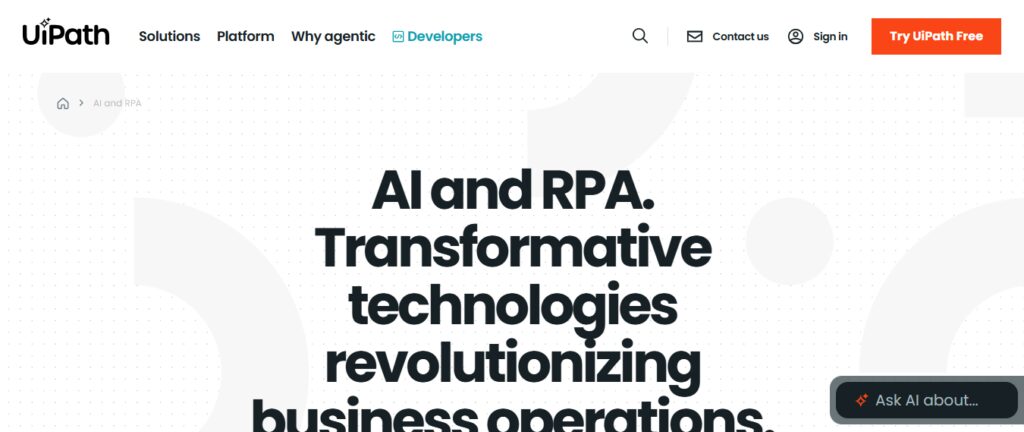
UiPath is one of the Best AI Systems for Business Process Optimization, at the center of modern digital transformation initiatives because it enables companies to identify automation potential through process mining and provides ongoing feedback on operational efficiency improvement with analytics-based automation insights.
UiPath AI-Powered RPA – Features
- AI And Computer Vision-Based Intelligent Document Processing
- Using data mining to discover opportunities for automation
- They are attended (human interaction is needed to start the bot) and unattended (the bot can be deployed without user intervention).
- Low-code automation development environment
- Performance Monitoring of Advanced Analytics & Automation
UiPath AI-Powered RPA
| Pros | Cons |
|---|---|
| Strong AI + RPA integration | Licensing cost can be high |
| Excellent process mining tools | Initial setup complexity |
| User-friendly low-code interface | Requires training for advanced automation |
| Large integration ecosystem | Maintenance needed for bots |
| Scalable enterprise automation | Infrastructure resources required |
2. Automation Anywhere + AI
Automation Anywhere provides a cloud-native intelligent automation platform that automates end-to-end business processes with ai, analytics, and robotic automation. Its AI Sense technology enables bots to comprehend documents, emails and business communication so organizations can achieve cognitive automation instead of just task-based automation.
Enterprises get to take advantage of real-time analytics, secure bot deployment and scalable management of digital workforce. Featured as one of the Best AI Systems for Business Process Optimization, Automation Anywhere enables organizations to lower operational costs while improving process speed and accuracy. It further provides API integrations and enterprise governance models to enable organizations maximize efficiencies by automating finance, HR, supply chain and customer service workflows.
Automation Anywhere + AI – Features
- Cloud-native intelligent automation platform
- AI Sense for understanding cognitive data
- This AI only labor management function is seamless, where service across multiple AI agents are morphed to create the Digital worker.
- Real-time automation analytics dashboards
- Enterprise-grade security and governance controls
Automation Anywhere + AI
| Pros | Cons |
|---|---|
| Cloud-native automation platform | Premium pricing tiers |
| AI Sense enhances cognitive automation | Learning curve for beginners |
| Strong analytics and monitoring | Customization may require expertise |
| Secure enterprise governance | Dependence on cloud connectivity |
| Easy bot deployment and scaling | Integration setup can be complex |
3. Blue Prism Intelligent Automation
Blue Prism Intelligent Automation – CBAAs blueprism.com Creating a Digital Workforce that is Secured Performance for Mission Critical Enterprise Processes Its automation framework brings together AI skills, machine learning models and rule-based automation for enhanced operational consistency. The platform focuses on governance, compliance, and auditability, which is well suited for regulated industries like banking and healthcare. Blue Prism:
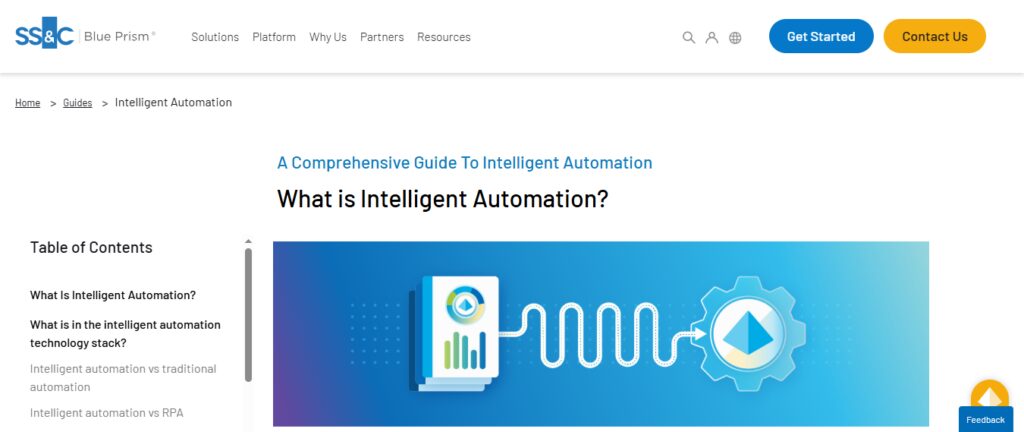
Acknowledged as one of the Best AI Systems for Business Process Optimization visually, Blue Prism allows organizations to automate complex workflows without sacrificing transparency or control. Organizations leverage it to automate back-office operations, enhance customer service delivery and productivity using scalable automation with enterprise-grade security architecture.
Blue Prism Intelligent Automation Features
- Secure digital workforce automation framework
- Intelligent workflows with AI skill blending
- Centralized control and compliance management
- Scalable enterprise automation deployment
- Process intelligence and performance analytics
Blue Prism Intelligent Automation
| Pros | Cons |
|---|---|
| High security and compliance standards | Less beginner-friendly |
| Reliable digital workforce model | Higher implementation cost |
| Strong governance framework | Slower development compared to low-code tools |
| Scalable enterprise deployment | Requires skilled developers |
| Stable automation performance | Limited built-in AI compared to competitors |
4. IBM Watson Orchestrate
IBM Watson Orchestrate is a conversational AI-enabled automation platform that helps orchestrate tasks, workflows, and enterprise applications automating using AI. Employees can converse with the system using queries in natural language, enabling AI assistants to automatically schedule meetings, process approvals or compile business data.
It offers a rich application ecosystem that integrates deeply with the surrounding enterprise software, promoting cross-departmental collaboration. Watson Orchestrate – GPT 2023 Integration for Business Process Optimization Considered One of the Best AI Systems For Business Process Optimization,
Watson Orchestrate enhances productivity by eliminating manual coordination steps and providing intelligent orchestration of workflows. Its machine learning powers constantly act on user interactions to also assist organizations in providing better quality decision-making, smoother operations and improved overall workforce productivity.
IBM Watson Orchestrate — Features
- Conversational AI task automation
- Intelligent workflow orchestration across applications
- Natural language interaction for users
- AI-powered recommendations and decision support
- Seamless enterprise software integrations
IBM Watson Orchestrate
| Pros | Cons |
|---|---|
| Powerful conversational AI automation | Setup may require IBM ecosystem knowledge |
| Intelligent workflow orchestration | Higher enterprise pricing |
| Natural language interaction | Custom integrations can be complex |
| AI-driven recommendations | Best suited for large organizations |
| Strong analytics capabilities | Smaller community support |
5. Microsoft Power Automate + Copilot
AI Copilot in Microsoft Power Automate enables creating workflows by natural language processing, where users need to articulate automation needs rather than code processes. The platform, which unites with Microsoft 365, Dynamics and Teams, empowers clients in automating over their business applications.
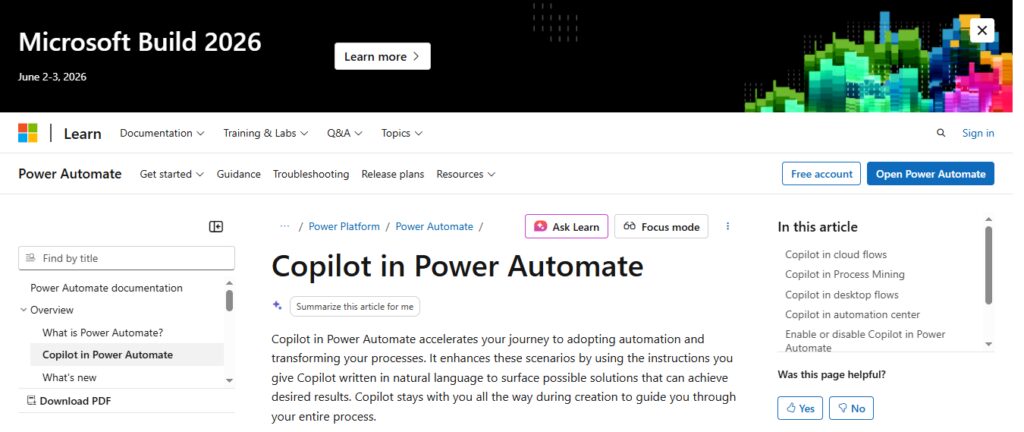
Manages inefficiencies: AI-enabled recommendations help enterprises automatically optimize their processes and find bottlenecks. Ranked #1 in list of Best Known AI Systems for Automating Business Processes, Power Automate enables both technical and business users to create automation solutions rapidly.
Its robotic process automation features address desktop and cloud functions, and the analytics dashboards offer visibility into performance — empowering enterprises to scale automation efforts while driving productivity and operational agility.
Microsoft Power Automate + Copilot Features
- Creating workflows in natural language with Copilot
- Tight integration with Microsoft 365 and Dynamics ecosystem
- Desktop and cloud robotic process automation
- Prebuilt automation templates and connectors
- Real-time monitoring and automation analytics
Microsoft Power Automate + Copilot
| Pros | Cons |
|---|---|
| Deep Microsoft ecosystem integration | Limited outside Microsoft stack |
| Low-code automation creation | Advanced features require premium plans |
| AI Copilot simplifies workflow building | Desktop automation setup complexity |
| Large template library | Performance varies for large workflows |
| Affordable entry-level pricing | Governance setup needed at scale |
6. SAP Business Technology Platform (BTP) AI
SAP BTP brings together data management, analytics, automation and AI in a single enterprise environment. BTP AI is used by organizations to help integrate applications, orchestrate data pipelines and deploy machine learning models that improve operational workflows. Supporting Intelligent automation across finance, procurement and supply chain Operations.
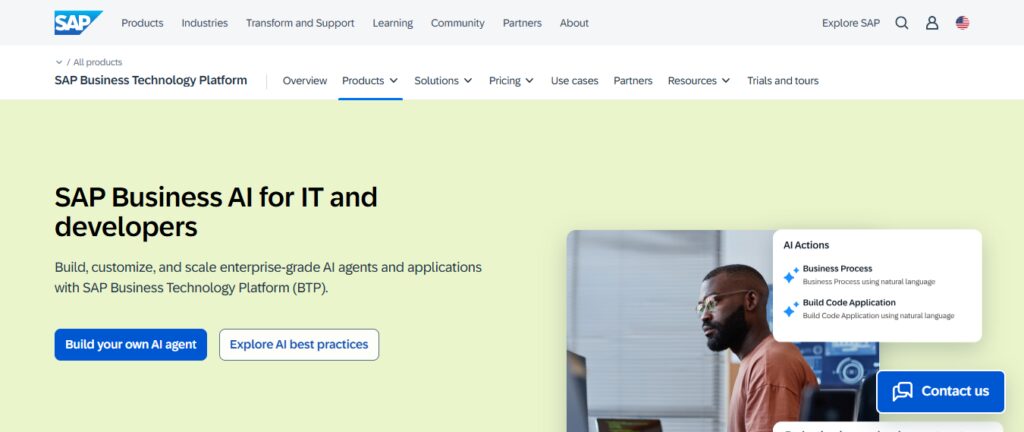
SAP BTP is ranked as one of the Best AI Systems for Business Process Optimization which help organizations reimagine legacy systems into intelligent digital processes. Through deep integration across SAP enterprise applications, organisations achieve real-time analytics, automated decisions and cross-functional collaboration while ensuring enterprise governance through scalable cloud infrastructure.
SAP BTP AI — Features
- One unified platform for data, analytics, and AI services
- Automation of business processes across SAP applications
- Frameworks and platforms to build and deploy AI models
- Enterprise data integration capabilities
- Real-time analytics and intelligent insights
SAP Business Technology Platform (BTP) AI
| Pros | Cons |
|---|---|
| Unified data, analytics, and AI platform | Complex implementation process |
| Strong SAP ecosystem integration | Expensive for smaller businesses |
| Enterprise-grade scalability | Requires SAP expertise |
| Real-time analytics capabilities | Customization may take time |
| Advanced business automation | Best suited for SAP users |
7. Oracle Fusion Cloud + AI
Oracle Fusion Cloud embeds AI capabilities in its ERP, HCM, and supply chain systems to automate complicated enterprise operations. Through predictive analytics, automation workflows, and intelligent recommendations the platform improves decision-making capability and operational performance.
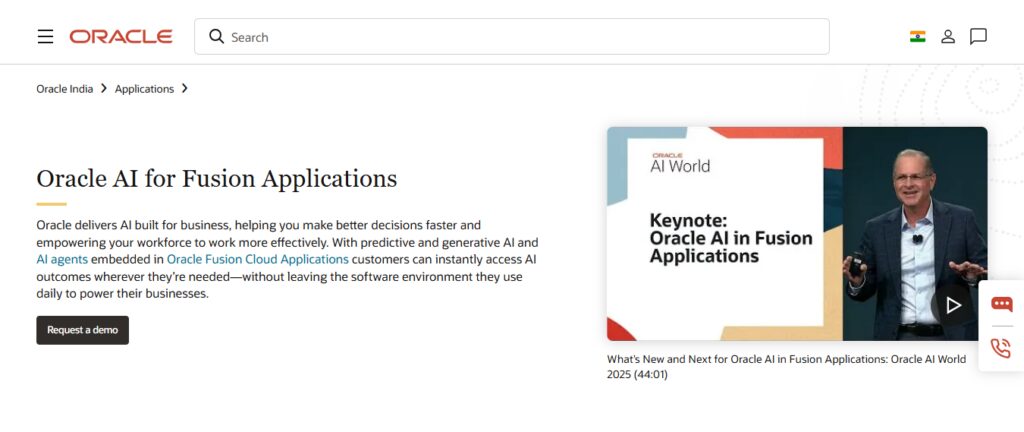
Automated financial forecasting, workforce planning, and procurement optimization help organizations. Also nominated as one of the Best AI Systems for Business Process Optimization, Oracle Fusion Cloud minimizes manual intervention and enhances accuracy and efficiency. Businesses can gain end-to-end visibility into processes and respond to business needs by streamlining workflows, increasing agility and driving transformative data-driven journeys in a unified cloud architecture.
Oracle Fusion Cloud + AI – Features
- LMS featured Embedded AI from ERP, HCM to Supply chain module
- Predictive analytics for business forecasting
- Automated workflow and decision automation
- Smart financial and workforce planning tools
- Scalable cloud-native enterprise infrastructure
Oracle Fusion Cloud + AI
| Pros | Cons |
|---|---|
| Embedded AI across enterprise applications | High subscription cost |
| Strong predictive analytics | Complex migration from legacy systems |
| Unified ERP and HCM platform | Requires experienced administrators |
| Automated decision-making workflows | Custom workflows may need consulting |
| Scalable cloud infrastructure | Implementation time can be long |
8. Workday AI
They work to bring AI capabilities and offerings to their solution product line through the evolution of intelligent automation, predictive analytics and analytics-driven technology, allowing organizations to innovate in human resources (HR) and finance.
A platform that uses the analysis of workforce data to drive better hiring decisions, higher levels of employee engagement and more accurate financial planning. Organizational behavior training helps AI models evolve through continual learning: to become adaptive automation and assistance for intelligent resource allocation.
Listed among the Best AI Systems for Business Process Optimization, Workday AI balances lifting the burden of routine administrative tasks from business units with providing key strategic insights to leadership teams. Providing organizations compliance management, business process transparency, and improved employee experience that underpins long-term digital transformation initiatives through the integration of AI into their business workflows.
Workday AI – Features
- How about AI-Enabled Automation for HR and Financial Management
- Predictive workforce analytics and planning
- Continuous machine learning optimization
- Automated compliance and reporting tools
- Real-time operational insights and dashboards
Workday AI
| Pros | Cons |
|---|---|
| Excellent HR and finance automation | Limited customization flexibility |
| Predictive workforce analytics | Premium enterprise pricing |
| Continuous learning AI models | Requires Workday ecosystem adoption |
| Strong compliance and reporting | Integration challenges with non-Workday tools |
| User-friendly interface | Smaller automation scope vs RPA platforms |
9. ServiceNow AI Workflow
ServiceNow AI Workflow automates enterprise service management workflows across IT, HR, customer support, and security operations. It utilizes predictive intelligence and AI-driven automation to proactively recognize issues, routes requests intelligently, and automatically resolve incidents.
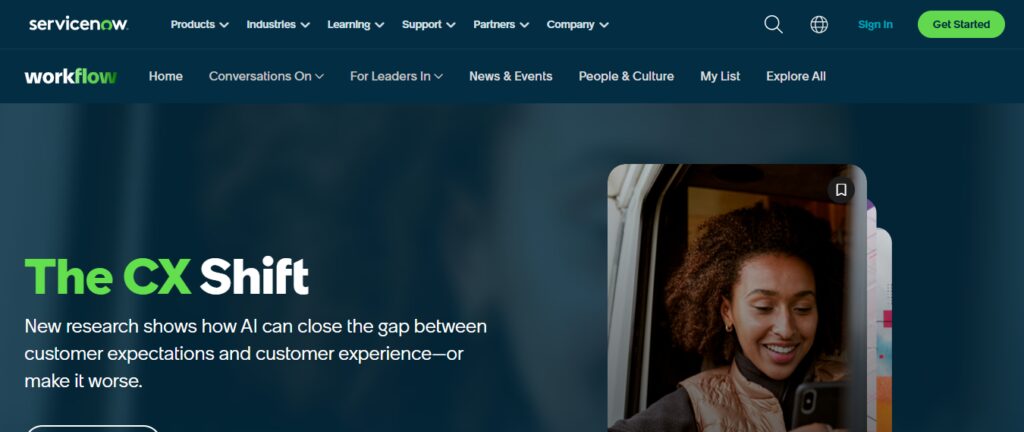
AI-powered virtual agents provide greater service delivery while also reducing response times. Ranked in the Top AI Systems for Business Process Optimization, ServiceNow helps organizations develop a greater level of cohesion through integrated workflows that bridge departments and break down operational silos.
The centralized platform provides visibility of all processes in real-time across the enterprise, helping companies to proactively resolve problems while boosting employee productivity and streamlining digital operations.
ServiceNow AI Workflow – Features
- Automation for IT, HR & customer service powered by AI
- Predictive intelligence for incident resolution
- Service delivery through Virtual AI agents
- End-to-end workflow orchestration platform
- Centralized process monitoring and analytics
ServiceNow AI Workflow
| Pros | Cons |
|---|---|
| Powerful workflow automation platform | Licensing cost is high |
| AI-powered service management | Requires configuration expertise |
| Strong incident prediction capabilities | Can be complex for small teams |
| Centralized enterprise workflows | Customization effort needed |
| Excellent IT and HR automation | Implementation timeline may be long |
10. Appian AI Process Automation
Appian AI Process Automation integrates low-code, robotic process automation and artificial intelligence in a single unified platform. Organizations can quickly build applications, automate workflows, and connect enterprise systems without deep coding knowledge.
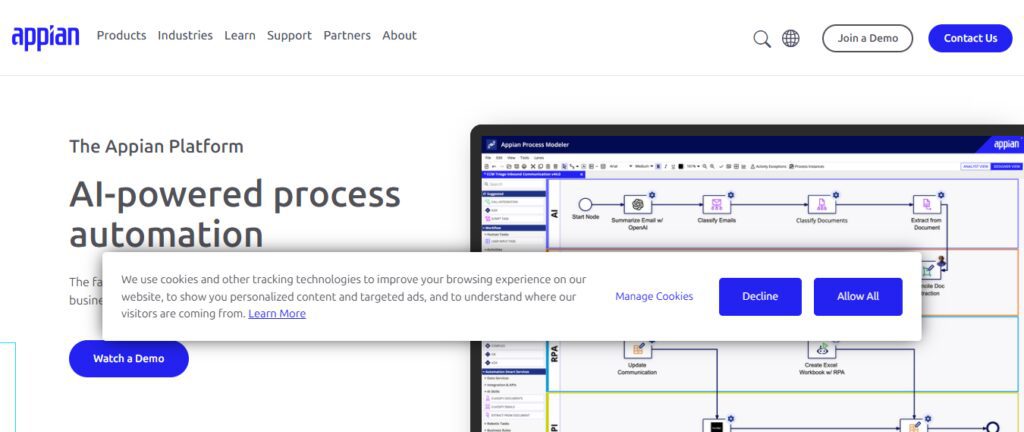
Supports Process Mining, Case Management / Intelligent Decision Automation to optimize complex operations. Best AI Systems for Business Process Optimization — Appian helps organizations speed up their digital transformation by shortening the time it takes to build and deploy applications, making them efficient at scale.
It provides support for seamless process visibility across departments with a single data fabric, enabling enterprises to monitor performance, improve compliance and continuously fine-tune business processes through AI-driven insights.
Appian AI Process Automation Features
- Low-code application and workflow development
- Combining RPA with AI decision automation
- Process mining for workflow optimization
- Case management and operational visibility
- Enterprise integrations on a unified automation platform
Appian AI Process Automation
| Pros | Cons |
|---|---|
| Low-code rapid application development | Advanced customization needs developers |
| Integrated RPA and AI automation | Licensing may be expensive |
| Strong case management features | Learning curve for complex workflows |
| Process mining and optimization tools | Smaller marketplace compared to competitors |
| Fast deployment capabilities | Performance tuning required for large workloads |
Conclusion
Summary: State-of-the-art AI automation platforms are becoming ever more critical for businesses to increase efficiency, optimize large-scale operations and augment decision-making capabilities across different divisions.
Enterprise solutions also prove how AI is revolutionizing business process management, examples include UiPath, Automation Anywhere, Blue Prism, IBM Watson, Microsoft Power Automate, SAP Business Technology Platform, Oracle Fusion Cloud and Workday +—+ ServiceNow and Appian.
Now these platforms combine automation, analytics, machine learning and workflow orchestration to reduce manual chunking and enable scalable digital transformations. It is all about implementing the right AI solutions for business process optimization as it helps in achieving rapid improvement in operations, cost-cutting and creating better experiences of customers and employees.
In short, AI-based process optimization is evolving into a strategic imperative for organizations looking to remain competitive in the long run within a progressive data-oriented economy.
FAQ
What are AI systems for business process optimization?
AI systems for business process optimization are intelligent software platforms that use artificial intelligence, automation, analytics, and machine learning to streamline business workflows. These systems reduce manual work, improve accuracy, automate decision-making, and enhance operational efficiency across departments such as finance, HR, IT, and customer service.
Why are AI-driven process optimization tools important for businesses?
AI optimization tools help organizations increase productivity, lower operational costs, minimize human errors, and accelerate decision-making. They enable companies to automate repetitive tasks while providing real-time insights that improve strategic planning and overall business performance.
Which industries benefit most from AI process optimization?
Industries such as banking, healthcare, manufacturing, retail, logistics, telecommunications, and technology benefit significantly. Any organization managing complex workflows, large datasets, or repetitive operational processes can gain value from AI automation platforms.