In this article, I will concentrate on the top institutional staking providers for pension funds and consider platforms offering secure custody, a known fee structure, and a good compliance structure. Pension funds require solutions for risk-managed staking that include protection from slashing, audited infrastructure, and regulatory compatibility.
By analyzing Coinbase, Figment, Kraken Institutional, Binance Institutional, Anchorage Digital, BitGo, Stakefish, P2P.org, Kiln, and AllNodes Institutional, we will determine how each of these companies provides pension funds the framework to achieve stability, yield optimization, and long term growth in a fiduciary capacity.
Why Choose Institutional Staking Providers for Pension Funds
Regulatory Compliance
Anchorage Digital and Coinbase Cloud operate in the U.S. under the SEC and banking regulations, respectively, and can meet fiduciary requirements for compliance.
Safe Asset Custody
BitGo and Anchorage Digital offer custody services for pension assets, providing insurance for custodial theft and mismanagement.

Slashing Protection
Validator slashing represents a real operational risk for pension funds, and Figment, P2P.org, and Stakefish offer insurance against those risks.
Known Fees
Most providers charge from 5 to 12 percent of rewards, and these firms have defined their fees, so pension funds can estimate rewards with certainty.
Expanding Networks and Safe Diversification
Many firms offer 25 to 50 different chains, allowing pension funds to stake different cryptocurrencies across many networks, such as Ethereum, Solana, and Polkadot.
Key Points
| Provider | Chains Supported | Institutional Safeguards | Key Strengths |
|---|---|---|---|
| Coinbase Cloud | ETH, SOL, DOT, ADA | SOC2 compliance, insured custody | Tier‑1 US regulated, strong reporting tools. |
| Figment | 50+ PoS chains | Slashing insurance, institutional dashboards | Widely trusted by funds, transparent governance. |
| Kraken Institutional | ETH, SOL, DOT | Segregated custody, compliance reporting | US regulated, strong liquidity integration. |
| Binance Institutional | ETH, BNB, SOL, ADA | Custody segregation, slashing protection | Global reach, deep liquidity pools. |
| Anchorage Digital | ETH, DOT, SOL | OCC chartered bank, insured custody | US chartered crypto bank, strong compliance. |
| BitGo | ETH, SOL, AVAX | Qualified custodian, insurance coverage | Institutional custody + staking integration. |
| Stakefish | ETH, SOL, DOT, ATOM | Transparent validator ops, slashing protection | Long‑standing validator, trusted by DAOs + funds. |
| P2P.org | ETH, SOL, NEAR, DOT | Institutional dashboards, slashing insurance | Large validator network, strong governance. |
| Kiln | ETH, SOL, MATIC | Enterprise APIs, reporting tools | Focused on institutional staking automation. |
| Allnodes Institutional | ETH, SOL, ADA, DOT | Non‑custodial validator hosting | Transparent pricing, strong uptime guarantees. |
1. Coinbase Cloud
Coinbase Cloud supports major chains like Ethereum, Solana, Polkadot, and Cardano. Having SOC2 compliance, they offer insured institutional custody, making it secure for pension funds. Coinbase manages validator operations and slashing protection with their custody based staking model, all for a 5%-10% staking reward fee.
Other providers may have a different fee structure, but in Coinbase Cloud’s case, the fee is justified by their solid compliance and reporting tools.
They have a high security rating because of their infrastructure and U.S. regulation. Pension-fund suitability is excellent since Coinbase Cloud has regulatory alignment, insured custody, and institutional dashboards. Because of this, fiduciary investors can meet their required compliance while ensuring higher staking returns.
Coinbase Cloud Features
- ETH, SOL, POL, ADA support
- Insured custodial services with SOC2 compliance
- Slashing protection for custodial staking
- Fees with transparency landing in the range of 5–10% of rewards
- High suitability for pension funds due to U.S. regulations
| Pros | Cons |
|---|---|
| Strong U.S. regulatory compliance | Fees ~5–10% may be higher than some peers |
| SOC2‑certified insured custody | Limited chain coverage compared to Figment |
| Transparent reporting dashboards | Custodial model reduces investor control |
| Slashing protection included | Dependent on Coinbase infrastructure |
| Excellent pension‑fund suitability | Jurisdictional restrictions outside U.S. |
2. Figment
Figment supports 50+ chains and has Solana, Cosmos, Polkadot, and Ethereum proof-of-stake among others. They offer custody with insurance and slashing protection, along with institutional dashboards. Their staking model is custody-based with Figment operating validators and with a certain level of governance.
For a staking reward fee of 7%-12%, Figment has a solid offering considering their chain coverage. Security ratings are high as so are Figment’s other offerings.
Pension fund suitability is excellent because of Figment’s chain coverage and the compliance offered. For funds seeking to increase their exposure in a risk controlled manner, Figment is an excellent option with their solid staking governance and reporting.
Figment Features
- 50+ supported chains including ETH, SOL, POL
- SOC2 compliance custodial services with slashing protection
- Custodial with governance staking dashboards
- Fees 7–12% of rewards
- High suitability for pension funds through considerable diversification
| Pros | Cons |
|---|---|
| Supports 50+ chains for diversification | Fees ~7–12% higher than exchanges |
| Institutional dashboards with governance | Custodial model reduces direct control |
| Slashing insurance coverage | Complex reporting may overwhelm smaller funds |
| Strong audited infrastructure | Less liquidity integration than exchanges |
| High pension‑fund suitability | Requires trust in third‑party custody |
3. Kraken Institutional
Kraken Institutional supports Ethereum, Solana, and Polkadot, and has custody and reporting solutions designed for institutional clients. Fiduciary clients appreciate custody segregation and reporting solutions designed specifically for them. Staking with Kraken includes staking rewards and liquidity, and carries a competitive fee of 5-8%. Staking is custodial, and uses Kraken’s infrastructure.
Kraken combines staking and the management of liquidity, giving institutional clients the choice of balance yield and flexibility. Kraken’s compliance reporting, ergonomic custody offerings for yield and liquidity integration make it an attractive custodian for regulated pension funds.
Kraken Institutional Features
- ETH, SOL, POL support
- Custody segregation with compliance reporting
- Slashing protection custodial staking with integrated exchange liquidity
- Fees of 5–8% of rewards
- Strong suitability for pension funds with both yield and liquidity
| Pros | Cons |
|---|---|
| Segregated custody with compliance tools | Limited chain support compared to Figment |
| Integrated liquidity + staking | Custodial model reduces autonomy |
| Transparent fees ~5–8% | U.S. regulatory exposure may limit global reach |
| Strong security infrastructure | Smaller chain coverage |
| Pension‑fund suitability strong | Reliance on exchange ecosystem |
4. Binance Institutional
Binance Institutional supports Ethereum, BNB, Solana, and Cardano and provides slashing protection and global custody segregation. Binance manages validators across multiple chains, and custodial staking fees of 5-7% are charged.
Binance’s scale and liquidity give staking clients fee protection and security ratings are strong, due to advanced infrastructure and slashing insurance.
Pension fund suitability is moderate to high, based on geographic location as Binance offers unmatched global liquidity and reach, but operates outside U.S. jurisdictions. Binance Institutional, a leading provider of cross-chain staking, is an excellent choice for global, deeply liquid staking solutions.
Binance Institutional Features
- Supports ETH, BNB, SOL, ADA
- Custody segregation with slashing protection
- Custodial services staking with chains spanning across
- Fees of 5–7% of rewards
- Moderate pension fund suitability with a strong global reach
| Pros | Cons |
|---|---|
| Broad chain coverage (ETH, BNB, Solana, Cardano) | Operates outside U.S. regulatory framework |
| Competitive fees ~5–7% | Custodial model reduces investor control |
| Global liquidity integration | Pension suitability varies by jurisdiction |
| Slashing protection included | Regulatory uncertainty in some regions |
| Strong infrastructure | Less ideal for highly regulated pension funds |
5. Anchorage Digital
Anchorage Digital supports Ethereum, Polkadot, and Solana and is the only U.S. OCC-chartered crypto bank with insured custodial staking. Anchorage is one of few providers that offers compliance staking services; its high security ratings and Ponzi-Proof insurance are a testament to its staking services.
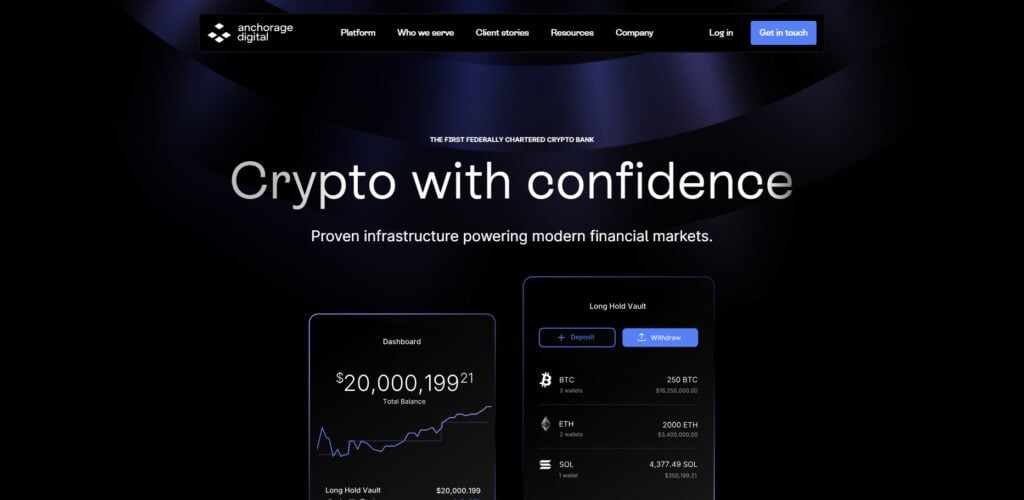
Pension Funds stand to benefit the most as Anchorage has established the strongest regulatory alignment across all staking providers. Anchorage enables fiduciary investors to comply with the staking services offered by a U.S. bank, making Anchorage one of the safest providers for Pension Funds to partner with.
Anchorage Digital Features
- Supports ETH, POL, SOL
- U.S. bank custody chartered by the OCC
- Staking with custody and provided infrastructure protection
- Fees resting between 6–10% of rewards
- U.S. compliance excellent pension fund suitability
| Pros | Cons |
|---|---|
| OCC‑chartered U.S. crypto bank | Limited chain coverage compared to Figment |
| Insured institutional custody | Fees ~6–10%, slightly higher |
| Strong compliance alignment | Custodial model reduces autonomy |
| Audited infrastructure | Focused mainly on U.S. investors |
| Excellent pension‑fund suitability | Less global reach |
6. BitGo
BitGo supports Ethereum, Polkadot, and Solana as well as Avalanche and offers qualified custodial staking services with insurance coverage. Similar to Anchorage, BitGo offers custody and integration services for staking at a cost of 7–12% (typically, being in the custody insurance and staking services business).
BitGo’s high security ratings reflect their staking services and custodial insurance. Pension Funds stand to benefit the most as BitGo combines institutional custody and staking services, making it a trusted custodian for Pension Funds.
BitGo Features
- Supports ETH, SOL, AVAX
- Services qualified institutional custody with insurance
- Custodial staking with integrated custody solutions
- Fees of 7–12% of rewards
- Excellent suitability for pension funds with insured custody
| Pros | Cons |
|---|---|
| Qualified custodian with insurance | Fees ~7–12% higher than exchanges |
| Supports ETH, Solana, Avalanche | Limited chain coverage |
| Integrated custody + staking | Custodial model reduces control |
| Strong audited infrastructure | Less liquidity integration |
| Pension‑fund suitability strong | Higher costs for smaller funds |
7. Stakefish
Stakefish offers staking for coins in the Ethereum, Solana, Polkadot and Cosmos blockchain ecosystems. It allows validator participation with the protection from slashing. Unlike similar staking, Stakefish utilizes a non-custodial model, meaning funds can retain control of private keys, but are free to stake with Stakefish validators.
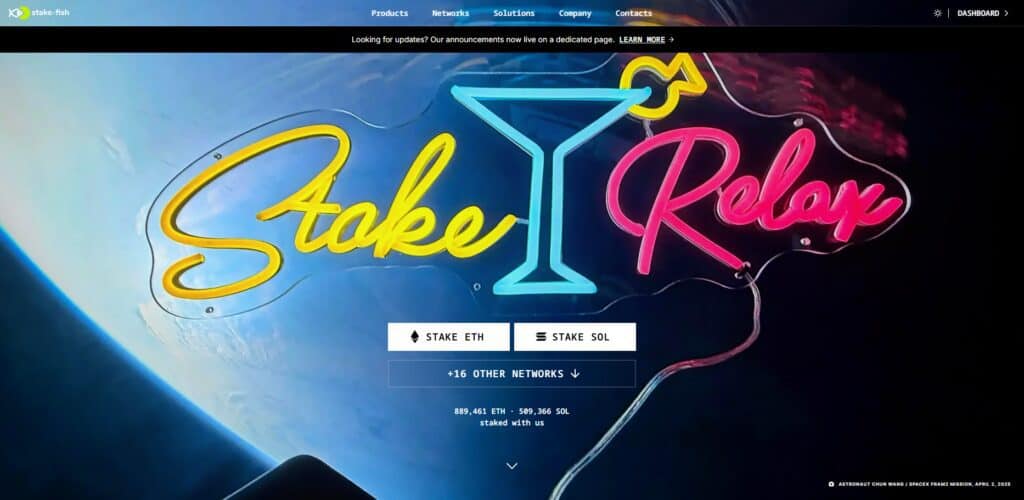
Stakefish fees are in the 5-10% range, with reporting that is visible and transparent. Stakefish also offers slashing protection insurance and a long-operating history. Pension fund comfortability, meaning institutional funds, are likely to be comfortable with Stakefish. It is trusted by DAOs and funds, making it a good option for pension fund investment for more secure staking.
Stakefish Features
- ETH, SOL, POL, and COS support
- Non-custodial delegation of validator model
- Slashing protection with transparent staking
- Fees of 5–10% of rewards
- Well suited for funds opting for non‑custodial
| Pros | Cons |
|---|---|
| Non‑custodial model retains investor control | Requires pension funds to manage custody |
| Supports ETH, Solana, Polkadot, Cosmos | No insured custody like Anchorage |
| Transparent validator operations | Fees ~5–10% may vary |
| Slashing protection included | More technical oversight needed |
| High suitability for decentralized funds | Less compliance alignment for regulated pensions |
8. P2P.org
P2P.org offers staking for coins of Ethereum, Solana, NEAR, and Polkadot. It has developed institutional dashboards and offers slashing insurance.
Because P2P.org is custodial staking, meaning P2P.org manages validators for multiple blockchains, fees are set at 7-12%, covering protection and governance. Security ratings are strong |because of| audited systems and the protection guarding against slashing.
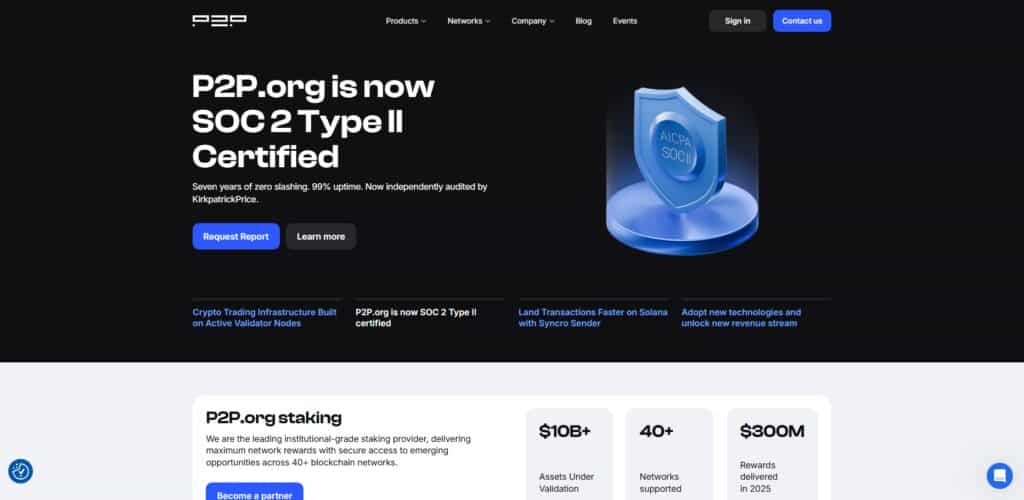
Pension fund comfortability (meaning institutional funds) is also likely to be comfortable with P2P.org because it provides broad chain coverage, governance transparency, and institutional reporting.
For funds where staking diversification is a priority, but so is safe staking, P2P.org is a reliable partner offering dashboards that fulfill regulatory requirements and insurance against validator penalties.
P2P.org Features
- ETH, Solana, NEAR, Polkadot Support
- Institutional dashboards with slashing insurance
- Custodial staking with governance
- Fees are approximately 7-12% of rewards
- Excellent pension-fund suitability with coverage
| Pros | Cons |
|---|---|
| Supports ETH, Solana, NEAR, Polkadot | Fees ~7–12% higher than exchanges |
| Institutional dashboards | Custodial model reduces autonomy |
| Slashing insurance coverage | Complex governance may deter some funds |
| Strong audited infrastructure | Less liquidity integration |
| High pension‑fund suitability | Requires trust in third‑party custody |
9. Kiln
Kiln covers Ethereum, Solana, and Polygon and focuses on enterprise APIs and compliance. Kiln’s staking model is custodial, built with tools geared toward automated staking for institutions. Fee automation and compliance reporting drive the 5-8% fee estimates.
Security ratings are backed by audited infrastructure and slashing defense. Kiln’s compliance automation and dashboards support a strong fit for pension funds. Their enterprise APIs enable pension fund staking integration with streams compliance and enhanced efficiency.
Kiln Features
- ETH, Solana, Polygon Support
- Enterprise APIs with compliance dashboards
- Custodial staking with automation
- Fees are approximately 5-8% of rewards
- Excellent suitability for pension operations
| Pros | Cons |
|---|---|
| Enterprise APIs for automation | Limited chain coverage (ETH, Solana, Polygon) |
| Compliance dashboards | Custodial model reduces autonomy |
| Transparent fees ~5–8% | Smaller ecosystem compared to Coinbase |
| Audited infrastructure | Less liquidity integration |
| Excellent pension‑fund suitability | Focused mainly on enterprise clients |
10. Allnodes Institutional
Allnodes Institutional supports Ethereum, Solana, Cardano, and Polkadot, offering non-custodial validator hosting. Allnodes’ staking model is non-custodial, allowing full control of private keys by funds while they outsource validator operations.
Fees are estimated at 5-7% with clear uptime guarantees. Security ratings stand tall with its non-custodial model and transparent infrastructure. Allnodes has a strong fit for pension funds whose administration teams can manage custody on their own, as Allnodes provides strong validator hosting with reliable uptime and transparent pricing.
Allnodes Institutional Features
- ETH, Solana, Cardano, Polkadot Support
- Non-custodial validator hosting model
- Transparent uptime guarantees and reporting
- Fees are approximately 5-7% of rewards
- Suited for funds that control custody internally
| Pros | Cons |
|---|---|
| Non‑custodial validator hosting | Pension funds must manage custody internally |
| Supports ETH, Solana, Cardano, Polkadot | No insured custody like BitGo |
| Transparent uptime guarantees | Requires technical oversight |
| Competitive fees ~5–7% | Less compliance dashboards |
| High suitability for funds preferring control | Less ideal for highly regulated pensions |
Conclusion
Each institutional staking provider has their own specific advantages. Careful evaluation has to be made by pension funds regarding custody, fees, security, and regulatory considerations before a decision can be made.
Coinbase Cloud and Anchorage Digital have a good compliance and regulatory position for the U.S., in addition to custodial insurance, and are good options for fiduciary investors. Figment and P2P.org have the best multi‑chain custody options, while Kraken Institutional and Binance Institutional add staking to custody and liquidity options.
For those who want more control, non-custodial models are available with Stakefish and Allnodes Institutional. BitGo and Kiln offer custody with automation and are good options where security and control are high priorities.
Pension funds have to be very careful to match a compliance need with a risk strategy that is operationally workable. Aligning all three of these factors as best they can, providers allow pension funds to meaningfully engage with blockchain networks at a custodial level that protects their beneficiaries.
FAQ
What is institutional staking?
Institutional staking is the process where pension funds and large investors delegate crypto assets to validators to earn rewards. Providers add custody, compliance, and slashing protection to meet fiduciary standards.
Which providers are most regulated?
Anchorage Digital and Coinbase Cloud stand out with U.S. regulatory oversight, insured custody, and audited infrastructure, making them highly suitable for pension funds.
Which providers offer the widest chain coverage?
Figment and P2P.org support 50+ chains, enabling diversification across Ethereum, Solana, Cosmos, Polkadot, and more. This helps pension funds spread risk across multiple ecosystems.
What custody models are available?
Custodial: Providers like Coinbase, Kraken Institutional, and BitGo hold assets and manage validators.
Non‑custodial: Providers like Stakefish and Allnodes Institutional let funds retain private key control while delegating validator operations.
How much do fees cost?
Fees generally range from 5–12% of staking rewards. Exchanges like Binance Institutional and Kraken Institutional charge lower fees (~5–7%), while specialized providers like Figment may charge more due to insurance and governance services.