


What Is Lombard Finance?
LBTC is a yield-bearing Bitcoin token offered by Lombard Finance. Each LBTC represents a claim to yield generated from an institutional covered call options strategy managed by Bitwise Investment Management.
Yield Generation: The yield is generated from the sale of call options on Bitcoin. The sale of the call options results in a yield (or premium) which is credited to the holder’s LBTC balance.
Current Annual Percentage Yield (APY): The goal of Lombard is to generate a net annual percentage yield to its customers of 2.5%. However, the yield generated may be less than the goal during the initial phase of the program.
Liquidity and Redemption: Customers may deposit Bitcoin to receive LBTC and reverse this process within 10 days. Therefore, customers are guaranteed to be able to redeem their LBTC.

Inter-operability and De-Fi Integration: LBTC can be used as collateral in a number of decentralized finance (De-Fi) and lending protocols.
Security: The bitcoin which is represented by LBTC is held by qualified custodians (Anchorage Digital Bank and Kraken) in accounts which are not controlled by Lombard.
target audience: Lombard offers customers an opportunity to earn an institutional yield on Bitcoin using the De-Fi infrastructure. The custody of the Bitcoin represents an improvement over other similar yield earning structures.
Why Consider Lombard Finance Alternatives?
More Yield Streams Alternative options provide staking, routing and DeFi vaults. This creates more ways to earn BTC yield and reduces the need to rely on BTC lending.
More Attractive Yields Some DeFi options like Lightning network routing provide over 13% APY, which is much higher than Lombard’s.
Native BTC Yield Babylon and the Stacks BTC lending options do not use wrapped BTC, and thus provide BTC yield without a custody risk.
Improved Risk Mitigation Decentralized finance reduces the risk of trusting a single entity, as was the case with Celsius and BlockFi.
Better Control of Liquidity With Lightning and DeFi pools, the user has more control over the liquidity of their funds.
Expand Your Reach Beyond Lombard, other DeFi options integrate with other blockchains and provide yield with other BTC vaults.
More Individualized Options Depending on the user’s risk tolerance, other DeFi options provide more individualized yield strategies, whether it be exploring various DeFi options or earning yield via the Lightning Network.
Advanced Options These options give the user access to more advanced BTC yield options and other DeFi innovations.
Key Points
| Platform | APY Range | Custody Model | Key Risk |
|---|---|---|---|
| Babylon Staking | 1–3% | Native BTC | Slashing, BABY token volatility |
| Stacks BTC Staking | ~3% | Native BTC (timelock) | Long bonding cycles, protocol maturity |
| Lightning Routing | 2–10% | Native BTC | Liquidity management, operational risk |
| Xverse Earn | Up to 10% | Self-custodial | Protocol risk across multiple L2s |
| Zest Protocol | ~1% | sBTC (synthetic) | Smart contract, synthetic peg risk |
| Kraken BTC Yield | 1–2% | Custodial | Exchange counterparty risk |
| SolvBTC Vaults | ~4% | Wrapped BTC | Custodian & cross-chain bridge risk |
| Aave WBTC Lending | ~0.01% | WBTC (Ethereum) | Custodian & smart contract risk |
| Compound v3 WBTC | 0% (collateral only) | WBTC (Ethereum) | No yield, collateral exposure |
| Uniswap v3 LP WBTC/USDC | 8–13% | WBTC (Ethereum) | Impermanent loss, smart contract risk |
1. BABYLON STAKING
Babylon Staking is a way for users to earn yield on their bitcoin by staking it on Babylon sidechain validators. Validator rewards and slashing are the main mechanisms to earn yield. Other sources of yield include BABY token rewards and transaction fees.
The estimated annual yield is 1% to 3%. Each staking period is followed by a wait period during which the user is unable to withdraw their funds. Currently, the staked bitcoin is only used on Babylon sidechains.

BABYLON STAKING provides a better yield than other staking options because BABYLON STAKING uses Bitcoins as the staking currency and offers other rewards in addition to validator rewards.
Because of these features, it attracts long term BTC holders who wish to earn a yield on their BTC without having to use a Custodial service.
2. STACKS BTC STAKING
STACKS BTC STAKING uses Proof of Transfer (PoX) to put BTC on the Stacks blockchain. The estimated annual yield is around 3% and comes from transaction fees and blocks produced by validators.

Like Babylon Staking, other sources of yield Earnings are locked up for a period of time during which the user is unable to retrieve their BTC. STACKS BTC STAKING has integrations with the Bitcoin and the Stacks blockchain.
Similar to Babylon, other DeFi applications on the Stacks blockchain provide additional ways to earn yield. STACKS BTC STAKING provides greater yield than other yield farming applications.
It primarily benefits BTC holders who wish to put their BTC on the Stacks blockchain and earn a yield while it is locked.
2. Lightning Routing
Rather than charging a service fee like most yield products, Lightning Routing collects routing fees from transactions. Payment channels use anchored assets to lock liquidity. Lightning Routing leverages this business model to generate yield.

Approximate yields range from 2%-10%, but are dependent on the level of activity and volume on the network. Funds can be withdrawn by closing payment channels. At this time, the product supports the Bitcoin and Lightning networks.
The product is designed for the technologically savvy Bitcoin holder. Operational risks are elevated, but so is the potential for yield.
4. Xverse Earn
Xverse Earn enables users to earn yield on Bitcoin through a selection of DeFi and Layer-2 products. Yield is generated through staking and lending and/or providing liquidity. The products supported by Xverse Earn vary, and consequently so do the rewards, which can be expressed in either Bitcoin or other tokens.

Earned rewards can be expressed in varying degrees of liquidity from staking to lending to providing liquidity. Xverse supports stacks, and Layer-2s as well as Layer-1s. Custody is controlled by the user through the Xverse wallet.
Xverse Earn provides users flexibility to generate yield through various DeFi products supported by the Xverse platform. User’s comfortable with DeFi and altcoin risk would definitely benefit from a yield offering.
5. Zest Protocol
Zest allows users to earn yield on their BTC by introducing synthetics sBTC lending and borrowing markets. Yield is generated by borrowers and is realized by the lenders through an intermediate state of the market. Lending APY is around 1% and incentives are issued by the protocol.

Taken as a whole, liquidity in the market is reasonable and BTC may be redeemed by users. Integrations with various DeFi protocols allow for interoperability. Synthetics mean BTC is represented by sBTC and therefore users of the protocol bear the counterparty, smart contract and slippage risk.
Best fit users of the protocol are those who wish to obtain synthetic BTC exposure and wish to take part in the DeFi lending space. Yield opportunities are geared more for riskier and less liquid market participants.
6. Kraken BTC Yield
Kraken utilizes lending and staking to provide BTC yield. Like staking, yields are derived from a centralized source, and Kraken notes yields around 1-2% annually. Like other centralized finance (CeFi) staking, yields are ultimately derived from client (in this case, Kraken’s) business and customer flows.

Kraken’s lending program is fully flexible, meaning clients can withdraw their BTC at any time. BTC is only lent on chains where Kraken is custodian, meaning no DeFi integrations are present. Clients should be aware of counterparty risk presented from Kraken.
Convenience and ease of use is of greater concern for a potential client. That client may also be willing to accept a custodial division of risk for a small return, like that presented from a regulated exchange.
7. SolvBTC Vaults
BTC yield is enabled by structured DeFi strategies. Yield is gained primarily through BTC liquidity and agent repartitioning. Trade commission fees and other DeFi pool rewards increase yield. Vaults have an approximate 4% yield potential. Liquidity is determined by vault lock up periods, and time locks may apply to withdrawal.

Supported chains are primarily Ethereum, and other blockchains supported by DeFi. Custody is maintained of wrapped BTC, thus clients are presented counterparty risk by the custodian, as well as risk from crypto asset bridges.
BTC yield seeking clients are the primary target clientele. DeFi may present risk, but that may be outweighed by the potential rewards.
8. Aave WBTC Lending
Aave uses its WBTC lending markets to enable BTC yield. Users of this approach earn yield by lending out WBTC. The expected annual yield is around 1%. The yield is variable and depends upon demand, which is typically low. Unlike other lending markets, Aave allows users to withdraw their WBTC at any time.

As of this writing, Aave supports WBTC lending markets on the Ethereum and Polygon blockchains. Because Aave’s WBTC is lent out by a third party, users of Aave bear the risks associated with that third party, as well as smart contract failure risk.
Users of this service are likely to be BTC holders who wish to have exposure to the BTC yield farm in a secure manner.
9. Compound v3 WBTC
Compound v3 allows BTC to be used as collateral, but BTC does not earn the user any direct yield. To earn yield using Compound v3, a user must provide WBTC to facilitate a borrowing transaction. In this case, the user earns yield through the borrowing transaction and the expected annual yield is 0%.

Compound v3 allows users to be fully liquid and to withdraw their WBTC at any time. As of this writing, Compound v3 supports the Ethereum blockchain. From a risk perspective, Compound v3 presents the same risks as Aave.
10. Uniswap v3: WBTC/USDC Liquidity Pool
The Uniswap v3 protocol allows users to earn yields from liquidity provision in the WBTC/USDC pool. Users in this pool are exposed to impermanent loss, but have the potential to earn yields from 8% to 13% APR from trading feeolas. Additionally, concentrated liquidity allows users to earmark a range of prices where they wish to provide liquidity.
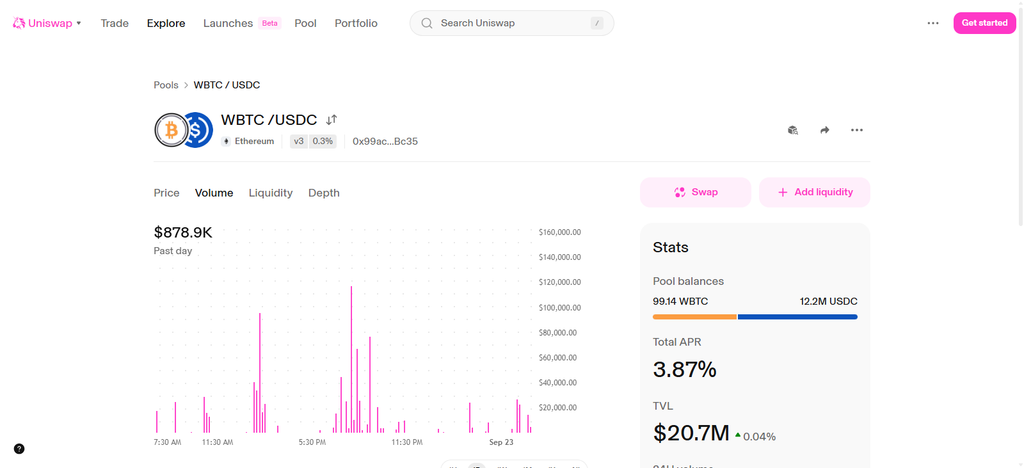
Because users of this pool are exposed to impermanent loss, this protocol is only appropriate for users who are experienced with DeFi. Additionally, this protocol is best for users wanting to earn a high yield on their BTC. Users should be aware that, as with all DeFi protocols, there is a risk of losing your entire investment. Reputable sources used in researching and writing this project report.
Lombard vs Alternatives: BTC Yield Comparison
| Platform | APY Range | Custody Model | Liquidity & Redemption | Key Risk |
|---|---|---|---|---|
| Lombard Finance | 4–6% | Custodial lending | Moderate (depends on loan terms) | Counterparty & platform solvency |
| Babylon Staking | 1–3% | Native BTC | Limited (bonding cycles) | Slashing, BABY token volatility |
| Stacks BTC Staking | ~3% | Native BTC (timelock) | Low (weeks-long lockups) | Protocol maturity, lockup risk |
| Lightning Routing | 2–10% | Native BTC | Flexible (channel closure) | Operational risk, liquidity management |
| Xverse Earn | Up to 10% | Self-custodial | Variable (depends on protocol) | DeFi protocol vulnerabilities |
| Zest Protocol | ~1% | Synthetic sBTC | Moderate (conversion required) | Peg stability, smart contract risk |
| Kraken BTC Yield | 1–2% | Custodial | High (exchange withdrawal) | Exchange counterparty collapse |
| SolvBTC Vaults | ~4% | Wrapped BTC | Moderate (vault lockups) | Bridge & smart contract risk |
| Aave WBTC Lending | ~0.01% | WBTC (Ethereum) | High (pool withdrawal anytime) | Custodian & smart contract risk |
| Compound v3 WBTC | 0% (collateral only) | WBTC (Ethereum) | High (collateral redeemable) | No yield, collateral exposure |
| Uniswap v3 LP WBTC/USDC | 8–13% | WBTC (Ethereum) | Flexible (pool exit anytime) | Impermanent loss, smart contract risk |
Conclusions
Lombard Finance gives Bitcoin (BTC) holders an opportunity to earn yields above traditional finance through LBTC. Lombard offers custody of BTC, and target yields of 2.5% through its lending desk.
Yields in traditional finance are far less, and BTC holders are incentivized to seek out higher yields. Investors need to consider the risks associated with DeFi and Centralized Finance. Liquid custody of BTC can be gained through the use of the Lightning Network, Staking and Routing.
Each of these methods offer BTC custodial security and increased earnings potential. However, investors need to consider the counterparty risk associated with routing and staking. BTC Custodial DeFi and Centralized Finance offer the ability to earn outsized yields. Investors need to find a balance between the three for increased yield potential.
FAQ
What is Lombard Finance?
Lombard Finance issues LBTC, a yield-bearing Bitcoin asset targeting ~2.5% APY via institutional covered-call strategies, backed by custodians like Anchorage and Kraken.
How does LBTC generate yield?
Yield comes from selling Bitcoin call options, with premiums collected in BTC and compounded into LBTC balances.
Is Lombard Finance custodial?
Yes. BTC backing LBTC is held with qualified custodians under bankruptcy-remote accounts, ensuring institutional-grade security.
What are Lombard’s risks?
Main risks include counterparty solvency, reliance on custodians, and lower APY compared to aggressive DeFi strategies.
Which alternatives offer higher APY?
Uniswap v3 LPs (8–13%), Lightning routing (2–10%), and Xverse Earn (up to 10%) often outperform Lombard’s 2.5% APY.
Which alternatives are safest?
Babylon and Stacks provide native BTC yield without wrapping or custodial risk, though APY is lower (1–3%).


