

Businesses and institutions want flexible ways to access capital without having too much tied up in crypto assets, and the DeFi lending landscape is evolving to meet that need. Clearpool has brought uncollateralized lending to the fore but it’s not the only protocol looking at different credit models.
There are a number of projects that provide different ways of borrowing, lending and risk management, from institutional lending platforms that include Maple Finance to niche markets like Wildcat Protocol. In this guide, we will look at the Best Clearpool Competitors for Uncollateralized DeFi and what makes each one worth your consideration.
How to Choose the Right Clearpool Competitor
Identify Your Lending Objectives: First of all, decide whether you want institutional borrowing, uncollateralized loans, working capital or access to decentralized lending markets before selecting a suitable protocol.
Compare Collateral Requirements: Look into whether the protocol allows uncollateralized, undercollateralized, or overcollateralized loans and how these impact borrowing costs and lender safety.

Rates and Fees: Check the borrowing rates, lender yield, platform fees, and repayment terms to determine if the protocol offers viable and sustainable financing options.
Credit Risk Management: Review borrower screening, credit assessments, default procedures and recovery mechanisms to understand how the protocol manages lending risks and protects capital providers.
Check Blockchain Compatibility Make sure to check the supported networks, transaction costs, wallet compatibility and liquidity availability to ensure the protocol fits your existing DeFi infrastructure and operational requirements.
Security and Audits Review: Review smart contract audits, security practices, incident history, and risk disclosures before transferring funds to minimize exposure to technical vulnerabilities and potential financial losses.
Evaluate Liquidity and Withdrawal Terms: Learn about the lending pool’s capacity, withdrawal terms, lock-up periods, and limitations on liquidity to ensure your funds will be available as per your financial needs and risk tolerance.
Examine Current Protocol Activity: Review the current operational status of the protocol, active lending markets, recent development updates and documentation before assuming it to be a viable alternative to Clearpool.
Best Clearpool Alternatives by Use Case
Best for Institutional Borrowing Maple Finance is the top pick for institutions looking for structured crypto lending, professional credit assessment and financing with collateral requirements dictated by specific lending products.
Best for Uncollateralized Credit: Historically, TrueFi offered uncollateralized institutional lending, keeping its original model relevant for comparing borrower creditworthiness, lending transparency and capital-efficient financing alternatives.
Best for real-world business credit: Goldfinch has historically connected investors with real-world business financing, offering a helpful benchmark for evaluating credit underwriting and structured investment risk.
Best for Payment Financing: Huma Finance specializes in payment financing and receivables and is therefore relevant for companies looking for liquidity backed by payment flows and real-world financial activity.
Best for Trust-Based Lending: Union Protocol uses community relationships and trust-based credit mechanisms, making it suitable for applications that look for borrowing models other than standard collateral requirements.
Best for Customized Lending Markets: Wildcat Protocol offers borrower-specific lending markets with adjustable rates and terms, perfect for discovering flexible credit arrangements and clear lending conditions.
Best For Future-Revenue Financing Credit Coop provides financing based on future revenues of a business. It is a relevant choice for Web3 companies looking for an alternative to traditional collateral-backed borrowing.
Best for Credit Transparency Accountable offers financial verification infrastructure to help lenders assess borrower financial health, improve underwriting decisions, and monitor credit exposure in decentralized finance markets.
Key Points
1. TrueFi
TrueFi is a decentralized credit protocol that connects lenders, borrowers and portfolio managers across the blockchain-based lending markets. Its first model provided uncollateralized loans based on borrower evaluations, not traditional crypto collateral.

Target users included institutional investors, crypto trading firms and companies that are seeking capital efficient financing. TrueFi had been operating on Ethereum and Optimism, using lending pools and governance mechanisms around its TRU token.
Its main differentiators were credit underwriting, transparent loan tracking and portfolio based investment options. But it would be wise to check its current operational status before bringing it in as an active direct competitor.
Best Fit Use Cases
- Uncollateralized Institutional Lending – Providing credit to eligible institutions without the need for traditional crypto collateral.
- Crypto Trading Firm Financing: Providing working capital for trading and liquidity needs to vetted trading firms.
- Stablecoin Lending: Connect eligible lenders with borrowing opportunities in stablecoin denomination.
- On-Chain Credit Assessment: Evaluate lending requests based on borrower reviews, credit analysis and governance mechanisms.
- Diversification of Credit Portfolio: Offering lenders several credit opportunities instead of just collateral-backed DeFi loans.
Important Differentiators
- Credit Based Underwriting: Focus is on the creditworthiness of the borrower rather than just the collateral deposited.
- Governance Participation: Previously, TRU token holders were involved in the evaluation or approval of lending activity.
- Transparent Loan Records: Uses blockchain infrastructure to increase transparency of loan terms and repayment activity.
- Institutional borrower focus: Developed lending products specifically for institutional and professional borrowers.2. Goldfinch
2. Goldfinch
Goldfinch is a decentralized lending protocol that pairs global lenders with real-world businesses that need financing, without requiring borrowers to put up crypto as collateral. Its historical model was built on borrower assessments and a community-based underwriting structure where Backers would assess borrowers and provide first-loss capital before the participation of Senior Pool investors.

The target users were credit funds, emerging-market businesses and investors looking for exposure to real-world lending. Goldfinch was built primarily on Ethereum, and its subsequent product, Goldfinch Prime, is on Base. Its historical approach is still relevant for comparisons with Clearpool, but Goldfinch went into maintenance mode in 2026 and its current operating status is an important qualification.
Use Cases Where It Fits Best
- Emerging Market Business Lending: Historically linked DeFi capital with businesses in developing economies.
- Fintech Credit Financing: Allowed eligible fintech lenders to access funding to finance their real-world lending business.
- Real Credit Investments: Blockchain-based capital linked with off-chain business loans.
- Community based credit assessment: It enabled independent participants to assess borrowers and commit capital based on their assessments.
- Tranche-Based Lending: Diversified credit risk among junior and senior capital providers with different layers of investment.
Distinctive Differentiators
- Consensus Trust: It didn’t require crypto collateral for each loan, but instead collective borrower assessments.
- First-loss capital: In the traditional model, supporters provided junior capital, absorbing losses before the senior investors.
- Real-world borrowers. Targeting companies and lenders that are not purely crypto-native.
- Structured risk distribution: Different investment positions with different risk and potential return levels.
3. Maple Finance
Maple Finance is an on-chain lending platform that enables institutional borrowers to connect with lenders looking for credit-based returns. Its current model is mostly geared toward overcollateralized fixed-rate loans backed by professional underwriting, due diligence and smart contract-based pool management.
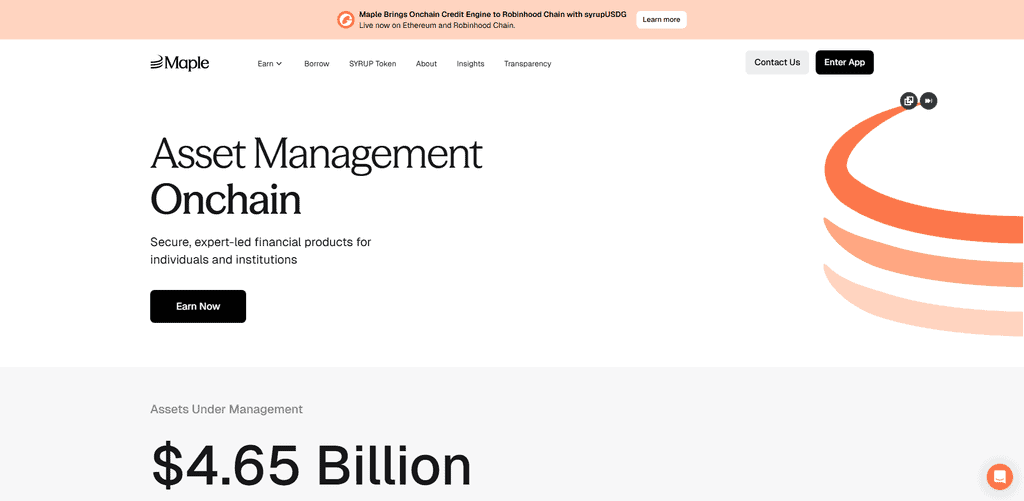
Target users are digital asset institutions, trading firms, professional investors and qualified liquidity providers. Maple supports multiple blockchain networks including Ethereum and cross-chain access via networks such as Solana, Arbitrum, Base and Plasma for select products.
Unlike Clearpool’s historical uncollateralized lending model, Maple focuses on collateral protection and institutional risk controls.
Best Use Case
- Institutional Borrowing: Assisting eligible digital asset businesses to secure loans with professionally assessed loan conditions.
- Collateral-Backed Credit: Enabling loans to borrowers able to provide eligible collateral.
- Pro Lending Pools: Giving lenders access to credit opportunities selected by experienced pool delegates.
- Digital Asset Treasury Financing: Offering potential financing solutions for companies managing digital asset treasuries.
- Institutional Yield Generation: Enabling qualified investors to earn lending income by allocating capital to selected lending pools.
Differences
- Delegates of the Professional Credit Management Pool assess borrowers, set lending terms and manage credit exposure.
- Institutional Focus: Oriented to the financing needs of professional borrowers and capital providers.
- Structured Lending Markets: Pools lending with specific terms and risk parameters.
- Flexible Collateral Models : Supports lending secured by collateral . Some institutional arrangements may provide different levels of collateralization .
4. Wildcat Protocol
Wildcat Protocol is a DeFi lending protocol designed to facilitate undercollateralized borrowing for institutional and advanced crypto market participants. It is mostly built on ethereum and lets borrowers set up their own lending markets with fixed interest rates, capacity constraints and withdrawal terms.

These markets can be directly funded by lenders and borrowers can have flexible access to liquidity without necessarily having to post full collateral. Wildcat is all about transparent loan terms, permissionless market formation, and borrower-specific credit terms. It provides an alternative model to the traditional overcollateralized DeFi lending, but still exposes lenders to borrower default and liquidity risks.
Best Fit Use Cases
- Community Lending: Supporting members to develop their ability to borrow from trusted relationships.
- Under-collateralized credit: We can offer credit that is not fully backed by traditional crypto collateral.
- DAO Funding: Potentially funding decentralized organizations in need of on-chain credit.
- Peer-to-Peer credit networks: Creditworthiness associated with social or community trust relationships.
- Programmable Credit Applications: Empowering infrastructure developers to build applications based on credit limits and trust based lending.
How We Are Different
- Trust Credit: It uses relationships and referrals to establish the amount of credit.
- Community Participation: Enables members to endorse or support other participants.
- On-chain Credit Limits: Describes credit relationships with blockchain-based mechanisms.
- Alternative Underwriting: It provides a different kind of underwriting than systems that rely only on traditional credit scores or collateral.
5. Union Protocol
Union Protocol is an open source credit network allowing individuals, communities and businesses access on-chain credit via trust relationships. Rather than just using traditional credit scores or old-school crypto collateral, members can vouch for other addresses to set borrowing limits. The target audience includes individuals, decentralized autonomous organizations, and developers building programmable credit applications.
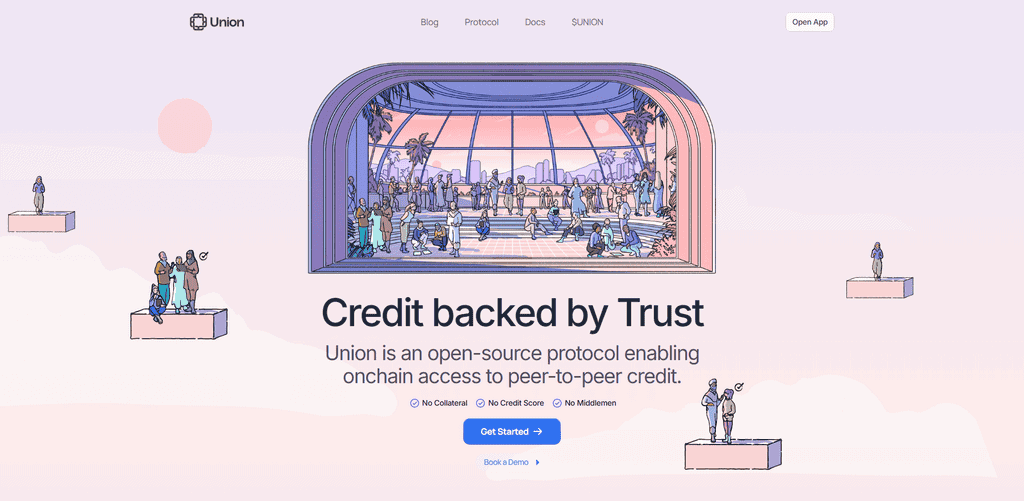
Union v2 is on Optimism, whereas the original Union infrastructure was built on Ethereum. Its novel feature is community-backed underwriting, which can reduce collateral requirements. But repayment depends on the dependability of the borrower and the willingness of backers to take risk.
Best Fit Use Cases
- Community Lending: Supporting members to develop their ability to borrow from trusted relationships.
- Under-collateralized credit: We can offer credit that is not fully backed by traditional crypto collateral.
- DAO Funding: Potentially funding decentralized organizations in need of on-chain credit.
- Peer-to-Peer credit networks: Creditworthiness associated with social or community trust relationships.
- Programmable Credit Applications: Empowering infrastructure developers to build applications based on credit limits and trust-based lending.
How We Are Different
- Trust Credit: It uses relationships and referrals to establish the amount of credit.
- Community Participation: Enables members to endorse or support other participants.
- On-chain Credit Limits: Describes credit relationships with blockchain-based mechanisms.
- Alternative Underwriting: It provides a different kind of underwriting than systems that rely only on traditional credit scores or collateral.
6. Huma Finance
Huma Finance is a decentralized finance protocol focused on PayFi, payment financing and real-world credit opportunities. Its model matches capital providers with financing opportunities secured by payment flows and receivables, giving businesses access to liquidity without having to rely exclusively on traditional bank loans.

It is intended for institutional investors, financial institutions, payment service providers and eligible liquidity providers. Huma 2.0 is built on Solana and Huma Institutional supports Solana, EVM-compatible networks and Stellar.
It has structured finance, tokenized receivables and configurable first-loss protection. Huma products may have different credit enhancements and risk structures, compared to purely uncollateralized lending.
Best Fit Use Cases
- Payment financing: Funding of eligible payment obligations and expected payment flows.
- Receivables Financing – Providing liquidity to businesses against outstanding invoices or other eligible receivables.
- Institutional PayFi: Allowing payment-financing infrastructure based on blockchain for financial institutions that want it.
- Real-World Asset Finance – Matching investors with structured finance opportunities tied to real economic activity.
- Structured Credit Investments: Facilitation of financing transactions with distinctive risk and return profile
Critical Differentiators
- Payment-centric lending: Focus on payment flows and receivables, not just crypto-native borrowing.
- Structured Finance: Enables investment tiers, first-loss protection and financial terms that can be tailored.
- On-chain Transparency: Allows for visibility of the lifecycle of eligible receivables through the infrastructure of the blockchain.
- Institutional Infrastructure: Provides configurable structures for financial institutions and professional capital providers
7. Pareto Credit (Pareto Credit)
Pareto Credit is an on-chain private credit marketplace connecting institutional borrowers, professional lenders and independent credit curators. The basic model is based on Credit Vaults where approved lenders deposit capital and verified borrowers can access it under predefined lending cycles and interest rate terms.
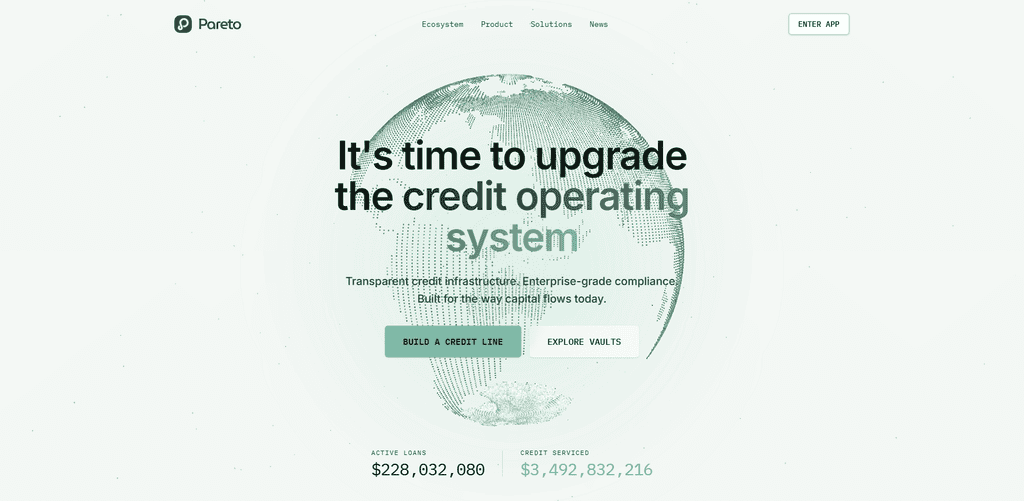
It will target asset managers, digital asset funds, institutional investors and corporates seeking finance. Vault infrastructure is blockchain-based on Pareto with specific networks based on deployment.
Features include fixed or variable interest rates, verification requirements and structured withdrawal processes. Its vaults may have other collateral and credit structures, as opposed to purely uncollateralized protocols, so each product needs to be evaluated.
Best Uses
- Private Credit Financing: Linking eligible borrowers with lenders seeking private credit exposure.
- Curated Lending Opportunities: Enabling professional credit curators to structure and administer lending arrangements.
- Institutional Lending: Lending to qualified corporates and digital asset market participants.
- Credit Vault Investments: Lenders are able to deploy capital into vaults with defined lending parameters.
- Risk-Based Yield Strategies. Assisting investors in comparing credit opportunities on the basis of interest rate, borrower quality and repayment risk
Distinguishing Factors
- Credit Vault Architecture: Facilitates lending opportunities with dedicated vaults.
- Curated Credit Markets: utilizes credit assessment and selection process to identify potential borrowers.
- Specified Lending Terms. May define interest rates, lending periods and withdrawal conditions.
- Flexible Credit Arrangements: The terms of the loan and collateral requirements can differ with each opportunity.
8. Atlendis
Atlendis is a decentralized lending protocol that allows for capital efficient credit via borrower-specific liquidity pools. The first model enabled approved borrowers to take uncollateralized crypto loans, with lenders setting interest rates and contributing liquidity based on their risk appetite.

The target users were crypto-native enterprises, institutional borrowers, and liquidity providers in decentralized finance. Atlendis relied on blockchain-based smart contract technology to manage lending positions, match liquidity and track loan activity, with its original protocol tied to Ethereum-compatible infrastructure.
Its main innovation was market-based discovery of interest rates without the need for borrowers to lock up traditional crypto collateral. However, the lender still had the borrower default, liquidity-utilization, and repayment risks
Best Use Cases
- Unsecured Business Lending: formerly allowed approved borrowers to access loans without needing to post traditional crypto collateral.
- Working Capital Financing: Provided short-term funding to companies requiring capital to support their operations.
- Borrower-Specific Lending: Pooled, generalized lending markets were replaced with a system of organizing liquidity for individual borrowers.
- Market Sensitive Interest Rates: permitted lenders to specify their preferred rates when offering liquidity.
- Capital Efficient Lending: Allowed eligible borrowers to access credit without necessarily tying up assets worth more than the loan amount.
Major Differentiators
- Dedicated lending markets: Tap into liquidity on a per-borrower basis through borrower-specific pools.
- Setting the interest rate. The lender could charge any interest rate it felt was appropriate to the risk of the borrower.
- Capital Efficiency: The original model reduced the requirement for traditional crypto over-collateralization.
- On-Chain Loan Management: Smart contract-driven loan operation and liquidity management.
9. Credit Coop
Credit Coop is a private credit platform that is looking to provide Web3 businesses with growth capital, using their future cash flows as a funding source. Its core model turns projected business revenues into programmable financing, offering an alternative to traditional loans that demand heavy upfront collateral.

Target users are crypto-native companies, Web3 startups and companies with predictable future income but no or limited access to traditional credit. Financing structures are enabled by intelligent contracts, which also help orchestrate lending arrangements.
Its main distinguishing factor is cash-flow-based financing, not relying solely on existing crypto assets. Future revenue uncertainty and repayment performance remain key risks for lenders.
Best Fit Use Cases
- Pre-Receipt Financing: Assisting eligible companies to obtain funding based on expected future revenue.
- Web3 Business Financing: Assisting crypto-native companies looking for alternatives to conventional business loans.
- Working Capital Management: Offering potential liquidity for operating expenses and business growth.
- Revenue-Based Financing Financing based on the expected revenue and repayment capacity of a business.
- Business Lending: Ideal for businesses that have consistent income but don’t have a lot of traditional collateral.
Significant Differences
- Cash-Flow Based Financing: It is based on future revenues as a measure of financing.
- Web3 Business Focus – Companies in the blockchain and digital asset ecosystems.
- Programmable Agreements: employs blockchain infrastructure to structure and manage financing agreements.
- Alternative to Asset Backed Lending Focuses on revenue potential, not just crypto holdings.9. Accountable
10. Accountable
Accountable is a financial verification infrastructure provider that enables institutions to demonstrate their financial health with constantly verifiable data on assets and liabilities. But it’s not just a direct lending protocol like Clearpool, it helps credit markets by providing more transparency around borrowers and better risk assessment.
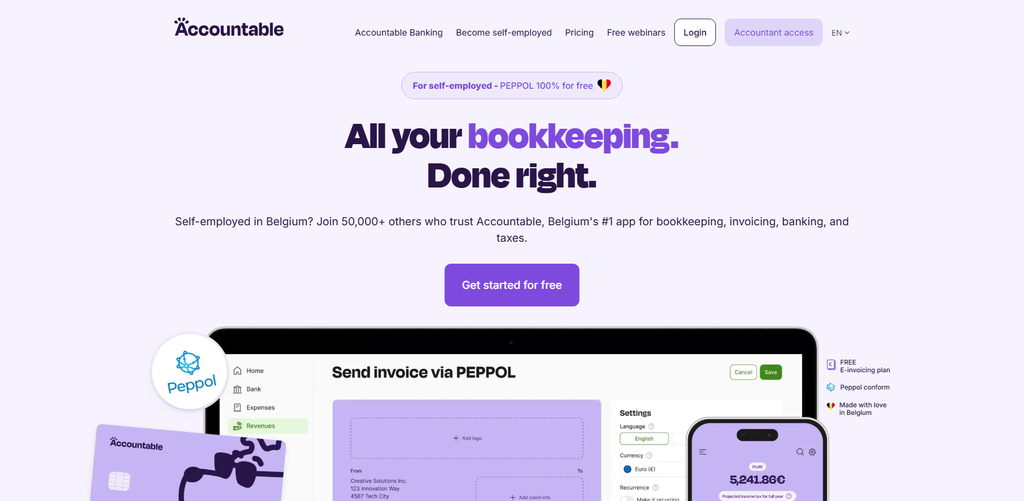
Target users include institutional borrowers, lenders, asset managers and on-chain credit platforms. Its technology combines cryptographic proofs and privacy-preserving verification to validate financial information without disclosing sensitive business data.
More than 100 blockchains and financial integrations for accountable reporting. The main benefit is enhanced verification of financial reporting, which can facilitate underwriting and monitoring. But verification does not eliminate the risk of default.
Best Use Cases
- Borrower Financial Verification Helping lenders verify financial information provided by prospective borrowers.
- Institutional Credit Assessment: Evidence that can support decisions on credit underwriting and lending.
- Proof of Reserves & Liabilities: Support any verification of assets and liabilities to help promote greater financial transparency.
- Ongoing risk monitoring: Assist counterparties in monitoring changes in their financial positions over time.
- DeFi Credit Infrastructure: Allowing lending protocols that need accurate financial data to evaluate borrowers and manage credit risk.
Differentiators
- Trustworthy Financial Information: Employs cryptographic methods to aid in the authentication of financial information.
- Privacy-Preserving Verification: aims at verifying the validity of relevant financial claims without disclosing sensitive underlying data.
- Ongoing Transparency: Allows for recurring financial verification instead of only one-time disclosures.
- Complementary Infrastructure: Enables credit protocols to enhance underwriting and monitoring, rather than just functioning as a lending marketplace.
Conclusion
Clearpool’s competitors provide a variety of solutions in uncollateralized DeFi lending, institutional credit and alternative financing. Protocols like TrueFi and Atlendis are historical examples of uncollateralized lending, while Maple Finance and Huma Finance are focused on more general institutional credit and payment-financing opportunities.
Union Protocol looks at credit through a lens of trust. Wildcat Protocol offers custom-built lending markets. Credit Coop is all about funding future revenues. Goldfinch is a historical example of real-world credit while Accountable is for financial verification, not direct lending. The best alternative is based on collateral requirements, borrower eligibility, interest rates, liquidity, security, and current protocol activity.
FAQ
What is Clearpool in DeFi?
Clearpool is a decentralized lending protocol designed to connect institutional borrowers with liquidity providers. Its lending model focuses on credit markets where lenders can supply capital to eligible borrowers and earn interest while taking on borrower credit risk.
What is uncollateralized DeFi lending?
Uncollateralized DeFi lending allows borrowers to obtain loans without pledging crypto assets equal to or greater than the loan value. It relies more heavily on credit assessment, borrower reputation, and repayment capacity, increasing potential default risk for lenders.
What are the best Clearpool competitors?
Relevant alternatives include Maple Finance, Huma Finance, Wildcat Protocol, Union Protocol, Pareto Credit, and Credit Coop. TrueFi, Goldfinch, and Atlendis are also useful historical comparisons. Accountable offers financial verification infrastructure rather than operating solely as a direct lending competitor.
How does Clearpool differ from Maple Finance?
Clearpool focuses on credit markets for eligible borrowers, while Maple offers institutional lending products with professional underwriting and collateral requirements that vary by product. Both expose lenders to credit and liquidity risks.
Is uncollateralized DeFi lending safe?
Uncollateralized lending carries significant risks because lenders may lose funds if borrowers default. Smart-contract vulnerabilities, liquidity restrictions, and limited recovery options can also affect returns. Always review the specific market’s risk disclosures before supplying capital.