

Hiring talent across borders opens up much larger talent pools to US companies but also brings with it complex payroll, tax, compliance and currency challenges. The Best International Payroll Platforms for US Companies Hiring Globally to pay employees and contractors accurately, remain compliant with local laws, and manage global teams from one system.
In this guide, we take a look at 10 of the best platforms, including Deel, Remote, Rippling, Papaya Global, ADP, Oyster, Multiplier, CloudPay, Velocity Global (Pebl), and Gusto Global, to help you choose the right one for your company’s global hiring needs.
How to Choose the Right Platform?
Countries covered: Make sure the platform covers all the countries where you plan to hire, including full-service payroll, EOR, contractor payments, benefits and local statutory compliance requirements.
Payroll Model Regarding hiring EOR, contractor payments or payroll for your own legal entities, the platforms are very different in terms of supported employment models.

Prices & Fees: Compare base fees, per worker charges, implementation costs, FX spreads, payment fees and add-ons to understand the real total cost of ownership.
Tax and Compliance Support: Ensure that the provider manages local tax registrations, social contributions, employment contracts, payslips, statutory benefits and changing labor laws in each country.
Currency and Payments: Confirm supported currencies, local bank transfer options, speed of payment, FX rates, funding requirements, and whether staff can be paid in their preferred local currency.
Integrations: Ensure it integrates with your HRIS, accounting software, ERP, time-tracking, expense and finance systems to reduce the amount of manual data entry and reconciliation work.
Security & Data Protection: Look at encryption, access control, SSO, audit logs, GDPR compliance, SOC 2, ISO certifications, and how the provider stores and transfers sensitive employee data.
Scalability and Support: Evaluate onboarding support, dedicated account management, response times, local knowledge and the platform’s ability to scale as your global workforce grows.
Platform Recommendations by Company Need
Best for Fast-Growing Startups: If you need a simple solution for global hiring, paying contractors, EOR services, solid country coverage, and a payroll solution that can grow with your international team, Deel or Remote are your best bet.
Best for companies with entities: If you have legal entities in foreign countries and need consolidated payroll, compliance, reporting, and enterprise-level controls, go with Rippling or ADP Global Payroll.
Best For Enterprise Payroll: Papaya Global or CloudPay for complex multi-country payroll, centralized payments, reconciliation, finance reporting and managed compliance for large workforces.
Best for Large Multinationals: ADP Global Payroll for mature compliance infrastructure, broad country coverage, high employee volumes, multi-entity operations, and deep HR and finance integrations.
Ideal for Remote-First Teams: Whether your team is remote or Oyster, you can hire distributed teams, pay them in local currency, draft compliant contracts, administer benefits, and get great support for fully remote teams.
Best for Contractor Payments: If you are looking to pay international freelancers and contractors quickly, compliantly and without creating foreign entities, then Gusto Global or Deel are your best options.
Best for Wide EOR Coverage: Choose Velocity Global (Pebl) or Multiplier if hiring in many countries without entities, especially where speed, local employment support and geographic reach are most important.
Best for Cost-Conscious Teams: If you want to save some money, closely compare Remote, Deel, and Multiplier and look at payroll fees, EOR prices, FX fees, implementation fees, and where you’re hiring.
Key Points
| Platform | Key Point |
|---|---|
| Deel | Combines global payroll, Employer of Record (EOR), contractor payments, compliance management, and HR tools across 150+ countries. |
| Remote | Uses an owned-entity model and provides global payroll, EOR services, contractor management, and localized compliance support. |
| Rippling Global Payroll | Integrates global payroll with HR, benefits, finance, and IT management in a single platform covering 185+ countries. |
| Papaya Global | Delivers centralized payroll, workforce payments, analytics, and compliance management for international teams. |
| ADP Global Payroll | Provides extensive global payroll expertise, regulatory compliance, and payroll services across 140+ countries |
| Oyster | Offers global hiring, EOR services, payroll processing, benefits administration, and employee onboarding worldwide. |
| Multiplier | Supports international payroll, EOR services, contractor payments, and compliance in multiple global markets. |
| CloudPay | Specializes in managed global payroll, payroll automation, reporting, and payments across multinational operations. |
| Velocity Global (Pebl) | Helps companies hire, pay, and manage employees internationally while handling compliance and employment requirements. |
| Gusto Global | Extends payroll capabilities to international employees and contractors with integrated HR and payroll workflows. |
1. Deel
Deel is a global HR, payroll and compliance platform serving startups to enterprises. It provides global payroll in 130+ countries, EOR in 150+ countries, and contractor management in 150 countries. Services include gross to net calculations, statutory filings, benefits, expenses and HRIS integrations.
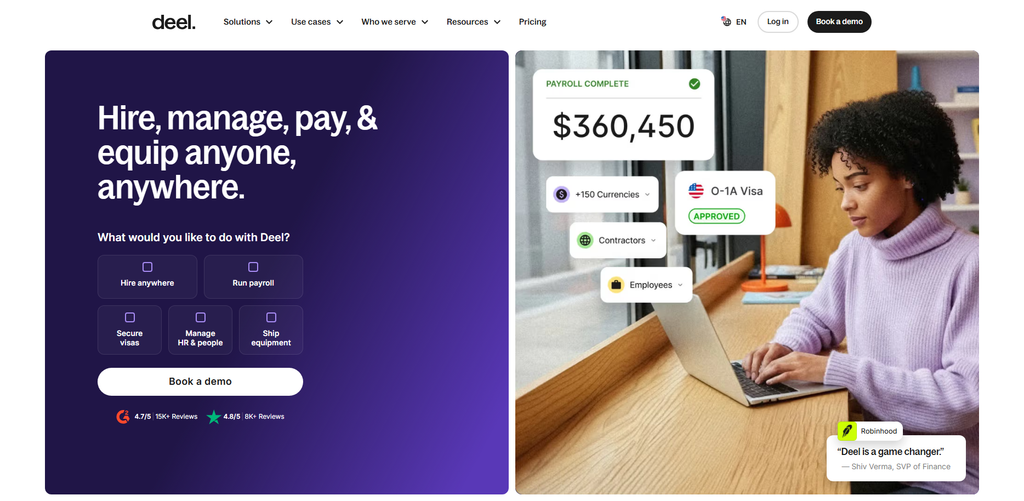
Global Payroll Pricing starts at $29 per employee per month with a one-time implementation fee of $1,000 per entity. EOR Pricing starts at $599 per month. It is multi currency and multi payment method, competitive FX. Security: SOC 1/2/3, ISO 27001, GDPR, HIPAA controls, AES-256 encryption, SSO and penetration testing.
Applications**
- Hiring employees through EOR in countries where there is no legal company.
- Pay global contractors, freelancers and employees on one platform.
- Scaling fast a distributed startup/tech company in multiple regions.
- Managing compliant multi-country payroll including local tax filings and benefits.
- Centralized management of onboarding, contracts, expenses, time off and HR documentation.
Main Limitations
- Payroll and EOR fees get expensive at scale.
— Full service payroll coverages vary by country and may need to be put in place. - Customer support can be hit or miss for complex payroll or compliance-related issues.
- The rich feature set might be overkill for smaller teams.
2. Remote employment
Remote is a fully remote first global HR and payroll platform for companies hiring internationally. It offers global payroll in 100+ countries, EOR in 90+ countries, and contractor payments in 190+ countries. Its payroll processes gross to net locally, files taxes, makes statutory contributions, tracks time off, manages expenses and provides country/entity reporting.
global Payroll starting at $29 per employee/month, Employer of Record starting at $599 per employee/month on annual contracts. It pays local currencies to employees and offers transparent, flat pricing with no FX spreads or onboarding fees. Security includes SOC 2 Type II, ISO 27001, GDPR, 2FA, SSO and regulated payment processing.
Use cases
- Hiring full-time staff in foreign countries without establishing local entities.
- Paying employees in local currencies in 100+ countries.
- Manage contractors worldwide with compliant contracts and invoicing.
- Equity, international benefits, equipment management.
- Centralizing HR, payroll and compliance reporting for global remote teams.
Principal Limitations
- Global Payroll is less supported than EOR in terms of countries.
- For companies with many employees, the price of EOR is relatively high.
Custom implementation may be required for some advanced enterprise workflows. - Currency conversion and timing of payment may differ from country to country due to banking practices
3. Rippling Global Payroll
Rippling is a unified workforce-management platform that combines HR, IT, finance, and payroll. Its global payroll is designed for companies with entities in multiple countries, bringing together employee data, payroll runs, approvals, reporting and compliance workflows in one system.
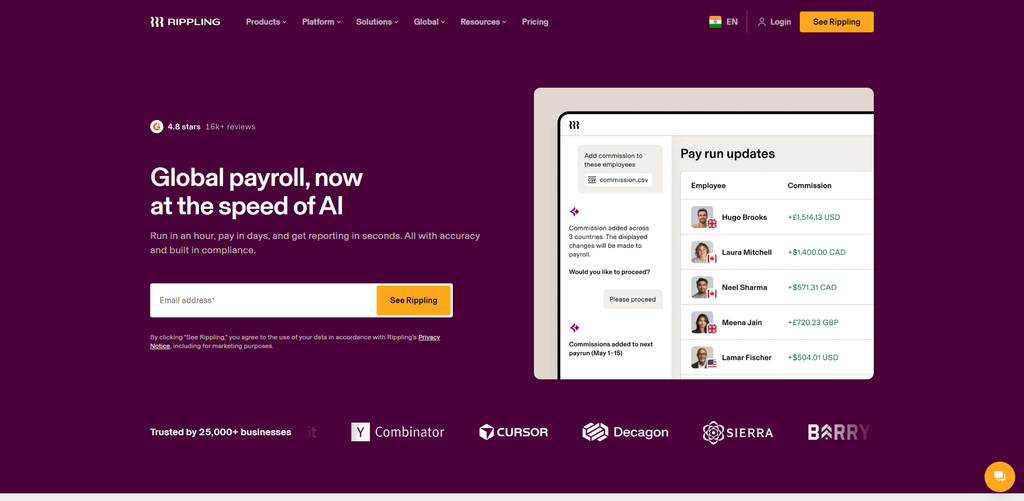
It provides multi-country payroll with local tax and statutory compliance, and Rippling’s EOR allows you to hire in countries where you don’t have an entity.
Pricing is usually modular and quote-based, based on products, employees count and countries. It supports multiple currencies and local payment methods. Rippling emphasizes encryption, role-based permissions, single sign-on (SSO), audit logs, and compliance-focused data controls across the platform.
Best Use Cases
- Companies that are already using Rippling for HR, IT and finance consolidation.
- Companies with entities in several countries that require payroll data in one place.
- Automation of payroll approvals, reporting and employee data synchronization.
- Scaling payroll operations, with links to HR, benefits, and finance systems.
- A single workforce platform to manage employee devices, access, and payroll.
Restrictions
- Best value only comes when multiple Rippling modules are adopted.
- Global payroll doesn’t work for companies without an existing entity.
- Pricing can get complicated as you add more products, employees and countries.
- Depth of international payroll may be less than that of specialist global-payroll providers
4. Papaya Global
Papaya Global is a global payroll, payments and workforce management platform for mid-size and enterprise companies. It covers payroll & payments in 160+ countries, supporting employees, contractors, vendors and tax authorities. The platform automates data consolidation, payroll processing, statutory payments, journal entries, reconciliation and real-time reporting.
Payments are $2.50 per transaction and workforce services are $15 per worker/month; EOR is $599 per employee/month to start. It funds in 15 currencies, pays out in 130+ currencies and leverages local payment rails. Security: ISO 27001/27701, SOC 1/2 Type II, GDPR, encryption, AML checks, segregated funds.
Top Use Cases
- Enterprises that want to combine payroll, payment and workforce data from multiple countries.
- Pay employees, contractors, vendors and tax authorities from one platform.
- Automation of payroll reconciliation, journal entries and finance reporting.
- Enabling large multi-country workforces to make mass payments.
- Dealing with EOR employment when there are no local entities.’
Key Limitations
- Pricing and implementation are targeted at enterprises and may not be a good fit for small teams.
- Some payroll services depend on local partners instead of wholly owned operations.
- Platform onboarding may require data cleaning and integration work.
- Advanced features are only available on higher-tier plans or require a custom quote
5. ADP Worldwide Payroll
ADP Global Payroll is a cloud-based payroll and HCM solution for enterprises with global operations. It processes payroll in more than 140 countries and territories, consolidating multi-country payroll data into one system of record. Services include local compliance monitoring, tax and statutory support, payroll processing, reporting, and integrations with HR and finance systems.
The pricing is fixed per number of employees and is scaled on the number of employees but the actual fees are quote based It provides multi-currency settlement, real-time FX rates, automatic funding and real-time payment status. ADP has a top five security program with 300 security, risk and privacy experts monitoring client accounts.
Best Uses
- Big multinationals who need to standardize their payroll across many countries.
- Companies needing experienced compliance, tax and regulatory support.
- Payroll integration with enterprise HCM, ERP and finance systems.
- Handling large numbers of employees in a centralized reporting and control environment.
- Support complex organizational structures and multi-entity payrolls.
Principal Limitations
- The platform might not look as modern or as flexible as some of the newer payroll tools.
- Certain country specific capabilities rely on ADP’s local partner network
- Prices are quoted and can be expensive for small businesses.
- Implementation can take a long time for multi-country global deployments.
6. Oysters
Oyster is a global employment platform for distributed teams, offering EOR, contractor management and payroll services. It offers EOR hiring support in over 130 countries, hiring coverage in over 180 countries, and payments in over 140 currencies. Its full-service payroll operates in 28+ countries, handling payslips, direct deposits, deductions, tax calculations, filings and local-authority payments.
Global Payroll is $290 per entity per month and $29 per team member per month with a $500 one-time implementation fee per entity; optional payment processing is $2 per employee per month. EOR starts at $699/month. Oyster accepts USD, EUR, GBP and CAD via direct debit or wire. Encryption and secure data storage.
Best Use Case
- Remote-first companies hiring employees using EOR across many countries.
- Payment of foreign contractors with compliant contracts and invoices.
- Support for distributed teams: Local benefits, equity and equipment.
- Processing payroll for businesses with entities in countries that are supported.
- Standardizing global HR workflows, documents and compliance reporting.
Constraints
- Full-service payroll in fewer countries than EOR footprint
- High cost-per-hire for companies that hire in volume.
- Payroll implementation fees and entity-based fees can add up.
- Advanced payroll customizations may be less than those on enterprise platforms
7. Multiplier
Multiplier is a global employment and payroll platform for companies scaling globally without heavy admin overhead. It offers global payroll in 100+ countries, EOR in 150+ countries and contractor management with a large global footprint. Its fully managed payroll includes gross to net calculations, benefits, tax, statutory contributions, payslips, salary disbursement and reconciliation.
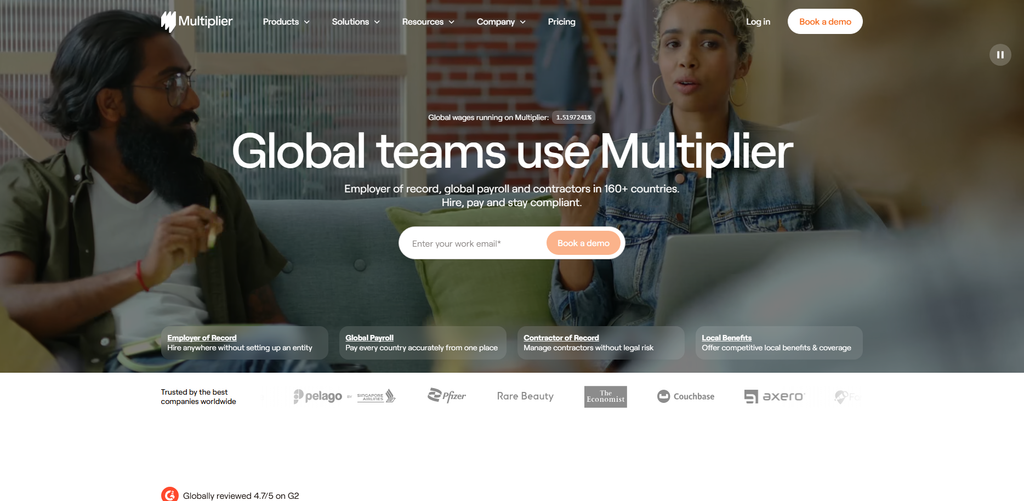
Global Payroll starts at $20 / employee / month; EOR is $459 / employee / month annually or $499 / month. Pay contractors in 120+ currencies, supports bank transfers, local rails and crypto. Security: Encryption and control of access, SOC 2, ISO 27001, GDPR agreements and cloud infrastructure built on AWS.
Application Scenarios
- Companies going into new countries without a local presence.
- One system to manage EOR employees, contractors, payroll.
- Automating onboarding, contracts, compliance docs and benefits.
- Paying global teams in local currencies, with local payment methods.
- Helping fast-growing startups and mid-market companies hire internationally.
Main Limitations
- EOR pricing is pretty high compared to contractor-only tools.
- Payroll coverage and depth of service varies by country.
- Quality of support on complex cases can be inconsistent for some customers.
- Additional configuration may be required for enterprise reporting needs.# CloudPay
8. CloudPay
CloudPay is a global managed payroll and payments provider for multinational and mid-market organizations. It provides single payroll processing across 130+ countries, combining payroll technology, in-country compliance expertise, reporting, analytics and dedicated customer success support. Its payments service can deal with employees, tax authorities and third parties in more than 110 currencies and can fund in over 70 countries.
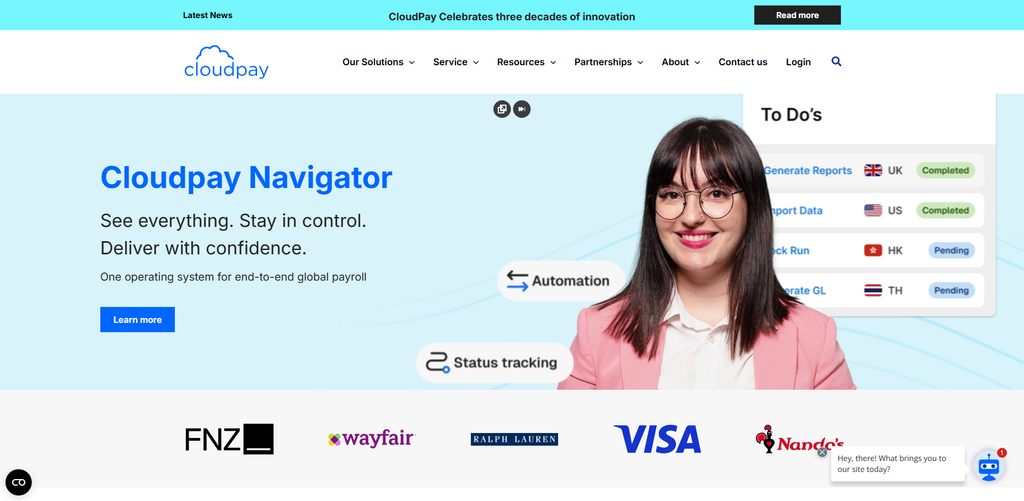
Its mid-market package starts at $20 per employee/month and features fixed-fee, transparent contracts; enterprise pricing is customized. It supports local currency payments, ACH, BACS, SEPA, wires and instant pay-to-card via Visa. CloudPay keeps client funds on the client’s balance sheet and applies safeguarding controls, compliance monitoring and secure payment infrastructure.
Top Use Cases
- Multinationals that need managed payroll in 20 or more countries.
- Companies requiring payroll, payments, compliance and reporting from a single provider.
- Organizations needing robust payroll reconciliation and finance integration.
- Paying employees, tax authorities and third parties worldwide.
- Mid-market companies looking for predictable, fixed-fee global payroll packages.
Principal Limitations
- It is less focused on hiring EOR for companies without entities.
- Pricing and implementation details usually need to be discussed directly with sales.
- The managed-service model can be heavier than self-serve platforms
- Good country coverage, but not as extensive as some EOR-first competitors.
9. Pebl (Velocity Global)
Velocity Global, now Pebl, is a global employment and payroll platform that enables companies to hire internationally without establishing entities. It provides EOR, global payroll, benefits, pensions, equity support, immigration and talent services in 185+ countries. Its payroll manages local employment compliance, salary processing, benefits administration and multi-country workforce management.

EOR pricing starts at $399 per employee/month with no setup or offboarding fees; country-specific payroll and EOR pricing is typically custom-quoted. It supports local-currency payroll and integrates with more than 250 HR, finance and recruiting tools Pebl is ISO/IEC 27001:2022 certified, has a SOC 2 Type 2 report, and follows GDPR-aligned data-protection practices.
Best Use Cases
- Engaging full-time employees in foreign countries without a local legal entity.
- Facilitate global expansion through EOR, benefits, and immigration services.
- Working with distributed teams across a very large country footprint.
- Employing international staff through compliant local employment structures.
- Providing HR, Mobility & Talent, Payroll services to global teams.
Key Limitations
- EOR pricing can be expensive as you scale larger teams.
- Full-service payroll coverage is more limited than its EOR coverage.
- There is little price transparency and most services require custom quotes.
- Not as suitable for companies that need a lot of self-service payroll automation.
10. Gusto Global
Gusto is mainly a U.S. payroll, benefits and HR platform that goes international through contractor payments, not full multi-country payroll. Its core payroll service supports businesses across the U.S. and its global contractor payments are available in 120+ countries. It handles contractor onboarding, invoicing, payment tracking, and cross-border payouts, which is ideal for companies that have a U.S. payroll hub and international contractors.
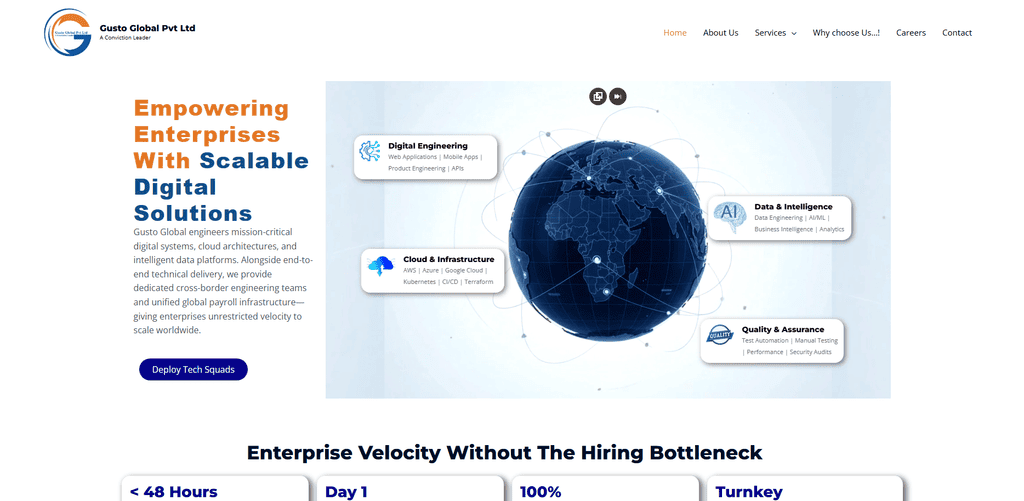
Pricing starts at $35/month plus $6 per person, and there is no monthly per-contractor fee for global contractor payments but each payment has a service and FX fee and U.S. bank accounts get $5 per payment. Gusto’s payment partners support a multiplicity of currencies, and standard encryption, control of access, and compliance safeguards are in place.
Best Use Cases
- US companies paying international contractors from one platform.
- Manage U.S. payroll, benefits, HR, and compliance in one system.
- Onboarding and invoicing of international freelancers and contractors.
- Paying contractors in many countries and currencies across borders.
- Focus on simple, affordable domestic payroll to support small businesses.
Limitations
- It does not offer full-service payroll in most countries outside the U.S.
- Hiring EOR is not a core competency for Gusto.
- International contractor payments include service fees and currency fees.
- If you’re a business that needs to pay employees in multiple countries, choose a global payroll specialist.
Conclusion
The right payroll platform for US companies hiring globally depends on workforce model, countries, budget and compliance requirements. Fast-growing startups with EOR and contractor payment needs should seriously consider Deel and Remote. Rippling and ADP are good if you already have an international entity, while Papaya Global and CloudPay are good for complex enterprise payroll and payments.
Oyster and Remote are good for remote-first teams, while Gusto Global is best for US companies paying international contractors. Pebl (Velocity Global) and Multiplier have broad EOR coverage. When selecting a platform, companies should compare country coverage, total fees, currencies, integrations, security and support.
FAQ
What is an international payroll platform?
An international payroll platform helps US companies pay employees and contractors in other countries while managing local taxes, statutory deductions, compliance, currency conversion, payslips, and country-specific reporting requirements.
What is the difference between EOR and global payroll?
An Employer of Record legally employs workers in countries where you have no entity. Global payroll processes salaries for workers employed through your own legal entities in each country.
Which platform is best for startups hiring globally?
Deel and Remote are strong options for startups because they combine EOR hiring, contractor payments, payroll, compliance, benefits, and multi-country coverage in one scalable platform.
Which platform is best for large multinational companies?
ADP Global Payroll is well suited for large multinationals needing broad country coverage, enterprise controls, complex reporting, multi-entity payroll, and mature compliance and tax infrastructure.