

The cryptocurrency industry is getting more and more competitive, making it harder for exchanges to get real traders and build a strong online presence. Choosing the right traffic generation service can help crypto exchanges reach their target audiences, boost brand awareness, and attract potential users through successful advertising campaigns.
In this article, I will discuss the Best Crypto Exchange Traffic Generation Services in 2026, and compare their key features, advertising options, audience targeting and limitations, to assist businesses in finding suitable traffic acquisition solutions.
Why Do Crypto Exchanges Need Traffic Generation Services?
Increase Brand Awareness Traffic generation services assist crypto exchanges to increase brand awareness by targeting cryptocurrency traders, investors, and blockchain enthusiasts through targeted ads on relevant digital platforms.
Attract Potential Traders: Through targeted advertising, exchanges can reach users who are interested in trading cryptocurrencies. This will draw in relevant visitors who can become active traders and long-term customers.

Drive More Users to Sign Up: A good traffic campaign brings potential customers to the exchange websites and registration pages, which increases the chances of getting new accounts and growing the user base of the platform.
Grow internationally: Crypto ad networks help exchanges reach people in different countries and regions, helping them grow internationally and getting better known among the global community of crypto traders.
Promote Trading Products: Traffic generation campaigns help exchanges promote spot trading, futures, staking, trading pairs and other platform features to users who are interested in specific crypto investment opportunities.
Improve Conversion Opportunities: Targeted campaigns attract relevant visitors who are more likely to explore exchange services, complete registration, verify accounts and make their first cryptocurrency deposits.
Improve Marketing Performance: Advertising analytics provide exchanges with insights on impressions, clicks, registrations, and conversions, helping marketing teams assess campaign effectiveness and refine future advertising strategies.
Control Customer Acquisition Costs: By comparing advertising channels, targeting options, and campaign results, exchanges can effectively manage their marketing budgets and find opportunities to acquire valuable users at sustainable costs.
How to Choose the Best Crypto Exchange Traffic Generation Service?
Assess Crypto Audience Reach: Select a service that can reach cryptocurrency traders, investors, and blockchain enthusiasts that match your exchange’s target audience and have a genuine interest in trading digital currencies.
Evaluate Traffic Quality: Make sure your advertising campaigns are driving real users, not irrelevant website traffic or bot visits, by looking for visitor authenticity, bot detection, invalid-click prevention and publisher quality.
Compare the advertising formats: Identify the platforms with suitable advertising formats like banner ads, native advertising, sponsored content, display campaigns, and in-app promotions for different exchange marketing objectives.
Check Audience Targeting: Look for services that offer audience targeting based on geography, device, interests, and crypto-related categories. This will help you reach potential traders in the right markets and make your campaigns more relevant.
Review Pricing Models: Look at CPM, CPC, CPA, and flat-rate placement pricing structures, minimum budgets, and additional campaign fees to determine whether services fit your marketing budget.
Explore tracking options. Opt for platforms offering campaign analytics, impression tracking, click reports, conversion measurement, and integration options to monitor registrations, KYC completions, and customer acquisition performance.
Check Advertising Compliance: Look at the cryptocurrency advertising policies, regional restrictions, advertizer verification requirements, and creative approval procedures to ensure that your exchange can run campaigns without unnecessary compliance problems.
Track performance and ROI: Benchmark the costs of customer acquisition, qualified registrations, first time deposits, and trading activity to isolate the services that deliver real business results, not merely website traffic.
Key Points
| Service / Platform | Key Point |
|---|---|
| Coinzilla | Connects advertisers with cryptocurrency-focused websites through banner and other advertising placements. |
| Cointraffic | Offers advertising campaigns and access to cryptocurrency-related publisher inventory. |
| A-ADS | Provides cryptocurrency advertising with budget and campaign options for advertisers. |
| Bitmedia | Helps businesses reach cryptocurrency audiences through display and performance-based advertising. |
| Blockchain-Ads | Provides audience-targeted advertising solutions for blockchain and cryptocurrency businesses. |
| HypeLab | Focuses on advertising across Web3 applications and crypto-related digital environments. |
| Brave Ads | Gives advertisers access to audiences through the Brave browser advertising ecosystem. |
| CoinGecko | Provides cryptocurrency market-data visibility and advertising opportunities for reaching crypto enthusiasts. |
| CoinMarketCap | Offers exchange and cryptocurrency brands opportunities to reach users researching digital assets and markets. |
| DexScreener | Provides advertising opportunities within a platform used by decentralized exchange traders to monitor token markets. |
1. CoinZilla
Coinzilla is a crypto-focused ad network that connects advertisers with crypto publishers such as news sites, blogs and market-data platforms. It focuses on CPM-based campaigns with a minimum deposit of €100 and a daily campaign budget of €50; marketplace placements, PR and sponsored content are priced separately.
The traffic is sourced from its publisher network, display inventory, and content-placement marketplace. Its target audience is crypto traders, investors, DeFi users, and blockchain enthusiasts. Formats: banners, native ads, pop-unders, header/sticky banners, press releases, social placements.
Targeting includes geography, device and campaign type. Traffic quality is based on the publisher tier and premium packages reach more relevant crypto audiences. It supports exchange campaigns such as CEX/DEX campaigns, token launches and ads for trading platforms.
Main Features
- Crypto Publisher Network: Links advertisers with cryptocurrency and finance-related websites to advertize exchanges and trading services.
- Variety of Ad Formats: Supports classic banners, header banners, sticky banners, native advertising placements, etc.
- Self-Service Campaigns: Advertisers can tailor campaign creatives, targeting settings, and advertising budgets.
- Campaign Optimization: Provides support to campaign manager to optimize advertising delivery and campaign performance.
- Geographic Targeting: Allows exchanges to target countries and devices to reach the right audiences.
Key Limitations
- Approval Requirements: The platform must review advertising campaigns and creatives before they are published.
- Limited Audience Channels: Mostly focuses on website advertising and does not provide every social media and search advertising channel.
- Competitive Placements: Higher ad spend may be needed for premium crypto publisher placements.
- Conversion Dependency : Actual exchange registrations and deposits depend on landing pages, offers, user experience.
2. Cointraffic
Cointraffic is a crypto advertising network targeting Europe, offering display, native, pop-under and PR placements on crypto media publishers. Its pricing is CPM auction based, with bids and targeting determining access to inventory. Indicative CPMs range from about €1 for pop-unders to €6-€11+ for display/native placements.
Minimum campaign budget on CPM basis is €500 and fixed placements start from about €670. Traffic comes from its publisher inventory and sponsored content marketplace. The target audience is crypto investors, traders, Web3 builders and fintech users, especially in European markets.
Ad formats include banners, native, pop-under and editorial placements. Main targeting is GEO, Format, Publisher Quality, Campaign Type. Traffic quality is typically higher on premium publisher placements. It supports crypto exchanges, wallets, DeFi protocols and token projects.
Main Features
- Crypto-focused marketing: connects crypto companies with people who are interested in blockchain, digital currencies and trading.
- Variety of Advertising Formats: Offers banner, display, native and pop-under advertising formats.
- Press Release Distribution: Assists in distributing the promotional content to increase the awareness of the cryptocurrency brand.
- Campaign Targeting: Provides targeting by geography, device and ad format.
- Conversion Tracking: Enables Server-to-Server (S2S) tracking and conversion measurement to help optimize campaigns.
Primary Limitations
- Budget Requirements: Managed advertising campaigns can require a huge amount of upfront investment.
- CPM Based Costs: If you bid on impressions, you may find your costs escalating in competitive audience segments.
- Dependence on Conversion of Traffic: Not all visitors to the website will convert into registered or depositing exchange users.
- Format Compatibility: Pop-under advertising may not be compatible with exchanges that emphasize a premium experience for users.
3. A-ADS
A-ADS is a lightweight crypto ad network with long-running Cost Per Day (CPD) model: advertisers set a daily budget, and receive a share of available targeted impressions instead of paying fixed CPM rates. It reported an average network CPM of around $0.04, which makes it good for low-cost broad awareness campaigns.
Across crypto, blog, business and community categories, the publisher sites generate thousands of traffic. Its audience is diverse and worldwide, from the average web user to the crypto-curious visitor.
Formats include banner ads and marketplace options for sponsored articles, video reviews and publisher specific placements. Targeting is pretty straightforward based on category, geography and budget share. Conversion tracking is important, as traffic quality can be mixed. It does token promotions, exchanges, wallets and advertising of crypto services.
Main Features
- Cryptocurrency Advertising : Offers advertising opportunities to Bitcoin related and cryptocurrency businesses.
- Banner Advertising: Allows for display advertising campaigns for crypto products and services.
- CPM and CPC Model: Display impression and click based advertising options.
- Flexible Budget: Enables advertisers to experiment with campaigns requiring different levels of spending.
- Privacy-Oriented Approach: Provides advertising solutions that are easy to participate in and have privacy-aware campaign management.
Major Limitations
- Limited Advertising Formats: It’s more focused on display advertising than a broad multichannel marketing platform.
- Traffic Quality Assessment: Advertisers should independently assess the engagement of visitors and the quality of conversions.
- Advanced Targeting: Audience segmentation may not be as in-depth as with niche blockchain audience platforms.
- Conversion Optimization: Exchanges may need better analytics programs to track deposits and verified registrations.
4. Bitmedia
Bitmedia is a performance based crypto advertising network with CPC, CPM and Smart Bid campaign options. The minimum bid is $0.25 CPC and $0.30 CPM , but the higher the bid , the better the visibility . Publishers are paid per valid click or per thousand impressions .

Crypto publisher inventory, display placements and its marketing marketplace drives traffic The platform is built for crypto traders, NFT collectors, DeFi users, investors and Web3-native audiences. Ad formats: standard and sticky banners, retargeting.
Available targeting options include language, geography, device, operating system, VPN/data-service filtering, interests, behavior and wallet-based Web3 audience segments. Precise retargeting and wallet/interest filters generally provide better quality traffic. It helps you acquire exchange users, install wallets, run token sales, build DeFi apps, and launch NFT campaigns.
Key Features
- Crypto Audience Reach: Helps cryptocurrency companies reach audiences on websites and advertising inventory that are related to cryptocurrency.
- Display Advertising: Supports banner and display advertising for promoting the exchange.
- Campaign Targeting: Offers targeting options to help advertisers reach relevant crypto audiences.
- Performance Based Campaigns: It supports advertising models like CPM, CPC.
- Campaign Management: Offers advertising campaign tools to manage delivery, monitor performance and maximize spend.
Major limitations
- Publisher dependency: the reach of a campaign depends on the inventory of ads available and the publishers participating.
- Conversion Uncertainty: Clicks and impressions do not translate into exchange registrations or trading activity.
- Creative Requirements Advertisers need to have relevant and engaging banner designs to attract potential traders.
- Campaign Testing: Exchanges may need to conduct a number of campaign tests to identify effective audiences and placements for advertising.
5. Blockchain Ads
Blockchain-Ads is a Web3 advertising platform leveraging programmatic DSP-style buying across display, native, video, in-app and connected-TV inventory. It’s for bigger advertisers: there’s a $10,000 deposit to access the platform, and a minimum spend of $30,000 a month for managed service.
Pricing is typically CPM or CPC, with published CPMs starting at about $7 depending on inventory and targeting. Traffic is sourced through programmatic and Web3 publisher partnerships, not a single publisher network. Its audience consists of crypto-native users, traders, investors, and high-intent Web3 prospects.
The formats are display, native, video, in-app and CTV creatives. Targeting can be informed by on-chain, interest, behavioral and audience signals. Traffic quality is premium and conversion oriented, but cost is higher. It supports centralized exchanges, DEXs, wallets, infrastructure companies and major token campaigns.
Main Features
- Blockchain Audience Targeting: helps advertisers reach users based on their cryptocurrency interests, blockchain behavior and audience signals.
- On-Chain Targeting: Enables audience segmentation based on blockchain activity and behavioral data related to wallets.
- Multi-Objective Campaigns: Supports brand awareness, website traffic, downloads, sign-ups and sales or deposit-focused campaigns.
- Advertising Inventory: Provides access to websites, apps, and digital ad placements through its advertising ecosystem.
- Campaign Optimization: Leverages performance data and automated optimization to enhance ad delivery and campaign outcomes.
Major Limitations
- Advertizer Qualification: Access is subject to advertizer qualification and checks for compliance.
- Budgetary Requirements: The platform may not be right for very small projects based on campaign spending requirements.
- Handling Complexity: More detailed audience segmentation might need campaign experience and careful setup.
- Conversion Dependency: On-chain targeting can’t guaranty KYC completion, exchange deposit or active trading users.
6. HypeLab
HypeLab is a Web3-native ad network that reaches users on crypto-related sites like portfolio dashboards, DEX interfaces and block explorers. It has dynamic CPC/CPM pricing with a minimum spend of $500. Average CPM is around $2.50 but it varies depending on audience and placement.
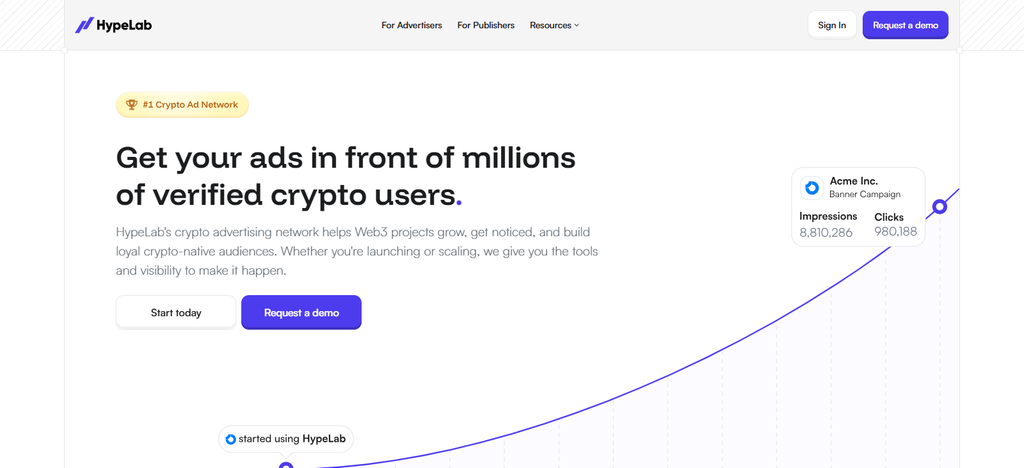
Programmatic traffic for Web3 publisher inventory. Its audience is very crypto specific: DeFi users, traders, NFT collectors, wallet holders and on-chain participants. Formats include banners, native placements and rich media ads.
Targeting is a big differentiator, using location, device, interest, engagement, wallet activity, token holdings and on chain behavior. Traffic quality is usually good for conversion-oriented campaigns, since targeting is based on actual crypto activity. It supports exchange signups, wallet downloads, DeFi protocol adoption, token launches and NFT promotions.
Main Features
- Wallet-Based Targeting: Allows advertisers to target crypto users based on wallet activity, token ownership and blockchain-related interests.
- Web3 Advertising Formats: Supports banner, native, and rich media ads in crypto apps.
- Publisher Network: Connects advertisers to Web3 sites, decentralized exchanges, portfolio trackers and blockchain apps.
- AI-Driven Optimization: Employs automated bidding and real-time campaign optimization to boost advertising performance.
- On-Chain Analytics: Reporting on wallet-level conversions and measurement of blockchain activity.
Primary Limitations
- Web3 Audience Targeting: It targets the crypto and Web3 audience with its ad approach, not the general consumer.
- Publisher Availability: Campaign reach is based on available participating publishers and advertising inventory.
- Campaign Learning: Advertisers may need to test to determine the most effective wallet-based audience segments.
- Conversion Dependency: Just because a wallet user engages, doesn’t mean the user signs up for an exchange account or makes a deposit.
7. Brave Ads
Brave Ads is the advertising platform for the Brave browser and Brave ecosystem. It engages privacy-conscious users via notification ads, New Tab sponsored images, Brave News placements, and search-result ads. Pricing is typically CPM-based and varies by format, market and targeting.
Third-party sources estimate typical crypto CPMs at $2-$8+, with more for premium placements. Traffic is driven within Brave’s browser, search, news feed and notification surfaces – not via a wide third-party publisher network. Its audience is typically tech-savvy, privacy-conscious and open to Web3 products.
Ad formats include push notifications, sponsored new-tab images, Brave News ads, and search ads. Targeting uses contextual and interest-based signals, respecting user privacy. Generally good traffic quality for brand awareness and getting users engaged, but only available to Brave users. It supports crypto exchanges, wallets, DeFi platforms, Web3 brands.
Key Features
- Browser Reach: Enables brands to reach audiences through ad placements within the Brave browser ecosystem.
- Privacy-first targeting: Uses on-device advertising technology to show you relevant ads without sending your personal browsing data to advertising servers.
- Multiple Ad Placements: Provides ad placements through browser notifications, new-tab experiences, and search-related placements.
- Contextual Targeting : Allows for targeting of content categories, keywords, and relevant audience interests.
- Geographic targeting: Enables country targeting and other regional targeting options on eligible ad formats.
Key Limitations
- Crypto Audience Specificity. Its audience is not limited to crypto traders or exchange users.
- Limited Advertising Environment: Campaigns are restricted to the Brave advertising ecosystem, not all crypto publishers.
- Targeting Limitations: Privacy-focused advertising restricts certain types of individual-level tracking and personalization.
- Conversion Measurement: Exchanges may need additional analytics and attribution tools to track registrations and deposits
8. CoinGecko
CoinGecko is a leading crypto market-data and token-discovery platform, so it’s useful for awareness and credibility, not for broad programmatic reach. Advertising is limited: Currently, CoinGecko only accepts ads from existing exchanges and projects that are listed on its platform.
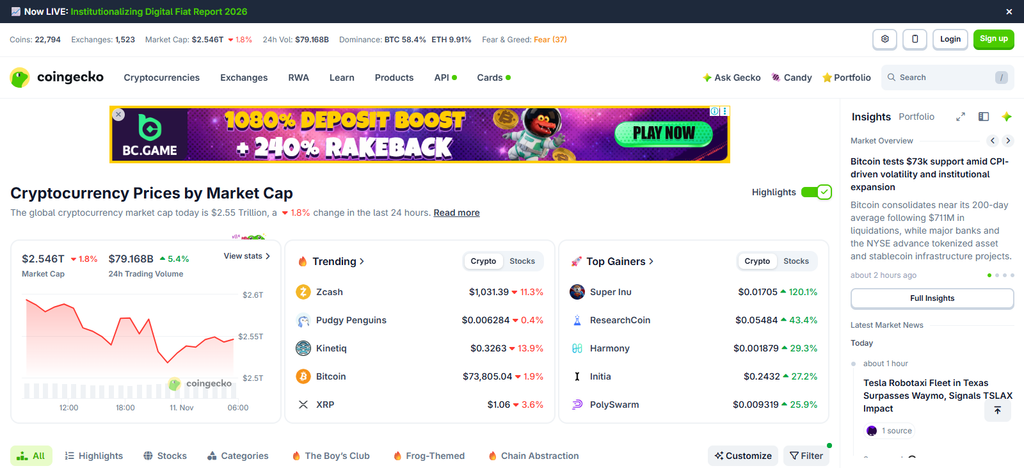
Pricing is bespoke and negotiated direct with its ads team; it is not a self-serve CPM marketplace in the normal network sense. Traffic comes from high intent visitors on CoinGecko researching prices, tokens, exchanges, portfolio and market data. The audience is retail investors, traders, DeFi users and token researching projects.
Ad formats are usually display placements, sponsored listings, and campaign-driven brand exposure, in accordance with CoinGecko’s advertising policy. Targeting is more limited than ad networks, and generally tied to placement on the platform.
The quality of traffic is high because users are actively researching crypto assets. It is especially adapted to exchanges and listed tokens projects looking for visibility.
Main Features
- Crypto Audience: Gives you access to users seeking information on cryptocurrency prices, digital assets in general, and market data.
- Advertising Opportunities: Provides qualified advertisers with self-service and managed advertising options.
- Market Relevant Placements: Opportunities to promote crypto brands in a crypto market-data environment.
- Brand Awareness – helps exchanges to be visible to users who are researching cryptocurrencies and blockchain projects.
- Advertising Compliance: Maintains the rules for approval of advertising policies for promo campaigns.
Primary limitations
- Advertising Access: Some placements require coordination with the advertising team directly.
- Less Control Over Traffic: Advertisers have less control over the overall publisher landscape than with independent ad networks.
- Advertising Costs: You may need to speak directly to the sales team to discuss placement costs and campaign budgets.
4.Conversion Dependency: Market data visibility does not convert to exchange registrations, deposits or trading activity.
9. CoinMarketCap
CoinMarketCap is one of the largest platforms for tracking crypto prices and market data, giving advertisers access to users researching tokens, exchanges, portfolios and market trends. Advertising is typically done through direct sales or partnership arrangements rather than open self-serve bidding, so pricing is custom and negotiated based on placement, duration, and campaign scope.
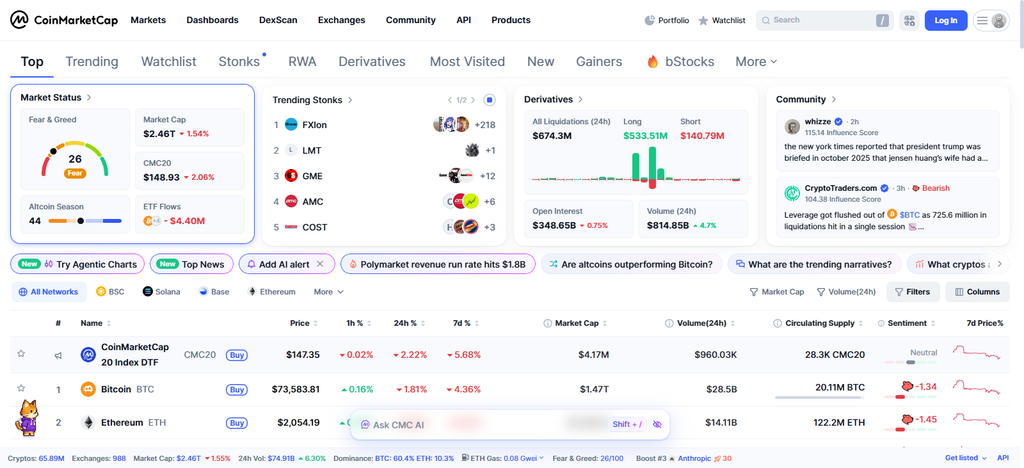
Traffic is funneled through CoinMarketCap’s website, mobile app, watchlists, token pages, and educational/content surfaces. The platform is intended for crypto investors, traders, developers and users who want to evaluate new tokens and exchanges. Formats can include display ads, sponsored placements, educational content and branded campaigns, depending on the agreement.
The targeting is not as granular as it is with programmatic networks, and is mostly placement and audience context based. The traffic quality is good for awareness and trust as the visitors are actively looking for assets. It supports crypto exchanges and listed projects, wallets and leading Web3 brands.
Main Features
- Big Crypto Audience: Reach to cryptocurrency investors, traders and blockchain enthusiasts researching digital currencies.
- Display Advertising: Provides banner placements across website and mobile application environments.
- Sponsored Content: Offers promotional content opportunities for cryptocurrency brands and businesses.
- Sponsorship Opportunities : Increases brand exposure with premium ads and sponsorship campaigns.
- Geographic and Device Targeting: Supports regional, desktop, mobile web and mobile application targeting .
Key limitations
- High Advertising Commitment: Its managed advertising program often demands a significant upfront budget.
- No Self-Service Campaigns: Advertisers have to work with the platform’s sales and business development team to run campaigns.
- Approval Requirements Advertisers and businesses must comply with the platform’s advertising policies.
- Reporting Restrictions: Standard campaign reporting is on impressions, clicks and CTR, not guarantyd exchange level conversions.
10. DexScreener
DexScreener is a DEX analytics and token-discovery platform heavily used by DeFi traders tracking token pairs, liquidity, price charts and trending assets. Its Marketplace features token advertising from $299 on fixed impression packages, while Trending Bar placements start at $2,000 and run for 24 hours to one week.
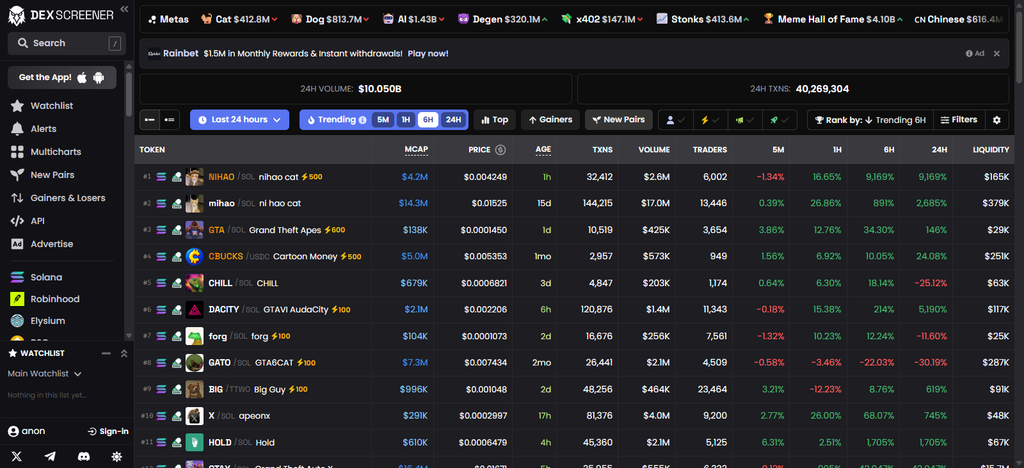
Payment via major cryptos and cards, direct custom deals require a minimum of $100,000 and KYC. There is traffic coming from users actively researching tokens on Ethereum, Solana, BNB Chain and other networks. The audience is very DeFi-savvy: degens, traders, liquidity providers, early token evaluators.
Available formats are banner ads, Trending Bar placements. Targeting is based more on chain, token and placement than on behavior. Token discovery traffic is of good quality but can be speculative. It supports DEX token promotion, however ads do not guaranty trending status.
Key Features
- DEX Trader Audience: Enables crypto projects to connect with users actively looking for decentralized exchange markets and token pairs.
- Token Advertising: Offers promotional spaces to showcase project logos and social information to platform users.
- Direct Advertising Deals: Custom advertising deals for individual chains, pages and promotional needs.
- Chain-Specific Promotion: Allows advertising campaigns for selected blockchain networks and trading environments.
- Crypto Payment Options: Supports crypto payments for some advertising products and promotional placements.
Principal Limitations
- DEX-Centric Audience: It has a more DEX-centric audience than one that focuses only on centralized exchange users.
- Advertisement Approval: Advertisers must undergo KYC and verification for direct advertising campaigns.
- Limited Campaign Formats: Its advertising options are more specialized than those offered by full-service multichannel advertising platforms.
- High Direct Deal Budget: Customized direct advertising campaigns can be expensive and not accessible to smaller exchanges.
Conclusion
Crypto exchange traffic generation services are the best way to increase brand visibility, attract potential traders, and expand cryptocurrency platforms. A number of platforms, including Coinzilla, Cointraffic, A-ADS, Bitmedia, Blockchain-Ads, HypeLab, Brave Ads, CoinGecko, CoinMarketCap, and DEX Screener provide various advertising opportunities and audience reach.
Choosing the right platform means considering traffic quality, audience targeting, advertising formats, pricing, compliance and conversion tracking. For crypto exchanges, it’s about real visitors, qualified registrations and deposit conversions, not just traffic. A good advertising strategy can help you acquire more users, expand internationally and improve your marketing performance in the long run.
FAQ
What are crypto exchange traffic generation services?
Crypto exchange traffic generation services help cryptocurrency trading platforms attract website visitors through display advertising, targeted campaigns, sponsored content, native ads, and blockchain-focused advertising networks.
Which are the best crypto exchange traffic generation services in 2026?
Some notable platforms include Coinzilla, Cointraffic, A-ADS, Bitmedia, Blockchain-Ads, HypeLab, Brave Ads, CoinGecko, CoinMarketCap, and DEX Screener.
How do crypto exchanges generate website traffic?
Crypto exchanges generate traffic through crypto advertising networks, SEO, PPC campaigns, influencer marketing, affiliate programs, sponsored content, and cryptocurrency publisher placements.
Which traffic generation service is best for crypto advertising?
The right service depends on campaign objectives. Coinzilla and Bitmedia focus on crypto advertising, while Blockchain-Ads and HypeLab offer specialized Web3 audience targeting.
How much do crypto exchange traffic generation services cost?
Costs vary depending on the platform, advertising format, targeting options, campaign duration, and pricing model, including CPM, CPC, CPA, and fixed advertising packages.