

As more and more companies use artificial intelligence and machine learning technologies, the need for high-quality AI training data is growing. Blockchain data labeling platforms are creating new methods for collecting, annotating, verifying and managing datasets through decentralized networks, human contributors and transparent data records.
In this article, I will discuss the Best Blockchain Data Labeling Platforms. I will explore the key features, benefits, best use cases, and capabilities of these platforms to help businesses choose suitable solutions for their AI data needs.
What Are Blockchain Data Labeling Platforms?
Definition: Blockchain data labeling platforms are decentralized systems that are used to collect, annotate, verify and organize datasets that are used to train artificial intelligence and machine learning algorithms.
Decentralized Annotation: These platforms crowdsource labeling tasks to global contributors, allowing businesses to access diverse human expertise without depending solely on centralized data annotation providers.

Blockchain Integration: They employ blockchain to document contributions, monitor data lineage, authenticate transactions, and keep transparent records of dataset ownership and labeling actions.
Human Data Annotation: These platforms link businesses with human contributors who annotate images, text, audio, video, and other information for AI training purposes.
AI-Assisted Labeling: Many platforms combine artificial intelligence with human annotation to automate repetitive labeling tasks, boost workflow efficiency, and simplify dataset preparation.
Data Quality Verification: They employ validation systems, reviewer networks, contributor reputation, and quality scoring systems to evaluate annotation accuracy and guaranty the reliability of training datasets.
Token-Based Incentives: Some decentralized platforms leverage blockchain-based rewards or digital tokens to incentivize contributors to accomplish labeling tasks and submit accepted data .
Support for AI Training: These platforms provide curated and tagged datasets for Artificial Intelligence applications like machine learning, computer vision, natural language processing, robotics etc.
Why Do Businesses Need Blockchain Data Labeling Platforms?
Enhanced Data Transparency: Blockchain records tagging activities and contributions so companies can trace the origin of datasets, monitor the annotation process, and assure transparent data management throughout AI development projects.
Access to Decentralized Workforce: Companies can more easily access contributors worldwide, leverage diverse annotation expertise, distribute labeling tasks, and handle large-scale data preparation needs.
Improved Data Quality: Human reviewers, validation mechanisms, and contributor reputation systems help businesses catch annotation errors, increase dataset consistency, and build trustworthy AI training data.
Proven Data Ownership: With blockchain-based records, contribution histories, licensing information and dataset provenance can be established, enabling businesses to manage digital data assets with more transparency.
Low-Cost Data Collection: 6. Scalable AI Development: Distributed contributors and flexible annotation workflows help businesses manage increasing volumes of image, text, audio, and video data for AI models. Crowdsourced annotation and distributed workflows can offer alternative means of managing labeling workloads and optimizing data preparation costs.
Incentives for Contributors: Businesses may utilize token-based reward mechanisms to incentivize participation, attracting contributors and rewarding them for completing accepted data labeling tasks.
Assistance with More Advanced AI Applications: These platforms are used to prepare specialized datasets for large language models, computer vision, robotics, autonomous systems, and other machine learning applications.
Key Points
| Platform | Key Features |
|---|---|
| 1. Sapien | Human annotation, expert validation, Proof of Quality, contributor reputation |
| 2. Sahara AI | Image labeling, audio tagging, peer review, automated rewards |
| 3. PublicAI | Text, audio, video, mapping data, AI-assisted annotation, validator network |
| 4. HUMAN Protocol | Task distribution, annotation, automated validation, reputation, HMT rewards |
| 5. LabelData | On-chain labeling, data NFTs, quality incentives, dataset marketplace |
| 6. Timeworx | Crowdsourcing, configurable pipelines, AI assistance, human labeling |
| 7. OORT DataHub | Data collection, preprocessing, crowdsourced data, multimodal workflows |
| 8. Bittensor Dojo | Crowdsourced labeling, model feedback, subnet-based contributor incentives |
| 9. DataCat | Geographically distributed annotation, dataset marketplace, contributor rewards |
| 10. scale.fun | Image, audio and text annotation, cUSD payments, verified identities, dataset marketplace |
1. Sapien
Sapien is a decentralized AI-data platform that evolved from a Base-network labeling marketplace to a Proof of Quality (PoQ) validation system for high-stakes AI work. Its labeling services are centered on expert validation for areas such as security, robotics and medical imaging, with buyers defining rubrics and qualified humans, AI judges or both rating outputs.
Pricing and rewards are project-specific: the earlier task app paid contributors mostly in USDC and $SAPIEN, while PoQ validators get a dollar reward set per review. The blockchain integration uses Base, on-chain payouts and staking; the AI integration uses expert panels and automated judging.
Human annotation remains fundamental, with quality scoring, named validator rosters, and referral incentives. Publicly little is known about supported formats, although its former marketplace hosted image, text and data-tagging jobs.
Advantages
- Data annotation verified by people.
- Network of expert contributors .
- Proof of quality check.
- Quality assessment with AI assistance.
- Transparent tracking of data contribution
Top Use Cases
- AI training for robotics.
- Datasets for computer vision.
- Fine-tuning AI models.
- AI model assessment.
- AI for safety-critical applications.
2. Sahara AI
Sahara AI is a full stack, AI native platform including a Data Services Platform, developer tooling, marketplace and its own blockchain. The company provides data-labeling services that gather, annotate, enrich and validate text, image, video, audio, RLHF, moderation, classification and multimodal prompt generation.

Enterprise pricing is usage-based with transparent per-data-point pricing and no stated hidden fees; contributors earn $SAHARA, partner tokens, or stablecoins on eligible dual-reward tasks with payouts varying by task complexity and quality. The integration of blockchain includes the registration of datasets on-chain, NFTs for ownership, provenance, licensing, revenue sharing and network operations based on $SAHARA.
Proprietary auto-labeling models + human-in-the-loop review for AI integration. ML screening, peer review, consensus, five-tier skill calibration, and accuracy-based rewards are the pillars of data quality. At present, we support JSON, CSV and TXT for uploading dataset registrations.
Advantages
- Data labeling at scale.
- Multi-stage data processing
- Incentives for contributors.
- Data provenance on blockchain.
- AI assets marketplace.
Top Use Cases
- Datasets for AI training.
- Training big language models.
- Development of multimodal AI.
- AI research projects 5.
- Monetization of datasets.
3. PublicAI
PublicAI is a decentralized “human layer” for AI that connects buyers to a global contributor network for data collection, annotation and model evaluation. It provides services for text, audio, video, mapping, image annotation, semantic segmentation, transcription, named entity recognition, and 3D LiDAR labeling.
Pricing is a freemium marketplace: there’s a free annotation allowance, pay-as-you-go for usage beyond that, and enterprise-grade PublicAI Pro options, while contributors can earn points, USDT, and $PUBLIC based on the campaign. Blockchain Integration: Staking, slashing, on-chain reputation, cross-chain compatibility, and token-based settlement.
AI integration is hybrid. AI assistants pre-label data and validators verify results. Its Data Hub supports dataset validation and APIs for AI application. Skill validation, consensus thresholds, and stake-backed accountability enhance human annotation. Supported formats include text, audio, video, images, LiDAR and mapping data.
Advantages
- Worldwide contributors network.
- Annotation of multimodal data.
- AI-assisted tagging.
- Quality control based on validator.
- Reward system for contributors
Best For
- Projects in computer vision.
- Natural Language Process.
- Annotation of audio data.
- Annotating videos
- Tagging of geospatial data.
4. HUMAN Protocol
HUMAN Protocol is a decentralized coordination layer for global digital work, especially for large-scale data labeling and AI training tasks. Requesters post jobs with smart-contract escrow. Workers do labeling, annotation, data collection and human-in-the-loop evaluation tasks via the HUMAN App and integrations such as CVAT.
Pricing is market and job based. Requesters prefund bounties and workers are paid HMT after accepted work. The protocol does not publish a universal hourly rate. The backbone of the system is the blockchain integration, using smart contract technology for escrow, task routing, cryptographic quality verification, automated payments, and multi-chain interoperability, powered by SKALE with gasless sFUEL transactions.
The AI integration is present in the form of CVAT-supported computer-vision annotation and workflow automation. Reputation is built on verified submissions and human annotation is essential, with distributed validators to ensure accuracy. Supported formats are image, video, and text annotation.
Advantages
- Decentralized distribution of tasks.
- automatic payment of rewards.
- Reputation of on-chain contributor.
- Developer friendly infrastructure.
- Automatic validation of task.
Top Use Cases
- Image tagging.
- Video annotation.
- Text data labeling.
- Machine learning training
- Crowdsourced AI projects.
5. LabelData
LabelData seems to be a brand/platform for a data-labeling service to prepare datasets for AI training, but limited publicly available authoritative information on its current services, pricing, token rewards, blockchain architecture and supported formats. The name and usual positioning implies it is best thought of as a labeling service helping teams to turn raw data into annotated datasets for use in machine learning and computer vision work.
Its likely value proposition is managed annotation, i.e. definition of labeling guidelines, assignment of annotators, review of output, and delivery of structured training data. Buyers should thus check directly whether it provides human-only annotation, AI-assisted pre-labeling, quality assurance, API access, custom schemas, and enterprise pricing.
There was no public evidence of a native token, on-chain rewards or blockchain-based provenance, unlike the Web3 platforms mentioned above. All reward or crypto claims unverified pending vendor confirmation.
Advantages
- On-chain data labeling.
- Collaboration across multiple roles.
- Data quality scoring
- Data NFT Ownership
- Incentives for contributors.
Best Use Case
- Datasets used to train LLMs.
- Dataset quality control.
- Development of data marketplace.
- Annotation that is community-based.
- Making money from AI Data
6. Timeworx
Timeworx.io is a decentralized data processing layer for the next generation of AI that combines human contributors and AI agents in a trustless workflow. Its services include data annotation, wider data processing and model deployment/monetization. Clients define pipelines and have access to a scalable global workforce.
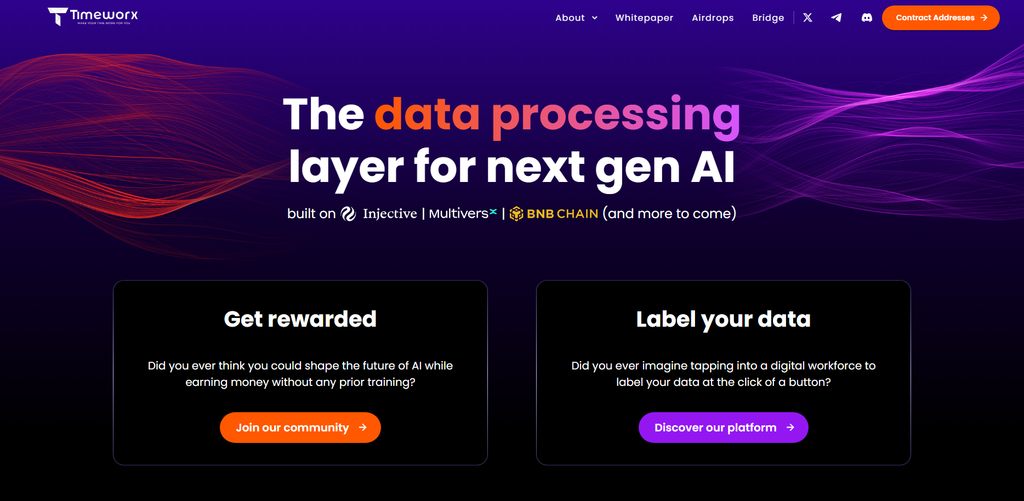
Prices are not fixed, but are set by the market: the protocol suggests prices for jobs according to supply and demand, complexity and market conditions; clients pay in $TIX and contributors are paid in $TIX for the work they do. The core of it is the integration with blockchain and the $TIX token is used for payments, staking, protocol security, on-chain attestations of performance and revenue sharing.
The project is also multi-chain enabled via partnerships with Injective and MultiversX. The integration of AI is unique because AI agents can process tasks but must stake $TIX, creating accountability. Quality is built through replication, consensus, continuous assessment of performance, audits and gamified incentives. There is no list of supported file formats in the public documentation.
Advantages
- Collaborating with AI.
- Configurable data pipelines
- AI-enabled processing.
- Crowdsourced labor force.
- Methods for assessing quality.
Best Use Cases
- Labeling text data.
- Image labeling.
- Processing video data.
- Sentiment analysis.
- Collection of human feedback
7. OORT DataHub
OORT DataHub is OORT’s decentralized data collection and labeling product that transforms a global community into a verifiable AI data engine. It allows for crowdsourced collection, preprocessing, classification, annotation & validation for AI training through enterprise-facing data pipelines and sample review prior to final delivery.
Pricing and contributor rewards are task-based, users complete micro-tasks, validate others’ work, climb leaderboards and earn points, OORT-token incentives, referral bonuses and in some cases USDT-equivalent rewards. Enterprise pricing is not publicly standardized.

The integration of blockchain uses OORT’s Olympus Protocol, a Layer-1 network with Proof of Honesty consensus, on-chain task records, decentralized storage, wallet integration, and cross-chain incentives.
AI integration with community preprocessing and support for AI model training workflows. At the core of it is human annotation, with professional validation and a human-in-the-loop quality layer. Supported data types include images, audio, video and text-based tasks.
Advantages
- Distributed data infrastructure.
- Support for multi-modal data.
- Preprocessed data features
- Data contributions for distribution.
- Opportunities to monetize data.
Top Use Cases
- Collection of AI training data.
- Multi-modal AI development.
- Preprocessing of data.
- Data management decentralized.
- Monetizing AI datasets
8. Bittensor Dojo
Bittensor Dojo is a component of the Bittensor ecosystem, where decentralized networks collaborate to perform machine-learning work and reward beneficial contributions with the TAO token. In the framework of data labeling, “Dojo” can mean a specialized subnet or application layer that organizes contributors, models, or validators around data preparation, evaluation, or model-training tasks.
Its main benefit is its incentive design, native to blockchain: TAO-based rewards can align miners, validators, and data contributors around measurable output quality. But publicly available, authoritative documentation that specifically describes a “Bittensor Dojo” labeling product, pricing tiers, annotation services, supported formats and quality-assurance process is limited.
Buyers and contributors are advised to verify the exact subnet, types of tasks, scoring system, wallet prerequisites and payout regulations prior to engagement. Bittensor is designed for decentralized model inference and training, so it is likely to have strong AI integration, but specifics will depend on the subnet.
Advantages
- Distributed human feedback.
- Incentive structures for contributors.
- Human preference collection
- Infrastructure of task generation.
- Distributed AI testing.
Use Case
- Model Evaluation of AI.
- Human preference labels.
- Gathering LLM feedback.
- Creating synthetic tasks.
- AI training is decentralized.
9. DataCat
DataCat seems to be a data-annotation or AI-data service platform, but the public search results did not have enough reliable and recent information to confirm the platform’s scope, pricing, rewards, blockchain features, or supported data formats. Platforms with this name are generally aimed at companies that need labeled datasets for computer vision, NLP, speech, or multimodal AI.

Thus a responsible profile should separate verified capabilities from assumptions. Image bounding boxes, segmentation, text classification, transcription, audio tagging, and model-output evaluation are possible services, but we cannot verify from the evidence we have that these are capabilities of this particular vendor.
There is no public evidence that DataCat uses a native token, crypto rewards or blockchain based provenance. Request a statement of work that outlines annotation guidelines, annotator qualifications, inter-annotator agreement, delivery formats, security controls, and pricing per task or per data point before you utilize
Advantages
- Data annotation in a decentralized way.
- Contributions from the community.
- Labeling workflows (distributed)
- Support for dataset marketplace.
- Contributors’ incentives.
Top Use Cases
- Community data annotation.
- AI training data preparation.
- Annotation projects, spread.
- Dataset discovery and sharing
- Decentralized collaborative data collaboration.
10 .scale.fun
scale.fun seems to be a data / AI-task platform with a Web3 focus, but the publicly available information is not rich enough in authoritative detail to confirm its labeling services, pricing model, reward structure, blockchain integration or supported formats. The name hints at a gamified or community-driven approach to scaling AI data work, potentially involving micro-tasks, contributor incentives, and tokenized rewards.

But to assume that as fact would be speculative. It is imperative that potential clients and contributors do their due diligence to see if it has data collection, annotation, validation, RLHF or model evaluation; if payment is fiat, stablecoin or native-token based; if quality is through human review, consensus, staking or AI-assisted checks. Scale until official docs are available.fun should be tagged as an emerging or insufficiently documented platform and not a verified enterprise data-labeling provider.
Advantages
- Data collection on the go.
- Crowdsourced annotation.
- Contributions on multimodal data.
- Blockchain Payment Infrastructure.
- Data marketplace opportunities.
Apps that work best:
- Image data labeling.
- Collection of audio data.
- Labeling Text Data.
- Mobile Crowdsourcing Projects
- Building AI training data sets.
Conclusion
Blockchain data labeling platforms are revolutionizing the way businesses collect, tag, verify, and manage AI training datasets. Saharan AI, Sapien, PublicAI, HUMAN Protocol and OORT DataHub are platforms that take different approaches to decentralized annotation, contributor participation, data quality and blockchain integration.
Such solutions can enable applications in machine learning, computer vision, natural language processing and multimodal AI.
But businesses should compare annotation capabilities, verification methods, data ownership, security, scalability and pricing before selecting a platform. With the right solution choice, organizations will be able to build reliable datasets, improve their AI development workflows and support future decentralized AI innovations.
FAQ
What are blockchain data labeling platforms?
Blockchain data labeling platforms are decentralized systems that help collect, annotate, verify, and manage datasets for training artificial intelligence and machine learning models.
How does blockchain improve data labeling?
Blockchain improves transparency by recording contributions, tracking dataset provenance, supporting ownership records, and maintaining verifiable information about data annotation activities.
Which are the best blockchain data labeling platforms in 2026?
Some notable platforms include Sapien, Sahara AI, PublicAI, HUMAN Protocol, LabelData, Timeworx, OORT DataHub, Bittensor Dojo, DataCat, and scale.fun.
What types of data can these platforms label?
Depending on their capabilities, these platforms support image, text, audio, video, document, and multimodal data annotation for different AI applications.
Are blockchain data labeling platforms suitable for businesses?
Yes. They can help businesses manage distributed annotation projects, access global contributors, track data contributions, and prepare datasets for AI model development.