

This article is Using AI to automate business decisions is becoming a necessity. Advanced tools help analyze, interpret, and streamline workflows. They also help identify and support faster, more accurate, and more data driven decisions.
Predictive analytics and intelligent automation allow organizations to optimize their operations, lower their mistakes, and stay competitive in their industry.
What Are AI Tools for Automating Business Decisions?
AI business decision-making automation tools are software solutions that use AI to help make decisions based on analyzed data and identified trends. They help streamline workflows, enhance forecasting, and inform strategic initiatives across finance, marketing, sales, and operations.
By improving speed and accuracy of decision-making, these tools allow businesses to streamline operations, reduce risk, and maximize value. With predictive analytics, smart recommendations, and real-time analytics, AI based decision automation tools help business focus on what’s important.
| AI Tool | Best For |
|---|---|
| ChatGPT Enterprise | Large organizations needing versatile AI for content, analysis, and decisions |
| Claude | Legal, compliance, and research-heavy industries |
| Microsoft Copilot | Companies already using Microsoft ecosystem |
| Google Gemini | Teams working in Google ecosystem |
| Perplexity Enterprise | Businesses needing reliable research & compliance checks |
| Make.com | Operations teams managing multi-step workflows |
| Apollo.io | Sales-driven organizations |
| Instantly.ai | Startups & SMEs scaling sales pipelines |
| DataRobot | Finance, insurance, and risk management |
| UiPath AI | Back-office operations, compliance-heavy industries |
1. ChatGPT Enterprise
ChatGPT Enterprise is an AI tool that businesses can use to help with their decision-making processes. The tool has to ability summarize reports and create strategic plans and operational assistance.
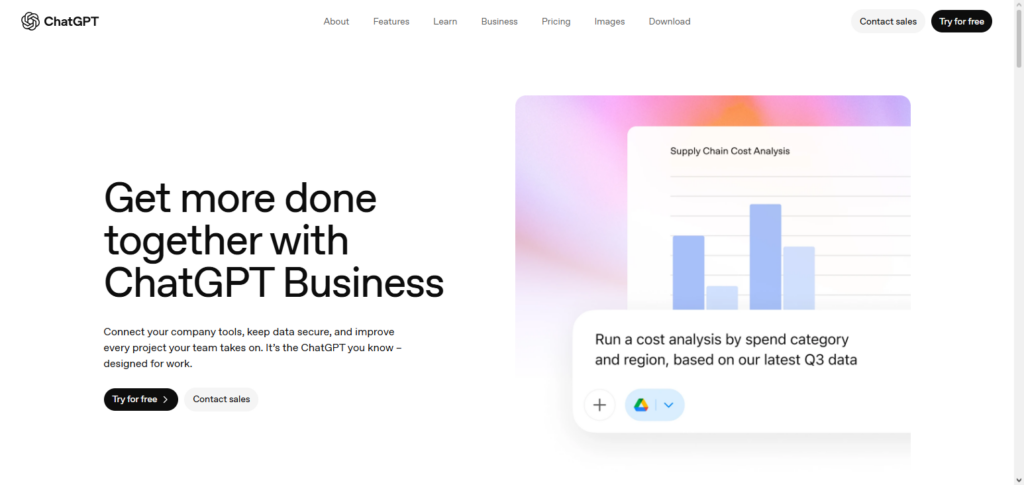
When coupled with internal databases, ChatGPT Enterprise promotes quick and accurate decision-making based on the data that is provided. In addition to data analysis and decision-making, ChatGPT also has operational assistance to improve communication with customers and to predict and improve market trends.
The tool is of the best AI tools for automating business decisions as it possesses the most intelligence with the ability to adapt to various enterprise contexts.
ChatGPT Enterprise Features, Pros & cons
Features:
- Natural language and understanding for enterprise
- Insight and summary generation in real-time
- Integrate with internal business processes
- Report generation and recommendations
Pros:
- Streamline decision-making and reporting
- Reduce manual analysis
- Scalable to all teams and workflows
- Provides insights for other departments
Cons:
- Limited understanding of company-specific context
- Draws poor conclusions from incorrect input
- Limited functionality when offline
- Legacy systems sometimes require integrations lack support
2. Claude
Claude is an AI tool that automates decision-making and is focused on the data analysis side of the process. Claude’s AI works on the financial, operational, and marketing side of the business to aid decision-making, data analysis, and reporting.
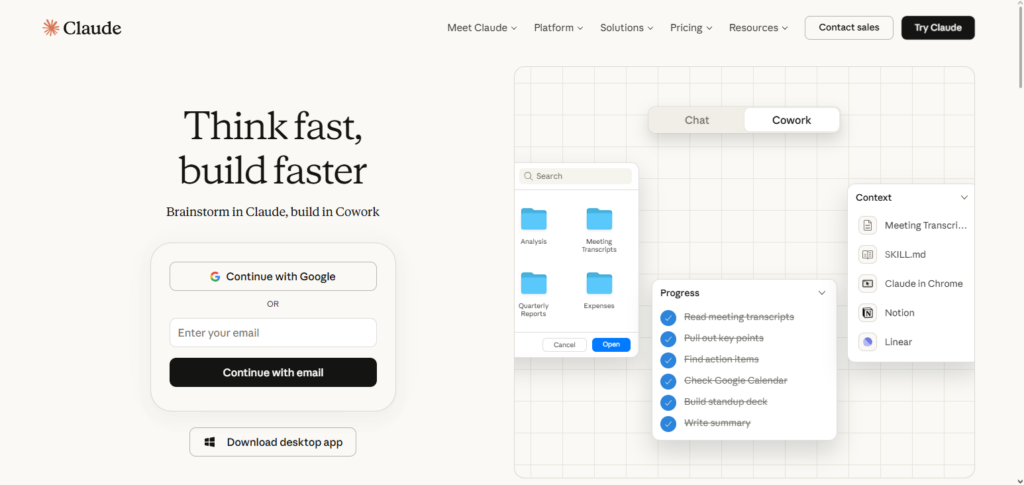
For the analysis and reporting process, Claude has implemented an intuitive interface that has reporting capabilities, but for the decision-making portion of the tool it centers around creating strategic instructions.
For the above reasons, Claude is one of the best AI tools for automating business decisions for businesses that place a high value on AI-driven insights.
Claude Features, Pros & cons
Features:
- Summarizes and analyzes documents as an AI assistant
- Provides recommended actions
- Promises safe and reliable AI
- Provides support for business decision-making
Pros:
- Reporting and research is all automated
- Reduces analysis of data by a human
- Simultaneous support for various departments
- Sensitive business data is safe
Cons:
- Smaller adoption than other platforms
- Limited cloud/internet based systems
- Problems when the data is extremely specific
- Smaller teams find cloud subscriptions expensive
3. Microsoft Copilot
Microsoft Copilot integrates with various Microsoft 365 products including Excel, Word, and Power BI to streamline work processes with automation. It aids in the development of business reports, recognition of trends in data, and the delivery of recommendations regarding important business decisions.
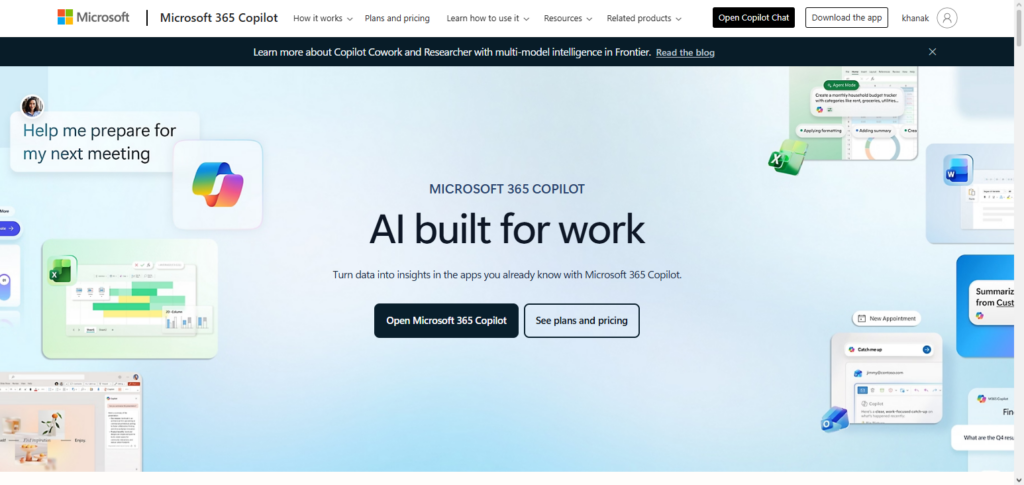
Copilot provides AI-enabled insights to managers which accelerates decision-making. It also automates repetitive activities and enhances the precision of predictions.
Because of its integration with software that is common to Microsoft users, Microsoft Copilot is able to facilitate the automation of business decisions for companies that are already deeply embedded in the Microsoft ecosystem for collaboration and workflow optimization.
Microsoft Copilot Features, Pros & cons
Features:
- Integrates with Microsoft 365 programs (Excel, Word, Power BI)
- Automated data analysis and reporting
- AI insights and prediction automation
- Automated workflow recommendations
Pros:
- Integrated with Microsoft programs
- Reduces reporting tasks
- Supports data-based decision making
- Microsoft 365 adoption is easier
Cons:
- Function few insights outside Microsoft ecosystem
- Insights could require human validation
- Certain features have to be in premium plans
- Advanced automation features have a learning curve
4. Google Gemini
Gemini is Google’s new AI application that utilizes advanced machine learning, coupled with natural language processing, to assist with data-driven decision-making in business.

It allows companies to streamline the process of data investigation, trend analysis, and strategic forecasting. Marketing, Sales, and Operations optimization are tasks that can be accomplished through data interpretation done by Gemini.
Eliminating menial tasks and boosting forecasting and planning accuracy is achieved through the generation of relevant predictions. Because of data-driven predictive analytics that Gemini provides, coupled with its AI flexibility, it is one of the most effective AI tools for automating business strategies.
Google Gemini Features, Pros & cons
Features:
- Understands natural language and machine learning
- Analytics for forecasting
- Offers actionable advice for business
- Concerned with operational and strategic advice
Pros:
- Complex data analytics can be automated
- Offers insight for future impacts
- Applies to big businesses
- Operational and strategic advice can be improved
Cons:
- Users must be technically advanced
- Processing data in the cloud is a must
- Small businesses, the expense is great
- Legacy system integration can be problematic
5. Perplexity Enterprise
Perplexity Enterprise offers an AI-powered knowledge management platform that assists businesses in extracting value from unstructured data. It can summarize texts, respond to intricate questions, and recommend options to guide decision-making.
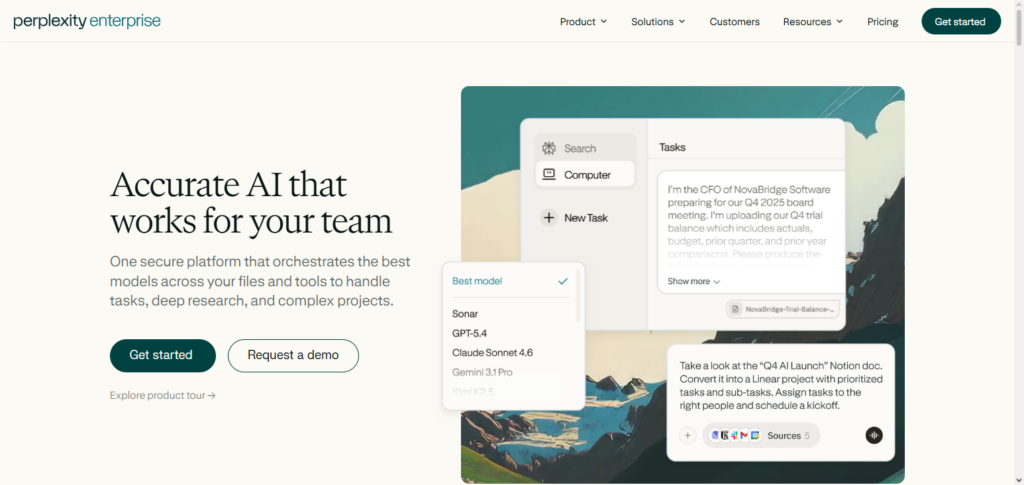
With this tool, businesses can automate research processes, report generation, and trend spotting within a given industry. The platform’s AI enables less manual human analysis of an extensive amount of data, and streamlines the way an enterprise operates overall.
Because the platform delivers actionable and accurate insights, Perplexity Enterprise is considered one of the top AI tools for automating business decisions. It allows executives and teams to more quickly and accurately make decisions in high-stakes business situations.
Perplexity Enterprise Features, Pros & cons
Features:
- Structured data analysis
- Document summarization and report generation
- Provides answers to complex questions
- Supports inter-departmental decision-making
Pros:
- Reduces time required for data research
- Automated reporting and insight generation
- Provides actionable recommendations
- In multiple departments easily adoption
Cons:
- Offline functionality is limited
- Time required for initial setup
- Subscription costs could be high
- Training is required for generation to be accurate
6. Make.com
Make.com is a platform that allows businesses to automate various processes without coding by building workflows to automate across different applications and systems. For enterprises, its AI modules automate redundant tasks, data synchronization, and workflows.
Make.com integrates customer relationship management, marketing, financial, and project management tools to reduce the manual work involved. The platform integrates business intelligence so that teams can utilize smart trade rules and automate processes in response to dynamic data conditions.
This positions Make.com among the top AI tools for automating business decisions especially for organizations that wish to optimize trade processes without considerable investments in information technologies.
Make.com Features, Pros & cons
Features:
- Workflow automation that is no-code
- Cross-app system integration
- Task triggers and action support
- Automation process driven by AI is possible
Pros:
- Workflow can be automated by non-tech users
- Less manual repetitive duty is improved
- Operational efficiency is improved
- Streamlined processes by app connectivity
Cons:
- Workflow advanced needs automation customized limit learning curvature for.
- Offered by the connected apps of stable automation.
- Certain advanced features are included in paid plans
7. Apollo.io
Apollo.io uses AI to make decisions on lead generation and revenue growth. Prediction from Apollo’s AI is based on analyzed data of potential customers. Apollo decides which leads are worth going after and how to reach them.

Automation of sales workflows and performance tracking is also enabled. Doing data driven decisions and intelligent data optimization regarding marketing and sales is also at the fingertips.
The intelligence and autonomy of Apollo’s tools allow businesses to increase revenue and operational efficiency while eliminating the labor and repetition of analysis to prioritize activities. This places Apollo among the most recommended AI tools in decision-making.
Apollo.io Features, Pros & cons
Features:
- Lead generation via AI
- Predictive sales analytics
- Outreach and workflow automation
- Performance metric monitoring
Pros:
- Efficient high-potential lead identification
- Email and follow-up automation
- Marketing and sales strategy optimization
- Manual prospecting time savings
Cons:
- Sales and marketing centric
- Data-centric accuracy
- Small teams may find subscription costly
- Some integrations require advanced knowledge
8. Instantly.ai
Automating outreach and communication is the goal of Instantly.ai. The AI is heavily employed to personalize emails. The AI also determines the best method to reach customers and the optimal strategy to be used in order to increase engagement rates.
Based on the analytics of the AI, Instantly.ai enhances decision-making. All of the functions provided by Instantly.ai allow businesses to expand communication on a large scale without losing the quality of their communication.
This is why Instantly.ai has been considered one of the most recommended AI tools in decision-making especially in marketing and sales where data driven and rapid outreach is necessary. This leads to increased conversions and engagement.
Instantly.ai Features, Pros & cons
Features:
- Email outreach automation via AI
- Messaging personalization in bulk
- Response pattern analysis by contact
- Communication strategy optimization
Pros:
- Response and engagement rates raise
- Outreach and follow-up automation
- Time savings in marketing campaign
- Contact list scalability
Cons:
- Tasks beyond communication are limited
- Data-focused accuracy
- Paid plans are required for advanced features
- Automations affect email deliverability
9. DataRobot
DataRobot is an enterprise AI platform that focuses on automated machine learning and predictive analytics. Using this platform, users can build, deploy and monitor AI models to observe trends, improve operational efficiency, and assist in strategic decision-making.
DataRobot’s automation of model selection, training, and validation decreases the technical resources necessary to take advantage of AI. With the predictive capabilities of DataRobot, decision makers can Act with confidence and precision.
One of the best AI tools for automating business decisions, DataRobot empowers organizations to use predictive analytics and machine learning without the need for large teams of data scientists.
DataRobot Features, Pros & cons
Features:
- Automated Machine Learning
- Predictive analytics and modeling
- Model monitoring and deployment
- Support for planning by scenario
Pros:
- Less reliance on Data Science teams
- Provides actionable predictions for decisions
- Automates end-to-end modeling processes
- Supports forecasting and planning for enterprises
Cons:
- Some technical expertise required
- Processes are Cloud-dependent
- Costly for smaller organizations
- Complex models may need human validation
10. UiPath AI
UiPath AI, a leader in intelligent automation, combines robotic process automation (RPA) with artificial intelligence to automate the more intricate steps in business process workflows.
This platform can review documents in a process workflow, make suggestions, and activate other automated steps in the process, whether in finance, human resources, IT, or customer service.
UiPath AI boosts productivity, streamlines work, and accelerates decision-making. Its intelligent automation framework helps businesses adjust to operational changes, effectively increasing the automation of work.
This positions UiPath AI among the best AI tools for automating business decisions with a blend of AI and automation.
UiPath AI Features, Pros & cons
Features:
- Combines Robotic Process Automation and AI
- Workflow automation of repetitive tasks
- Process optimization & analysis
- Assists cross-departmental automation
Pros:
- Lessens manual errors & workloads
- Faster decisions
- Suitable for enterprise-level processes
- Combines AI & RPA for smart automation
Cons:
- Can be complicated to set up
- Training is necessary for designing workflows
- Difficult to work with legacy systems
- Workflow licensing & subscriptions can be costly
Key Features of AI Tools for Business Decisions
Data Analysis & Predictive Analytics. AI tools simplify the analysis of large data sets. They enable businesses to make higher-quality decisions with greater speed and precision.
Workflow & Process Automation. Employees are empowered to make complex business decisions as systems automate basic tasks, approvals, and business workflows.
Integration with Enterprise Systems. AI tools make business decisions better by helping disparate systems & applications work as one. They ensure data is shared in real-time.
Real-Time Reporting & Dashboards. Executives are enabled to make decisions that are better and faster by effectively monitoring KPIs with good reporting tools and analytical dashboards.
AI-Powered Recommendations. Data-driven AI tools can make better decisions for businesses by recommending the best course of actions, the best way to use their resources, and the best way to minimize risks.
Scalability & Customization. AI tools remain useful as businesses expand by providing ongoing customization and modifications to their changing needs.
Enhanced Collaboration & Accessibility. AI tools housed analytics that enhance communication by fostering accessibility to data and cross-team collaboration.
Risk Assessment & Compliance Support. AI tools can minimize risk and enhance business compliance by use of alert systems and predictive analysis to automate risk management.
Advantages of Using AI Tools in Business Decisions
Speed – AI processes data far quicker than humans, enabling business leaders to circumvent resource intensive data gathering to make decisions.
Accuracy – AI focuses on data relevant to the best possible decision to eliminate the human factor as an error, enabling highly precise decision making.
Operational Efficiency – AI helps optimizes how people work, as the people can then be, as the AI takes the repetitive tasks of the people instead of the people.
Data Driven Consideration – AI enables greater, pattern and trend, recognition throughout data relevant to the business as the humans have data blindness.
Growth – AI tools help handle more data as more people are generated in the business, in be the business, in handling the data.
Risk Management – AI enables no mistakes to keep the people is compliance.
Expenses – AI lessens the work is compliance, enabling no mistakes to keep the people is compliance.
Market Advantage – AI helps assist with fewer effective and highly less people decisions as is market less people.
Service – AI lessens the work is compliance, enabling no mistakes to keep the people is compliance.
Strategy – AI helps to no people, enabling less engagement in is less.
Challenges and Considerations
Availability and Quality of Data
AI requires clean and comprehensive data to generate insights and drive decisions. When data is lacking and of lower quality AI is more likely to drive poor decisions.
Compatibility with Current Systems
Integrating AI technology with existing legacy systems, ERPs, CRMs or other enterprise technologies is often difficult and require a high degree of complexity and a high level of technical ability.
Costs
Subscription, licensing, and implementation and maintenance costs, which are often quite high, can make Enterprise AI tools cost prohibitive to smaller businesses.
Training & Learning Curve
The potential for AI tools to add positive value is diminished in the absence of training as employees will not understand how to effectively utilize the tools and system into their decision making.
Security and Privacy
The AI technology will have to touch and deal with customer data and other sensitive data which creates added stress and complexity in regards to compliance issues.
Dependence on the Internet and/or Cloud
The AI tools are typically cloud based which means data will be in realtime and their data is susceptible to downtime.
Over-reliance on AI Technology
A poorly designed AI model with a great deal of trust aligned with poor human oversight can facilitate poor decisions and decision making.
Lack of Customization
Certain characteristics of a particular business process or a particular industry domain may not be handled fully by the AI tools.
Conclusion
Automation, predictive analysis, and advanced technology have transformed business decision-making. Tools such as ChatGPT Enterprise, Microsoft Copilot, and DataRobot increase workflow efficiency, precision, and eliminate human mistakes.
These tools provide businesses with the ability to automate and improve the speed and quality of their decisions. Though there is a high potential for increased efficiency and favorable competitive positioning, there are still issues such as cost, technical complexity of integration, training, and data quality that must be addressed.
Using AI tools to automate decisions fosters an innovative culture, decreases effort, and protects a business’s competitive position.
FAQ
Which industries benefit most from AI decision tools?
AI decision tools are useful across finance, marketing, sales, HR, operations, supply chain, and customer service, helping companies optimize processes and improve efficiency.
Are AI tools expensive for small businesses?
Costs vary by platform. Some enterprise AI tools can be expensive, but scalable or subscription-based solutions are available for smaller businesses with limited budgets.
How do AI tools improve business decision-making?
They reduce human error, provide predictive analytics, automate repetitive tasks, and generate actionable insights for strategic planning, resource allocation, and operational efficiency.
Can AI tools replace human decision-making?
No. AI tools support and enhance decision-making, but human oversight is essential to interpret insights, handle exceptions, and make judgment-based choices.