This article is about the Best AI Trading Infrastructure Providers for Crypto Hedge Funds. As the cryptocurrency market evolves and becomes more complex, hedge funds are relying more and more on AI and machine learning for trade optimizations, upkeep market security, and access deep liquidity.
Talos, Fireblocks, Copper, and FalconX provide solid infrastructures that allow the automated implementations of strategies, provide analytics in real-time, and allow for better and more efficient integrations for professional trading.
Key Point & Best AI Trading Infrastructure Providers for Crypto Hedge Funds List
| Exchange | Key Points / Features |
|---|---|
| Talos | 1. Full-stack crypto trading and custody solution2. Advanced API integration for institutional clients3. Compliance-focused platform with AML/KYC support |
| Fireblocks | 1. Secure digital asset custody and transfer network2. Multi-party computation (MPC) security3. Supports DeFi, trading, and lending operations |
| Copper | 1. Cold storage and institutional-grade custody2. Fast settlement via ClearLoop technology3. Regulatory compliance and insured assets |
| FalconX | 1. Institutional crypto trading platform with liquidity aggregation2. Real-time execution and settlement3. API access for automated trading strategies |
| LMAX Digital | 1. High-performance crypto exchange for institutions2. Low-latency matching engine3. Transparent pricing and market integrity |
| CME Group (Crypto Futures) | 1. Regulated crypto futures and options trading2. Deep liquidity for BTC and ETH contracts3. Risk management tools for hedging exposure |
| Kraken Institutional | 1. Advanced trading and OTC services for institutions2. Robust security and compliance framework3. Staking and treasury management solutions |
| OKX Institutional | 1. Institutional-grade trading platform with API support2. Derivatives, spot, and lending services3. Risk management and liquidity tools |
| Bitstamp Institutional | 1. Established crypto exchange with fiat support2. OTC desk for large-volume trades3. Regulated in multiple jurisdictions |
1. Talos
Talos provides infrastructure for hedge funds investing in crypto. As a fully integrated provider in trading, settlement, custody, and risk management, Talos has a fully integrated infrastructure for crypto hedge funds. Funds seeking to automate can use the advanced APIs for faster integrations for their hedge fund AI trading algorithms.
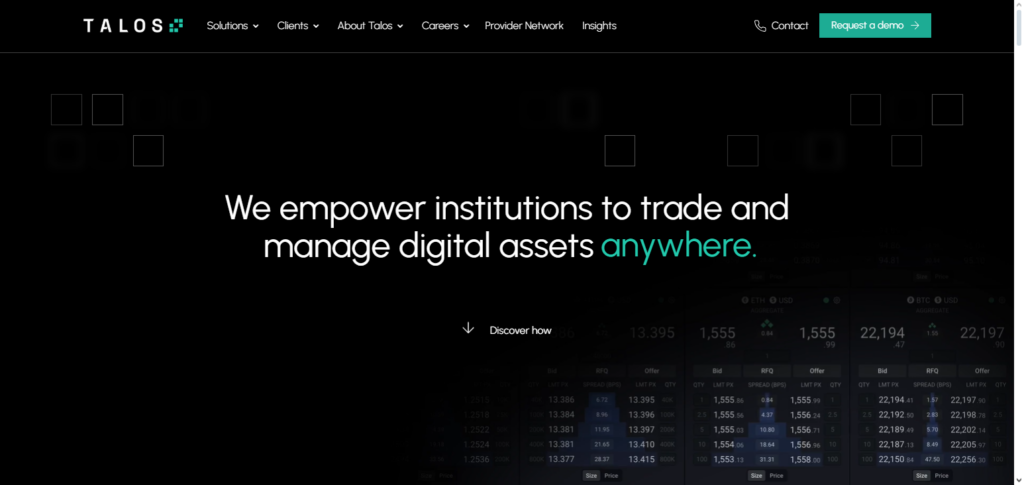
Talos’ infrastructure operates in a compliant, scalable hedge fund environment. Moreover, the ability to automate crypto hedge fund management, reporting, and analytics at real time enables the automated driven crypto fund strategies to trade at higher efficiency wherever in the world to remain compliant and operationally granular.
Pros & Cons Talos
Pros
- Talos is a one-stop shop for trading infrastructure, connecting clients to 60 trading venues and providing the necessary tools to conduct price discovery, trade, and settle.
- Talos offers smart order routing and execution algorithms, along with multi-dealer RFQs, helping clients to reduce price slippage and get better fill execution on large orders.
- Talos offers clients the ability to manage portfolios, risks, treasury, and settlement on one comprehensive platform, allowing funds to manage their counterparty exposure across spot and derivative products at the same time.
Cons
- As a specialized institutional infrastructure layer, Talos is likely to be more complex and costly to onboard and integrate than the average exchange account over a given hedge fund.
- Talos’ intermediation structure means the liquidity quality and price the fund receives is entirely based on the underlying venues or counterparties, leading to a less certain net benefit.
- Talos likely has a higher operational overhead and minimum requirements than its competitors, meaning it is likely less suited for the smaller funds or traders in the market.—
2. Fireblocks
Hedge funds and other institutional means of investing will find a prime asset custody and transfer network in Fireblocks, who emphasizes and provides safety and security and speed. They use Multi-Party Computation (MPC), a system that separates and secures private keys, eliminating a single point of failure.
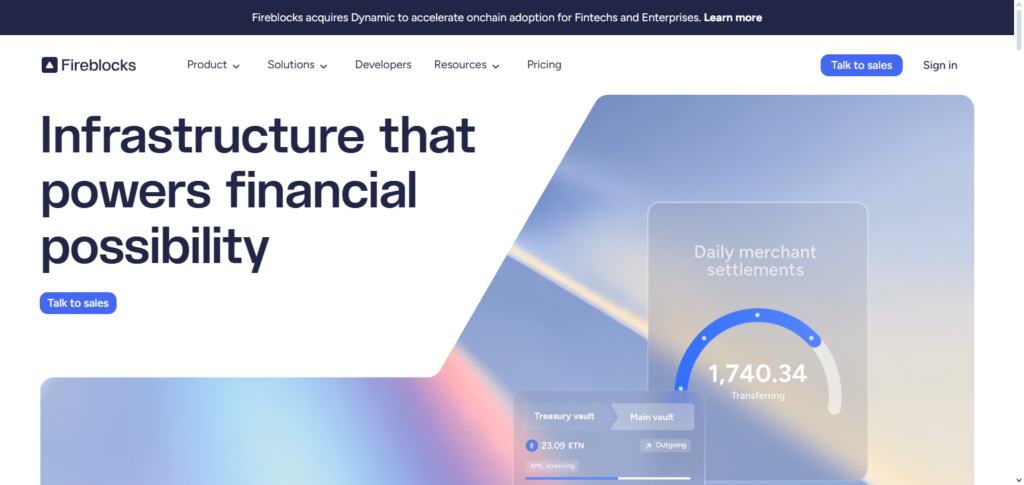
Fireblocks provides an AI trading system via their APIs, allowing hedge funds to automate and simplify trade, transfer, and settlement functionalities. The platform provides trading and portfolio management via DeFi, lending, and staking.
The Fireblocks platform allows insurance provisioning, regulatory compliance, and automated reports to be created for audits. This platform marries security to flexible operational capacities to allow hedge funds with crypto strategies that depend on the use of AI to scale while minimizing the risk associated with the management of digital assets.
Pros & Cons Fireblocks
Pros:
- Offers secure custody with asset management through MPC (Multi-Party Computation) + policy-engine wallet management — minimizing single-point-of-failure vulnerabilities.
- Empowers organizations with wallet management, treasury, tokenization, transfers, settlement, and smart-contract asset flow management, all on a single framework — convenient for funds that have complicated operations to manage aside from trading.
- Credibility and confidence from clients for large-volume transfers, notably with protective measures for trillions of assets. Trusted by many large institutions (banks, funds, exchanges) and has defended from hacks with transfers of over trillions in total assets.
Cons:
- As a custody solution/infrastructure (not an exchange), Fireblocks by itself does not offer liquidity or trading, and institutions still have to add in exchanges or trading venues.
- From a maximum control perspective, there will be an added dependency on that vendor’s uptime, security, and compliance.
- For relatively smaller operations, the cost and complexity of institutional-grade custody might provide less value than the friction of just using simpler wallets or self-custody.
3. Copper
Copper provides institutional-grade custody and settlement services designed for hedge funds and professional investors. The proprietary ClearLoop technology provides off-exchange settlement and mitigates counterparty risk.
For AI-driven trading strategies that rely on digital assets, ropes hedge funds and advanced APIs for trade and liquidity management to integrate with cold crypto assets.
Copper’s cold storage includes insurance and safeguards, with regulated and compliant custody provisions, and transparency on KYC and AML rules. The speeds and integrated offerings of trading infrastructure with Copper’s AI crypto are secure and enduring.
Pros & Cons FalconX
Pros:
- There is the possibility of obtaining top-tier FX liquidity and prime broker services for digital assets through integrations with platforms such as Talos and is ideal for funds requiring fiat-crypto and cross-currency liquidity.
- FalconX provides efficient pricing and settlement workflows for FX and synthetic crypto- fiat which is useful to funds with global operations and multi-currency.
- FalconX as a prime broker has the potential to bridge traditional finance (fiat/ FX) with crypto which is valuable to funds for the purpose of transitioning and/ or hedging to the other asset class.
Cons:
- There is a possibility of FX liquidity services carrying costs and onboarding criteria which could limit access for smaller funds.
- The availability of FX liquidity and services may be influenced by the regulatory environment of the jurisdiction, as well as the regulatory environment of the counterparties.
- Implementing FX/prime broker services adds a layer of complexity compared to crypto only arrangements; funds must take on a further layer of currency and settlement risk.
4. FalconX
FalconX is an advanced crypto trading platform that serves institutional clients. FalconX’s trading platform is focused on optimizing trading execution and obtaining the best price over multiple exchanges. Hedge funds are able to use AI to execute high-frequency or large-volume trades that are able to avoid impacting the market.
FalconX offers real-time customized priced trades and supports sophisticated automated execution that can enhance AI trading strategies. FalconX has a fast and clear settlement process.
The platform also supports trading both derivatives and spots to provide multiple trading strategies. With a combination of deep liquidity, automation, and regulatory compliant, FalconX is built to support hedge funds to use AI to trade cryptocurrencies on FalconX’s trading platform.
Pros & Cons FalconX
Pros:
- There is the possibility of obtaining top-tier FX liquidity and prime broker services for digital assets through integrations with platforms such as Talos and is ideal for funds requiring fiat-crypto and cross-currency liquidity.
- FalconX provides efficient pricing and settlement workflows for FX and synthetic crypto- fiat which is useful to funds with global operations and multi-currency.
- FalconX as a prime broker has the potential to bridge traditional finance (fiat/ FX) with crypto which is valuable to funds for the purpose of transitioning and/ or hedging to the other asset class.
Cons:
- There is a possibility of FX liquidity services carrying costs and onboarding criteria which could limit access for smaller funds.
- The availability of FX liquidity and services may be influenced by the regulatory environment of the jurisdiction, as well as the regulatory environment of the counterparties.
- Implementing FX/prime broker services adds a layer of complexity compared to crypto only arrangements; funds must take on a further layer of currency and settlement risk.
5. LMAX Digital
Let’s discuss LMAX Digital. This is a crypto trading platform built on a regulated model, focusing primarily on institutional clientele like hedge funds. For the AI trading strategies LMAX Digital supports, the crypto exchange integrates a low-latency matching engine built for fast and precise executions.
This exchange offers transparency and integrity by maintaining exchange-level liquidity on the top digital assets. In a fully managed way, hedge funds can connect their AI systems via the platform’s APIs and receive automatic trading, analytics streaming, and risk management tools and reports on a custom-built trading interface. Owing to unmatched speed, market reliability, and compliance, LMAX Digital is a preferred trading venue for hedge funds.
Pros & Cons LMAX Digital
Pros:
- Infrastructure permitting spot crypto trading with transparency and regulation — unique selling point for hedge funds
- Superior execution with low latency, high performance, and liquidity — an advantage in both FX and crypto markets
- Funds benefit from improved price discovery and risk/valuation models with reliable market data, in real-time, and no bandwidth limitations
Cons:
- Retail-style accessibility and risk management tools may be beneficial for smaller funds.
- Supports only a limited number of the larger, more liquid cryptocurrencies
- Most institutions have a more complex onboarding and compliance process, which comes with a greater increase in operational effort than integrations with the far simpler consumer-focused exchanges.
6. CME Group (Crypto Futures)
The CME Group offers regulated options and crypto futures that allow hedge funds to speculate or hedge with CME institutional-grade instruments. CME holds significant BTC and ETH liquidity, with deep-predictable execution and risk contracts that allow for execution of AI-strategies.
CME provides full counterparty risk solutions through its integrated platform offering specialized reporting, margining and clearing. Hedge funds utilize third parties or APIs to CME to enhance the optimization of their AI trading strategies.
CME Group offers crypto hedge funds the opportunity to trade efficiently and compliantly, supported by a robust risk management framework and infrastructure. CME Group crypto futures facilitate the AI-enabled hedging, arbitrage, and speculation of funds. The CME Group provides all of the above with a regulated environment.
Pros & Cons CME Group (Crypto Futures & Derivatives)
Pros:
- Provides regulated, cleared crypto futures and options (including newer contracts like XRP and SOL) and thus enables hedge funds to hedge, speculate, or manage risk legally. (CME Group Investor)
- Good liquidity and strong interest from institutions — evidenced by recent record volumes and open interest in 2025 crypto derivatives suite.
- Plans to offer 24/7 trading of crypto futures/options — and thus bridges crypto derivatives trading with the always-on nature of digital asset markets. This is aligned with the operational needs of global funds.
Cons:
- Futures and options trading likely requires separate clearing, margin, and risk management frameworks which makes it operationally complex for funds.
- Regulated derivatives products likely come with stricter compliance and settlement requirements thus imposing more operational rigidity relative to offshore/less regulated venues.
- Access is purely via derivatives, i.e., there are no actual tokens. This may not be appealing to funds that want to have the underlying asset or have certain DeFi-native strategies.
7. Kraken Institutional
For professional cryptocurrency traders, Kraken Institutional offers premium trading, precious over-the-counter trading, and staking services. Kraken’s services include AI trading and automate diversified trading at hedge funds.
Kraken provides additional security features, including cold storage, multiple signatures, and comprehensive KYC-AML checks.
With Kraken’s services, institutions get deep liquidity and low execution latency. Kraken’s services include comprehensive reports for regulatory and compliance reporting. Kraken IAM hedge funds the security, versatility, and proprietary services needed to scale AI focused trading with reduced operational and regulatory risk.
Pros & Cons Kraken Institutional
Pros:
- As per CoinDesk, institutional derivatives arms integrating with custody/settlement systems, such as Copper’s ClearLoop, provides a combination of crypto custody with derivatives trading and secure asset management.
- CoinDesk states that the ability to access a suite of products including derivatives and futures allows professional funds to implement advance trading or hedging strategies beyond spot trading.
- CoinDesk states that there is more flexibility and potentially less counterparty risk compared to self custody or retail solutions if there is external custody.
Cons:
- Integration is a problem as there is no custody and settlement beyond the exchange and those external third parties.
- There are possible higher minimums or more stringent KYC/AML for institutional-grade derivatives trading which is not ideal for smaller or newer funds.
- Because there is less depth than major global derivatives venues, there is less liquidity on certain pairs or products. This is the situation with many of the more specialized offerings aimed at institutions.
8. OKX Institutional
Hedge funds have access to a fully featured platform from OKX Institutional that includes spot and derivatives trading, lending, and margin.
Users can seamlessly integrate automated trading algorithms and risk-management systems via API that OKX offers. OKX provides regulatory-compliant crypto custody solutions, a requirement for many institutions. The liquidity available for many pairs allows hedge funds to fill large trade volumes without slippage.
The platform also offers analytics, reporting, and market insights that help to influence trading decisions through AI. The high level of liquidity combined with the robust technology and customization capabilities makes OKX Institutional a unique provider for hedge funds focused on AI trading.
Pros & Cons OKX Institutional
Pros:
- Provides off-exchange custody services with regulated counterparts (including Komainu). This adds additional security and helps reduce counterparty risks.
- Provides derivatives and spot trading, giving clients the ability to trade a numbe rof instruments on a single platform.
- Global presence and extensive licensing (over several geographies) mean that funds operating on a global scale are able to obtain liquidity and services on a myriad of markets.
Cons:
- The use of third-party custody and institutional relationships may introduce additional dependencies and complications that are not present with in-house custody.
- Some services may not be available due to funds’ regulatory and jurisdictional frameworks.
- Trade-offs regarding some institutional features such as integrations and workflows may be necessary compared to purely crypto infrastructure providers.
9. Bitstamp Institutional
One of the oldest crypto trading platforms that Bitstamp has institutional investors is also one of the few that is regulated and caters to professional investors. For hedge funds that use AI algorithms to determine precise entry and exit points, the Over the Counter (OTC) desk is particularly important.
Bitstamp has generously provided their users with state of the art APIs that have real time data and that can facilitate automated algorithmic trading. For regulatory compliant jurisdictions, Bitstamp assures cold storage, multi-sig wallets with insurance, and other compliance facility.
While some might claim that SPI is regulated, Bitstamp allocates the CFD to hedge the risk, creating trading with and allocated to hedge. With regulated crypto trading and APIs, Bitstamp lets hedge funds us their AI to actively trade.
Pros & Cons Bitstamp (Institutional)
Pros:
- The reputation and longevity of Bitstamp as a fully regulated exchange translates into stability and trust — compliance and regulatory certainty is of utmost importance for hedge funds and asset managers.
- Direct fiat-to-crypto access enables institutional clients to easily manage treasury operations and streamline fiat onboarding.
- More conservative and compliance-focused than high-leverage derivatives venues, which is a better fit for funds with spot custody and security regulatory clarity.
Cons:
- As a spot-focused institutional exchange, it may miss out on having more advanced derivatives or leveraged products like other venues.
- Compared with specialized high-performance exchanges, there could be some drawbacks concerning the liquidity and trading functionality for high-frequency or bigger-size trading strategies.
- Unlike more lightly regulated exchanges, there may be additional onboarding time due to regulatory compliance, the scope of which may limit the exchanges or assets in the markets.
Conclusion
In the contemporary world of cryptocurrency, hedge funds are in constant need of secure, highly adaptable, and AI-efficient trading infrastructures.
To provide advanced custody, settlement, and execution solutions, there are companies such as Talos, Fireblocks, Copper and FalconX, while LMAX Digital, CME Group, Kraken Institutional, OKX Institutional, Bitstamp Institutional and CrossTower Institutional are all fully regulated exchanges that offer high liquidity and low latency.
Automated trading of sophisticated strategies with less risk and increased efficiency absolute mass trades is possible when hedge funds AI systems to these platforms.
To these provide the operational dependability, sophisticated predictive algorithms, and constant comparitive advantage required by the cryptographic ecosystem.
FAQ
How do these providers ensure security for hedge funds?
Providers like Fireblocks and Copper use multi-party computation (MPC), cold storage, and insurance coverage. Exchanges enforce compliance, multi-signature wallets, and monitoring tools to secure assets against theft or operational risks.
Can hedge funds use multiple providers simultaneously?
Yes, many hedge funds integrate multiple platforms for liquidity aggregation, risk management, and redundancy, ensuring AI trading systems have reliable access to markets while diversifying operational risk.
Are these infrastructures regulated?
Most top providers operate under strict regulatory frameworks, including KYC/AML compliance and licensing requirements, particularly exchanges like CME Group, Bitstamp, and Kraken Institutional.