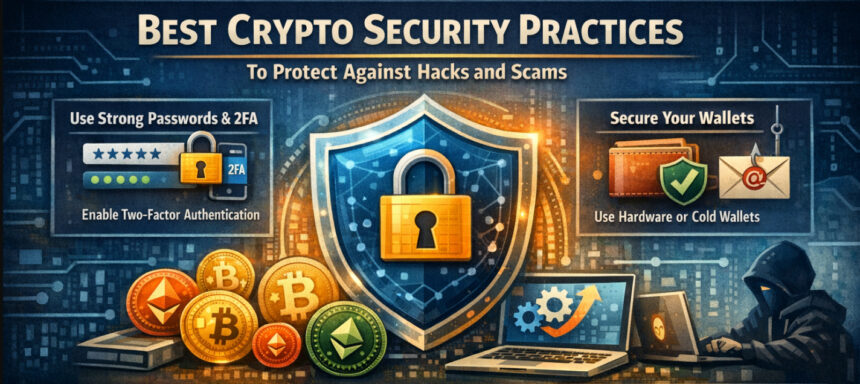
The cryptocurrency industry is constantly evolving, and securing your assets is extremely important. The Best Crypto Security Practices to Protect Against Hacks and Scams are proven methods to protect your wallet, transactions, and private keys.
Best practices, such as using hardware wallets, creating strong passwords, enabling Two-Factor Authentication (2FA), and verifying addresses, help crypto investors and users secure their assets and lower their exposure to risk.
Key Point & Best Crypto Security Practices
| Crypto Security Practice | Key Point / Action |
|---|---|
| Use Hardware Wallets | Store crypto in offline wallets like Ledger or Trezor to prevent online hacks. |
| Enable Two-Factor Authentication (2FA) | Add 2FA on all exchange and wallet accounts to secure logins. |
| Keep Software Updated | Regularly update wallet software, devices, and antivirus for latest security patches. |
| Use Strong, Unique Passwords | Create complex passwords for wallets and exchanges; avoid reusing them. |
| Verify Addresses Carefully | Always double-check crypto addresses before sending transactions. |
| Beware of Phishing Attacks | Avoid clicking suspicious links or downloading unverified apps/emails. |
| Use Multi-Signature Wallets | Require multiple approvals for transactions to reduce single-point-of-failure risks. |
| Limit Exchange Storage | Keep only active trading funds on exchanges; store long-term holdings in cold wallets. |
| Regular Backups | Securely back up wallet seed phrases and private keys offline in multiple locations. |
| Educate Yourself Continuously | Stay informed about scams, vulnerabilities, and emerging crypto security best practices. |
1. Use Hardware Wallets
One of the most trustworthy methods of ensuring the safety of your cryptocurrency investments is the use of hardware wallets. Hardware wallets store private keys offline which makes them invulnerable to hacks, viruses, and phishing scams. Because of this, hardware wallets are much more secure than software wallets.
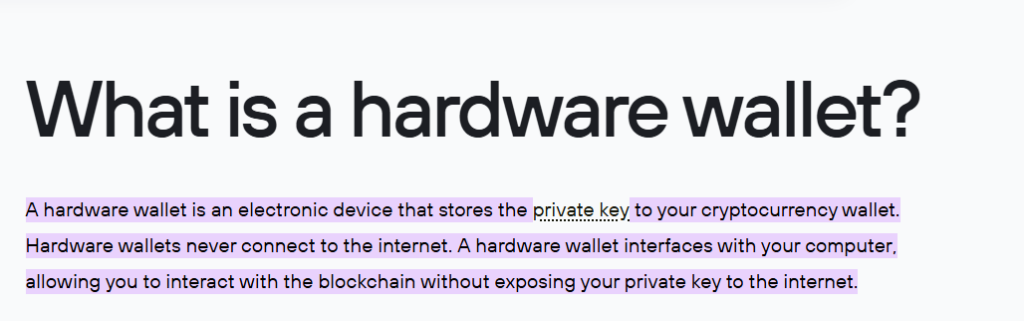
Your crypto will be secure even if your computer is hacked. You should only use hardware wallets from reputable manufacturers and protect your seed phrases. If hardware wallets are used properly and frequently, you will significantly reduce the chances of losing your crypto.
Use Hardware Wallets Features
- Offline storage of the keys helps eliminate the chance of online theft.
- To access the funds, a user must enter a PIN or passphrase.
- Users can support multiple cryptocurrencies with one Hardware Wallet.
- For users to recover assets, a recovery seed phrase can be generated.
- For every transaction, users receive physical confirmation.
Use Hardware Wallets Pros & Cons
Pros:
- Protects assets from online hacks and malware.
- Stores private keys offline for maximum security.
- Supports multiple cryptocurrencies in one device.
- Provides a recovery option with seed phrases.
- Physical confirmation prevents unauthorized transactions.
Cons:
- Initial cost can be high for some models.
- Device can be lost, stolen, or damaged.
- Setup can be complex for beginners.
- Not convenient for frequent trading.
- Recovery requires careful management of seed phrases.
2. Enable Two-Factor Authentication (2FA)
The first step to securing your crypto accounts is activating Two-Factor Authentication (2FA). 2FA is designed to stop cyber criminals from gaining access to your account even if they were successful in stealing your password
. Most exchanges and crypto wallets allow you to set up 2FA with an Authenticator app and in general, it is safer to use an Authenticator app as your second verification step instead of using SMS. Your crypto accounts are protected from unauthorized access if you are required to verify your identity every time you log in or make a withdrawal. Enabling 2FA on your accounts is a great way to defend against criminals who are specifically targeting your accounts.
Enable Two-Factor Authentication(2FA) Features
- For logging in, a user must complete an additional verification step.
- An authenticator app generates time-sensitive codes.
- A user can protect any wallet or exchange account.
- In case of an emergency, backup codes can be used.
- With password theft, the risk is significantly reduced.
Enable Two-Factor Authentication (2FA) Pros & Cons
Pros:
- Adds an extra security layer beyond passwords.
- Reduces risk of unauthorized account access.
- Works for both wallet and exchange accounts.
- Backup codes ensure access if device is lost.
- Easy to implement with authenticator apps.
Cons:
- Extra step can slow logins.
- Loss of 2FA device may lock access temporarily.
- SMS-based 2FA can be vulnerable to SIM swap attacks.
- Backup codes must be stored securely.
- Setup may confuse new users.
3. Keep Software Updated
Updating your software is one of the most important aspects of crypto security, so make sure to do it. This is often how viruses and hackers gain access to your information through your crypto apps and wallets. Keeping everything updated decreases the amount of times your information can be stolen.

Updating everything is almost a must, even down to your phone. Automatic updates, accessed through a security setting, are usually a good decision. Updates make sure your transactions, and the crypto you are storing, remain secure.
This is the best way to make sure that an outdated system does not contribute to viruses, fraudulent software, or hacked information. This is especially true for the software that is running your crypto accounts.
Keep Software Updated Features
- For vulnerabilities, security patches are applied automatically.
- Smooth performance due to the updates in wallet and exchange applications.
- Updates ensure the safety and compatibility of the operating system.
- Protection against malware and other invokes of cybercrime is improved.
- Updates help to ensure the system continues to follow the prescribed protocols.
Keep Software Updated Pros & Cons
Pros:
- Fixes known security vulnerabilities.
- Protects wallets and devices from malware.
- Maintains smooth operation of exchanges and wallets.
- Ensures compatibility with blockchain protocols.
- Automatic updates reduce manual effort.
Cons:
- Updates may temporarily disrupt usage.
- Can introduce new bugs occasionally.
- Requires user attention for manual updates.
- Some updates require device restart.
- Ignoring updates reduces security significantly.
4. Use Strong, Unique Passwords
Passwords are one of the most important factors in the security of your crypto accounts. Substitute your passwords for ones that are more likely to be cracked and reused. Attempting to guess your passwords will put you in more danger and make you more likely to be attacked. Personal information such as your birthday or name should not be included in your passwords.

They are simpler to hack and more likely to be used in attacks. Password generating and storing programs are able to create and save very safe passwords that are complex. If all of your crypto wallets and exchange passwords are per transaction, unique, and complex, your other crypto accounts will be secured from unauthorized access.
Use Strong, Unique Passwords Features
- Passwords must include an upper case letter, lower case letters, numbers, and symbols.
- Passwords must be distinct for every wallet or exchange account.
- To ensure security, passwords must be changed every few months*.
- In the case of a hack, guessing the password or using a brute force hack will be extremely difficult.
- These services are offered by password managers.
Use Strong, Unique Passwords Pros & Cons
Pros:
- Difficult to guess or crack.
- Reduces risk if one account is compromised.
- Enhances overall account security.
- Can be generated using password managers.
- Helps prevent brute-force attacks.
Cons:
- Hard to remember complex passwords.
- Frequent changes can be inconvenient.
- Password managers are sometimes needed.
- Resetting forgotten passwords can be tedious.
- Weak or reused passwords compromise security.
5. Verify Addresses Carefully
The fact that crypto transactions are irreversible makes verifying addresses the most important step in sending crypto. There are many ways for hackers to intercept your crypto if you are not careful. One of them is clipboard malware to phishing.

Always verify that you are sending your cryptocurrency to the correct recipient. Ideally, you should do so by verifying the first and the last, as in the cases of many phishing attempts. The next step to be taken is to ensure that the code is from a trustworthy source and that it is correct.
Chances are that they will make a mistake, and so when you have to do it over and over again, make sure that you do so. Ways to ensure that cryptocurrency is sent to the correct recipient also protect crypto users from scams. Rest assured that your funds are sent to the right address and definitely not to some scammer.
Verify Addresses Carefully Features
- Addresses require verification prior to sending.
- The first and last letters must be confirmed by copy-pasting.
- Most mistakes when sending money to an address can be avoided by scanning a QR code.
- For multiple transactions, reconfirm the address.
- This ensures that the intended recipient receives the cryptocurrencies.
Verify Addresses Carefully Pros & Cons
Pros:
- Prevents accidental loss of funds.
- Reduces risk from malware altering clipboard addresses.
- Ensures crypto reaches the intended recipient.
- Adds a safety check before transactions.
- Can detect errors even in repeated transactions.
Cons:
- Time-consuming for multiple transfers.
- Human error may still occur.
- Malware or phishing could still compromise addresses.
- Slows down frequent transactions.
- Requires constant attention and diligence.
6. Beware of Phishing Attacks
Phishing scams are one of the most common ways to steal cryptocurrencies. Phishers may create fake websites or emails or messages that look like real exchanges or wallets to steal your login information.
Always examine the link before clicking on it. Never provide your seed phrase to anyone. Additional protection against phishing scams is provided by hardware wallets and Two-Factor Authentication (2FA). Educating yourself about phishing scams will help you to not fall victim to one.
Beware of Phishing Attacks Features
- Look out for emails that are not exchange mails.
- Don’t go to a website that is foreign to you.
- Do not log into a website without knowing the URL.
- Know that you are the target.
- Don’t let anyone take the keys to your wallets.
Beware of Phishing Attacks Pros & Cons
Pros:
- Protects credentials from theft.
- Prevents unauthorized wallet or exchange access.
- Reduces exposure to scams and malware.
- Enhances overall online safety.
- Encourages safer online habits.
Cons:
- Requires constant vigilance.
- Can cause hesitation in interacting with legitimate sources.
- New phishing tactics emerge frequently.
- May require additional time to verify links.
- Mistakes in judgment can still lead to compromise.
7. Use Multi-Signature Wallets
Multi-signature wallets provide another level of security because multiple parties must consent to complete a transaction. They are also safer on a higher level because a single point of failure cannot complete transactions like traditional single-key wallets.

For corporate treasury management and large multi-signature wallets, single individual access is often designed to be limited to guard against fraud. For protection against other fraud, a combination of hardware wallets and multi-signature wallets is ideal for serious crypto holders.
Wallets with Multiple Signatures Features
- Many keys are needed to authorize a transaction.
- The number of required signatures can be established.
- For better security, it is compatible with hardware wallets.
- If one key is misplaced, it offers recovery.
- The chances of a transaction being authorized or executed by mistake are significantly decreased.
Use Multi-Signature Wallets Pros & Cons
Pros:
- Requires multiple approvals for transactions.
- Reduces risk of unauthorized withdrawals.
- Enhances security for high-value assets.
- Recovery possible if one key is lost.
- Works with hardware wallets for added protection.
Cons:
- Setup is more complex than single-signature wallets.
- Slower transaction process due to multiple approvals.
- Coordination required among signatories.
- Not ideal for casual or small-scale users.
- Management of multiple keys can be confusing.
8. Limit Exchange Storage
Keeping crypto assets on exchanges is dangerous because your assets will be compromised in a potential hack. You should limit that risk by keeping just enough funds on the exchange to trade and then move your longer term assets to a wallet that is safer.

You should keep your assets under your control and limit your assets stored on an exchange. Loss of funds from an exchange can happen even if the exchange is reputable.
The risk from hacks, vulnerable insiders, exchange insolvency, and even your own mistakes can be reduced if you just take your own funds off an exchange. Greater control happens because of the regular movement of funds to your own storage from an exchange.
Limit Exchange Storage Features
- On exchanges, only money that you will actually trade should be kept.
- All money that you plan to keep for a long time should be kept in a safe wallet.
- Keeping money on exchanges will increase the chances of hacking.
- Check for strange activity on your balance regularly.
- Plan to keep your money without relying on the exchange.
Limit Exchange Storage Pros & Cons
Pros:
- Reduces exposure to exchange hacks.
- Maintains control over assets.
- Encourages use of personal wallets for long-term storage.
- Minimizes risk from exchange failures.
- Allows monitoring and management of active funds.
Cons:
- Limits immediate liquidity for trading.
- Requires frequent transfers to personal wallets.
- Users must actively manage balances.
- Cold storage setup may be inconvenient.
- Neglecting transfers can increase risk if exchange is hacked.
9. Regular Backups
Crypto security is all about the regular backup of the wallets, seed phrases, and of private keys. The loss can be due to malfunction of hardware of software, loss of the device, or passwords, or other mistakes by the user.

Permanent loss can happen without backups, and that is why backups are so important. Backups storage should be offline in a safe location, and, preferably in different locations. Hacking is risk are very low if the backups are digital and the backups are online.
For emergencies and even in situations backups are the only way to have access to your funds. Backups, combined with other safes and hardware wallets are central in crypto. Investments can be secured against all cyber and physical damage with these methods.
Regular Backups Features
- Keep wallet recovery phrases somewhere safe.
- Store backups in different locations.
- Make new backups based on changes.
- Digital backups should be encrypted.
- Even lost or damaged devices will allow access.
Regular Backups Pros & Cons
Pros:
- Protects funds in case of device loss or failure.
- Ensures recovery through seed phrases or encrypted backups.
- Maintains up-to-date account access.
- Multiple backups reduce single-point-of-failure risk.
- Supports both offline and digital storage options.
Cons:
- Backups must be securely stored.
- Physical copies can be stolen or damaged.
- Digital backups require encryption knowledge.
- Forgetting to update backups reduces effectiveness.
- Managing multiple backups adds complexity.
10. Educate Yourself Continuously
New scams and security vulnerabilities can appear at any given day. Therefore it’s pivotal to continue educating yourself. Make sure to follow the latest news and updates within crypto (legit crypto news, security blog sites, etc.).

Make sure to understand risks with certain blockchains, wallets, and exchanges. Make sure to understand the risks when it comes to phishing, scams, and malware. Being aware and up-to-date with the latest news will help adopt the best security methods to remain fraud-free.
The stronger the knowledge in the community, the stronger the community is against hacks. This is the crypto ecosystem and will help to keep digital assets guarded.
Educate Yourself Continuously Features
- Research the newest crypto security concerns.
- Familiarize yourself with the wallet and exchange updates.
- Know the patterns of scams, hacks, and attacks.
- Join forums and groups.
- Protect your assets by acting wisely.
Educate Yourself Continuously Pros & Cons
Pros:
- Keeps you aware of emerging threats and scams.
- Helps make informed decisions on security.
- Improves ability to identify phishing and malware.
- Encourages adoption of new best practices.
- Reduces risk of human error in crypto transactions.
Cons:
- Requires ongoing time and effort.
- Can be overwhelming due to constant updates.
- Not all advice encountered is trustworthy.
- May create unnecessary caution or hesitation.
- Knowledge alone doesn’t replace proper security tools.
How to Choose the Best Crypto Security Practices
Use Security Practices That Provide Frequent Updates. Most security holes are discovered in outdated software. As a result, always use practices that suggest frequent wallet and exchange updates, as well as device updates.
Limit Your Resources on Exchanges. Keep the minimum amount you can get in your exchange account and limit your trading exchange storage. Staying on the safe side will help you as large-scale losses, if an exchange is hacked.
Security Practices With Malware Instructions. Make sure you follow ** the carefully verified address ** practices because in case you mistakenly sent the wrong coin to someone, malware may attack you and other accounts to redirect your funds.
Educate Yourself on Phishing and Scams Continuous self-education on phishing scams is essential and knowledge of these scams is just as valuable as any other form of technical protections.
Include Recovery Options as Part of Your Practices Recovery options are a critical part of any safety measures. Regular backups of wallets and seed phrases are essential to not losing your assets due to a broken or lost device.
Consider the Trade-Off Between Convenience and Security Many safety practices involve a trade-off between security and convenience. An example is multi-signature wallets which are more secure than single signature or even self-custody wallets. Choose practices that are more easy to use and secure.
Be More Safety Focused than Protection Focused Focus on practices that are safety oriented, such as hardware wallets and offline backups to increase safety by eliminating online protections that are less effective
.Educate and Practice on an Ongoing Basis The crypto environment is rapidly changing and new threats and tools are continuously developing. Choose practices that are adaptive to change and encourage ongoing education and practice.
Conclusion
A major part of risk management is always going to be protecting your digital assets. Saving your assets from hacks and scams can be done by best practice implementations like enabling 2-factor authentication, using a hardware wallet, and using a password that is both very strong and unique.
If you recognize and manage your phishing attacks and address scams and back up your digital assets regularly, you will be protecting your digital assets from cyber threats. As a result, you will be more confident investing in crypto and protecting yourself from cyber threats.
FAQ
1: What is the safest way to store cryptocurrency?
The safest way to store crypto is using hardware wallets, which keep your private keys offline and safe from online hacks or malware. Pairing them with strong passwords and backups further enhances security.
2 How often should I update my software?
Always keep wallets, exchanges, and devices updated. Updates patch vulnerabilities, protect against malware, and ensure smooth crypto transactions. Regular updates are critical to reduce hacking risks.
3 Why should I enable Two-Factor Authentication (2FA)?
2FA adds an extra layer of protection. Even if someone obtains your password, they cannot access your account without the second authentication factor, typically via an authenticator app or backup codes.
4 Why are strong, unique passwords important?
Using strong, unique passwords prevents brute-force attacks and reduces the chance of multiple accounts being compromised. Never reuse passwords across wallets or exchanges.
5 How can continuous education improve crypto security?
Educating yourself continuously helps you stay aware of new scams, vulnerabilities, and security tools. Knowledge allows you to make informed decisions and adopt the latest best practices.