
The Top Crypto Wallets for Corporate Treasury Management will be covered in this post. The appropriate wallet is essential for corporate treasuries to manage digital assets in a safe, legal, and effective manner.
These wallets assist companies in protecting assets, streamlining processes, and successfully navigating the rapidly changing world of cryptocurrency finance. They offer everything from institutional-grade security to regulatory compliance and smooth treasury operations.
Why Use Crypto Wallets for Corporate Treasury Management
Regulatory Compliance: Mitigates operational and legal risk by adhering to the Travel Rule and other compliance measures.
Efficient Treasury Operations: Processes rapid and compliant transfers with automated multi-user approvals and trading platform integrations.
Secure Asset Storage: Protects corporate funds using advanced technologies such as cold storage, multi-signature wallets, or MPC.
Transparent Auditing: Supports corporate audits with detailed records and transaction reporting.
Portfolio Management: Corporates can manage, track, and hold multiple crypto assets from a single platform.
Key Point & Best Crypto Wallets for Corporate Treasury Management List
| Crypto Custody Platform | Key Points |
|---|---|
| Fireblocks | Institutional-grade custody with MPC (multi-party computation), instant transfers, compliance automation, and robust security. |
| BitGo | Multi-signature wallet, enterprise-grade security, regulatory compliance, supports a wide range of tokens, and integrated insurance. |
| Ledger Enterprise | Hardware wallet solution for enterprises, strong offline security, user-friendly management via Ledger Live, and multi-currency support. |
| Coinbase Custody | Regulated custody with insurance coverage, segregated cold storage, strong compliance for institutional clients, and reporting tools. |
| Anchorage Digital | Fully regulated digital bank and custody, supports staking, DeFi access, MPC security, and institutional-grade compliance. |
| Copper ClearLoop | Innovative custody with secure off-chain settlements, transaction monitoring, MPC security, and API integration for institutions. |
| Qredo | Decentralized MPC custody, multi-chain support, instant settlement, high security for institutional crypto assets. |
| Zengo Business | Keyless crypto custody using MPC, seamless mobile/desktop management, compliance-ready, multi-chain support. |
| Gemini Custody | Regulated and insured cold storage, strong compliance and reporting, integrated trading options for institutions. |
| Kraken Custody | Regulated custody with insured storage, supports staking, multi-chain assets, enterprise-level security and reporting tools. |
1. Fireblocks
Fireblocks acts as an institutional-grade custody and transfer solution for corporate treasury management and is one of the best in the industry. Using Multi-Party Computation (MPC), Fireblocks secures digital assets and allows for instant transfers between any wallets and any exchanges.
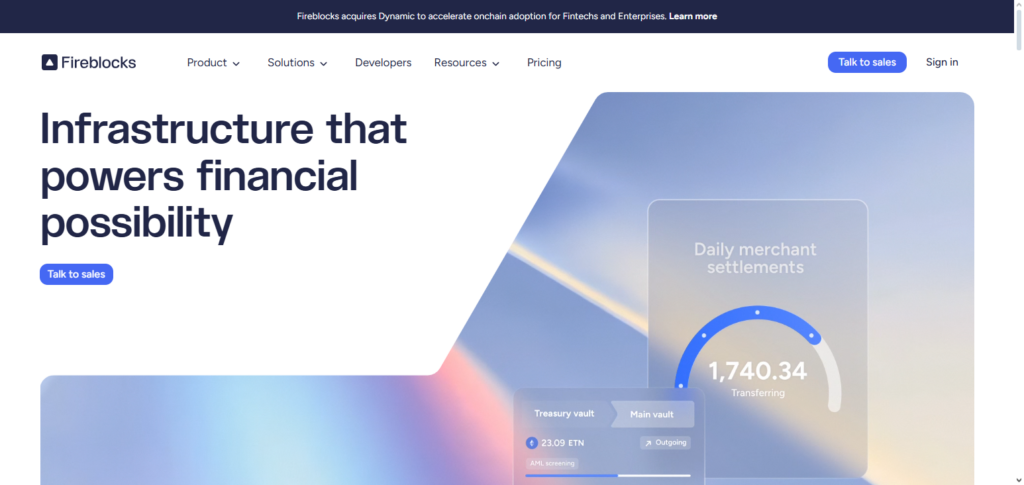
For corporates managing large volumes of crypto, Fireblocks handles compliance and transaction monitoring integrating tools. Automating treasury corporate functions is made easy with enterprise-grade APIs which helps treasury teams automate processes, and record-keeping for audits.
Fireblocks is highly thought of, with industry insurance and cybersecurity, and with good reason. They provide one of the best operational experiences in the crypto world. They meet the criteria for one of the Best Crypto Wallets for Corporate Treasury Management.
Fireblocks Features, Pros & Cons
Features:
- The wallets security is backed by Multi-Party Computation (MPC)
- Automation of treasury operations for transactions of enterprise grade
- Cross-platform transfers and multi-asset management with security
- Travel Rule ready infrastructure and compliance tools.
- Digital assets are covered by insurance.
Pros:
- Transfers are secure and fast.
- Corporate treasury scaling is optimal.
- The operational burden is reduced by automated compliance.
- Multiasset portfolios are supported.
- Ideal for transactions of significant volume.
Cons:
- Smaller companies will incur fees that are higher than the average.
- The use of onboarding support is a necessity due to the systems complexity.
- There is less offline cold storage than what hardware wallets provide.
- There is dependence on platform infrastructure.
- There is a lower than average suitability for more complex treasury requirements.
2. BitGo
Enterprise crypto custody is a new sector of the crypto economy, and BitGo is one of the leading companies in this fast-growing industry. They have developed multi-signature wallets and other digital safe technologies.
Their service includes a large variety of tokens, and they even have a regulatory insurance protection service to keep corporate treasuries safe. To keep treasury teams in compliance with their auditing standards, they provide advanced reporting and compliance tools to monitor their tokens.
BitGo is a top choice for corporate treasury wallets because of the variety of services they offer, such as staking, hot and cold wallets, and scalable API services. They offer governance and compliance at the institutional level. Flexibility, reliability, and governance are their top 3 benefits as a corporate treasury crypto management service.
BitGo Features, Pros & Cons
Features:
- The wallets added security comes from the use of Multi-signature wallet technology.
- Digital assets held on the platform are covered by insurance.
- There are features for compliance that include support for the Travel Rule.
- There are multiple users and control policy based access.
- Support for integration with trading platforms and exchanges.
Pros:
- There is support on managing corporate treasury with multiple users.
- There is a streamlining of crypto operations in the institution.
- The platform is trusted and operational in enterprise environments.
- There is a clearing of crypto operations in the institution.
- There is enterprise adoption of the trusted platform.
Cons:
- The service is costly to small corporate treasury organizations.
- Less offline storage compared to tactical solutions.
- Certain functionalities need advanced technical skills.
- Regional variation in customer support.
- Less automation in DeFi services.
3. Ledger Enterprise
Combining the management enterprise tools with the safety of the hardware wallets, Ledger Live provides centralized management for treasury teams. Their role-based access controls along with other security features makes Ledger from falling to online threats.

For treasury operations, integrating with corporate finance software, and supporting multiple currencies, Ledger Enterprise stands as one of the Best Crypto Wallets for Corporate Treasury Management especially for those organizations prioritizing security and operational efficiency.
Ledger Enterprise Features, Pros & Cons
Features:
- Ultimate security with cold storage hardware.
- Ledger Live capabilities across multiple users and assets.
- Enterprise-grade permissions and access control.
- Custodians and exchange integration.
- Travel Rule and compliance reporting support.
Pros:
- Extremely secure cold storage.
- Excellent for corporate treasury scalability.
- Great reporting and audit features.
- Mitigates key theft risk.
- Supports various digital assets.
Cons:
- Less automation for recurring transfers.
- Initial costs are steeper.
- Team setup is more technical.
- Limited integrations with DeFi.
- Workflow is slower due to hardware dependencies.
4. Coinbase Custody
As the name implies, Coinbase Custody is a crypto custody service to crypto institutions that allows them to pinch Coinbase’s custody service. This service is also regulated and insured. It comprises a few different regulatory “features,” such as the “Audit Readiness.” It also provides segregated cold storage, custody services at the level of a top institution, and seamless integration to Coinbase’s trading engine.
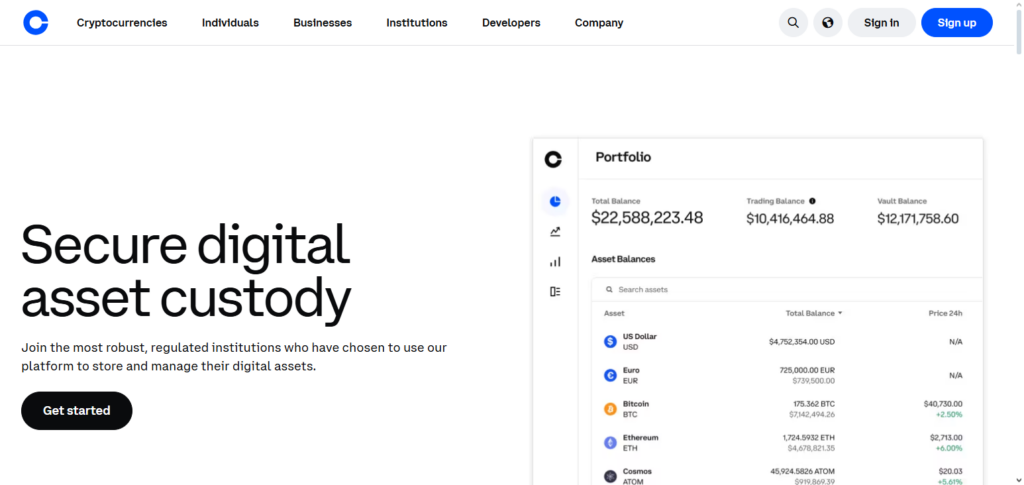
Coinbase custody is also straightforward, has an easy to use interface, and even provides reports, as well as supports a number of tokens. This is why, for a long time, Coinbase custody was rated as one of the Best Crypto Wallets for Corporate Treasury Management and a safe bet for regulated corporates.
Coinbase Custody Features, Pros & Cons
Features:
- Insured custody for institutions and US regulation compliance.
- Integration of users and APIs for corporate functions.
- Compliance and Travel Rule-enabled features.
- Available staking and activities in DeFi.
- Treasury management reporting (audit-ready).
Pros:
- Trustworthy regulated platform.
- Institutional onboarding is uncomplicated.
- Cold storage with insurance.
- Integration of DeFi and multiple assets is supported.
- Compliance and reporting is clear.
Cons:
- Global flexibility is limited due to US regulations.
- More expensive than some competitors.
- Custom workflow limitations.
- Less support for cross-chain.
- Dependent on the Coinbase ecosystem.
5. Anchorage Digital
One of the leading institutions for modern digital banking/financial institutions, Anchorage possesses the most modern and fully licensed custody, staking, and custody banking services, as well as all the banking services for corporate clients. Anchorage solution also allows safe withdrawals of and corporate funds built on ai and biometrics.
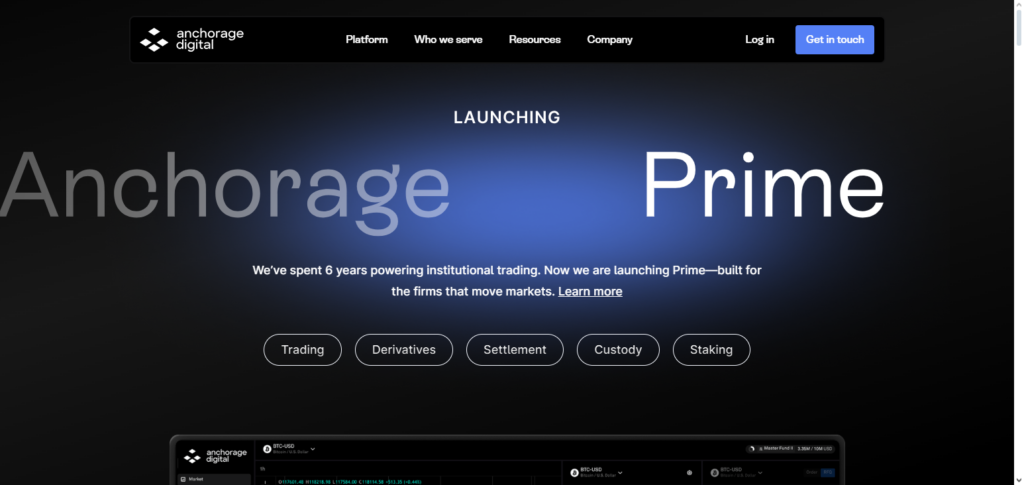
Treasury services includes instant banking safe integrations, advanced compliance, and custody banking services for all crypto assets and safe management. Anchorage also includes the most modern custodial banking services and corporate clients, all banking services for modern digital banking/financial institutions and custody banking services.
Anchorage Digital Features, Pros & Cons
Features:
- Fully insured and regulated custody solution.
- Integrates with corporate treasury systems via API.
- Compliance and Travel Rule support.
- Participation in staking, governance, and DeFi.
- Enterprise-level security with multi-asset storage.
Pros:
- All regulated, comprehensive platform.
- Corporate treasury support at an advanced level.
- Secure and compliant.
- For automation, the flexible API is great.
- Large-scale operations for treasury systems.
Cons:
- Smaller treasuries bear higher expense.
- Lengthy onboarding.
- Offline cold storage is limited.
- Ecosystem is platform-centric.
- Smaller firms may find it unfamiliar.
6. Copper ClearLoop
Copper ClearLoop is focused on developing custody solutions with secure off-chain settlement, wallet security based on MPC, and infrastructure that is always compliant. Automated transaction monitoring, reporting, and API integrations with corporate budget systems are some of the treasury-centric features offered.
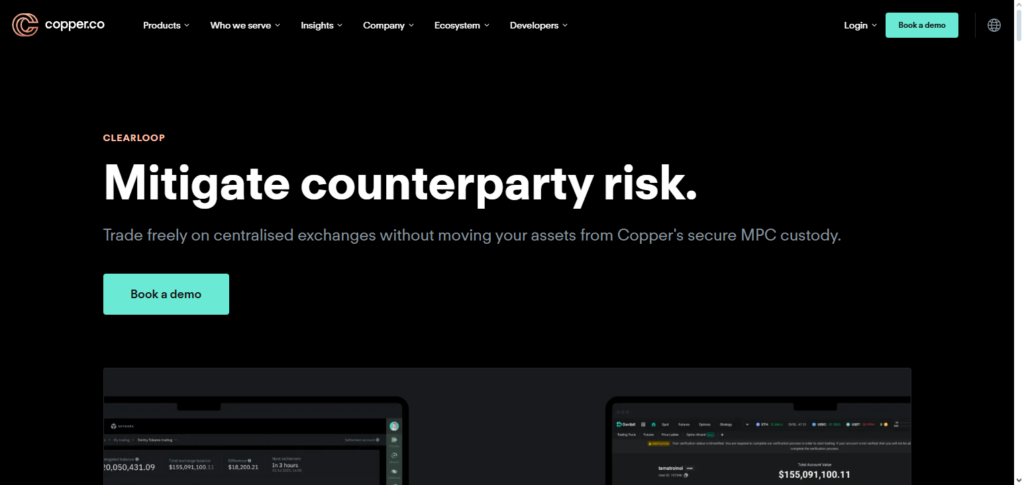
ClearLoop Treasury with the integration provides fast and secure transfers, operational efficiency, and the protection of assets. Its ability to support a wide range of tokens and institutional processes is why it is ranked one of the Best Crypto Wallets for Corporate Treasury Management among corporate institutions for its protection and full compliance with innovative technology to manage digital assets.
Copper ClearLoop Features, Pros & Cons
Features:
- Key management with MPC wallet security.
- Fast treasury transfers and instant settlement.
- Enterprise reporting for multi-asset management.
- Travel Rule compliance tools and support.
- Insured coverage for stored assets.
Pros:
- Fast settlement for treasury operations.
- Secure wallets with multi-party computation.
- Compliance automation for processes.
- Supports multiple assets.
- Corporate treasury operations simplified.
Cons:
- Less adoption than Fireblocks/BitGo.
- Limited storage offline.
- Additional advanced features may need support onboarding.
- Limited presence globally.
- Operations dependent on the platform.
7. Qredo
Qredo is a custodial platform for institutional decentralization and MPC. With private keys distributed across different nodes, it avoids single points of failure, and provides instant settlement and multi-chain functionalities. Its governance and transaction monitoring features make it a fit for corporate treasuries who are focused on transparency and security.

Qredo also facilitates token transfer, and with the liquidity of staking and DeFi, treasury management for large portfolios is simplified. Qredo’s decentralized security and multi-chain capabilities place it among the Best Crypto Wallets for Corporate Treasury Management.
Qredo Features, Pros & Cons
Features:
- Security via decentralized custody and MPC.
- Corporate compliance and adaptable to Travel Rule.
- Supports multiple assets and cross-chain treasuries.
- Rapid payment with several approvals.
- DeFi and trading platform integration.
Pros:
- Corporate treasuries can develop cross-chain solutions.
- Regulated, Defi oriented, and treasuries with multiple users.
- DeFi operations focused on treasuries.
- Supports decentralized cross-chain treasuries.
Cons:
- Adoption gap with classic corporates.
- Requires a certain degree of knowledge.
- Few DeFi integrations.
- Less established than other custodians.
- Treasuries have an adoption gap.
8. Zengo Business
Keyless crypto custody powered by MPC tech lets Zengo Business customers bypass the headaches. Instead, corporate treasuries can manage crypto assets without the concerns that come with key loss or theft. Zengo Business provides custody services across multiple chains with mobile and desktop crypto asset management facilities, treasury workflows, and real-time reporting for compliance.
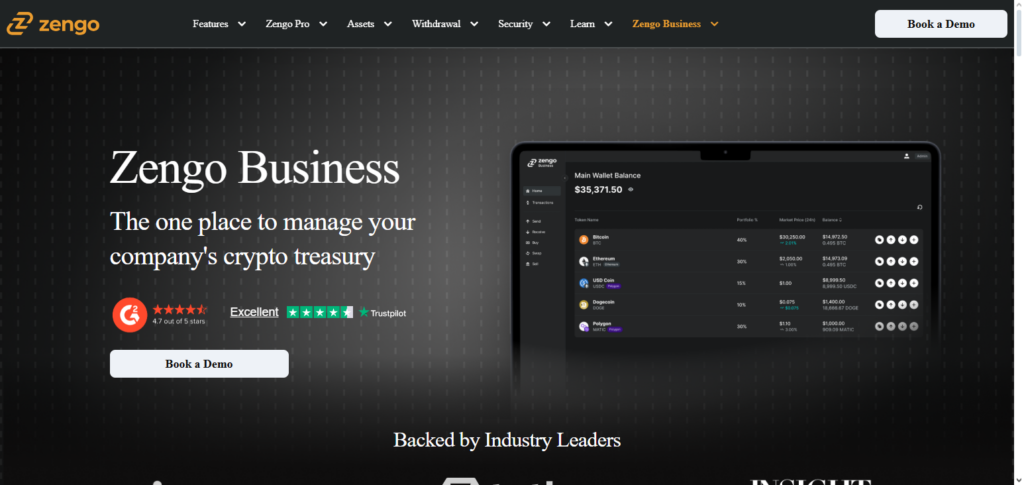
Zengo Business optimizes keyless custody without management complexities, operational risk, and access concerns for corporate teams. Zengo Business is highly praised for offering supreme crypto custody services, and is thus dubbed Best Crypto Wallets for Corporate Treasury Management.
Zengo Business Features, Pros & Cons
Features:
- Wallet technology with no keys and MPC.
- Transfers compliant with the Travel Rule.
- Reporting and access on a corporate and multi-user level.
- Both mobile and web interface.
- No private keys with secure enterprise storage.
Pros:
- No private key exposure.
- Treasury teams can access multi-user permissions.
- Compliance with regulations.
- Enterprise storage levels of security.
- Multi-access with web and mobile.
Cons:
- Less integrations with DeFi solutions.
- Limited platform functionality.
- Less applicable for corporate level operations.
- Basic level of analytics available.
- MPC driven.
9. Gemini Custody
Gemini Custody is a custodian for compliant cold storage crypto for institutions that are insured and regulated. They are among the first in offering seamless multi-signature control cold storage, corporate treasury compliant reporting, and export control corporate treasury systems.
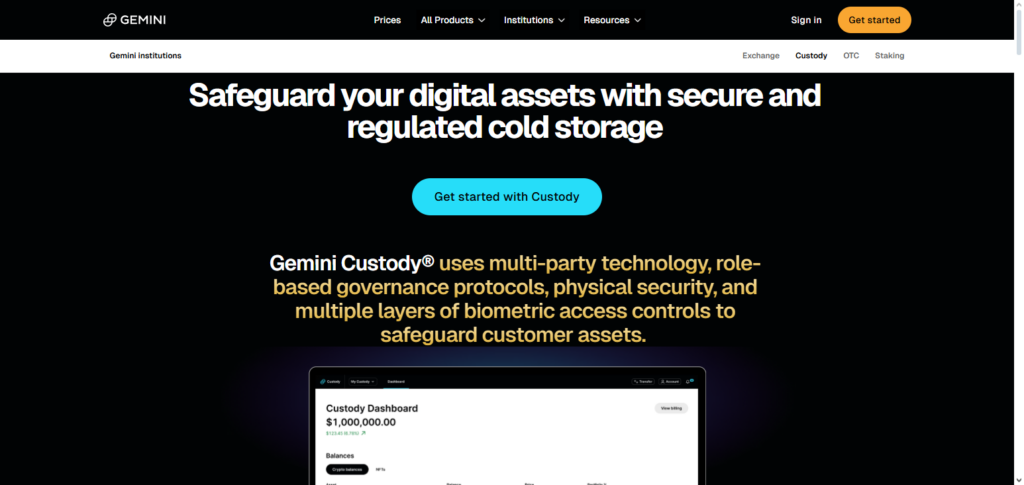
They also support a treasury management system that incorporates staking, crypto trading, and asset shifting, which is seamless and offers corporate treasury teams management of a mixed product portfolio. Gemini Custody is one of the Best Crypto Wallets for Corporate Treasury Management due to well-balanced compliance and operational transparency with corporate organizations.
Gemini Custody Features, Pros & Cons
Features:
- Digital assets custody with multi-user management and corporate teams.
- Travel Rule and Compliance Readiness
- Audit-Ready Reporting and Treasury Dashboards
- Support for Multiple Assets and Integrated Exchanges
Pros:
- Platform is reliable and fully regulated.
- Custodial services are secure and fully insured.
- Compliance and reporting is fully transparent.
- Multi-customer support is available for enterprises.
- Multiple digital assets are supported.
Cons:
- Focus is mainly on the United States.
- DeFi capabilities and cross-chain transaction capabilities are limited.
- Treasury services for smaller amounts come with higher fees.
- The ecosystem is dependent on the platform.
- Competitors have greater global adoption.
10. Kraken Custody
Providing regulated, insured, and secure enterprise-grade storage solutions, Kraken Custody supports multi-chain assets as well as staking. Custody Kraken’s analytics, compliance and APIs make it easier for corporate treasury teams to manage and scale audit-driven internal processes.
Kraken’s flexible operational functionality combined with secure enterprise-grade storage is perfect for corporates managing substantial digital assets.
As a result of Kraken’s effective operational functionality, regulatory compliance, and enterprise-grade digital asset storage, Kraken Custody is considered one of the Best Crypto Wallets for Corporate Treasury Management, as it fulfills the majority of treasury management needs in the crypto space.
Kraken Custody Features, Pros & Cons
Features:
- Custody services regulated by the US and the EU.
- Monitoring for compliant transactions under Travel Rule.
- Access for multiple users and withdrawal control.
- Reporting and audit readiness with insurance.
- Integration with multiple assets and exchanges.
Pros:
- Excellent regulatory compliance.
- Custodial services are secure and fully insured.
- Integration with Kraken’s trading services.
- Multiple digital assets are supported.
- The platform is suitable for enterprises.
Cons:
- Advanced operations highly depend on the platform.
- No or limited features for DeFi.
- Global presence is limited.
- Services can have high fees.
- Compared to Fireblocks, there is less automation.
Conclusion
In conclusion, choosing the appropriate cryptocurrency wallet is essential for corporate treasury management, where operational effectiveness, security, and compliance are crucial.
Institutional-grade security, multi-chain support, compliance tools, and smooth integration for treasury workflows are all provided by platforms like as Fireblocks, BitGo, Ledger Enterprise, Coinbase Custody, Anchorage Digital, Copper ClearLoop, Qredo, Zengo Business, Gemini Custody, and Kraken Custody.
Organizations can confidently protect digital assets, optimize operations, and uphold regulatory compliance by utilizing these Best Crypto Wallets for Corporate Treasury Management. This ensures that their corporate crypto strategy is both safe and effective in the rapidly changing digital finance landscape of today.
FAQ
What is a corporate crypto wallet?
A corporate crypto wallet is a secure digital wallet designed specifically for businesses and institutional clients to store, manage, and transfer cryptocurrencies. These wallets prioritize security, compliance, and operational features suitable for treasury teams handling large volumes of digital assets.
Why are corporate crypto wallets important for treasury management?
Corporate crypto wallets help treasuries securely store digital assets, automate transactions, and maintain regulatory compliance. They provide multi-signature or MPC security, audit-ready reporting, and integration with financial systems, reducing operational and regulatory risks.
Which wallets are best for corporate treasury management?
Some of the leading wallets include Fireblocks, BitGo, Ledger Enterprise, Coinbase Custody, Anchorage Digital, Copper ClearLoop, Qredo, Zengo Business, Gemini Custody, and Kraken Custody. These platforms combine institutional-grade security, compliance, and operational efficiency for treasury teams.
What security features should I look for in a corporate crypto wallet?
Key security features include multi-party computation (MPC), multi-signature support, cold storage, hardware wallet integration, insurance coverage, and real-time transaction monitoring. These ensure the safety of corporate crypto holdings against hacks and key loss.
Can corporate wallets integrate with existing treasury workflows?
Yes, most institutional wallets provide API integrations, reporting tools, and automation features that allow treasury teams to streamline workflows, reconcile accounts, and maintain compliance with internal and external audit requirements.