A developer’s success can be made or broken by their choice of Best Game Distribution Platforms for Developers. Each platform offers distinct tools, business methods, and audience reach, with a plethora of alternatives.
Developers must carefully consider features, monetization tactics, and community participation for everything from indie-friendly markets to large worldwide shops. In order to assist you optimize visibility, income, and player satisfaction, we examine the top game distribution platforms for developers in this post.
Key Factors Best Game Distribution Platforms for Developers
The following is a breakdown of the most important factors when selecting a game distribution platform for developers:
Revenue Share and Payout Structure
Consider the platform’s revenue split, when and how they pay you, and what methods they use to pay. A balanced structure lets developers earn more and have a consistent cash flow.
Audience Reach and Market Size
The number of users and countries the platform operates in defines how much they can advertise your content. More users lead to more game purchases.
Developer Tools and SDK Support
Platforms that offer comprehensive documentation in regards to their SDK, APIs, and integration developer tools provide better development, testing, and analysis.
Monetization Options
Evaluate the platform’s payment methods such as in-game purchases, advertising, subscription models, or one-time purchases. The more options, the more flexible developers are in revenue generation.
Update and Patch Flexibility
The more flexible a platform is with how game updates and bug fixes are distributed, the less downtime the game will have, leading to higher player satisfaction.
Community Engagement Features
If a platform supports player interaction through forums, reviews, or mods, they will be more engaged. A more engaged community is a great way for a game to acquire users through word of mouth.
Availability of Marketing and Promotions
Each platform has its own built-in promotion features they offer. Some will even promote your games more aggressively and offer discounts on their service which ultimately can lead to more sales for you.
Options for digital rights management and security
It’s important that you are protected from piracy and that your transactions are secured. Platforms that offer the best security features are the ones that utilize the best digital rights management and encryption.
Access to analytics and performance metrics
Good analytics are critical for tracking progress and helps in understanding player patterns as well as revenue flow. These metrics help in game optimization and revenue strategies.
Compatibility and support for various devices
Take into consideration the devices and of which operating systems and any hardware they support. Offering wider compatibility will help you reach a more inclusive audience.
Key Point
| Platform Name | Key Features |
|---|---|
| Steam | Massive global audience, community hubs, reviews, mods, achievements |
| Epic Games Store | Lower revenue cut, free game promotions, strong Unreal Engine support |
| Google Play | Largest mobile distribution, in-app purchases, ads monetization |
| App Store | Premium users, strong security, high spending audience |
| GOG.com | DRM-free games, indie-friendly, classic game focus |
| itch.io | Open publishing, flexible pricing, strong indie community |
| Microsoft Store | Cross-platform integration, Game Pass support |
| PlayStation Store | Large console user base, exclusive content support |
| Nintendo eShop | Strong first-party audience, family-friendly market |
| Xbox Store | S |
1. Steam
Steam is the world’s largest PC game distribution channel and serves as the primary distribution point for both AAA and indie developers. It earns its spot via massive community integrated tools, achievements, and cloud saving, as well as Steamworks APIs for multiplayer and DRM.
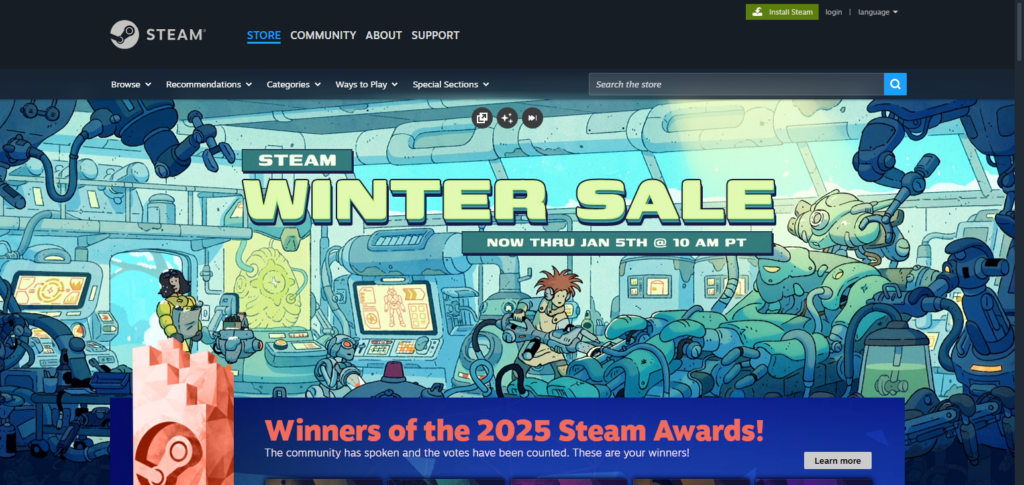
Developers get high reach and discoverability from Steam’s promotion on their seasonal sales, and discover systems. On gaming community platforms, Steam is unrivaled with its 70/30 revenue share, which shifts to 80/20 for high earning titles. Steam is ideal for community and world exposure. Although revenue share is high, it is the best.
Steam Features
- Steam is the largest PC gaming storefront, with millions of active users.
- Steamworks API features include: Steam Achievements, multiplayer integration, DRM, and cloud save.
- Community features include user reviews, discussion boards, and user-created content (Steam Workshop).
- Huge seasonal discounts can be used for visibility.
- Steam has a revenue share of 70/30 which can go to 80/20 (most likely for top performers) making them offer the largest revenue share.
Steam Pros & Cons
Pros:
- Largest audience of PC gamers globally.
- Rich community features (reviews, mods, forums).
- Steamworks API supports multiplayer, DRM, and cloud saves.
- Seasonal sales boost discoverability.
Cons:
- Intense rivalry makes discoverability challenging.
- Default 30% revenue share.
- Thorough verification processes for quality control.
2. Epic Games Store
Epic Games Store is Steam’s newest and fastest competitor, with Epic offering developers revenue splits of 88/12. Competing developer’s store is ideal for indie and mid-size gaming studios. It now adds free weekly game promotions and has fully integrated Unreal Engine with streamlining development tools.
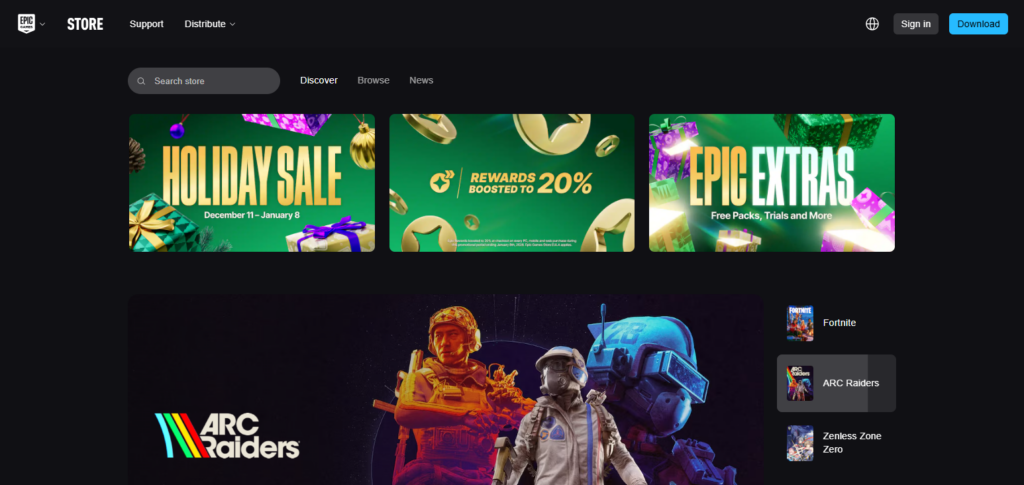
Epic also finances exclusivity agreements and gives developers initial funding. The Epic Games Store has one of the best distributions for developers. Epic has a developer-oriented revenue system and aggressive audience acquisition.
Epic Games Store Features
- Epic has the most revenue friendly distribution to creators with a share of 88/12
- The store releases free games as a marketing tool which increases customers.
- The store is closely affiliated with Unreal Engine.
- There is less competition on the store because it is a curated store with fewer offerings.
- Some creators receive exclusivity contracts that include monetary incentives.
Epic Games Store Pros & Cons
Pros:
- Best revenue distribution (88/12).
- Weekly free game ads increases visibility.
- Deep integration with Unreal Engine.
- Less catalog variety decreases competition.
Cons:
- Less users than Steam.
- Strong dependence on exclusive titles.
- Community features are lacking.
3. Google Play Store
Google Play Store is the leading platform for distributing mobile games on Android devices. It has billions of users and offers simple publishing, in app purchases, and subscriptions. Marketing can be done using Google Ads which is a plus. It offers the best scale for mobile developers, but the competition is steep.
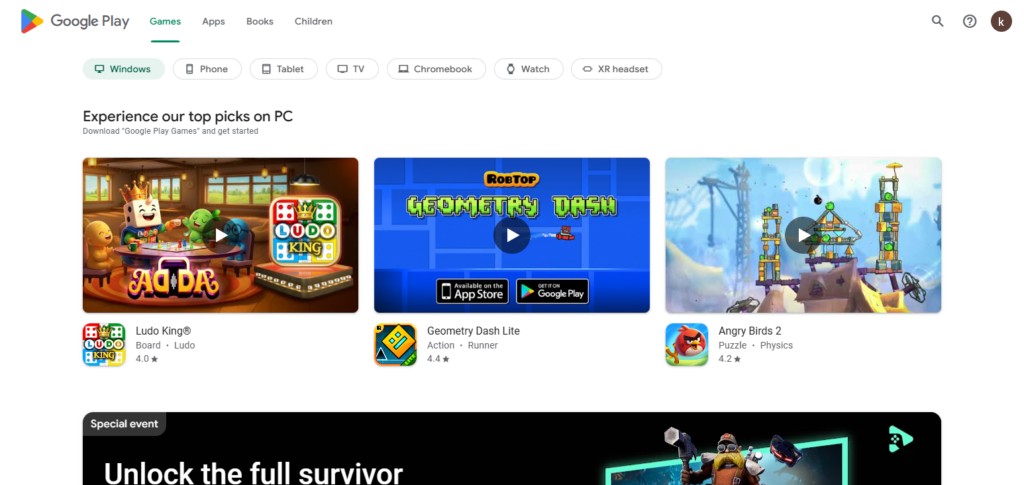
Revenue split is a standard 70/30, but developers making under $1M a year receive a 85/15 split. This makes Google Play Store one of the best platforms for game developers. Mobile focused teams that are looking to achieve rapid adoption, will find Google Play Store to be a necessity.
Google Play Store Features
- The play store can be accessed on billions of devices worldwide.
- Publishing a game is as simple as using the Google Play Console.
- The play store also supports purchases within games (IGPs), advertisements, and recurring revenue through subscriptions.
- Google also integrates their analytics and advertising systems with the store for developers.
- The revenue share for Google is also 70/30, though smaller companies will receive a split of 85/15.
Google Play Store Pros & Cons
Pros:
- Billions of Android devices give worldwide access.
- One-click publishing with Play Console.
- Ads, in-app purchases, and subscriptions are supported.
- 85/15 revenue cut is further reduced for smaller developers.
Cons:
- Competition is fierce in this hub.
- Guides are taped and removed.
- Users are hard to find without running ads.
4. Apple App Store
Developers targeting iOS users find the Apple App Store to be their best option. The App Store is known for its high monetization abilities, though it does come with strict quality controls. In app purchases and subscriptions are offered, along with Apple Arcade.
Developers are given access to a rich audience that is willing to pay for quality experiences. The revenue split is standard for mobile distribution at 70/30 with some exceptions. Revenue of $1 million in annual sales is the break point for an 85/15 split for smaller developers.
Being a developer’s best gaming distribution platforms, Apple App Store provides good monetizing possibilities and brand prestige.
Apple App Store Features
- The Apple App Store is a premium mobile marketplace with strict quality assurance guidelines for entry.
- There is a strong potential for revenue generation with in-game monetization and subscriptions.
- Apple Arcade has also launched a renewed version of seven popular Apple Arcade games.
- Arcade consoles are also available for Apple Arcade.
- Revenue share is 70/30, and 85/15 for smaller developers.
Apple App Store Pros & Cons
Pros:
- High income potential with premium iOS user bases.
- Strong revenue generation through subscription and IAP.
- A curated atmosphere guarantees quality.
- Apple Arcade provides access to premium offers.
Cons:
- Considerable scrutiny in the approval process.
- Revenue Sharing Models: App Store is 30% (15% for small devs), Google is 30% with more flexibility.
5. GOG.com (Good Old Games)
GOG.com is also a DRM free gaming distribution platform. It is appealing to both developers and players who appreciate ownership and preservation. With accolades like, DRM free downloads, support for retro games, and a loyal niche gaming audience.
GOG is great for developers with classic indie and niche gaming titles and focuses heavily on trusting developers and long term gaming accessibility.
GOG like Steam also has a 70/30 revenue share. GOG is among leading developers distribution platforms for those studios focusing on retro players and gaming enthusiasts who value unrestricted access.
GOG.com Features
- They especially try to keep old games compatible, and available for use.
- They focus on a very specific audience, plus those who enjoy the diminutive.
- They have a very particular audience, boutique store.
- With the GOG Galaxy client, you can not just get cloud saves and complete they achievement lists.
- They have a very particular audience, boutique store.
GOG.com Pros & Cons
Pros:
- Players enjoy GOG’s DRM-free distribution.
- Has a strong following for retro and niche games.
- Community focused on game preservation.
- Quality curated store.
Cons:
- Smaller market than Steam.
- DRM-free approach can lead to more piracy and turn off some developers.
- New games won’t find exposure.
6. itch.io
Itch.io is an indie distributive gaming platform that provides great developer resources including adjustable revenue sharing. Features free gaming submissions, is community based, and supports experimental gaming.
Best for indie gaming developers, itch.io also allows gaming price owners to set their own revenue share with a default of 90/10 indie split, and build their gaming communities. It’s especially good for prototyping, gaming competitions (jams), and niche genres.
Itch.io is one among best developer distribution platforms for independent gaming developers that allows unrestrictive gaming community access and creative expression.
itch.io Features
- They focus on the games created rom a developers imagination, then the revenue share 90/10.
- You can add a game, play, and add the game for free.
- They have community discussions, and host game competitions.
- They are also a prototype and evaluation support.
- The developers have their own pages, where they can communicate with the audience.
itch.io Pros & Cons
Pros:
- Revenue model is flexible (defaults to 90/10, but is customizable).
- Submissions are free with little restrictions.
- Game discovery is community driven along with game jams.
- Ideal for indie and experimental games.
Cons:
- Small audience compared to bigger platforms.
- Some monetization options are not provided.
- Commercial titles lose visibility if they are more polished.
7. Microsoft Store
With Microsoft Store, developers can distribute games to Windows PCs and Xbox Consoles. Accessible publishing tools, cloud saves, and integration with Xbox Game Pass are some of the notable features of the Microsoft Store.
It is ideal for developers who want to reach “both PC and console users.” Microsoft’s ecosystem includes “millions of users.” A Game Pass deal can be an extra revenue stream, but the revenue share is typically 70/30.
It is recommended to use Microsoft Store for the Xbox and Windows integration, especially for smaller studios. It is one of the best-distributed stores for gaming developers.
Microsoft Store Features
- You can use the same system on your Windows PC, and your Xbox consoles.
- If you partner with Xbox Game Pass you can also get revenue from their subscriptions.
- You can use cloud saves, and get achievement rewards for cross-platform publishing.
- With their Xbox revenue share, you can get 70/30.
Microsoft Store Pros & Cons
Pros:
- Distribution is merged on Windows PCs and Xbox.
- Game Pass integration for consistent revenue.
- Windows OS has a massive market share.
- Achievements and cloud saves are supported.
Cons:
- Standard revenue share is 30%.
- Competing with Steam is harder to do for Windows.
- Finding games is more difficult compared to Steam.
8. PlayStation Store
With access to one of the most extensive console audiences, PlayStation Store is Sony’s digital marketplace for console developers. It is known for console developers in particular.
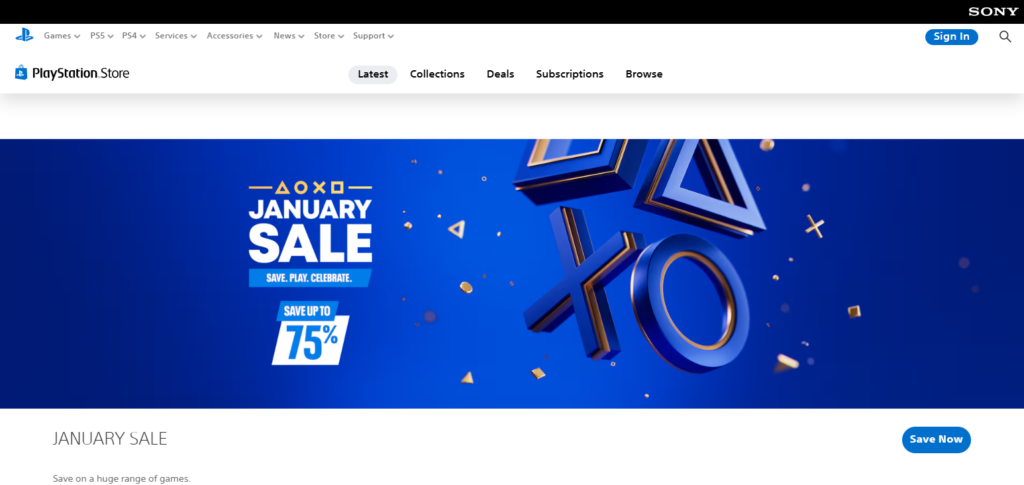
Access to loyal PlayStation fans is easily obtained, and exclusive branding, Sony PlayStation Plus integration, and promotional marketing are some of the standout features. It is one of the leading distribution platforms for gaming developers.
Amid other industry competitors, the revenue share is 70/30, and with that, console gaming reach is gained. It is one of the highest platforms in gaming distribution for developers.
PlayStation Store Features
- You can PlayStation consoles.
- With the PlayStation Plus service you can get some discounts and games promotions.
- The Shop has a good collection of a medieval themed, and noble themed games.
- The Store is grandeur and has a more exclusive collection of games.
- The share is also 70/30 just like with other stores.
PlayStation Store Pros & Cons
Pros:
- Loyal and vast audience on consoles.
- PlayStation Plus has promotional integration.
- Well-recognized brand among gamers.
- Exclusive games are more visible.
Cons:
- Going through the process for the first time is slow and difficult to get certified.
- 30 % cut on revenue.
- Limited options for indie developers.
9. Nintendo eShop
Known for its range of family-centric games, Nintendo eShop is the main distribution service for the Nintendo Switch, and for its main console titles, it integrates Nintendo Switch Online with other games and provides Nintendo Switch eShop promotions. Digital publishing is easy and promotions are available through Nintendo’s curated selections.
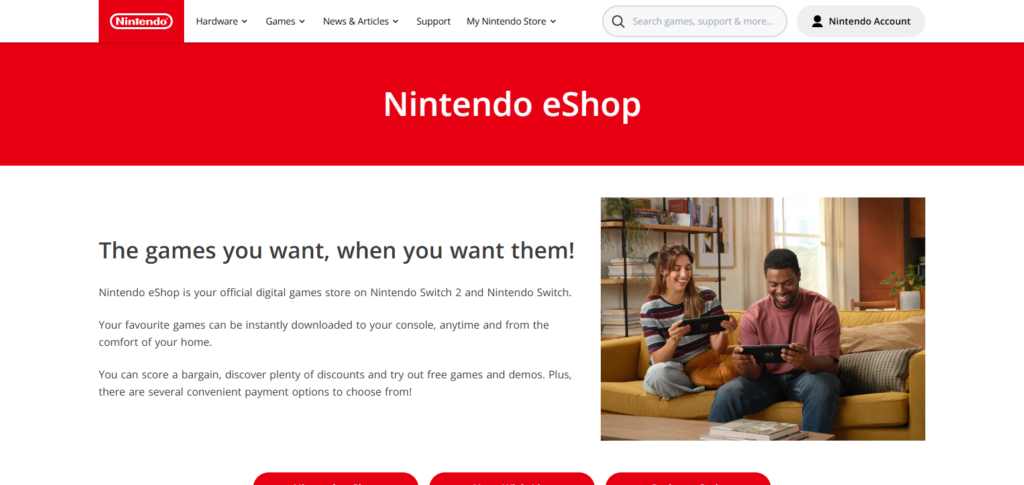
Ideal for developers specializing in family-friendly and creative gameplay experiences, Nintendo eShop connects developers to a highly engaged customer base.
Revenue split is 70/30, the industry standard for console platforms. Nintendo eShop is a major game distribution service for developers, especially for studios focusing on the Nintendo Switch.
Nintendo eShop Features
- Digital store for Nintendo Switch games.
- Audience includes families and people interested in innovations.
- Integration with Nintendo Online services.
- Featured listings and promotions.
Nintendo eShop Pros & Cons
Pros:
- Distribution on Nintendo Switch, an exclusive console.
- Customers of the platform are families with kids, and the console targets innovation.
- Nintendo Switch offers editorial features, promotions and boosts.
- Nintendo has a good reputation.
Cons:
- 30% revenue cut.
- Approval is very difficult.
- Not many 3rd parties compared to the playstation and Xbox.
10. Xbox Store
Xbox Store is Microsoft’s marketplace for consoles, to be used alongside the Microsoft Store for PCs. Prominent features include Xbox Live integrations, achievement systems, and support for Game Pass.
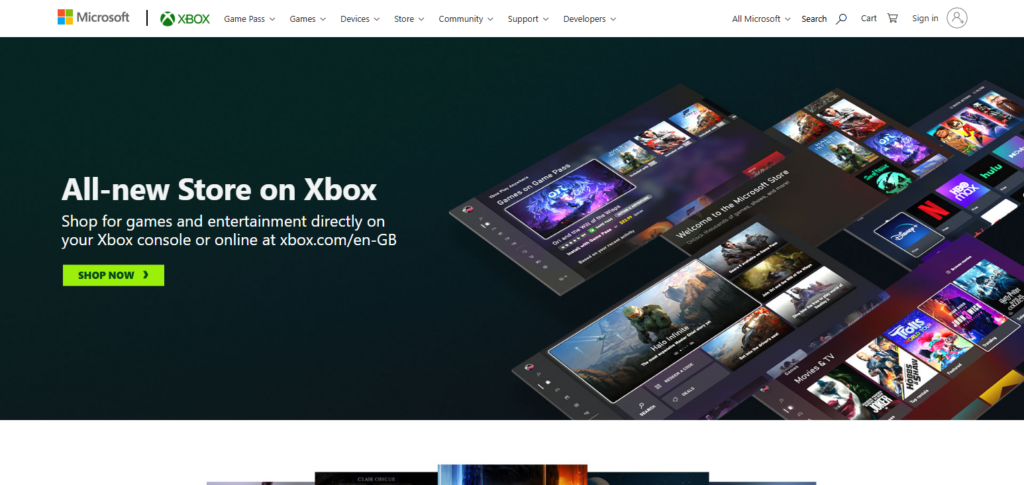
Xbox Store offers console developers the opportunity to reach millions of Xbox players, making it one of the best game distribution platforms for developers.
Game Pass agreements also add to developer earnings. Xbox Store is one of the most important platforms for developers to access console gamers and Microsoft’s subscription-based ecosystem.
Xbox Store Features
- Marketplace focused on consoles within Microsoft ecosystem.
- Integration with Xbox Live achievements and multiplayer.
- Game Pass integration for recurring revenue.
- Big audience on consoles worldwide.
- Standard revenue share of 70/30.
Xbox Store Pros & Cons
Pros:
- Audience is worldwide.
- Xbox live is offered with game achievements and multiplayer.
- Game pass is available for revenue on subscription.
- Microsoft is a strong company.
Cons:
- 30% cut on revenue.
- Biggest titles are more competitive.
- Not as focused on indie games as on itch.io or steam.
Conclusion
Selecting a game distribution platform is one of the undertaking choices developers must face because it impacts their visibility, revenue, and overall success of the distribution. The overwhelming reach and community engagement of Steam, along with the top revenue split of the Epic Games Store, makes them the go to platforms for PC distribution.
For the mobile game developers, Apple and Google’s mobile ecosystems distribute games worldwide while profiting from premium monetization. Players with consoles are reached via the Microsoft Store, PlayStation Store, Nintendo eShop, and Xbox Store, which also include subscription monetization via Game Pass and PlayStation Plus.
Niche markets such as itch.io and GOG.com are also available to developers. These indie and retro platforms focus more on their audience than their policies.
To have the best reach and revenue the best approach is to go for multi-platform distribution. A mix of mainstream and niche platforms ensures all areas are covered. The platform choices and monetization methods should be adapted to the genre of the game and the audience it targets.
FAQ
What is the best platform for PC game distribution?
Steam is the largest PC marketplace with millions of active users, strong community tools, and global reach. Epic Games Store is also popular due to its 88/12 revenue split.
Which platform offers the highest revenue share for developers?
Epic Games Store provides the most developer-friendly split at 88/12, while itch.io allows customizable revenue sharing (default 90/10). Most other platforms use a standard 70/30 model.
What are the best platforms for mobile game developers?
Google Play Store (Android) and Apple App Store (iOS) dominate mobile distribution. Google Play offers global reach, while Apple App Store provides premium monetization opportunities.
Which platforms are best for indie developers?
itch.io is the most indie-friendly, offering flexibility and community-driven discovery. Epic Games Store and Steam also support indie titles, though competition is higher on Steam.
Are console platforms important for developers?
Yes. PlayStation Store, Nintendo eShop, and Xbox Store are essential for reaching console gamers. They provide strong brand loyalty and subscription-driven ecosystems like Game Pass and PlayStation Plus.