When managing both traditional and digital assets in today’s changing financial environment, private investors are confronted with more complex regulatory requirements and sophisticated security concerns.
Professional, regulated safekeeping with cutting-edge security, insurance protection, and compliance frameworks is provided by the best institutional-grade custody systems.
Private investors can ensure peace of mind while successfully navigating international markets and emerging investment opportunities by utilizing these services to protect their portfolios, obtain clear reporting, and access scalable infrastructure.
What Is Institutional-Grade Custody?
A professional, strictly regulated asset storage service intended for major investors like banks, hedge funds, asset managers, and enterprises is known as institutional-grade custody.
It incorporates sophisticated security features such as cold storage, insurance coverage, multi-signature or MPC key management, stringent compliance controls, and verified operational procedures.
Protecting valuable traditional or digital assets while adhering to the governance, reporting, and regulatory requirements set by institutional clients is the aim.
Why Private Investors Need Institutional-Level Security?
Greater Security Solutions Deterrent Hacks, Phishing, and Internal Fraud, Safeguarding Investors’ Capital that includes Nested Defense, Professional Monitoring, and Audited Safeguard Standards.
High End Custody Solutions Offers Secure Cold Storage with Encrypted Access Controls and Operational Error Alerts to Ensure Investors Maintain a Full View of Their Assets.
Institutional Grade Compliance Helps Investors Meet Regulatory Requirements, Streamlines Reporting, and Provides Regulatory Coverage and Transparency Across Global Market Financial Institutions.
Professional Custody Services Assure Investors the Financial Safety of Their Assets Against Loss Due to System Failure or Security Breach, Enhanced by Disaster Recovery Solutions.
Enterprise Level Access Controls Ensure Investors Gain from No Single Point of Failure System, Providing Checks, Balances, and Accountable Transaction Approvals.
Private Investors Scalable Asset Growth, Market Expansion, and Advanced Financial Product Adoption Without Compromising Safety.
Key Criteria for Choosing an Institutional-Grade Custody Provider
Regulatory compliance and licensing means the custody provider can operate within the law and offers frameworks for transparency, auditing, and legal safety for the custody of assets of both institutions and private investors in multiple jurisdictions.
The provider’s security architecture should include all the elements like multi-signature keys or MPC key management, cold storage, encryption, and monitoring that minimize the risks of hacking, internal threats and operational weaknesses at all stages of a transaction.
Insurance and a financial guarantee show that the provider can defend client assets from theft, cyber, and operational risks, and that clients can trust their losses can be covered by the proven insurers and good capital.
The required assets for ecosystem integrations and asset coverage from the provider can be found in the cryptocurrencies, the traditional assets of the provider, combined with staking, and DeFi, and the trading platforms, all of which allow for good liquidity and efficient management of the portfolio.
In the case of operational transparency, the reporting tools should give real-time feedback, audit trail access, and customizable compliance which enable the investors to monitor results, validate transactions, and satisfy internal governance and external regulation.
The best client onboarding, the quality of support, and service-level agreements signal how fast accounts are activated, how quickly issues are resolved, and how proactive relationship managers are in supporting the more sophisticated custody service needs of institutions.
Key Point
| Custody Provider | Key Point (Institutional-Grade Feature / Strength) |
|---|---|
| BNY Mellon Custody Services (Traditional Assets) | Global leader in traditional custody with a massive $40 + trillion in assets under custody, offering securities safekeeping, settlement, accounting, and reporting infrastructure for institutional portfolios. |
| State Street Global Custody (Traditional & Digital) | World-scale custody and asset servicing with comprehensive safekeeping, settlement, reporting, and cash management across markets; expanding digital asset services alongside traditional custody. |
| Citi Custody & Securities Services (Traditional & Evolving Digital) | Established global custody and securities services franchise exploring expanded digital asset and stablecoin custody services to support institutional and tokenized investment products. |
| JPMorgan Securities Services (Traditional & Hybrid Custody) | Provides full-lifecycle custody, settlement, reporting, and treasury services to institutional investors worldwide with deep operational infrastructure and global market access. |
| Fidelity Digital Assets (Crypto Custody) | Institutional crypto custody with trust-charter governance, cold storage, MPC key management, staking support, and high-value insurance coverage for digital assets. |
| Coinbase Custody (Crypto) | Regulated custody trust company offering cold storage, multi-signature security, API integrations, and substantial insurance — trusted by major crypto ETF issuers and institutional clients. |
| BitGo Trust Company (Crypto) | Veteran institutional crypto custodian featuring multi-signature/MPC key security and broad token support with compliance and insurance suitable for funds and exchanges. |
| Gemini Custody (Crypto) | NYDFS-regulated crypto custody with cold storage, multi-signature security, and insurance coverage — designed for compliance-conscious institutional investors. |
| Fireblocks (Institutional Digital Asset Infrastructure) | Provides secure MPC-based custody infrastructure and secure transfer network, enabling institutions to store, move and integrate digital assets across counterparties and exchanges. |
| Hex Trust & Zodia Custody (Asia-Focused Institutional Crypto) | Asia-centric institutional custodians offering bank-grade security, regulatory compliance, and deep integration with financial institutions for digital assets. |
1. BNY Mellon (Traditional Assets) Custody Services
For traditional financial assets and financial services, BNY Mellon is a custodian of choice to most institutions, including a good number of private investors. BNY is a Global Systemically Important Bank (G-SIB) and controls a little over 4 trillion dollar in individual and institutional assets.
They does that with solid protection and state-of-the-art infrastructure with practical and effective sub-custody networks in over 100 markets. Does global settlements, reports, and risk management, a service that most institutional investors have come to rely on.
They also has fraud protection over assets, liquidity, and FX. Access to these services is seamless and in real-time. For private investors, BNY is a great option, highly dependable, and has an extensive international network.
Custody Services BNY Mellon (Traditional Assets)
- Global custody services with multi-market access
- Strong adherence to regulations with robust risk management
- Sophisticated reporting and asset servicing
- Fund administration and collateral management integration
- Custom-built for institutional clients
BNY Mellon’s Custody Services (Traditional Assets) Pros & Cons
✅ Pros
- Global Presence and Custodian Trust – They are the largest custodian and are the largest trustworthy across all continents.
- Traditional Assets Servicing – Servicing in more than just one asset. They service equities, multiple fixed income and mutual fund assets.
- Global Regulatory Compliance – Regulations across the world seamlessly integrate with the custody service’s infrastructure.
❌ Cons
- Lack of Innovative Digital-Crypto Assets Service – Other than the crypto assets, they lack service in the innovative digital assets.
- Complex Operations – Depending on the adopted technology, the operation of multiple legacy systems can be complex, and take time to implement the advanced technologies.
2. State Street Global Custody (Traditional & Digital)
As an experienced custodian banker, State Street Global Custody is responsible for the safety of financial assets of institutions for the first time.
State Street helps investors track their portfolios and their compliance with real-time reporting and other services such as trade settlement, corporate actions processing, income collection, and proxy services. Its global sub-custodian network and advanced technology enhance reliability and transparency.
State Street has been broadening its offerings in digital assets and tokenization, which helps bridge traditional and modern investments to ensure relevance to diversified institutional portfolios.
State Street Global Custody (Traditional & Digital)
- Comprehensive custody services for equities, bonds, and alternatives
- Digital asset servicing since its inception
- Data analytics and reporting
- Mutual fund and ETF services
- Global network with cross-border settlement
State Street Global Custody (Traditional & Digital) Pros & Cons
✅ Pros
- Digital and Traditional Services Blend – Custody services for traditional and digital assets are offered.
- Risk & Reporting Systems – Reporting, Risk and Analytics technologies are advanced.
- Worldwide Presence – They have currencies and services in all continents along with cross border and multi-currency services.
❌ Cons
- Transition Challenges – Innovations may be stunted as the merging of new digital asset technologies and legacy systems may cause delays.
- Higher Cost Structure – Premium and added features designed for institutional clients may be offered at a high price point to smaller customers.
3. Citi Custody & Securities Services (Traditional & Evolving Digital)
Citi Custody & Securities Services provides institutional clients global custody, fund services, and post-trade services, which include safekeeping and settlement of securities, corporate actions, and reporting.
With Citi’s global reach and liquidity, custody clients benefit from cross-border settlement, cash management, and sophisticated risk analytics in portfolio risk management.
Citi also aims to expand its custody services to include digital assets, stablecoin securities, and blockchain services as traditional and digital services continue to converge, integrating custody services with advanced technologies in a compliant way that provides institutional control.
Citi Custody & Securities Services (Traditional & Evolving Digital)
- Custody for traditional securities with digital assets
- Integrated post-trade settlement and clearing services
- Strong multi-regulatory compliance
- Focus on digital custody and tokenization innovation
Citi Custody & Securities Services (Traditional & Evolving Digital) Pros & Cons
Pros
- Global Institutional Reach – Close Custody relationships for institutional and corporate clients.
- Cross-Asset Integration – Integration of custody with treasury and securities services.
- Digital Asset Exploration – Initiatives involving blockchain and tokenization currently in pilot.
❌ Cons
- Not Fully Crypto-Native – Digital asset services are evolving, and maturity does not rival dedicated crypto custodians.
- Complex Onboarding – Lengthy client activation due to strong institutional requirements.
4. JPMorgan Securities Services (Traditional & Hybrid Custody)
JPMorgan Securities Services is the institutional custody branch of JPMorgan Chase, and provides safekeeping and end-to-end support for global securities in all asset classes.
Institutional investors are assisted by JPMorgan in managing asset settlement, corporate actions, cash management, reporting, and regulatory compliance with centralized supervision thanks to robust infrastructure and strict controls.

Since the company can manage risk and maintain a strong balance sheet, investors are able to access a wide variety of markets and liquidity options.
Even though the company has modified some local custody operations in certain Asian markets, the firm continues to be a core custodian for institutional portfolios that require reliable asset protection.
JPMorgan Securities Services (Traditional & Hybrid Custody)
- Custody for traditional securities with hybrid digital solutions
- Integration with JPMorgan’s payments and liquidity services
- Advanced collateral and risk management
- Digital assets via blockchain-based Onyx
- Global network with institutional clients
JPMorgan Securities Services (Traditional & Hybrid Custody) Pros & Cons
Pros
- Hybrid Capabilities – Merging traditional assets with expanding blockchain-enabled services (ex. JPM Coin, tokenized assets) is available.
- Strong Institutional Support – Close cooperation with banking and capital markets services.
- High Security & Governance Standards – Security and risk frameworks are of enterprise level controls.
Cons
- Limited Crypto Custody Compared to Pure Players – More focus given to institutional tokenized assets, resulting in limited crypto custody.
- Conservative Approach – Can have a more gradual move toward some new digital protocols.
5. Fidelity Digital Assets (Crypto Custody)
Fidelity Digital Assets combines cutting-edge crypto security with the traditional financial rigor of Fidelity Investments to provide institutional-grade digital asset custody and trading services.
As a New York State trust chartered company, Fidelity Digital Assets operates tailored institutional-grade, cold-vault custody, multi-site key management, and control audits for hedge funds, family offices, and asset management companies.
Bank-level oversight in crypto custody is facilitated by Fidelity with governance and compliance frameworks.
In addition, high-net-worth individuals investing in digital markets can trust Fidelity Digital Assets because of the optimal combination of insurance, regulatory compliance, and digital market investments.
Fidelity Digital Assets (Crypto Custody)
- Cold storage for institutional-grade cryptocurrencies
- Trading and settlement support available 24 hours a day, 7 days a week
- Digital assets are covered by insurance
- Seamless integration with Fidelity’s investment ecosystem
- Custody services focus on Bitcoin and Ethereum
Fidelity Digital Assets (Crypto Custody) Pros & Cons
✅ Pros
- Crypto Institutional Custody – Has state of the art security and optional insurance.
- Reputation & Reliability – Supported by Fidelity Investments.
- Access to Deep Market Liquidity – Has trading and executing capabilities.
❌ Cons
- Major Tokens Focus with Less Diverse Offering – Compared to ecosystem specialists primarily focusing on the bigger tokens (BTC, ETH).
- Maximum Minimums – More inaccessible to smaller clients due to an institutional focus.
6. Coinbase Custody (Crypto)
Large asset managers and ETF issuers frequently employ Coinbase Custody Trust Company, a licensed custodian with the New York Department of Financial Services (NYDFS), to securely store digital assets.
Cold storage that is distributed geographically, along with multi-tiered access controls and segregated trust accounts, are all measures that the platform uses to ensure the safety of the client’s crypto assets.
APIs for reporting, staking, and treasury management allow Coinbase Custody to integrate safe storage with the operational flexibility required by institutional investors.
The company’s endorsement of a significant commercial liability policy, as well as its endorsement of high-profile clientele, including custody for significant Share Bitcoin and Ethereum ETFs, shows that the company lacks no credibility and is a leading provider of digital asset custody services.
Coinbase Custody (Crypto)
- Custody is registered with SEC, focuses on institutions
- Assets are stored in cold storage with multi-signature protection
- Storing assets is covered by insurance
- Integrated with Coinbase’s exchange liquidity
- Coinbase supports a large variety of cryptocurrencies
Coinbase Custody (Crypto) Pros & Cons
✅ Pros
- Broad Support of Crypto Assets – Offers a variety of tokens and staking.
- Integrated with Coinbase Exchange – Offers trading and liquidity access.
- Outstanding Security History – Great security measures and an insurance policy on digital assets.
❌ Cons
- Regulatory Scrutiny – Lawmakers have some level of concern with this product in some parts of the world.
- Centralization Risks – Keeping custody with an exchange can worry some users, especially larger ones.
7. BitGo Trust Company (Crypto)
For many years, BitGo Trust Company has provided custody services for crypto, and is especially well liked for having multi-sig and MPC secure key management systems that help mitigate the risks associated with a single point of failure.
They are able to support custody of hundreds of tokens, and are able to balance security and accessibility with regulated trust frameworks and SOC-audited operations which hot and cold storage are offered.
BitGo’s infrastructure is well known and used by institutional funds, financial platform, and exchange liquidity along with integrated services, regulatory compliant, and large portfolio insured services.
BitGo is a great option for private investors who need a sophisticated crypto storage service due to their deep asset coverage and regulated status.
BitGo Trust Company (Crypto)
- Has qualified custodian status and other regulatory approvals
- Uses multi-signature wallet technology
- Custody solutions come with insurance
- Supports over 600 crypto assets
- Offers compliance and reporting at an institutional level
BitGo Trust Company (Crypto) Pros & Cons
✅ Pros
- Multi-Signature Security Model. Industry-leading multi-sig approach decreases single points of failure.
- Institutional Services Suite. Provides integrated custody, staking, and lending services, with insurance.
- Regulated Trust Company Status. Meets fiduciary custody compliance in principal jurisdictions.
❌ Cons
- Costly for Smaller Clients. Pricing is enterprise-level and may discourage smaller clients.
- Limited to Crypto Focus. No custody of traditional assets, resulting in fragmented coverage of client assets.
8. Gemini Custody (Crypto)
Gemini Custody is a qualified institutional custodian and regulated under the New York banking Law through the Gemini Trust Company. It offers institutional clients segregated, air-gapped cold storage, which is backed by a multi-sig and hardware security modules.
The company highlights the reporting transparency as well as insurance coverage for some loss situations and adherence to strict regulations.
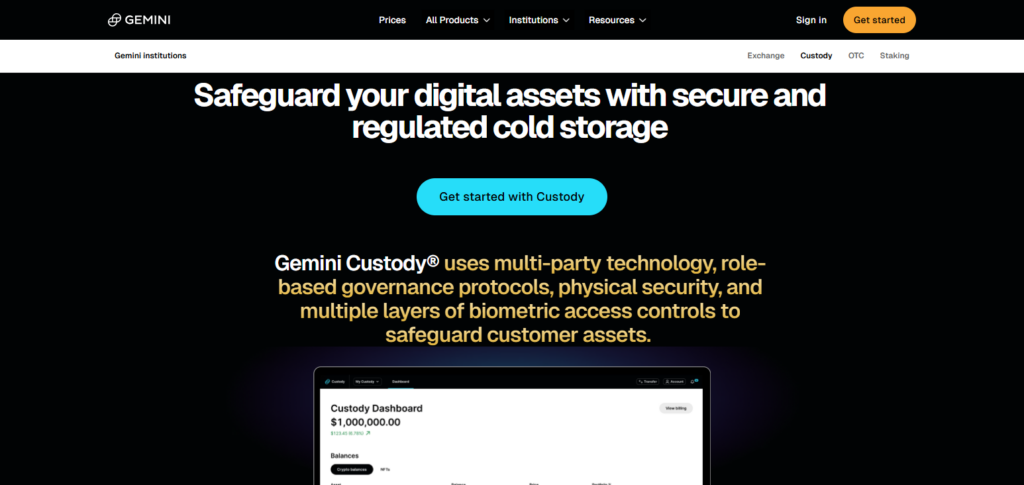
Gemini also facilitates instant trading and simplifies customer workflows, which appeals to institutional customers who want safe custody and quick market liquidity.
Gemini has also implemented appropriate regulations and governance on digital asset custody, making it a reputable choice.
Gemini Custody (Crypto)
- Regulated by the New York State Department of Financial Services
- Cold storage is secured by hardware security modules
- Digital assets are covered by insurance
- Integrated with services offered by the Gemini exchange
- Security framework is certified as SOC 2 Type II
Gemini Custody (Crypto) Pros & Cons
✅ Pros
- Regulated Custodian. A trust charter offers more regulatory protection.
- Strong Compliance Culture. Sees to KYC/AML, with a strong emphasis on institutional controls.
- Additional Services. Gemini trading and earn products are integrated.
❌ Cons
- Asset Support Scope Limited vs Competitors. Not as many custodians support as many tokens.
- Custody Fees May Be Higher. There will be a premium on administering security and regulatory compliance.
9. Fireblocks (Institutional Digital Asset Infrastructure)
Fireblocks is a pioneer in digital asset infrastructure, combining MPC-based custody technology and safe enterprise transfer networks to give institutions control over the storage, movement, and management of digital assets without exposing private keys.
Unlike conventional custodians, Fireblocks prioritizes secure key isolation and automated transfer policy controls for wallets, exchanges, counterparties, and liquidity.
Fireblocks also offers treasury services, programmable settlement rails, and real-time settlement tools to help with the complex operations of sophisticated institutions.
Fireblocks is often used in conjunction with regulated custodians. It provides a flexible layer of security and transfer automation for digital asset portfolios of institutions.
Fireblocks (Institutional Digital Asset Infrastructure)
- Offers a secure network for the transfer of digital assets
- Wallet technology based on multi-party computation (MPC)
- Supports decentralized finance (DeFi), staking, and tokenization
- Offers institutional-grade treasury management and settlement
- Infrastructure is API-driven, tailored for banks and fintechs
Fireblocks (Institutional Digital Asset Infrastructure) Pros & Cons
✅ Pros
- Network of Secure MPC Wallets. Multi-party computation for high security with flexible key management.2. Ecosystem Connectivity – DeFi, liquidity providers, and exchange integrations are quick and straightforward.
- Scalable for Institutions – APIs and enterprise-focused workflows.
❌ Cons
- Not a Custodian Itself – Custody and regulatory trust functions are dependent on partners. Infrastructure providers.
- Technical Complexity – Requires implementation effort on institutional side.
10. Hex Trust & Zodia Custody (Asia-Focused Institutional Crypto)
With a focus on the Asia-Pacific region, Hex Trust and Zodia Custody offer institutional clients integrated custody services with a bank-grade pledge and regulatory compliance across Singapore, Hong Kong, the UK, and EU.
Family offices and asset managers with global reach can work with these platforms as they emphasize cold storage, multi-jurisdiction risk, and seamless integration with traditional finance, backed by cold storage financial institutions.
Zodia, for example, benefits from trust-level governance and reporting because of its collaboration with legacy banks. On the other hand, Hex Trust offers additional services, including tokenization and custody infrastructures, tailored to the needs of institutions.
Hex Trust & Zodia Custody (Asia-Focused Institutional Crypto)
- Compliance with licensing and regulations in Asian jurisdictions
- Institutional-grade crypto custody services with a focus on compliance
- Trading and settlement services are integrated
- Offers storage solutions that are backed by insurance
- Strategic collaboration with banks and asset managers in Asia
Hex Trust & Zodia Custody (Asia-Focused Institutional Crypto) Pros & Cons
✅ Pros
- Asia-Focused Institutional Custody – Services specifically designed for the Asia market and regulatory frameworks.
- Regulated Entities – Licensed custodians in certain jurisdictions, increasing trust.
- Enterprise Crypto Services – Token custody, DeFi access, and staking support.
❌ Cons
- Geographically Concentrated Footprint – Most presence in APAC, limited in the Americas and EMEA.
- Smaller Ecosystem vs Global Players – Compared to large global custodians, may offer fewer integrations.
Conclusion
Private investors may safeguard expanding portfolios with the same security, compliance, and transparency that international financial institutions rely on by selecting the best institutional-grade custody solution.
Investors may lower operational risk and gain confidence to scale across traditional and digital markets by placing a high priority on strong security architecture, regulatory licensing, insurance coverage, and seamless asset integration.
In an increasingly complicated financial environment, the proper custody partner turns asset protection into a strategic advantage that allows for long-term growth, regulatory readiness, and peace of mind.
FAQ
What is an institutional-grade custody solution?
An institutional-grade custody solution is a regulated, professional asset safekeeping service using advanced security, compliance controls, insurance coverage, and audited processes to protect high-value traditional and digital assets.
How is institutional custody different from regular crypto wallets or brokerage accounts?
Institutional custody offers multi-signature or MPC security, segregation of duties, compliance reporting, insurance, and dedicated support, whereas regular wallets or brokers usually provide limited governance and security layers.
Do private investors really need institutional-level custody?
Yes, especially for larger portfolios. Institutional custody reduces hacking risk, improves regulatory transparency, and provides disaster recovery, insurance, and professional oversight not typically available in retail solutions.
Are institutional-grade custody providers regulated?
Most reputable providers operate under financial authorities or trust charters in specific jurisdictions, following KYC/AML rules, capital requirements, and regular third-party audits.
What types of assets can institutional custody support?
Depending on the provider, services may include cryptocurrencies, tokenized assets, equities, bonds, funds, stablecoins, and staking or DeFi integrations for diversified portfolio management.