

This article will explore the Best Litecoin Miners Choosing the Best for Profitability in 2026 Miners Since Litecoin mining is based on fast Scrypt ASIC hardware, the miner’s selection directly affects efficiency, electricity costs and long term gains.
Modern miners come in many shapes and sizes, ranging from powerful industrial machines to home-friendly compact units. This data-driven approach enables miners to make well-informed decisions around important factors such as hash rate, power consumption and reliability.
What is Litecoin Mining?
LiteCoin mining is the process of validating transactions on theLitecoin blockchain and recording them to its public ledger. Litecoin functions as a decentralized cryptocurrency, meaning it is not dependent on banks or financial institutions. So the entire network of miners around the world keeps all transactions secure, verified and prevents things such as double spending.
Like Bitcoin, Litecoin applies the Proof of Work (PoW) consensus mechanism. This system requires miners to solve complex cryptographic puzzles. This needs a lot of computational ‘work’ to solve, and hence makes mining quite intensive as well as competitive.
Litecoin miners use ASICS (Application-Specific Integrated Circuit) devices that are designed to mine this type of Scrypt. These devices have high hash rates that help the users to solve problems faster and earn rewards.
Miners are rewarded with new Litecoins when they validate a block correctly. This system of incentivization both secures the network and causes new coins to enter circulation.
1. VolcMiner D1 Hydro
VolcMiner D1 Hydro, a high-end Scrypt ASIC miner with impressive 33 GH/s Hash (i.e.9300W power consumption) yields at only 0.28 J/MH efficiency Industrial grade, built for industrial mining with hydro cooling for superior heat management and stable long-term performance.
At 28 kg+ and over it is clearly a miner’s card, not for home users. This model ranks up there among the Best Litecoin Miners of high-performance setups due to its huge output. It’s noise at 75 dB and input of 380V, (professional professional only).
VolcMiner D1 Hydro
| Specification | Details |
|---|---|
| Hashrate | 33 GH/s |
| Power | 9300W |
| Efficiency | 0.28 J/MH |
| Voltage | 380V |
| Noise | 75 dB |
| Cooling | Hydro |
2. ElphaPex DG2+
ElphaPex DG2+ is a phenomenal Scrypt miner with 20.5 GH/s and just 3900W power consumption, which leads to wonderful efficiency at only 0.19 J/MH! While utilizing four cooling fans, which provide stable thermal performance for continuous mining.
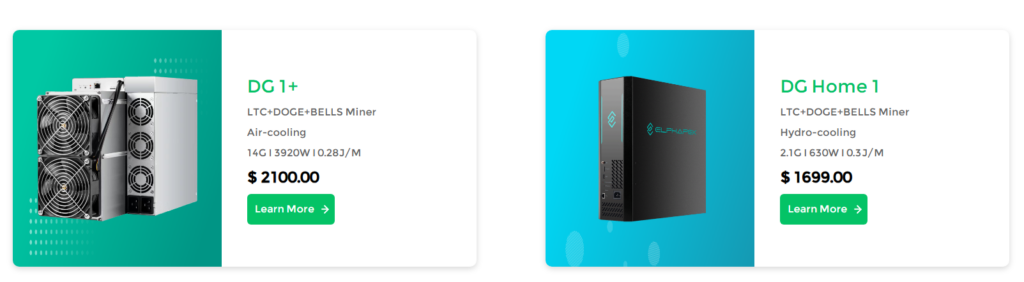
It is enterable for advanced home miners and mid-scale farms due to its manageable size and 200–240V input voltage. With a competitive positioning within the market, it boasts as one of the Best Litecoin Miners in terms of performance-to-efficiency ratio.
With 75 dB noise and Ethernet, it provides DAGs of the highest quality with extremely robust hardware endurance that guarantees consistent mining.
ElphaPex DG2+
| Specification | Details |
|---|---|
| Hashrate | 20.5 GH/s |
| Power | 3900W |
| Efficiency | 0.19 J/MH |
| Voltage | 200–240V |
| Noise | 75 dB |
| Cooling | 4 Fans |
3. VolcMiner D1 Pro
With a decent 18 GH/s hashrate at only 3500W power consumption, the VolcMiner D1 Pro achieves an energy efficiency of 0.19 J/MH. The device has four cooling fans, operates at a voltage range of 200–300V and can work with different mining setups.
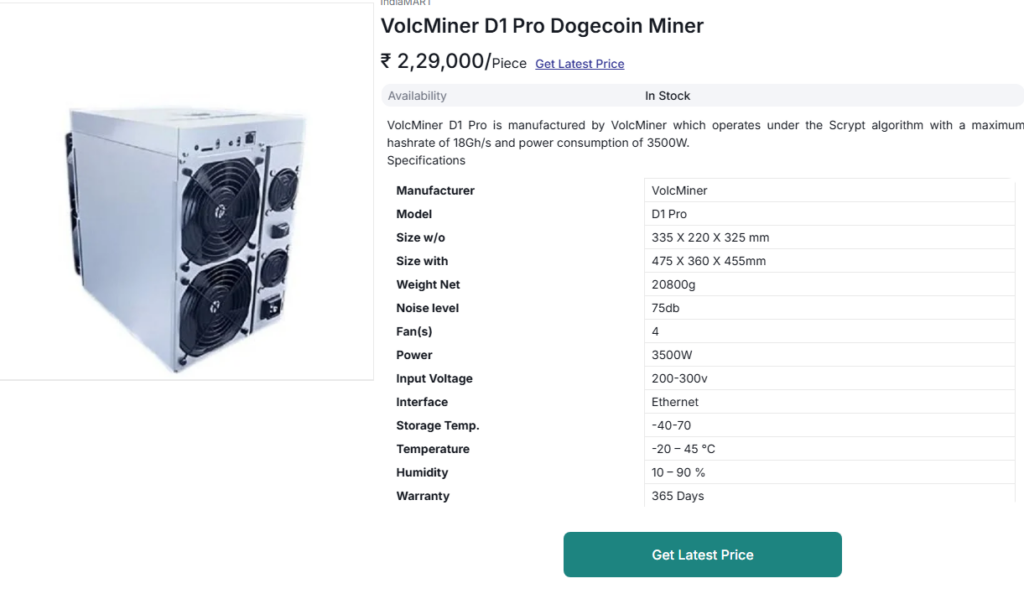
Despite being compact compared to industrial rectifier units, the miner is still powerful enough to be used for a serious mining operation. It ranks B on list of the Best Litecoin Miners because it provides a good balance between performance and efficiency in competitive mining environments.
Due to its 75 dB noise level and sturdy design, you can expect consistent output from this machine; a plus point for professional as well as semi-professional miners.
VolcMiner D1 Pro
| Specification | Details |
|---|---|
| Hashrate | 18 GH/s |
| Power | 3500W |
| Efficiency | 0.19 J/MH |
| Voltage | 200–300V |
| Noise | 75 dB |
| Cooling | 4 Fans |
4. VolcMiner D1
VolcMiner D1: Seral ASIC miner for Scrypt 17 GH/s, 3900W It features a four-fan cooling system to keep the chips at optimal operating temperatures for consistent mining performance. With a voltage range of 200–300V, it is versatile for various mining setups.
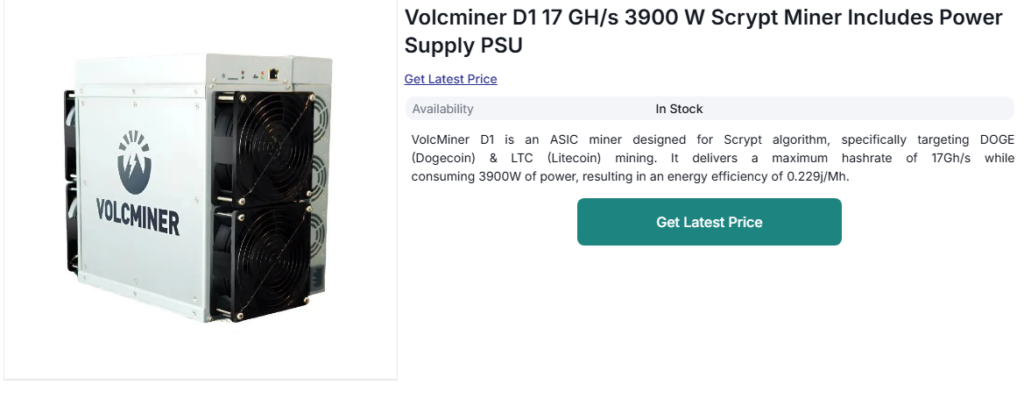
It would become one of the Best Litecoin Miners for its stability and performance although a little less efficient than newer models. At 75 dB, it has a high noise level and solid construction; It’ll work for medium-scale mining farms requiring stable and predictable production.
VolcMiner D1
| Specification | Details |
|---|---|
| Hashrate | 17 GH/s |
| Power | 3900W |
| Voltage | 200–300V |
| Noise | 75 dB |
| Cooling | 4 Fans |
| Algorithm | Scrypt |
5. Bitmain Antminer L9
The Bitmain Antminer L9 is an engineering masterpiece as a Scrypt miner providing 16 GH/s hash rate with 3360W power consumption and 0.21 J/MH efficiency. Currently, it is available for purchase and provides consistent performance due to being manufactured essentially by Bitmain.
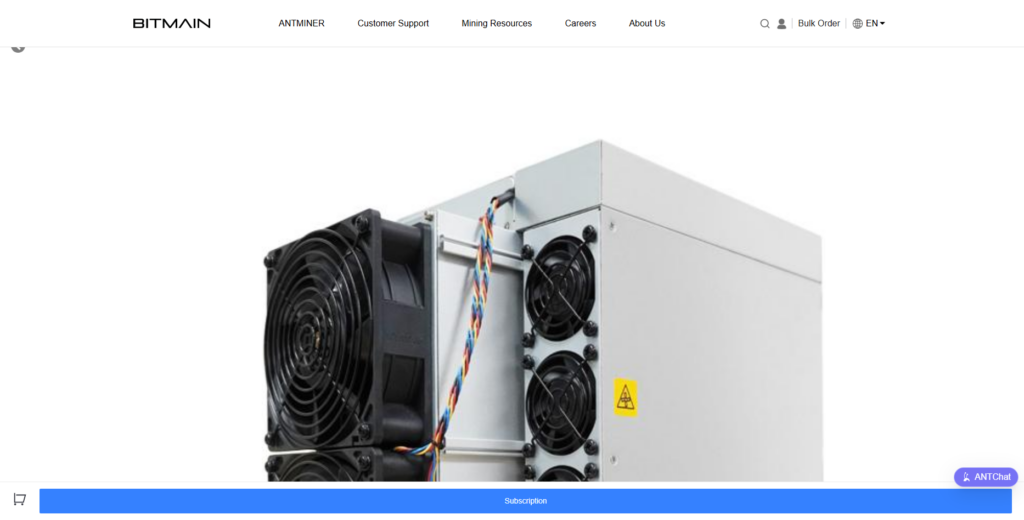
The device has 4 cooling fans inside and working noise level of 75 db which is normal for ASIC miners. Additionally, it features a broad temperature range and Ethernet connectivity, ensuring consistent mining activities.
Ranking high on our list of the Best Litecoin Miners, alongside being a resilient ASIC miner, the Antminer L9 is an excellent choice for pro farms and serious individual miners who value long-term profitability and hardware reliability.
Bitmain Antminer L9
| Specification | Details |
|---|---|
| Hashrate | 16 GH/s |
| Power | 3360W |
| Efficiency | 0.21 J/MH |
| Voltage | 220–277V |
| Noise | 75 dB |
| Cooling | 4 Fans |
6. ElphaPex DG1+
ElphaPex DG1+ Hashrate ( 14,400 MH/s (14.4 GH/s) Power Consumption3950W Efficiency(CREATED BY MCRATTASKERMIGINSTV_TIF)06564849.053COP/175COP1566 It’s built for consistent mining and comes with four cooling fans and stable Ethernet connectivity.
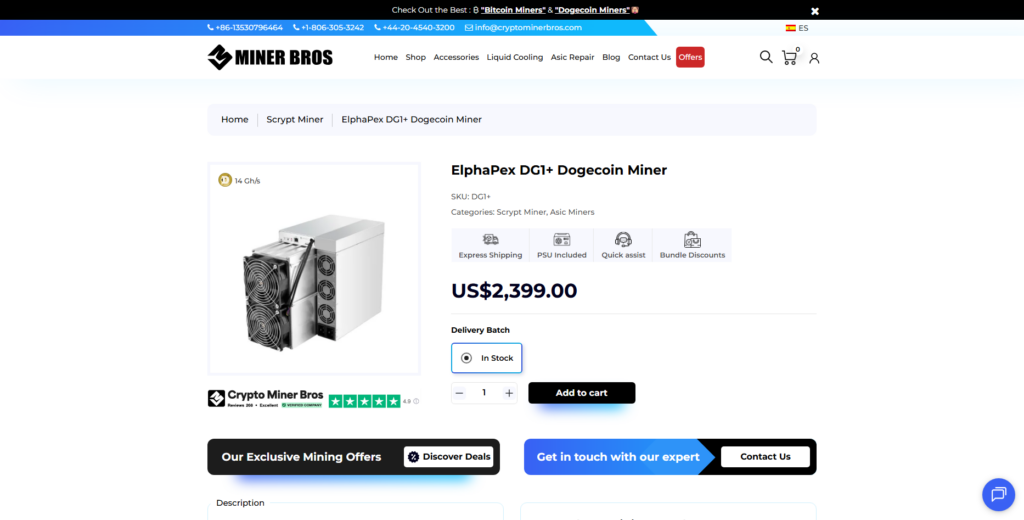
It operates at 200–240V, making it ideal for controlled mining conditions. While not the most efficient compared to modern options, it still ranks high in terms of stable output and durability among the Best Litecoin Miners.
Packing 75 dB noise with modest dimensions, it finds use in mid-scale mining setups. It offers a strong performance and is a suitable choice for miners requiring consistent long-term returns from reliable hardware.
ElphaPex DG1+
| Specification | Details |
|---|---|
| Hashrate | 14.4 GH/s |
| Power | 3950W |
| Efficiency | 0.27 J/MH |
| Voltage | 200–240V |
| Noise | 75 dB |
| Cooling | 4 Fans |
7. Fluminer L1 Pro
Model Fluminer L1 Pro Hash Rate (GH/s) 6 Power Consumption @1400W Power Supply Efficiency >0.23j <1gh@M Weight <400g Operating with a noise output of 45 dB, the miner is suitable for at-home rigs as opposed to larger industrial miners.
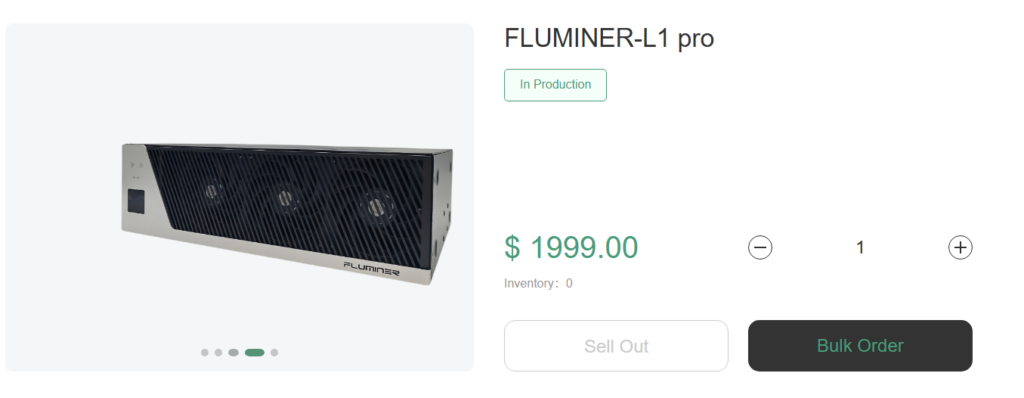
Another advantage is that it accepts 110–240V, which also makes it beginner-friendly. In its favour, the Best Litecoin Miners feature an affordable price and a noiseless operation so it’s still very much on the list even with its hash power capabilities. Its small design and reliable output make it suitable for small or hobby mining systems.
Fluminer L1 Pro
| Specification | Details |
|---|---|
| Hashrate | 6 GH/s |
| Power | 1400W |
| Efficiency | 0.23 J/MH |
| Voltage | 110–240V |
| Noise | 45 dB |
| Cooling | Quiet Air |
8. Bitmain Antminer L7 9050 MH/s
The Antminer L7 9050MH/s is currently one of the fastest and most popular Scrypt ASIC miners that are built to mine Litecoin and Dogecoin. Provides strong performance and stable efficiency with a hash rate of ~9050 MH/s (9.05 GH/s) toward the 3260–3425W power consumption range.
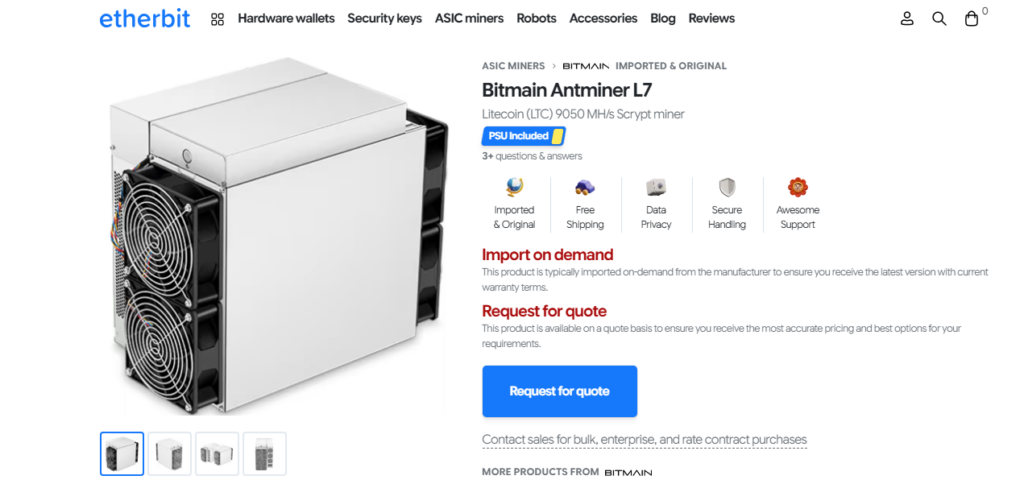
Designed for longevity, this Antminer possesses advanced cooling systems and registers 75 dB noise. It is one of the Best Litecoin Miners in competitive ASIC markets smartly balancing power and reliability. With Ethernet support, it works well at 64 degrees in mining conditions.
Antminer L7 9050 MH/s
| Specification | Details |
|---|---|
| Manufacturer | Bitmain |
| Hashrate | 9050 MH/s (9.05 GH/s) |
| Power Consumption | ~3260–3425W |
| Algorithm | Scrypt |
| Efficiency | ~0.36 J/MH |
| Cooling | Air Cooling (Dual Fans) |
| Noise Level | ~75 dB |
| Connectivity | Ethernet |
9. Goldshell LT7 Pro
LT7 Pro – Goldshell Litecoin Scrypt Asic Miner Its performance is competitive on watt usage, delivering a hash rate 9–10 GH/s at about 3100–3200W. It features stable operation, user-friendly setup and durable hardware design that was built by Goldshell.
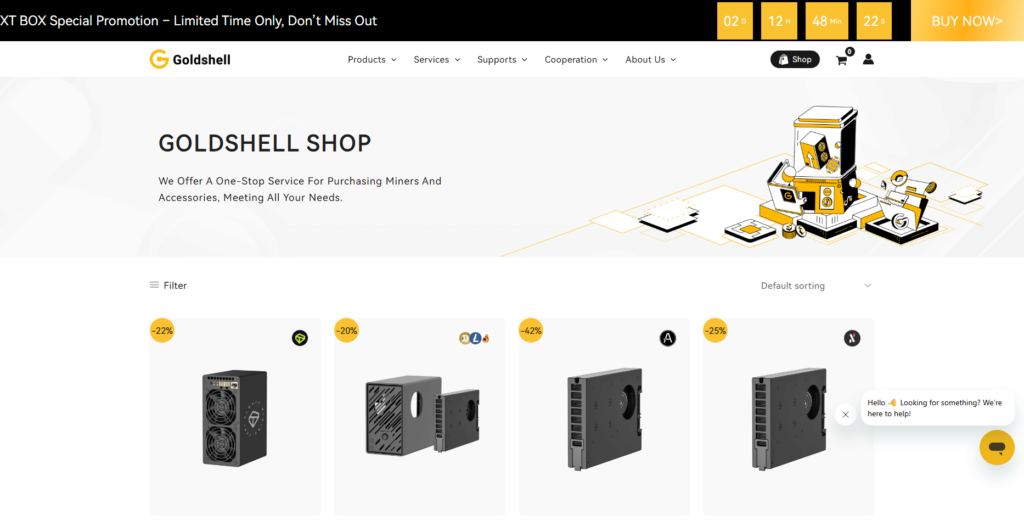
One of the Best Litecoin Miners in the mid-to-high-end mining caliber, it offers a solid choice for reliable hash power with consistent yield. And it’s an ideal fit for farms and advanced users, thanks to its efficient cooling system and tolerable noise levels.
Goldshell LT7 Pro
| Key Specification | Details |
|---|---|
| Manufacturer | Goldshell |
| Hashrate | ~9–10 GH/s |
| Power Consumption | ~3100–3200W |
| Algorithm | Scrypt |
| Efficiency | ~0.31–0.34 J/MH |
| Cooling | Advanced Air Cooling |
| Noise Level | ~72–75 dB |
| Connectivity | Ethernet |
10. iPollo G1 Scrypt
iPollo G1 Scrypt is the newest compact and low-power ASIC miner suitable for Litecoin and other Scrypt-based cryptocurrencies. With a hash rate of approximately 12 GH/s at fairly optimized power consumption, it is the best in its class.
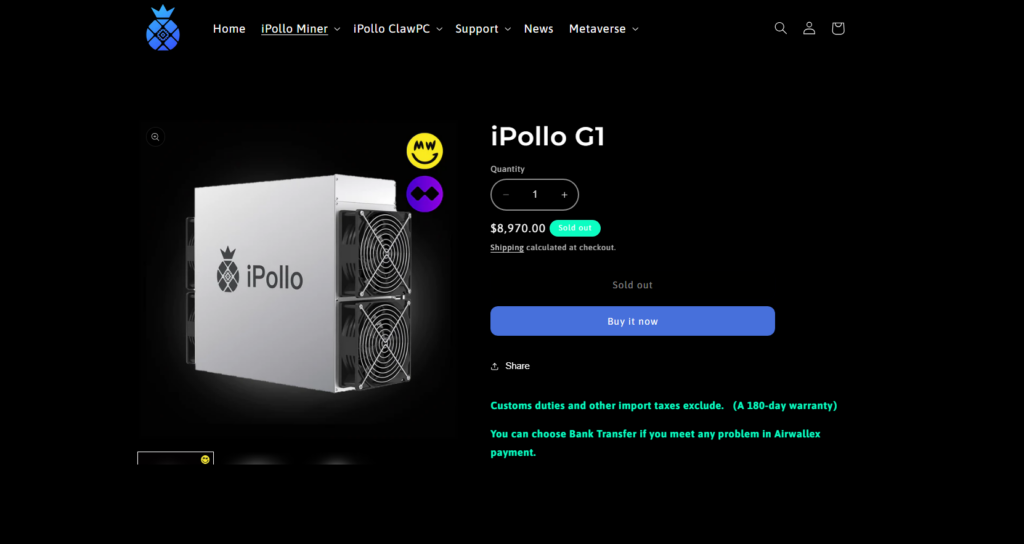
This miner is produced by iPollo and had been designed for steady and durability mining. Its efficient cooling and Ethernet connectivity, combined with durable construction, ensure that it will perform well for years.
Ranked on list amongst the Best Litecoin Miners it is particularly well-suited for miners targeting higher hash rates but balanced with energy efficiency meaning it can be used in semi-professional setups and growing mining farms alike.
iPollo G1 Scrypt
| Key Specification | Details |
|---|---|
| Manufacturer | iPollo |
| Hashrate | ~12 GH/s |
| Power Consumption | ~3600W |
| Algorithm | Scrypt |
| Efficiency | ~0.30 J/MH |
| Cooling | Air Cooling |
| Noise Level | ~75 dB |
| Connectivity | Ethernet |
How Litecoin Mining Works?
Litecoin mining refers to the process of confirming transactions and adding them to the Litecoin blockchain through the use of computational power. Built using the Proof of Work (PoW) pseudo-code, where miners solve complex mathematical puzzles.
Step-by-Step Process
Transaction Collection
When users send Litecoin, the transactions are broadcasted to the network and combined into a “block” awaiting confirmation.
Hashing with Scrypt Algorithm
Miners process these transactions with ASIC machines, specifically designed for memory-intensive and fast computations on the Scrypt algorithm, which is more efficient than Bitcoin’s SHA-256 per-puzzle basis.
Solving the Puzzle
In order to get the right hash, miners need to try a number of one-way hashes by guessing the nonce. That needs huge computing power and high hash rates.
Block Validation
The first miner to solve the puzzle then broadcasts the solution across the network. And other nodes check this to make sure it is correct and not fraudulent (such as double-spending).
Block Added to Blockchain
When verified, that block is permanently added to the Litecoin blockchain — ensuring transparency and security.
Mining Rewards
The successful miner is rewarded with newly minted Litecoin and transaction fees. This gives miners reason to keep securing the network.
Key Factors to Consider Before Choosing a Miner
Hashrate (Mining Power)
The hashrate decides how quickly a miner can solve these cryptographic puzzles. Higher hash rates means greater chances to earn rewards, making it one of the most critical factors affecting profitability in Litecoin mining.
Power Consumption
Mining costs are directly correlated with electricity usage. Power-hungry miners cut into profits if the cost of electricity is high, thus it is important to choose hardware that’s energy-efficient for sustainable and long-term mining operations.
Energy Efficiency (J/MH)
Efficiency is defined as the amount of power used per unit hash rate. Efficiency is measured in J/MH, the lower the better; allows miners to get the most output for each unit of electricity consumed and directly impacts profitability.
Initial Cost
Upfront cost for ASIC miners can be costly. Be sure to consider your budget and calculate return on investment (ROI), so you know how long the miner will take to pay itself off, in a reasonable timeframe.
Cooling System
The mining process creates a lot of heat that needs to be dissipated through fan and/or hydro cooling systems. The correct cooling guarantees stable performance, avoids overheating and prolongs the life of mining hardware.
Noise Level
ASIC miners are noisy beasts, with sound levels typically reaching 70–80 dB. If you are mining from home noise levels are a consideration, so quieter models will be more suited to originating from residential environments and smaller setups.
Durability & Build Quality
Good hardware maintains a stable state over time. Good miners have low maintenance costs, low downtime, and ensure stable mining output, even under continuous heavy loads.
Challenges and Risks of Litecoin Mining
| Challenge / Risk | Description |
|---|---|
| High Electricity Costs | Mining consumes significant power, and rising electricity prices can drastically reduce profitability, especially in regions with expensive energy rates. |
| Expensive Hardware | ASIC miners require a large upfront investment, making it difficult for beginners to enter the mining industry without substantial capital. |
| Increasing Mining Difficulty | As more miners join the Litecoin network, difficulty increases, reducing individual mining rewards over time. |
| Market Volatility | The price of Litecoin fluctuates frequently, directly impacting mining profits and return on investment. |
| Hardware Obsolescence | Mining hardware becomes outdated quickly due to rapid technological advancements, requiring frequent upgrades to stay competitive. |
| Heat and Cooling Issues | ASIC miners generate excessive heat, requiring proper cooling systems to prevent overheating, hardware damage, and performance drops. |
| Noise Pollution | Most miners operate at high noise levels (70–80 dB), making them unsuitable for home environments without soundproofing solutions. |
| Maintenance and Downtime | Continuous operation can lead to wear and tear, increasing maintenance costs and causing downtime that affects overall mining efficiency. |
| Regulatory Uncertainty | Government regulations on cryptocurrency mining can change, potentially restricting or banning operations in certain regions. |
| Mining Pool Dependency | Solo mining is difficult, so many rely on pools, which involve fees and shared rewards, reducing individual earnings. |
Future of Litecoin Mining
Litecoin mining is also likely to evolve considerably, with technology, market dynamics and network changes driving this transformation. One of the most significant upcoming events is the 2027 halving, which will cut block rewards from 6.25 LTC to 3.125 LTC, having a direct effect on miner profitability and pushing operators to run more efficiently. (Litecoin Watch)
Increasing Hardware Efficiency
Mining will move even further towards the advanced Scrypt based ASIC miners with higher energy efficiency. Electric bills are climbing and competition is increasing, meaning only high-performance machines will stay profitable — so efficiency will evolve into one of the most useful factors for survival.
Shift Toward Affordable & Renewable Energy
The ability to mine in terms of cost-per-kWh will win. Long-term sustainability of gliders will improve significantly as future operations become more and more reliant on renewable energy sources (solar, hydro or wind) which have a much lower cost and environmental impact. (Litecoin Watch)
Growth of Merged Mining
The continued expansion of profitability from merged mining with Dogecoin Miners can simultaneously receive rewards from both blockchains with no extra cost, giving Litecoin mining an added economic appeal. (Litecoin Watch)
Impact of Halving Events
Every four years there will be halving cycles that reduce the mining rewards driving out weaker miners. This may mean less competition in the near term, but also higher efficiency targets across the industry. (Litecoin Watch)
Rise of Industrial-Scale Mining
mining is becoming more and more professional, the network is dominated by large mining farms. Individual miners can have a hard time unless they pool or buy very efficient hardware.
Increasing Mining Difficulty
If hash rate continues to grow, mining difficulty will also continue to increase. Miners must therefore invest in better hardware to remain competitive and earn the same level of rewards over time.
Institutional Adoption & Market Growth
For example, recent developments in the space such as ETFs or even institutional investment could drive Litecoin demand which could thereby increase profitability margins over time and leading to increased long-term sustainable mining. (CoinMarketCap)
Smarter Mining Strategies
Up and coming miners will depend more on methods like firmware optimizing, underclocking for efficiency, and improved cooling their gear to earn profit while spending less cash to run procedures. (Litecoin Watch)
Conclusion
Litecoin mining in 2026 is a competitive yet potentially profitable endeavor, as ASIC hardware continues to advance and more miners join the network. Ultimately, success is very dependent on selecting miners who have high rates of return with a low power draw, as power costs are a significant driver in profitability overall.
Scrypt ASICs are now widely available, and hardware is better than ever before to make large, optimized setups feasible. Yet, factors like increasing mining difficulty, market speculations, and the upcoming halving events need to be seriously accounted for.
In summary, Litecoin mining can still offer sustainable long-term returns if you employ the proper strategy, utilize efficient equipment, and manage costs carefully.
FAQ
Is Litecoin mining still profitable in 2026?
Yes, Litecoin mining can still be profitable in 2026 if you use efficient ASIC miners and have access to low-cost electricity. Profitability depends on hash rate, power consumption, and market price.
What hardware is required for Litecoin mining?
You need specialized ASIC miners designed for the Scrypt algorithm. GPUs and CPUs are no longer efficient for Litecoin mining due to high competition and difficulty.
How much electricity does Litecoin mining consume?
Electricity usage depends on the miner. High-end ASIC miners can consume between 3000W to 9000W, making power cost one of the biggest factors affecting profitability.
Can I mine Litecoin at home?
Yes, but it depends on your setup. Smaller, low-noise miners can be used at home, while large industrial miners require dedicated space due to heat, noise, and power requirements.
What is the best Litecoin miner in 2026?
Top miners include high-performance ASICs like Antminer and VolcMiner models, offering high hash rates and efficiency. The best choice depends on your budget and electricity costs.