I’ll go over the Best Private Equity Platforms for Accredited Investors in this post. These platforms provide unique access to real estate, venture capital, and high-growth enterprises that were previously only available to major institutions.
Accredited investors can diversify portfolios, control risk, and optimize returns by utilizing carefully chosen deals, thorough due diligence, and open reporting. In private markets, selecting the appropriate platform is essential for long-term, strategic wealth building.
Key Point
| Platform | Key Point (What It Offers) |
|---|---|
| Moonfare | Digital private equity platform giving accredited investors access to top‑tier PE and VC funds with lower minimums via feeder funds and a secondary market. |
| EquityZen | Marketplace for accredited investors to buy and sell pre‑IPO or late‑stage private company shares, including single‑company and multi‑company funds. |
| Willow Wealth (formerly Yieldstreet) | Alternative investment marketplace offering private credit, real estate, private equity, art, and more for accredited investors. |
| EquityNet | Crowdfunding platform focused on helping privately held companies raise capital from accredited investors. |
| Linqto | Accredited investment platform for private‑market startups and pre‑IPO companies with global deal access. |
| CrowdStreet | Specialized commercial real estate investing platform for accredited investors (commercial property deals). |
| Hiive | Platform for acquiring shares in venture‑backed, private companies (accredited only) before IPO. |
| Percent | Structured private credit investment platform for accredited investors with fractional access. |
| EquityMultiple | Commercial real estate and private debt platform focusing on institutional‑grade deals for accredited investors. |
| AcreTrader | Farmland investing platform giving accredited investors direct exposure to agricultural land PE‑style deals. |
1. Moonfare — Best for Private Equity & Venture Capital Access
Moonfare is a digital investment platform that aims to provide accredited and qualified investors with access to private equity and venture capital funds that are of institutional quality and breadth. Moonfare only selects a candid few funds for investment.

These range from buyouts to structured growth equity, secondaries, co-investment and semi-liquid products. Moonfare also uses a feeder fund structure to minimize the relative direct commitments.
Members of Moonfare get to trade on a second market to adjust their exposure before the fund has matured. This is not common for private equity investing.
Moonfare Key Features
- Private equity fund access
- Fund investment minimums
- Selected fund listings
- Onboarding digitally
- Investors globally
Pros
- Provides democratized access to private equity
- Fund professional vetting
- Experience digitally streamlined
- Network is globally strong
Cons
- Investments minimums are high
- Options for liquidity are limited
- Significant fees are possible
- Investors must be accredited
2. EquityZen — Secondary Market for Pre-IPO Shares
EquityZen is a marketplace that creates a bridge for accredited investors and employees, as well as early investors, of private companies seeking to divest their pre-IPO shares. Investing in a private equity is a high-growth start-up, and it is believed that the company is on the verge of a great an IPO or major liquidity event.
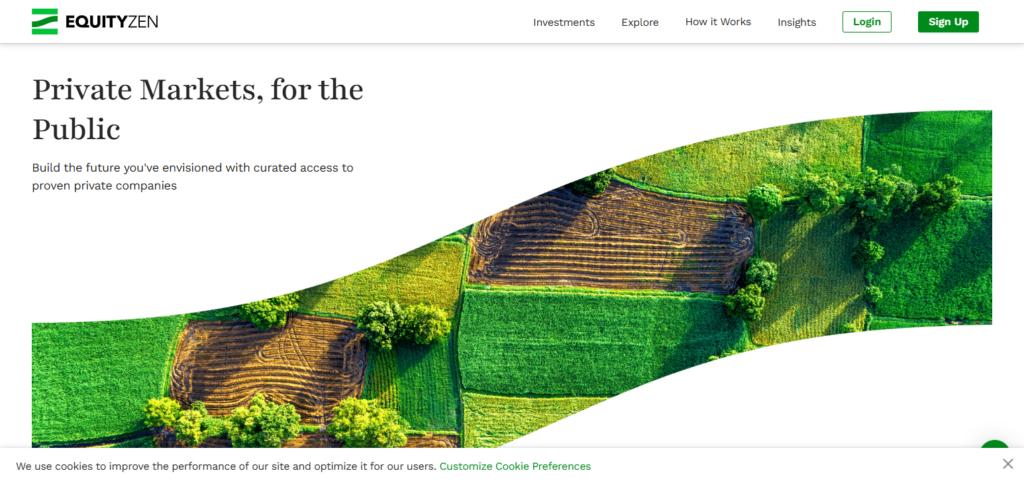
The platform enables secondary transactions between buyers and sellers of private company stock and ownership transfers that previously occurred solely within private networks. Most notable, **EquityZen** was acquired by *Morgan Stanley* in 2026, solidifying its integration within the private markets ecosystem.
EquityZen Key Features
- Marketplace for shares pre-IPO
- Access to secondary markets
- Investor accreditation is necessary
- Simplicity in transactions
- Coverage on wide-ranging startups
Pros
- Investments in startups that are at a late stage
- Traditional VC cartel minimums are lower
- Structure for deals is clearly defined
- Database of companies is growing
Cons
- Investments are illiquidity
- Risk is high in case of an IPO failure
- In every deal, diversification is limited
- Accreditation is an obstruction
3. Willow Wealth — Multi‑Asset Private Markets Platform
**Willow Wealth** (previously *Yieldstreet*) is a versatile alternative investment platform providing accredited investors access to private credit, real estate, private equity, art finance, legal finance, and other asset classes, all through a single account.

It integrates direct, self‑chosen opportunities with managed portfolios and access to institutional funds. Willow’s multi‑asset approach enables investors to diversify beyond public equity and debt markets while leveraging professional due diligence.
Since inception, the platform has expanded significantly, and it has billions of total invested capital. Some of its flagship offerings also distribute funds quarterly, providing renters with pooled exposure across various transactions.
Willow Wealth Key Features
- Advisory for management of wealth
- Investments that are alternative
- Portfolios that are custom
- Management for risks
- Reporting dashboard in digital form
Pros
- Financial planning that is customized
- Assets that are diverse to access
- Advisory support is strong
- Transparent reporting
Cons
- Advisory fees can be high
- Limited to wealthier clients
- Less focus on niche startups
- Market-dependent performance
4. EquityNet
EquityNet is among the most established equity crowdfunding platforms. It is a direct link between entrepreneurs and accredited investors interested in making equity or debt investments in private companies.

Instead of managing deals from a centralized location, EquityNet allows issuers to directly draft business plans and terms, while accredited investors negotiate specific details of the investment. Issuers can use analytics tools to evaluate and compare the risks and opportunities of various startups and small businesses.
Since launching, EquityNet has helped its users raise hundreds of millions through its Marketplace, making it ideal for users who want to take a more hands-on approach to the fundamentals of a company and negotiate the underlying structure of a deal.
EquityNet Key Features
- Crowdfunding platform
- Business plan analysis tools
- Investor-matching algorithms
- Wide range of industries
- Equity and debt offerings
Pros
- Open to non-accredited investors
- Strong analytics for startups
- Broad industry coverage
- Lower entry barriers
Cons
- Higher risk for retail investors
- Less liquidity
- Quality of startups varies
- Limited secondary market
5. Linqto — Global Private Market Startup Investing
Linqto is a San Francisco-based investment platform that enables global accredited investors to access the equity of private startups and pre-IPO companies. Investors can use the digital marketplace to access private tech ventures that previously required a direct relationship with a VC.
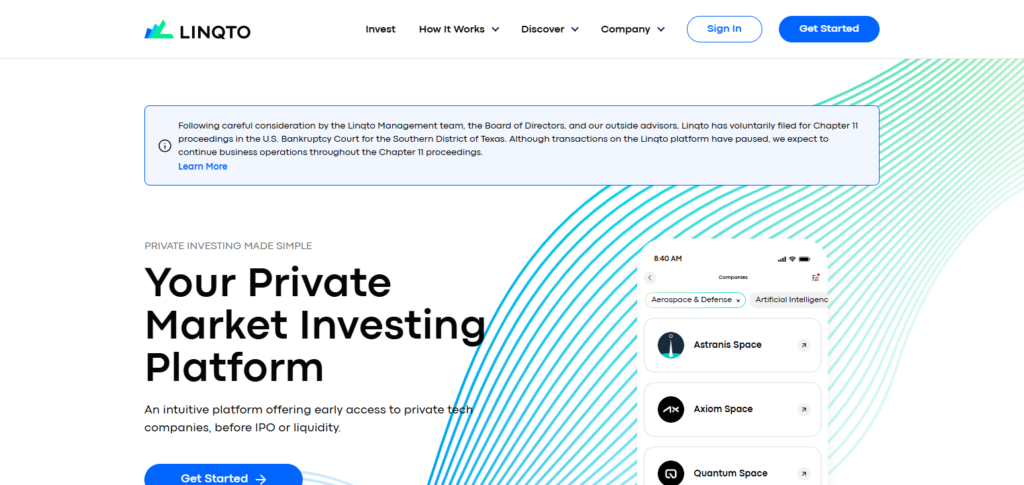
Linqto also allows investors to buy and sell stakes in private companies, especially those at unicorn stage, thereby providing more opportunities. The platform aims to facilitate access to private markets by providing a low barrier to entry and incorporating a seamless investment process.
Linqto Key Features
- Pre-IPO investment access
- Mobile-first platform
- Lower minimums ($10k)
- Instant settlement process
- Curated company list
Pros
- Affordable entry point
- Fast transactions
- User-friendly app
- Access to unicorns
Cons
- Still illiquid until IPO
- Limited deal flow compared to big funds
- Accreditation required
- Market risk if IPO delayed
6. CrowdStreet — Commercial Real Estate & Funds
CrowdStreet is the only online platform that focuses on accredited investors to access commercial real estate opportunities. All three are examples of how EACH provides access to specially vetted institutional quality assets.

One can invest in equity stakes of commercial office, multifamily, industrial, retail, and mixed-use commercial properties, or take a diversified fund approach to commercial real estate.
Real estate sponsors post opportunities and draft offering documents, financial models, and sponsor biographies to help investors make decisions on CrowdStreet before funding a deal.
CrowdStreet Key Features
- Real estate crowdfunding
- Institutional-grade projects
- Direct investment opportunities
- Investor marketplace
- Portfolio diversification tools
Pros
- Access to commercial real estate
- Transparent project details
- Strong diversification potential
- Lower minimums than direct ownership
Cons
- Hard-to-sell investments
- Risk associated with a declining market
- High capital needed to spread investments around
- Complicated taxes
7. Hiive — Private Company Marketplace Before IPOs
Hiive operates in private markets as a trading system where accredited investors can buy, sell, or trade shares of companies that are pre-IPO and venture-backed. It resembles a stock market for private company shares, offering buy and sell prices and enabling direct secondary trading.
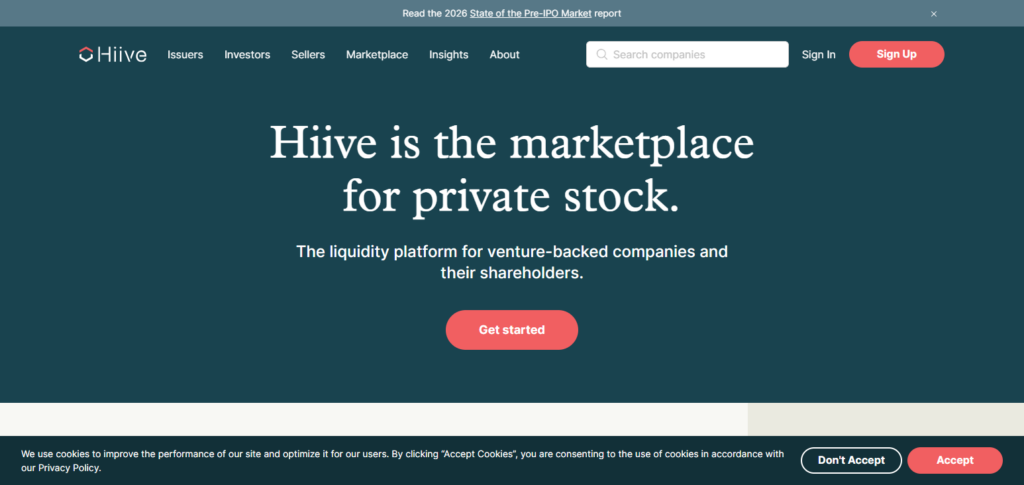
Hiive has shares in high-growth companies, particularly in tech, that are not easily accessible through traditional VC. Investors must be accredited to trade, in compliance with private securities regulations.
Hiive Key Features
- Secondary market for private shares
- Pricing engine that works in real time
- Individual-to-individual trades
- Must be accredited
- Focus on technology startups
Pros
- Pricing Transparency
- Increased private share liquidity
- Increased efficiency for trades
- Startups with increasing coverage
Cons
- Must be an accredited investor
- Risk associated with a declining market
- Less overall activity when compared to larger marketplaces
- If there are no buyers, private shares become illiquid
8. Percent — Investment in Private Credit for Accredited Investors
Percent is a platform for private credit investing created for accredited and institutional investors only. It provides access to loans and other debt financing alternatives to traditional bank financing.
Private credit consists of asset-based lending, financings of small businesses, trade receivables, and other forms of customized debt for which investors act as lenders.
Percent’s platform features marketplace loans with shorter maturities paired with customizable and transparent terms, which provide opportunities for ongoing interest returns and separate diversification from public markets.
Investors may select either individual loan opportunities from the marketplace or a blended note that consists of multiple loans to a credit issuer, which allows for reduction of risk while seeking higher returns.
Percent Key Features
- Marketplace for private credit
- Debt structured offerings
- Deals considered institutional
- Reporting is transparent
- Investment timeframes are shorter
Pros
- If you invest with private credit, you are able to invest in a lot of different things
- Lock up periods are shorter
- The reporting for this credit is of a good standard
- The potential profits are good
Cons
- You are taking a risk with credit
- There is little employment upside
- You must be accredited
- Less overall activity
9. EquityMultiple — Crowdfunding Commercial Real Estate
EquityMultiple is a crowdfunding platform for commercial real estate that allows accredited investors to access institutional-grade real estate opportunities. Investors can take positions as equity holders, preferred equity holders, or senior debt holders in multifamily, office, industrial, and other commercial business transactions.
The platform’s detailed underwriting is accompanied by thorough documentation of each transaction to assist investors in assessing the associated risks and potential rewards of each investment.

Compared to other forms of direct commercial real estate investing, EquityMultiple’s minimum investment amounts are often lower, which increases the accessibility of participation in large commercial real estate transactions to additional accredited investors.
Depending on the nature of the investment and its structure, returns may come as scheduled interest distributions or increases in the value of the property after a number of years.
EquityMultiple Key Features
- Platform for investments in real estate
- Debt, Equity and Preferred Financing
- Partnerships with institutions
- Access to diversified projects
- Investor reporting
Pros
- Flexibility in the way you want to invest
- Good institutional support
- Good reporting for this credit
- Good variety across the real estate investments
Cons
- Hard-to-sell investments
- Risk associated with a declining market
- Some offerings have a high required investment—
10. AcreTrader — Farmland Investing For Accredited Investors
AcreTrader is the first platform of its kind that allows accredited investors to access farmland as an investment. Traditionally, farmland has provided possible returns via rent payments from farming tenants, as well as through appreciation of the land’s value over the long term.
AcreTrader does the due diligence, property buying, and management, making investing in farmland almost completely passive.

They also allow investors to diversify across different crops and areas from land deals that only a small percentage are accepted to further improve quality control.
While farmland investments are often illiquid until the land is sold, they offer a unique diversification benefit when combined with the typical private market investments. (Wikipedia)
Moonfare Key Features
- Private equity fund access
- Investment thresholds
- Selected fund curation
- Digital onboarding
- Investors worldwide
Pros
- Private equity is available to the general population
- Funding is professionally vetted
- Digital process is simple,
- Network is good worldwide
Cons
- Investment threshold is high
- Less liquidity is available
- There are notable costs
- Access is only to accredited investors
Key Features to Consider in PE Platforms
Requirements for Accreditation
Due to legal ramifications and potential dangers for ignorant investors, private equity platforms mandate users to attain accredited status. Accreditation illustrates one’s income or net worth to qualified private markets.
Investment Size Requirements
Some platforms restrict investment amounts, which gives the opportunity of private equity investments to people with smaller amounts of capital. More flexible limits give the opportunity to invest in high-quality funds.
Variety of Deals
A platform should have a range of investment options spanning from startups, real estate, venture capital, to buyouts. When investors can spread out their investments, the risk and potential losses are lower.
Support for Due Diligence
Many platforms provide investors with tools necessary for conducting due diligence, along with the appropriate frameworks for analyzing and evaluating risk associated with the investment.
Options for Liquidity
Because of their nature, private equity investments are generally long-term and illiquid which is why other platforms that offer means of liquidity are more preferable.
Fees and Charges
Management fees, performance fees, and subscription fees are some of the various types of fees charged by platforms. Understanding various fees helps investors understand the costs associated, value different platforms, and keep investors’ net returns on investments from hidden fees.
Transparency and Reporting
Investors want to be able to monitor the performance of their portfolios, and timely, clear, and accurate reporting with performance metrics aids in this. Transparency helps build trust, and platforms that are transparent provide investors with regular updates to their finances and help them track their progress towards their goals.
How to Choose the Right Platform?
Align with Investment Goals
Look for a platform that accommodates your financial goals, risk appetite, and preferred asset class. The available deals should aid your objectives in earning, growth or, diversification.
Evaluate Fees vs Returns
Analyze the management, performance, and platform fees versus the expected returns. A lower fees increase overall returns, while deals with higher fees might provide more value and growth opportunity.
Assess Track Record
Analyze the historical data of the platform, performance of its past deals, and the sponsors. Also, a good track record is an indicator of execution and reliabilty.
Check Transparency & Reporting
Opt for the platform that has concise and periodic financial reports, transparently announced set dates to evaluate performance and metrics. Transparency ensures you are in control of the decisions.
Consider Liquidity Options
Determine the presence of secondary market, structured exit and flexible duration of investment on the platform. The above factors aid control of investment and decrease or eliminate lock-in risk.
Evaluate Deal Variety
If a platform has a combination of early-stage startups, real estate, venture, and buyouts, it is easier to diversify your portfolio, minimize risk, and capitalize on several growth opportunities.
Seek Out Co-Investment and Networking Opportunities
Platforms offering co-investment solutions and networks of investors foster collaboration and the sharing of knowledge, as well as the ability to tap into deals of significantly better quality that are not accessible to individual investors.
Conclusion
Accredited investors can engage in high-growth opportunities, diversify their portfolios, and take advantage of expert deal curation by gaining access to private equity through leading platforms. Selecting the appropriate platform maximizes rewards while controlling risk by taking fees, transparency, liquidity, and deal variety into account.
Private equity is a strategic tool for long-term wealth building since investors may now access institutional-quality investments that were previously only available to huge funds by utilizing these platforms.
FAQ
What is a private equity platform?
A private equity platform is an online marketplace that connects accredited investors with private investment opportunities, such as startups, real estate, and buyouts, providing access to curated, high-growth deals.
Who qualifies as an accredited investor?
An accredited investor meets SEC requirements, typically having a net worth of $1 million (excluding primary residence) or an annual income of $200,000+ ($300,000+ jointly) for the last two years.
What is the minimum investment required?
Minimum investments vary by platform. Some allow as little as $1,000–$10,000, while institutional-quality funds may require $50,000 or more. Always check each platform’s thresholds before investing.
How do I assess platform risk?
Evaluate the platform’s track record, due diligence processes, transparency, deal variety, liquidity options, and fees. Platforms with strong reporting and credible sponsors reduce investment risks.
Can I sell my investment early?
Private equity is usually long-term and illiquid. Some platforms offer secondary markets or structured exit options, but early liquidity is limited compared to public markets.