As the pace of financial market activity Best Systems for Real-Time Portfolio Stress Testing now represents an essential element in risk management and stability assurance.
Advanced solutions such as BlackRock Aladdin, Bloomberg PORT, MSCI RiskMetrics and SAS Risk Management offer sophisticated analytics that allow fund managers to run “what-if” scenarios to stress test their portfolios for classes of shocks to the markets, identify vulnerabilities in real-time and make more confident investment decisions.
Key Point
| System / Platform | Key Point |
|---|---|
| BlackRock Aladdin | Integrates real-time risk analytics with scenario-based stress testing across multi-asset portfolios using extensive market data and predictive models. |
| MSCI RiskMetrics / BarraOne | Provides factor-based stress testing with global risk models, enabling institutions to simulate macroeconomic shocks and portfolio sensitivities. |
| Axioma Risk (Deutsche Börse) | Delivers intraday stress testing with customizable scenarios and high-performance analytics for equity and multi-asset portfolios. |
| Bloomberg PORT (Portfolio & Risk Analytics) | Offers real-time scenario analysis using live market data and pre-built stress scenarios like interest rate shocks and credit events. |
| FactSet Risk Solutions | Combines portfolio analytics with flexible stress testing tools, allowing users to model historical and hypothetical scenarios efficiently. |
| S&P Global Market Intelligence (Risk Gauge) | Enables dynamic stress testing with integrated credit risk insights and macroeconomic scenario modeling capabilities. |
| Moody’s Analytics RiskConfidence | Focuses on forward-looking stress testing using economic scenarios, particularly strong in credit and fixed income risk analysis. |
| SimCorp Dimension | Provides enterprise-level real-time stress testing with integrated portfolio management, supporting regulatory and internal risk assessments. |
| FIS Front Arena | Offers real-time trading and risk analytics with scenario-based stress testing for derivatives and complex financial instruments. |
| Quantifi Risk Analytics | Specializes in derivatives and fixed income stress testing with real-time pricing and advanced scenario simulation tools. |
1. BlackRock Aladdin
The most sophisticated enterprise risk platform, BlackRock Aladdin is used by global institutions for real-time portfolio stress testing and analytics. It brings together multi-asset risk modeling, scenario analysis, and performance attribution in one system so users can assess exposures across equity, fixed income and alternatives.

Now Aladdin shines in the Best Systems for Real-Time Portfolio Stress Testing categories, with over 2,000 risk factors and thousands of stress tests run per day.
It supports historical and hypothetical simulations to help firms prepare for market shocks and make better investment decisions through high-quality, centralized data.
BlackRock Aladdin Features:
- Multi-asset risk analytics platform
- Developed scenario and stress testing tools
- Real-time portfolio monitoring
- Unified trading, risk and compliance across workflows
Core Strengths:
- Sloping with ten institutions
- Excellent predictive and scenario design
- Single source of truth (Unified data architecture)
- End-to-end investment lifecycle coverage
Notable Limitations:
- Very high cost
- Complex implementation process
- Requires specialized expertise
- Not the best fit for small enterprises
2. MSCI RiskMetrics / BarraOne
MSCI BarraOne is a multi-asset class risk and performance tool, with strong factor-based analytics and full balance sheet revaluation stress testing. It allows investors to analyze risk drivers across public and private assets with advanced factor models and value-at-risk methodologies.

In the context of Best Systems for Real-Time Portfolio Stress Testing, BarraOne is known for its capacity to forecast accurate scenario analysis including both historical and tailored scenarios.
Providing simultaneous risk-return assessment, scenario analysis, and auto reporting – making it ideal for those managing complex portfolios needing transparency, scalability and regulatory compliance across global markets.
MSCI RiskMetrics / BarraOne Features:
- Factor-based risk modeling
- Full revaluation stress testing
- VaR and scenario simulations
- Performance attribution tools
Core Strengths:
- Industry-leading factor models
- Global market coverage
- Very tight knit analysis between risk and return
- Advanced scenario flexibility
Notable Limitations:
- Expensive licensing
- Complex for non-quant users
- Dependency on MSCI data
- No niche strategy customization capability
3. Axioma Risk (Deutsche Börse)
Axioma Risk is an advanced, high-performance risk analytics platform from Deutsche Börse Group that allows for real-time monitoring and stress testing of portfolios. It offers factor-based risk models, portfolio optimization and scenario analysis tools specific to equities and multi-asset portfolios.

Ranked with the Best Systems for Real-Time Portfolio Stress Testing category, Axioma’s core strength is intraday risk calculations and flexible scenario customization.
Its powerful analytics engine provides users with the ability to evaluate sensitivities to changes in market prices, interest rates, and macroeconomic variables, making it easier for users to mitigate risk preemptively. Asset managers and hedge funds often use the platform for clean, customizable, scalable risk insights.
Axioma Risk (Deutsche Börse) Features:
- Factor-based analytics engine
- Portfolio optimization tools
- Intraday risk monitoring
- Custom scenario analysis
Core Strengths:
- High-speed risk calculations
- Strong quantitative modeling
- Flexible customization
- Trusted by hedge funds
Notable Limitations:
- Requires technical expertise
- Integration challenges
- Less beginner-friendly
- Smaller data ecosystem
4. PORT (Portfolio & Risk Analytics)
Bloomberg PORT A popular portfolio analytics tool built into the Bloomberg Terminal itself with real-time risk monitoring and stress testing features It allows users to conduct scenario analysis based on real-time market data, including previous events and potential shocks.

Among systems considered for the Best in Real-Time Portfolio Stress Test category is Bloomberg PORT because of its access to large databases and analytical capabilities.
You currently have access to factor exposure analytics, real-time value-at-risk calculations, and liquidity analysis—excellent tools for institutional/pro-level investors looking to grasp insight into how their portfolios would be impacted under different market environments.
Bloomberg PORT Features
- Live market datawd real-time analytics
- Data until October 2023
- Factor exposure analysis
- Integration with Bloomberg Terminal
Core Strengths:
- Massive proprietary data access
- User-friendly interface
- Seamless workflow integration
- Reliable real-time insights
Notable Limitations:
- Expensive subscription
- Limited deep customization
- Ecosystem dependency
- Less Fine Tuning for Advanced Models
5. FactSet Risk Solutions
FactSet Risk Solutions – Portfolio risk analytics that offer multi-asset class coverage as well as flexible stress testing and scenario modeling tools Its functionality enables users to write exposures, run macroeconomic scenarios and stress test portfolio sensitivities in real time.
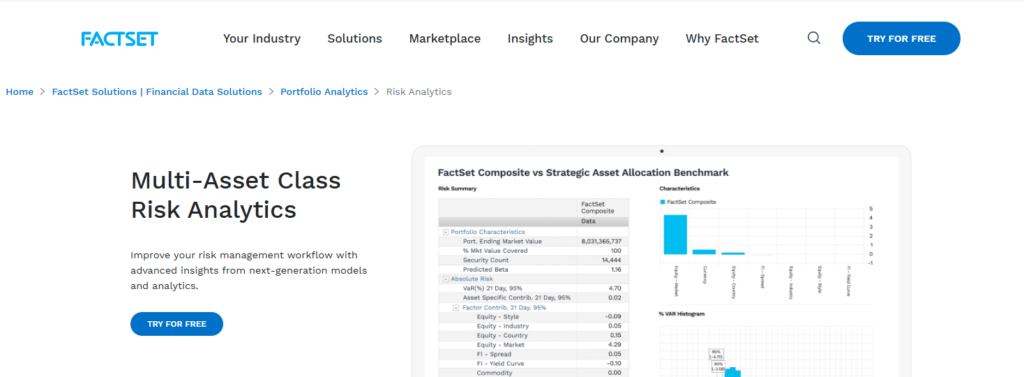
In the attribution section (now known as Best Systems for RealTime Portfolio Stress Testing), FactSet is noted for its customizable dashboards, third party data in-feed integration and advanced report generation..
It supports both historical and forward-looking portfolios, enabling asset managers to enhance strategies as well as downside risk management. Its scalable infrastructure and easy-to-use interface are well-suited for both midsize firms and large institutions.
FactSet Risk Solutions Features:
- Multi-asset risk analytics
- Scenario modeling tools
- Custom dashboards
- Third-party data integration
Core Strengths:
- Easy-to-use interface
- Flexible customization
- Strong reporting capabilities
- Suitable for mid-sized firms
Notable Limitations:
- Less sophisticated analytics versus leading systems
- Rising data costs
- Limited derivatives depth
- Moderate scalability
6. S&P Global Market Intelligence (Risk Gauge)
The S&P Global Risk Gauge is an advanced analytics platform focused on credit risk, macroeconomic stress testing, and scenario analysis. It allows users to model the effect of economic shocks, interest rate changes and credit events on portfolios.
Among the Best Systems for Real-Time Portfolio Stress Testing, it shines when it comes into play in integrating macroeconomic data with portfolio level analytics.
Equally valuable for banks and financial institutions managing credit-heavy portfolios with a need for robust stress testing within the global regulatory framework, the system offers forward-looking risk assessments, compliance tools & detailed reporting features in line with solidifying business ecosystems.
S&P Global Market Intelligence (Risk Gauge) Features:
- Credit risk modeling
- Macroeconomic scenario testing
- Regulatory reporting tools
- Integrated financial datasets
Core Strengths:
- Strong credit risk focus
- Reliable macroeconomic data
- Regulatory compliance support
- Useful for banking sector
Notable Limitations:
- Limited equity analytics
- Complex setup
- High cost
- Not flexible for multi-asset portfolios
7. Moody’s Analytics RiskConfidence
Moody’s Analytics RiskConfidence A risk aggregation, scenario analysis, and enterprise-wide stress testing platform in the cloud. It is largely driven by credit risk, economic forecasting and regulatory compliance.
(When assessing the Best Systems for Real-Time Portfolio Stress Testing, not surprisingly, RiskConfidence shines with its forward-looking macroeconomic scenarios and predictive analytics focus.
It allows financial institutions to measure prospective losses across a range of economic scenarios, informing both capital planning and regulatory submissions.
With its scalable architecture and integration with Moody’s data ecosystem, it is well positioned for banks and institutions managing complex credit portfolios ortfolios.
Moody’s Analytics RiskConfidence Features:
- Enterprise risk aggregation
- Forward-looking scenario analysis
- Cloud-based platform
- Regulatory stress testing
Core Strengths:
- Strong economic forecasting
- Excellent for credit portfolios
- Scalable infrastructure
- Regulatory alignment
Notable Limitations:
- Limited multi-asset capabilities
- Data dependency on Moody’s
- Complex customization
- Not well-suited for equity-heavy portfolios
8. SimCorp Dimension
SimCorp Dimension is an investment management SaaS solution that provides end-to-end portfolio management, risk analysis, and real-time stress testing functionalities. It enables multi-asset portfolios as well as a complete suite of scenarios tools to measure market risks and investment strategies.

Section 10: Systems for Real-Time Portfolio Stress Testing see SimCorp Dimension (up to October 2023) it is known for its end-to-end workflow integration which allows data flow across front, middle and back offices.
The investment management module provides strong compliance, customizable reporting, and real-time analytics to give asset managers and pension funds a single framework for investment- and risk-related work.
SimCorp Dimension Features:
- End-to-end portfolio management
- Multi-asset stress testing
- Integrated workflows
- Real-time compliance monitoring
Core Strengths:
- Full lifecycle integration
- Strong automation
- High scalability
- Robust governance tools
Notable Limitations:
- High implementation cost
- Long deployment time
- Requires IT support
- Complex system
9. FIS Front Arena
FIS Front Arena is a real-time trading and risk management system specifically for complex instruments such as derivatives and fixed income. It offers next-generation analytics, scenario testing and pricing for front-office operations.

Best Systems for Real-Time Portfolio Stress Testing In the Landscape: Despite the pause on opportunities to trade in the morning, Front Arena is one of the systems that get plugged into engines capable of providing insights across intraday experience and simulating market shocks in real time.
Combining trading, risk and compliance functions automatically across data from different partners enables institutions to react faster in times of market volatility while calculating accurate and consistent risk assessments across portfolios.
FIS Front Arena Features:
- Time-sensitive trading and risk analytics.
- Derivatives pricing models
- Scenario-based stress testing
- Front-office integration
Core Strengths:
- Strong derivatives capabilities
- Intraday risk insights
- Flexible system architecture
- Combines trading and risk
Notable Limitations:
- Complex to use
- Expensive
- Requires technical expertise
- Not the best for basic portfolios
10. Quantifi Risk Analytics
Quantifi Risk Analytics provides real-time pricing and risk modeling and stress testing for derivatives and structured products. It provides value-added scenario analysis, credit risk modeling and exposure management solutions for fixed income and complex instruments.
Quantifi has been named Best Systems for Real-Time Portfolio Stress Testing, and is recognized within that category for its high performance analytics processing engines and accurate valuation.
Deployed on a platform that allows users to simulate market events, assess sensitivities, and manage counterparty risk. It is favorite amongst hedge funds and investment banks due to its flexibility, cloud deployment options, and focus on derivatives.
Quantifi Risk Analytics Features:
- Instant price quoting and risk modeling
- Tools for credit and counterparty risk
- Scenario analysis
- Flexible deployment (cloud/on-premise)
Core Strengths:
- Strong derivatives focus
- High-performance analytics
- Accurate pricing models
- Customizable solutions
- Notable Limitations:
- Narrow asset class focus
- Requires quant knowledge
- Less intuitive UI
- Limited for broad portfolios
Key Objectives of Stress Testing Systems
Identify Portfolio Vulnerabilities
Stress test systems reveal portfolio vulnerabilities and assess how assets behave under stressed market conditions, allowing investors to identify risks lurking beneath the surface and strengthen their overall portfolios.
Simulate Extreme Market Conditions
These systems run scenarios so extreme that they include financial crises, interest rate jumps or market crashes – and by doing so, allow aid institutions to identify potential losses over a certain timeframe and devise strategies to manage unforeseen financial disruptions.
Support Regulatory Compliance
Stress testing ensures compliance with global financial regulations by providing standardized risk assessments, detailed reports, and transparency, helping institutions meet requirements set by regulatory authorities and avoid penalties.
Enhance Risk Management Decisions
Stress testing systems enable real-time insights and predictive analytics, informing proactive decision-making that can lead portfolio managers to rebalance asset allocation, hedge against risks, and sustain financial performance over the long term.
Real-Time Risk Analytics Platforms
Continuous Market Data Processing
In order to react to real-time changes in financial health, robust risk analytics platforms process live market data such as prices and volatility for immediate evaluation against economic indicators.
Instant Portfolio Risk Assessment
These allow for real-time information around portfolio exposure, along with calculations of Value at Risk, stress losses and sensitivities through to informing fast and dynamic investment decisions based on data.
Advanced Scenario Analysis
They offer dynamic scenario analysis, enabling test portfolios against hypothetical and historical events in real time, thus becoming better prepared for market shocks and other unforeseen financial disruptions.
Scalable Cloud-Based Infrastructure
Today, cloud computing and distributed systems come together to process major datasets with great efficiency in a manner that is high-speed, scalable and reliable for diverse portfolios across various asset classes and markets.
Conclusion
Presently, stress-testing of portfolios in real time has emerged as a must-have utility for contemporary financial institutions owing to progressive increment in market volatility and the complex structure of investments.
These are the tools that most effectively provide risk insights: platforms that can integrate continuous market data, offer real-time scenario analysis, and enable high-performance computing capabilities. These systems allow the portfolio managers to quickly spot weaknesses, model worst-case market scenarios and proactively mitigate possible losses.
Moreover, the amalgamation of cloud based infrastructure together with scalable analytics guarantee that even the large multi asset portfolios can be evaluated practically in real time.
From a regulatory perspective, compliance is still key here with many systems designed to comply with global standards whilst delivering transparently automated reports.
When combined with comprehensive risk management processes, they instill superior decision-making, resilience to shocks, and ultimately better portfolio performance in an ever-evolving financial landscape.
FAQ
What is real-time portfolio stress testing?
Real-time portfolio stress testing is a process that evaluates how a portfolio performs under adverse market conditions using live data, enabling immediate risk assessment and faster decision-making.
Why is real-time stress testing important?
It helps identify potential losses instantly, improves risk management strategies, and allows investors to respond quickly to market volatility, reducing the chances of significant financial damage.
What types of scenarios are used in stress testing?
Stress testing uses historical scenarios, hypothetical events, and extreme market conditions such as financial crises, interest rate shocks, or sudden market crashes to assess portfolio resilience.
Which industries use stress testing systems the most?
Banks, asset management firms, hedge funds, insurance companies, and regulatory institutions widely use stress testing systems to manage risk, ensure compliance, and maintain financial stability.
How do real-time risk analytics platforms work?
These platforms collect and process live market data, apply risk models, and generate instant insights on portfolio exposure, helping managers evaluate risks and take timely corrective actions.