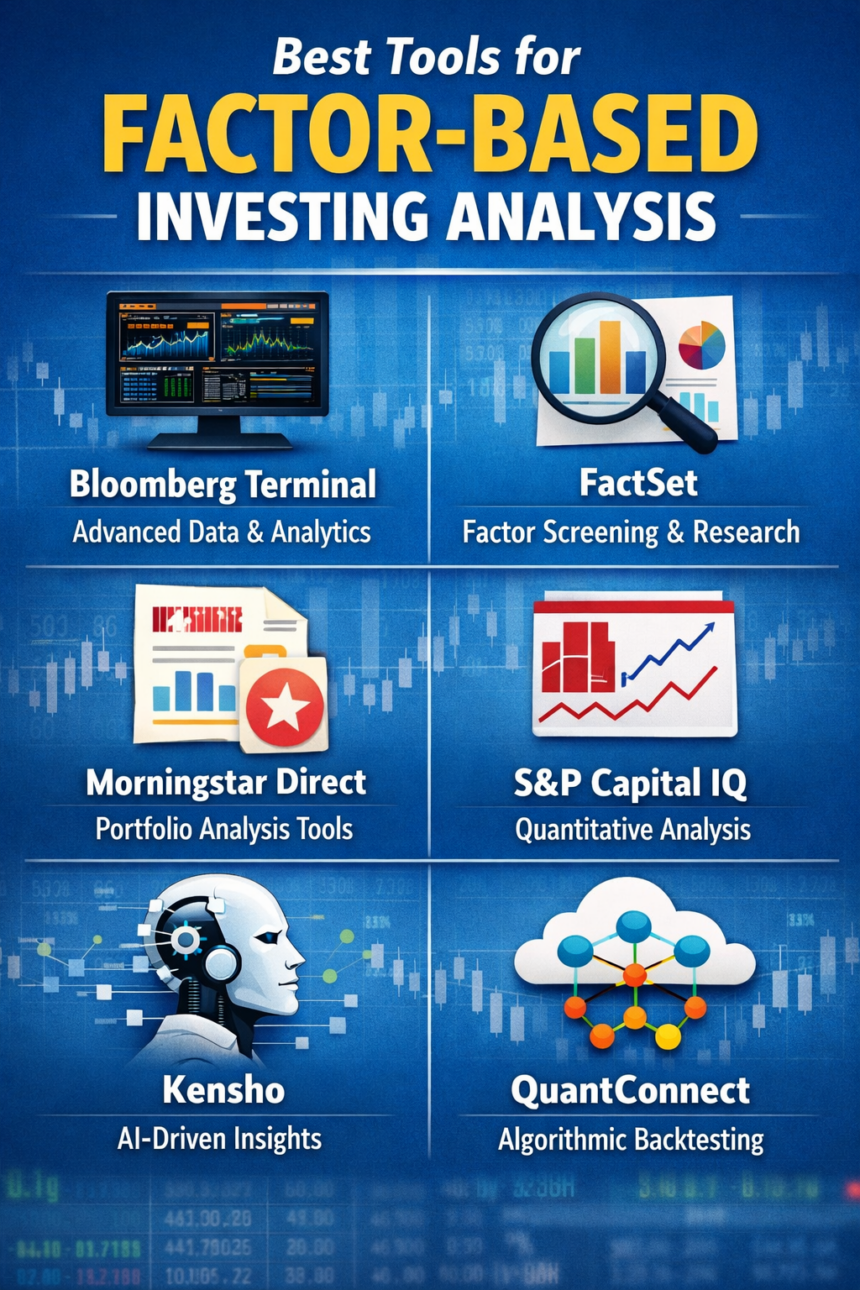
In the modern financial world where data is at its center, investors use Best Tools for Factor-Based Investing Analysis to identify the key determinants of portfolio returns. These tools allow for the scoring of value, momentum, risk factors and more to create stronger portfolios that are well hedged.
The spectrum of traditional assets is unlocked using everything from institutional platforms through flexible quantitative propositions, empowering investors to leave behind more passive strategies and pursue systematic, insight-driven solutions that enhance decision-making access, improve diversification, and facilitate steadier long-term investment outcomes.
Key Point
| Tool Name | Key Point |
|---|---|
| BarraOne (MSCI) | Integrates multi-asset risk models with factor decomposition, enabling precise attribution of returns to style factors like value, momentum, and volatility. |
| Axioma Risk | Offers flexible factor modeling with customizable risk factors and real-time portfolio analytics for institutional-grade factor exposure monitoring. |
| Bloomberg PORT | Provides robust factor analysis using Bloomberg’s data ecosystem, allowing investors to evaluate style exposures and scenario impacts efficiently. |
| FactSet Portfolio Analytics | Delivers detailed factor attribution with customizable models, helping users understand performance drivers across equity and multi-asset portfolios. |
| BlackRock Aladdin | Combines risk analytics with factor-based insights, enabling large-scale portfolio stress testing and systematic factor exposure management. |
| QuantConnect | Supports algorithmic factor strategy development with backtesting capabilities, allowing users to test factor signals like momentum and quality quantitatively. |
| Portfolio Visualizer | Offers accessible factor regression tools, enabling investors to analyze portfolio exposure to common factors such as size, value, and market beta. |
| Morningstar Direct | Provides factor-based analytics with strong fundamental data integration, helping investors evaluate style drift and long-term factor performance. |
| MSCI FactorLab | Enables construction and testing of custom factor strategies with advanced analytics and historical simulations for institutional investors. |
| Python (Pandas + NumPy + PyPortfolioOpt) | Allows full customization of factor models and backtesting workflows, making it ideal for quantitative investors building proprietary factor strategies. |
1. BarraOne (MSCI)
Best Factor-Based Investing Analysis Tools – BarraOne (MSCI): Best for institutional investors with multi-asset portfolios. It combines risk, return and performance attribution within a single framework based on MSCI’s proprietary factor models.
Its biggest strength is its ability to break down portfolio risk and returns at their most fundamental level based on style, macro and asset-specific factors. BarraOne includes equities, fixed income, derivatives and alternatives to allow for cross-asset factor analysis.
It also provides stress testing, scenario analysis and what-if simulations for assessing market shocks. It specializes in recognizing drivers of performance and accommodating investment strategies with exposures across factors in the global environment. (MSCI)
Why It’s Good:
- Integrates multi-asset factor modelling across equities, fixed income and derivatives.
- Provides sophisticated factor decomposition for precise risk and return attribution.
- Enables strong stress testing and scenario analysis for market shocks.
- Provides industry standard institutional quality risk models.
- Facilitates consistent monitoring of factor exposures over large portfolios.
Why It’s Bad:
- High capital for large investors only, hard for smaller investor.
- Highly complex with nursing degree needed.
- This often requires considerable time and resources to actually implement.
- Not much useful for retail or beginner investors.
2. Axioma Risk
Axioma Risk | Best Tools/Software for Factor-Based Investing Analysis – Axioma Risk Most asset managers rely on quantitative asset managers for risk modeling and factor-based portfolio construction. Its main feature is the flexibility in creating custom risk factors and applying them to your portfolio.
With strong capabilities for optimization, Axioma caters to multi-asset class modeling allowing the user to manage factor exposures and constraints at runtime. It accounts for important factors including value, growth, volatility, macro variables and liquidity.
The platform also offers scenario analysis and stress testing solutions, which allows investors to understand how their factor exposures perform in various market environments as well as improve their risk-adjusted returns.
Why It’s Good:
- Supports customizable factor models unique to each investment strategy
- Theoretical portfolio optimization with factor constraints and controls
- Provides real-time analytics for dynamic risk monitoring.
- Handles multiple asset classes efficiently.
- Provides in-depth intelligence on factor-based risk exposures.
Why It’s Bad:
- New users have a steep learning curve.
- Requires technical and quantitative expertise.
- A burden for small companies or individuals.
- The User interface seems quite complex and not so intuitive.
3. Bloomberg PORT
*Top Factor-Based Investing Analysis Tools – Bloomberg PORT * using a chance for professionals who currently are operating the Blooming Terminal ecosystem It carries comprehensive portfolio analytics features with powerful factors exposure and performance attribution tools.

Its strength is in integrating real-time data and providing intuitive visualization of the risks faced by factors. Bloomberg PORT allows users to decompose common equity factor exposures, such as beta, size, momentum and industry risk.
It also provides scenario analysis, tracking error measurement and portfolio optimization. This functionality is very useful to track live portfolios and make tactical allocation decisions accounting for the changing nature of factor dynamics
Why It’s Good:
- Ties in live market data straight from Bloomberg Terminal.
- Provides easy-to-interpret visualizations of the factor exposures and risks
- Facilitates rapid performance attribution and analysis.
- Integrates easily with other Bloomberg products.
- Trained data to October 2023.
Why It’s Bad:
- Requires expensive Bloomberg Terminal subscription.
- Flexibility is limited to custom factor modeling.
- Heavy reliance on Bloomberg ecosystem.
- If you have no other experience, this is not the best starting point.
4. FactSet Portfolio Analytics
Best Factor-Based Investing Analysis Tools – FactSet Portfolio Analytics: Best for Asset Managers Seeking Customizable and Scalable Analysis. It offers powerful factor attribution capabilities leveraging both integrated data and third-party models, such as MSCI Barra.
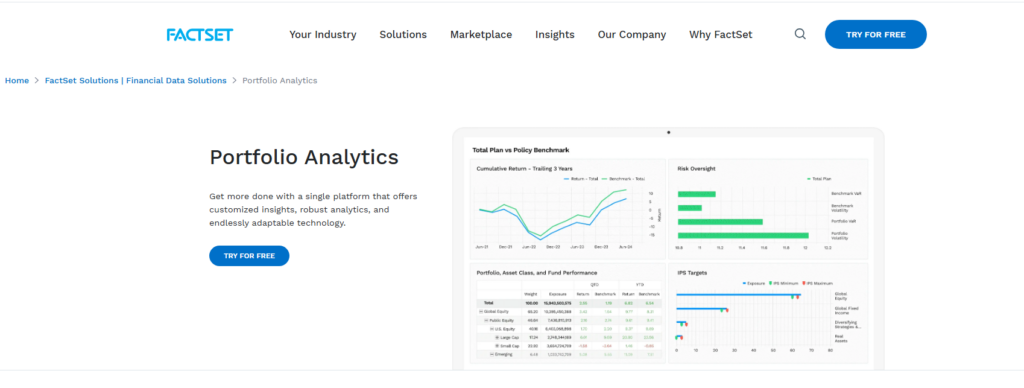
Its primary value proposition is its flexibility in constructing customized factor models and integrating them with fundamental and market data. The platform encompasses sector, region, style and macroeconomic drivers.
They also get portfolio optimization, risk decomposition and performance benchmarking with FactSet. Dynostics is especially valuable for firms that need analytics natively embedded ininvestment workflows and reporting systems.
Why It’s Good:
- I have decided to build my custom fact-models on top of some highly flexible platform.
- Strong reporting and presentation capabilities.
- Combines different data sources and analytics tools.
- Supports detailed portfolio attribution analysis.
- Grows with you as asset management firms expand.
Why It’s Bad:
- High subscription cost.
- Requires setup and configuration effort.
- Requires training to take complete advantage of features
- Customization can be time-consuming.
5. BlackRock Aladdin
Best for Enterprise Financial Risk Analysis – BlackRock Aladdin best used among Institutions requiring enterprise level risk and portfolio management. Its technology is fundamentally strong as it combines risk analytics, portfolio construction and trading tools in one platform.

Aladdin combines a single, factor-based view across equity, fixed income and alternatives to enable deep insights into exposures including duration, credit, style factors and more. They also provide for stress testing and scenario analysis based on historical or hypothetical events.
This platform can scale easily and help in the integration of data across front, middle, and back-office operations — a holistic solution to manage investment strategies driven by factors.
Why It’s Good:
- Comprehensive end-to-end investment management platform.
- Integrates risk analytics, trading, portfolio management.
- Multi-asset advanced factor analysis.
- Very scalable, even for institutional portfolios.
- Strong scenario and stress-testing capabilities.
Why It’s Bad:
- Extremely expensive and enterprise-focused.
- Steep onboarding process for complex system.
- Not accessible to individual investors.
- Requires significant infrastructure and integration.
6. QuantConnect
QuantConnect — Factor-Based Investing Analysis Tool: * is suited for quantitative traders and developers of systematic factor strategies. Its main focus is algorithmic backtesting and live trading features which can operate with historical data and real-time data.
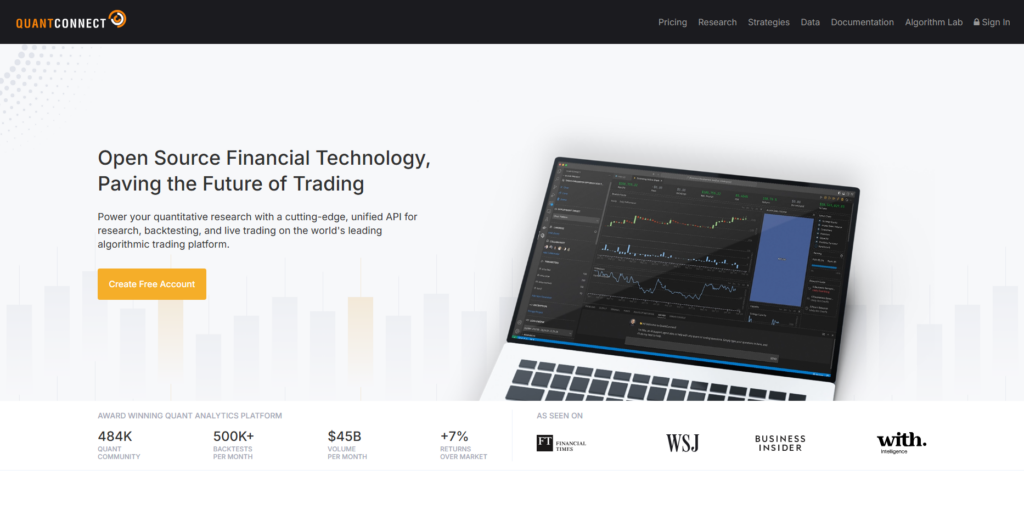
You can build and test factor models according to different signals on the QuantConnect platform, such as momentum, value or quality, and volatility.
Multiple asset classes, Python and C# integration. Scalable research execution is also supported through cloud-based infrastructure. This is especially useful when testing factor hypotheses or applying automated strategies in a real trading regime.
Why It’s Good:
- Facilitates factor-based strategies to algorithmically develop.
- Extensive back-testing ability for historical data
- Feather supports many programming languages including python and c#.
- Cloud-based infrastructure for scalability.
- Good for systematic and quantitative investing.
Why It’s Bad:
- Requires coding knowledge.
- Not beginner-friendly for non-technical users.
- Limited traditional portfolio reporting tools.
- This hinges too much on user skill for actual strategy performance.
7. Portfolio Visualizer
TOP RATED Factor-Based Investing Analysis Tool– Portfolio Visualizer — handiest for retail investors and analysts in search of accessible issue research instruments. Its strength lies in a simple and extensible interface for some strong statistical models, such as factor regression & backtesting.
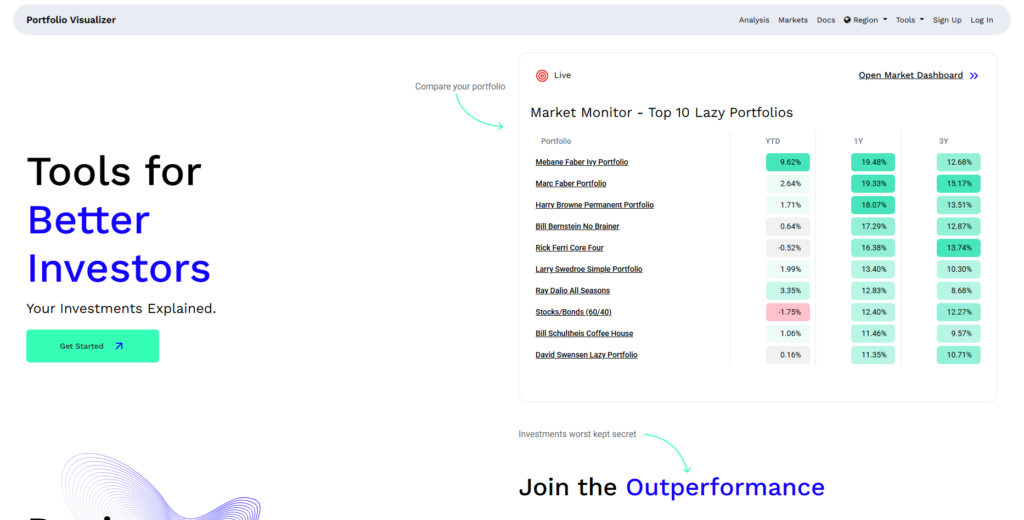
Users can assess portfolio exposures across market beta, size, value and momentum with popular models such as Fama-French. Monte Carlo simulations, optimization tools and historical performance analysis is also available on the platform.
This is provide an easy way to analyse how factor exposures impact portfolio returns over time with minimal programming skills.
Why It’s Good:
- Easy-to-use interface for factor analysis.
- Provides factor regression on top of known models.
- Great for quick backtesting and simulating.
- Easy to use for people with limited experience.
- Provides share portfolio management and allocation tools.
Why It’s Bad:
- Less customization options than advanced platforms.
- Lacks deep institutional-level analytics.
- Data scope is relatively limited.
- Not designed for multi-asset portfolios.
8. Morningstar Direct
Top Tools for Factor-Based Investing Analysis – Morningstar Direct ideal for Fundamental Investors and Research Analysts. Its comparative advantage is melding its deep fundamental data with factor-based analytics to assess investment styles and performance.
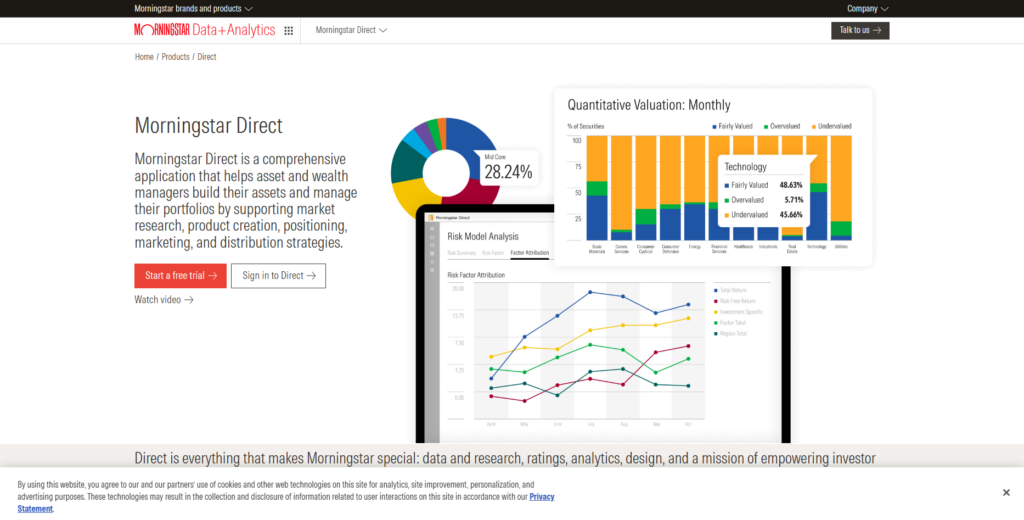
It analyzes factors such as value, growth, quality, yield, style drift and consistency. Morningstar Direct also offers portfolio analytics, benchmarking and screening tools.
It is best suited for in-depth investment analysis, ongoing fund assessment and the design of portfolios that reflect desired factors as well as complementary investing goals.
Why It’s Good:
- Adds factor-based analysis to the fundamental data.
- POWERFUL TOOLS FOR STYLE EVALUATION.
- Useful for long-term portfolio research.
- Offers in-depth fund and asset-level analysis.
- Reliable data for performance comparison.
Why It’s Bad:
- Expensive subscription cost.
- Limited advanced quantitative modeling features.
- Not so great for building bespoke factors
- Centering on multi-asset classes.
9. MSCI FactorLab
The Best FactorBased Investing Analysis Tools — MSCI FactorLab is built for institutional investors looking to build custom factor strategies. Core functionality is to build, test and analyze proprietary factor models with MSCIs amounts of data.
You are based on data until October 2023. This includes style, macro and thematic drivers. This adaptable platform is great for advanced quantitative research and cutting-edge factor-based strategies.
Why It’s Good:
- Allows for the development of custom factor strategies.
- Provides high-quality historical datasets.
- Strong backtesting and simulation capabilities.
- Supports advanced quantitative research.
- What You Need to Know about Style and Macro Factors
Why It’s Bad:
- Complex platform requiring expertise.
- Mainly designed for institutional users.
- High cost of access.
- Requires integration with other systems.
10. Python (with libraries Pandas + NumPy + PyPortfolioOpt)
Python (Pandas + NumPy + PyPortfolioOpt) – Best Tools for Factor-Based Investing Analysis ● Python is best suited for quantitative analysts and data scientists who want complete customization.
It has its strength in flexibly building proprietary factor models, regression analysis, and portfolio optimization. Pandas, NumPy, and other libraries enable users to handle large amounts of data and calculate factor exposures with ease.
PyPortfolioOpt allows you to optimize a portfolio with respect to risk-return objectives. This framework supports value, momentum, volatility, and macro variables; It is best for investors who prefer hands-on control of model design, testing, and implementation.
Why It’s Good:
- Fully customizable for development of proprietary factor models
- NumPy and Pandas for powerful data analysis
- Enables advanced portfolio optimization techniques.
- Allows for scaling over large datasets and complex strategies
- Open-source ecosystem with continuous improvements.
Why It’s Bad:
- Requires strong programming skills.
- No built-in user interface.
- Time-consuming development and debugging.
- Sourcing data externally and validating it outside of the model.
Why Factor-Based Analysis Tools Are Essential?
Factor-based analysis tools allow investors to identify what is driving their portfolio returns beyond price, whether that be value, momentum, and size among other factors so they can leverage that information in deciding when and how to trade.
These tools enhance risk management by measuring exposure to individual factors, enabling investors to manage unintended risks and ensure that their portfolios track their investment goals.
They allow systematic investments through the application of data-driven technical strategies that minimize emotional biases thus allowing consistent decision making across various market conditions and investing cycles.
By diversifying a portfolio across assets within individual factor buckets, Factor tools would typically reduce the reliance on any single source of return and help to stabilize overall performance through periods of increased volatility.
Offering performance attribution insights, they help investors identify the drivers behind gains or losses, enabling better assessment of strategies and informing future investment decisions.
These tools allow for back testing of both factor strategies, using historical data to assess how employees would have performed if implemented in an actual portfolio.
These models provide insights into correlations across various factors, allowing for more efficient asset allocation and improved portfolio construction to maximize return at a given level of risk across different sectors or assets.
Through factor-based tools, we can increase visibility in our client portfolios by deconstructing complex and varied exposure into recognizable building blocks that improve investor and stakeholder analysis and conversation around investment strategies.
By helping investors rethink portfolio positions to account for changing factor exposures in real time, they allow us to hedge against exposure variations and respond immediately to shifts in capital and/or economic conditions.
They offer a competitive edge by utilizing complex data and analytics that give investors insight into areas of opportunity and inefficiencies inaccessible through traditional investment methods.
Benefits of Using Factor-Based Investing Tools
Highlights why investor should use factor-based investing tools and then further down provide qick description of key benefits
Factor-based investing tools improve the return generation in a portfolio by controlling for established drivers of returns, such as value, momentum and quality exposure, enabling investors to rely on factors with historical availability to consistently achieve long-term performance.
Such tools can help improve risk management by quantifying and managing exposure to a wide range of factors, making sure that investors do not end up with unintended concentration and build a balanced portfolio according to their risk appetite and objectives.
They allow for data-driven decision making through quantitative models and analytics, minimizing reliance on gut feeling, intuition or emotional biases and enabling more consistent and disciplined investment strategies under different market conditions.
Factor-based tools promote effective diversification by allocating capital across various factors, thus not relying on a single source of return and making the portfolio more robust against market turmoil or economic uncertainty.
They also offer analytical performance attribution, which lets the investor know what makes them gain and lose, to improve their strategy and privilege analytics based on a clear approach.
These tools also provide comprehensive backtesting features that allow investors to test factor strategies with historical data, evaluate potential outcomes, and enhance their approaches before deploying them.
They also improve asset allocation decisions, leading to improved portfolio optimization and avoiding potential pitfalls in investment allocations as correlations between factors determinants (or bonds) and assets are exposed.
The use of factor-based tools helps to enhance transparency by deconstructing opaque and complex portfolios down to simple, digestible pieces of clear factor exposures for investors, market analysts and stakeholders.
They’re designed for real-time tracking of factor exposures, allowing investors to reposition portfolios quickly in response to market changes while staying on target with evolving economic feedback and investment objectives.
Common Challenges and Limitations
This high price for advanced factor-based tools restricts accessibility to these services, only allowing institutional players with costly subscriptions and licenses, as well as infrastructure investments to make it a reality — retail investors and small firms simply do not have access.
The complexity of models and advanced analytics creates a steep learning curve that often means you need strong financial knowledge or quantitative skills to fully grasp the full effective potential, which can make it difficult for beginners to get value from using them.
Then there is the crux of all the issues — data dependency: Having inaccurate, missing or delayed data can lead to mixed factor analysis results, flawed insights and a disaster for investment decisions.
The risk of overfitting occurs when models are not sufficiently generalized to historical data such that the strategies appear to work great in backtests but fail to reproduce consistent results amid practical market situations.
Some platforms offer limited opportunities for model customization, meaning users may be restricted to those frameworks and unable to build models around things that matter in their specific investment strategy or process.
Integration challenges: Efficiently managing factor-based investment workflows can be complex due to the inconsistencies discovered when data is derived from multiple sources or systems.
The instability of factor performance is an issue, as such factors may underperform over lengthy time horizons, challenging the patience of investors and undermining confidence in systematic strategies.
Another possible disadvantage of a quant fund is that heavy reliance on quantitative models may overlook qualitative insights.
Delay using some tools due to lack of real-time capability would make decision-making difficult, not allowing the investor to respond timely if market conditions change or adjust their factor exposures.
Advanced platforms also need a fair amount of computing power, data storage, and amount of system maintenance, which adds to operational costs for users by including adding technical infrastructure requirements.
Conclusion
Leveraging data, analytics, and systematic decision-making process for the modern portfolio management tools formed a core of factor-based investing. Tools range from institutional offerings such as MSCI’s BarraOne and FactorLab to flexible solutions like Bloomberg PORT and open-source capabilities available within Python; they deliver insight into return drivers, risk exposures, and portfolio behavior.
There is a well documented history of performance for investors who use factor analysis to help mitigate risk, enhance diversification, and produce more consistent relative returns through the harvesting of proven factors such as value, momentum and quality.
That said, use cases such as high costs, complexity and data dependency prove that there is no one-size-fits-all for users. Institutional investors work from sophisticated, integrated systems; individual and quantitative investors often look for flexible, budget options.
Ultimately, the applicability of factor-based investing instruments is determined on a case-by-case basis by matching each platform to investment objectives, technical know-how and scale. As technology continues to advance with AI, real-time analytics, and alternative data, these tools will remain vital in developing smarter, more resilient and data-driven investment strategies.
FAQ
What are factor-based investing tools?
Factor-based investing tools are platforms or software that analyze portfolio performance using key drivers like value, momentum, size, quality, and volatility to improve investment decisions and risk management.
Why are factor-based investing tools important?
These tools help investors understand return drivers, manage risk exposure, improve diversification, and make data-driven decisions, leading to more consistent and efficient portfolio performance over time.
Who should use factor-based investing tools?
Institutional investors, asset managers, quantitative analysts, and even retail investors can use these tools, depending on complexity, to enhance portfolio analysis and implement systematic investment strategies effectively.
What factors are commonly analyzed in these tools?
Common factors include value, momentum, size, quality, low volatility, liquidity, and macroeconomic factors, which help explain asset returns and guide portfolio construction decisions.
Are factor-based investing tools only for professionals?
No, while many advanced platforms target institutions, simpler tools and platforms are available for retail investors, making factor-based analysis accessible at different experience levels.