
The Best Web3 Commerce Infrastructure Alternatives helping businesses develop and expand decentralized applications are discussed in this article.
With robust tools, APIs, and security, these infrastructures allow automated blockchain integration, real-time data retrieval, and improved transaction controls, and give seamless infrastructure for commerce.
Optimizing the infrastructure can improve many of the fintech applications for performance, scalability, and reliability in Web3 commerce.
Key Points & Best Web3 Commerce Infrastructure Alternatives
| Platform | Key Point |
|---|---|
| Alchemy | Reliable Web3 infrastructure with enhanced APIs, accurate blockchain data, and developer tools |
| Moralis | Comprehensive Web3 SDK offering APIs, authentication, and cross-chain support beyond just node access |
| Tenderly | Smart contract monitoring and debugging platform with transaction simulation and alerting features |
| Chainstack | Multi-chain node hosting service with managed infrastructure for enterprises and developers |
| Infura (Consensys) | Ethereum & IPFS API access widely used for dApp connectivity without running full nodes |
| QuickNode | Fast RPC node provider with global distribution and performance-focused Web3 infrastructure |
| Thirdweb | Developer toolkit for building Web3 apps, offering SDKs, smart contract templates, and dashboards |
| Fireblocks | Digital asset custody and transfer platform with enterprise-grade security for institutions |
| Forta | Real-time blockchain security network for threat detection and monitoring of smart contracts |
| Covalent | Unified blockchain data API providing granular, historical, and real-time data across multiple chains |
10 Best Web3 Commerce Infrastructure Alternatives
1. Alchemy
Alchemy provides one of the best alternatives for Web3 commerce infrastructure, owing to its developer-centric technology position at the cross section of blockchain and commerce.
The company’s distinct advantage involves providing scalable APIs and strong node infrastructure, allowing other companies to develop dApps quickly and reliably.
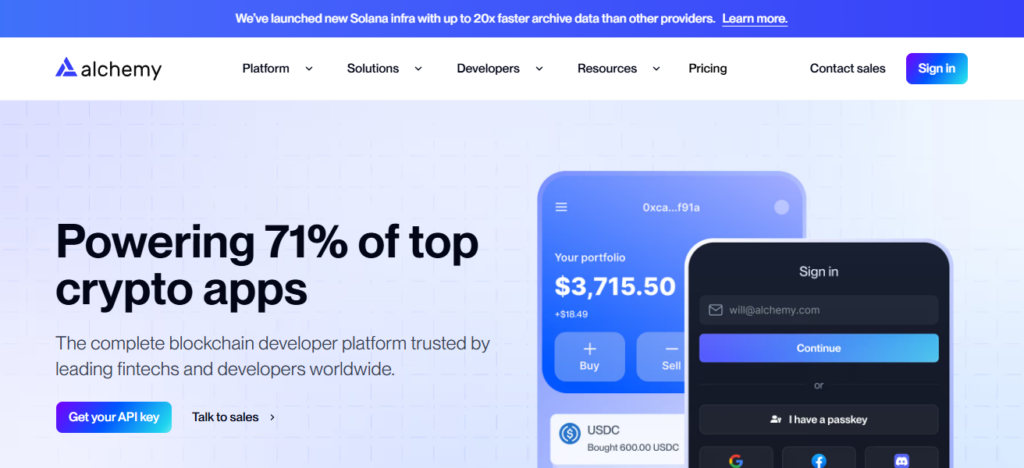
With respect to Web3 commerce, Alchemy provides a unique advantage as the smarts contract interactions, on-chain data svn, and transaction control become a low friction feature, rather than a cumbersome one.
Providing a low friction approach to blockchain, Alchemy characterizes the best of what a modern decentralized business demands.
| Pros | Cons |
|---|---|
| High-performance, scalable node infrastructure | Can be expensive for high-volume enterprise usage |
| Comprehensive developer tools and APIs | Limited support for some emerging blockchains |
| Real-time monitoring of transactions | Advanced features may have a learning curve for beginners |
| Reliable uptime, reducing operational overhead | Some features require technical knowledge to fully utilize |
Features Alchemy
- Scalable Node Infrastructure. Alchemy has fully managed, reliable, and high-performance Ethereum and other blockchain nodes so they can offer their customers Lightning-Fast Transactions.
- Developer Tools. Alchemy has API’s, SDK’s, and Dashboards which make the development and debugging of Smart Contracts a piece of cake.
- Real-Time Blockchain Event Monitoring. Alchemy has the ability to monitor blockchain events and transactions within the sync window of several Alchemy Products.
- Reduced administrative overhead. Alchemy helps to minimize downtime, and helps with Infrastructure Management so developers can spend less time maintaining and more time Building!
2. Moralis
Moralis is recognized as one of the best Web3 commerce infrastructure alternatives due to its consolidated platform that streamlines the deployment of decentralized applications.
Its key competitive advantage is the ability to synchronize a database with blockchains in real time, enabling developers to work with on-chain data instantly, negate the need for intricate backend systems, and also obtain data with minimal operational friction.
Additionally, Moralis provides support for multiple blockchains and makes it easier for enterprises to conduct commerce across different blockchain networks.
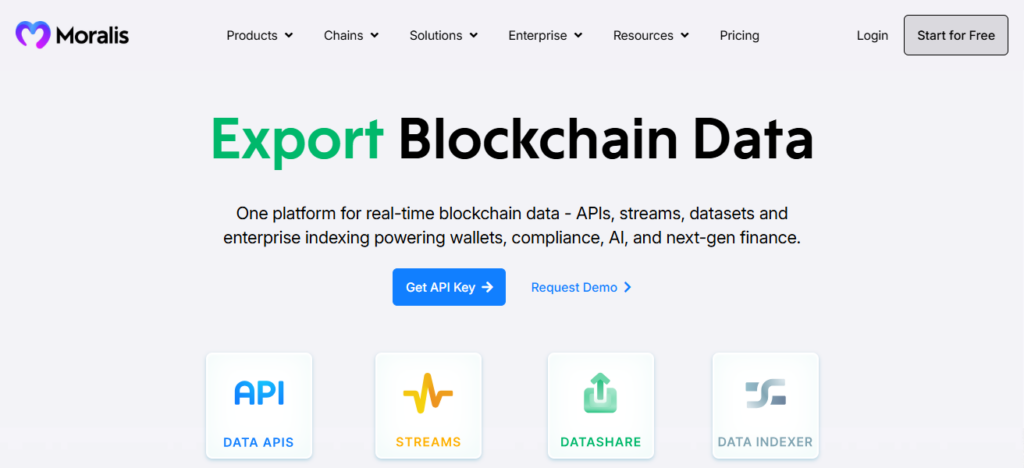
Moralis’ infrastructure on its own improves developer productivity because it incorporates authentication, cloud storage, and various API services, enabling faster, high-performance apps to be developed.
This combination of effortless interoperability and developer support is why Moralis stands out as a provider of scalable Web3 commerce.
| Pros | Cons |
|---|---|
| Real-time blockchain data syncing | Free tier has limited features and request limits |
| Cross-chain support for multiple blockchains | May require additional customization for complex apps |
| Built-in authentication and security | Some integrations can be complex for beginners |
| Rapid development with ready-to-use SDKs | Heavy reliance on platform could affect flexibility |
Features Moralis
- Real-Time DB Sync. Moralis is the only service provider which has the capability of seamless blockchain data sync to a real-time DB.
- Cross-Chain Multi-Chain Support. Moralis is the only alternative which has the ability to implement nearly every other service provider’s blockchains\/databases, which in turn simplifies the multi-chain operations for businesses.
- Wallet Authentication & Secure User Management. Moralis has seamless built-in wallet authentication.
- Rapid Development. Moralis is the only service provider whom has the capability of providing SDK’s, and API’s which removes the need of setting up a complex backend!
3. Tenderly
Tenderly is a competitor in the Web3 commerce infrastructure space, providing superior debugging and monitoring tools for smart contracts.
Tenderly is most distinguished among competitors for offering the ability to simulate transactions in real time and track errors.
Developers can diagnose and troubleshoot issues in a sandbox environment and deploy to production commerce applications, much to the developer’s delight.
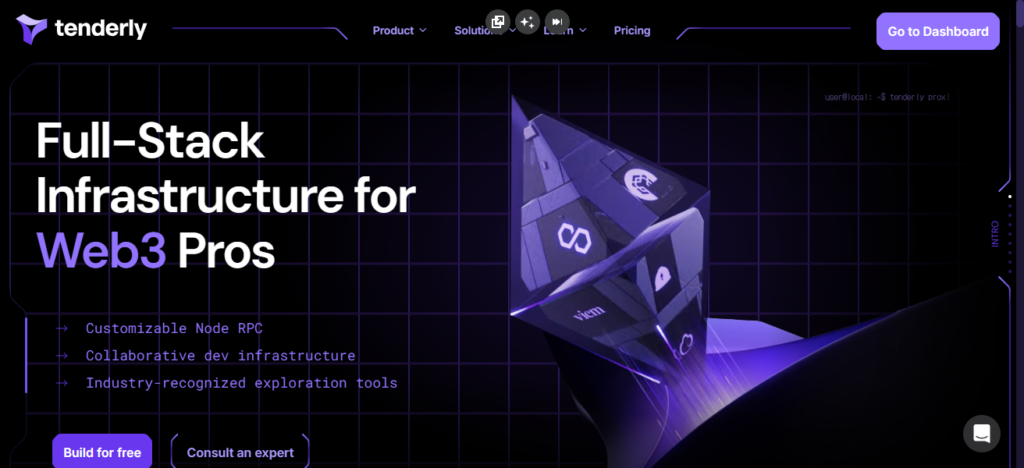
Many developers do complex blockchain operations, and Tenderly simplifies smart contract management with granular metrics and an intuitive dashboard.
By addressing the visibility issues developers face, Tenderly gives the developer the confidence to build robust, augmented, scalable Web3 commerce applications.
| Pros | Cons |
|---|---|
| Advanced smart contract debugging and simulation | Primarily focused on Ethereum-based contracts |
| Real-time transaction alerts and monitoring | Enterprise features can be costly |
| Detailed analytics for performance optimization | Less suitable for beginners without blockchain knowledge |
| User-friendly dashboard for contract management | Limited support for multi-chain deployment |
Features Tenderly
- Smart Contract Debugging. Tenderly is the only provider which is able to provide developers with simulated transactions to ensure the ability to find the which errors exist before going live.
- Gas Optimization. Tenderly possesses the ability to monitor contract executions in order to ensure the best performance is achieved while gas costs are reduced.
- Alerts. Tenderly is the only service which is able to provide real-time notifications of lost and lost transactions, especially those with high risk which can lead to substantial financial losses.
- User-Friendly Dashboard: Displays contract activity in a digestible manner, making tracking and management a breeze.
4. Chainstack
Chainstack is one of the priciest providers of Web3 commerce infrastructure and the only one to offer fully managed enterprise-grade blockchain services.
Their primary competitive advantage is the fast and seamless deployment of their nodes across multiple protocols.
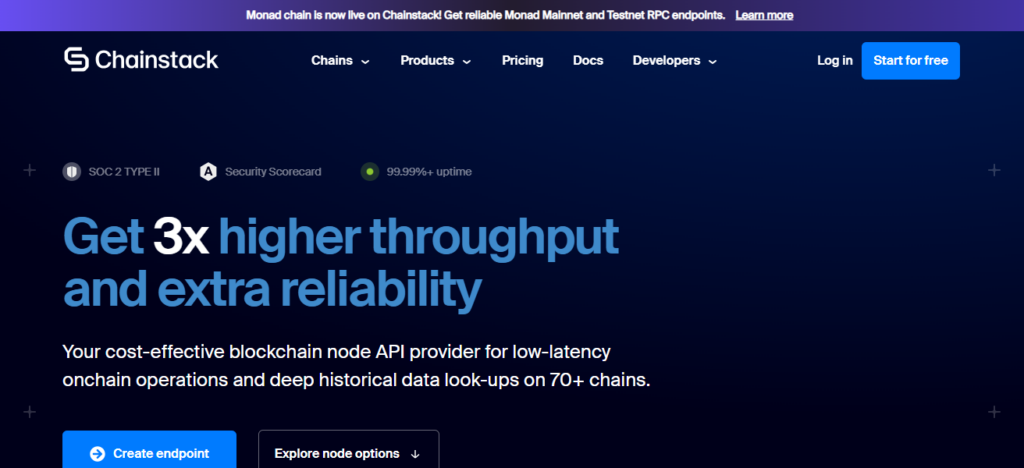
This feature allows clients to easily run dApps without the hassles of managing complex infrastructures. The ease of deployment of blockchain technology makes Chainstack a great choice for Web3 Commerce and Business.
Their multi-cloud connectivity, user interface, powerful API, and overall commerce blockchain deployment allow secured transactions and Chainstack to focus on their core business.
| Pros | Cons |
|---|---|
| Supports multiple blockchain protocols | Premium plans can be expensive for small teams |
| Fully managed node services | Some advanced features require technical expertise |
| Scalable node deployment | Documentation can be overwhelming for beginners |
| Robust API integrations for applications | Not as specialized in analytics or monitoring |
Features Chainstack
- Multi-Protocol Support: Flexible in deployment, as it supports Ethereum, Polygon, Binance Smart Chain and others.
- Managed Node Services: No manual node maintenance, which is a huge operational workload relief.
- Scalable Deployment: For expanding projects, provision cloud and on-premises nodes in record time.
- API Integrations: Strong APIs are provided for straightforward integration in any Web3 service or application.
5. Infura (Consensys)
Infura by ConsenSys is a top alternative for Web3 commerce infrastructure., offering dependable and scalable services with Ethereum and IPFS nodes.
Infura’s one of a kind value proposition is offering developers simplified access to blockchain networks without the operational requirements of running and maintaining nodes, which streamlines developer processes.
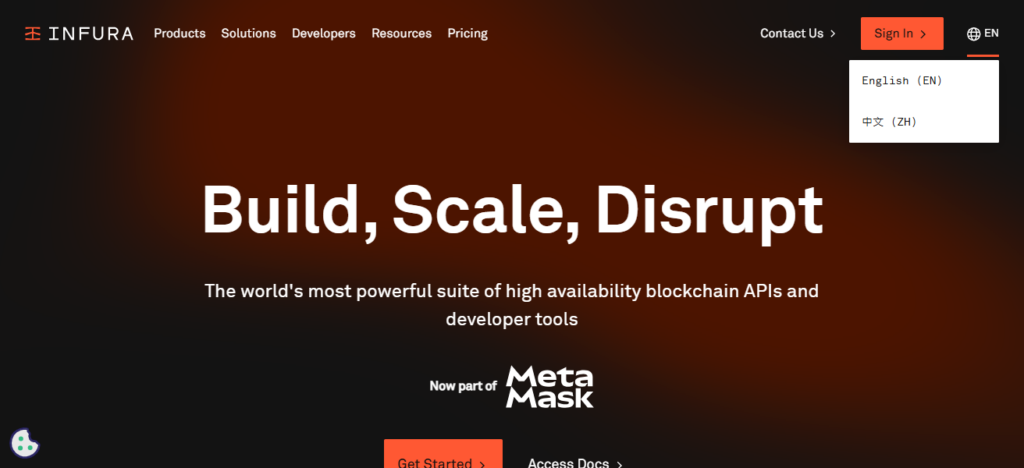
Infura’s high uptime and quick data retrieval with solid API support allow efficient and effective development of decentralized applications.
Infura’s secured, easy to use and globally scalable infrastructure provides Web3 commerce services the ability to operate at scale with high transactional throughput and exceptional service delivery.
| Pros | Cons |
|---|---|
| Reliable access to Ethereum and IPFS nodes | Limited support for newer, niche blockchains |
| High uptime ensures app reliability | Free tier has request limitations |
| Scalable APIs for high-volume transactions | Advanced features can be complex for beginners |
| Secure infrastructure for enterprise applications | Lacks some advanced developer monitoring tools |
Features Infura (ConsenSys)
- Node as a Service: Users receive dependable access to Ethereum and IPFS nodes without self-hosting.
- High Uptime: Keeps applications online, exhibiting minimal downtime.
- Scalable APIs: Efficiently maintains performance for Web3 commerce applications with high transaction volume.
- Secure Infrastructure: For decentralized applications, it provides secured communication and reliability of enterprise grade.
6. QuickNode
QuickNode is considered the second fastest provider and the only with a globally distributed blockchain node network.
Unlike competitors with data centers on a given continent, QuickNode provides ultra-low blockchain access latency on a global scale, enabling instant real-time data processing on multiple blockchains and high-volume transactions.
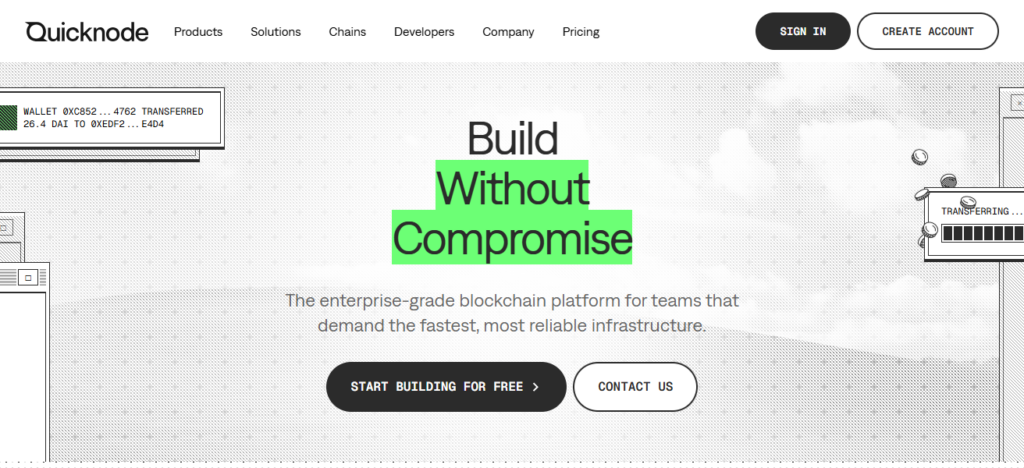
QuickNode’s analytics and APIs help streamline the development and scaling of a dapp. The speed, reliability, and multi-chain support of their products have positioned
QuickNode at the top of the industry, enabling Web3 commerce and traditional businesses to develop and scale integrated solutions and processes.
| Pros | Cons |
|---|---|
| Ultra-low latency for fast blockchain access | Pricing can increase with high usage |
| Supports multiple blockchains | Some features limited on lower-tier plans |
| Developer-friendly APIs and analytics | Certain integrations require technical expertise |
| High scalability for growing applications | Limited on-chain data analytics compared to Covalent |
Features QuickNode
- Ultra-Low Latency: Global and diversely distributed network offers quick access to the blockchain, especially for transaction-heavy applications.
- Multi-Chain Access: Different blockchains are supported, which allows flexibility in Web3 applications.
- Developer Tools: To ease integration and tracking, a combination of APIs, analytics, and dashboards is provided.
- Scalability: Maintaining performance, transaction volume can grow rapidly.
7. Thirdweb
Thirdweb is a leading provider of Web3 commerce infrastructure offerings and has unique no-code and low-code offerings that make it easier for users to build apps on the blockchain.
Its core competency is empowering businesses to implement NFTs, Smart Contracts, and Token-Gated Experiences, without needing to have in-depth technical know-how.
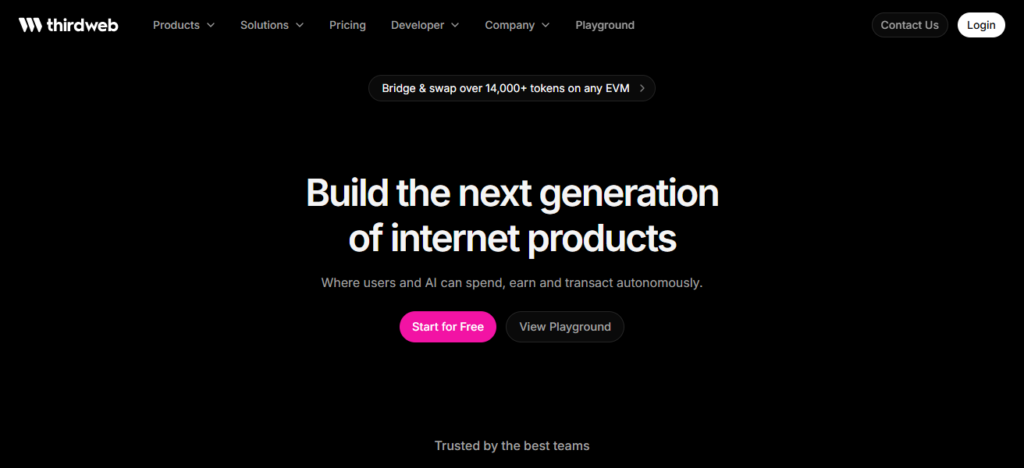
Together with a user-friendly dashboard, prebuilt templates, and multi-blockchain interoperability, Thirdweb makes the Web3 commerce easier to adopt.
They make it possible for developers to leverage a fully decentralized suite of applications to build and configure innovative Web3 experiences in record time, and that is why Thirdweb is one of the best in modern commerce.
| Pros | Cons |
|---|---|
| No-code and low-code tools for rapid deployment | Advanced customizations may require coding |
| Multi-chain support for NFTs and smart contracts | Limited to supported blockchains |
| Prebuilt modules simplify development | Some features may not be suitable for large enterprises |
| Intuitive dashboard for easy management | Smaller developer community than Alchemy or Moralis |
Features Thirdweb
- No-Code/Low-Code Tools: Smart contracts, NFTs, and token-gated experiences can be easily set up.
- Multi-Chain Support: Partnerships with different blockchains for cross-chain commerce.
- Prebuilt Modules: Enable faster creation of Web3 applications with already constructed.
- User-Friendly Dashboard: Eases the handling of contracts and tokens and the actions of users.
8. Fireblocks
Fireblocks is one of the top Web3 commerce infrastructure alternatives. They have best-in-class enterprise security and asset transfer services.
Their digital asset custody and transfer network is the most secure custody and digital asset transfer network because of their exclusively use of multi-party computation (MPC) and hardware isolation.
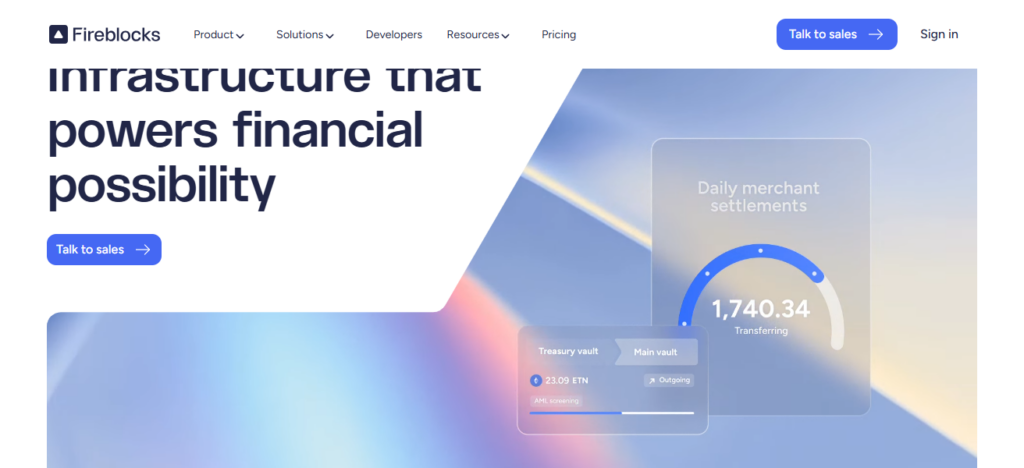
Fireblocks allows businesses to transfer, store and manage digital currencies on multiple blockchains safe and seamless.
Fireblocks, with their top security and compliance tools, and the best API integrations. Is able to give Web3 commerce the opportunity to transact and scale securely, store digital currencies safe, and manage operational risk, which makes Fireblocks the best option to use for enterprise solutions.
| Pros | Cons |
|---|---|
| Enterprise-grade security for digital assets | Primarily aimed at institutional users, expensive for small teams |
| Secure asset transfers across wallets and exchanges | Less focused on application development tools |
| Compliance and regulatory tools built-in | Limited blockchain analytics capabilities |
| API integrations for automation | Learning curve for integration and setup |
Features Fireblocks
- Secure Asset Custody: Using Multi-Party Computation to defend crypto assets.
- Fast Transfers: Safely shifts assets to and from varied wallets and exchanges.
- Compliance Tools: Available for institutional end users.
- API Integrations: Automates asset management and transfers for businesses.
9. Forta
Forta is at the top level of the Web3 commerce infrastructure alternatives. They specialize in providing real-time safety monitoring and tracking on different blockchains.
Forta is the only company with the ability to identify and pinpoint threats, weaknesses, and irregularities in smart contracts, and transactions in real-time to assist clients in stopping fraud and the negative impacts of operational failures.
Forta’s decentralized monitoring is real-time and always available, providing transparency and trust in commerce on the Web3.
The integration of proactive safety and seamless integration make Forta a choice infrastructure for Web3 commerce platforms, allowing clients to keep their decentralized applications safe and operational at all times.
| Pros | Cons |
|---|---|
| Real-time threat detection for smart contracts | Focused on security, not application development |
| Decentralized monitoring network | Integration may require technical expertise |
| Custom alerts for suspicious activity | Limited cross-chain support compared to Moralis or Covalent |
| Enhances transparency and trust in Web3 commerce | Best suited for security-conscious projects |
Features Forta
- Real-Time Threat Detection: Uncovers irregularities in smart contracts and transactions.
- Decentralized Monitoring: Employs a polyglot of nodes to provide continuous security.
- Custom Alerts: Enabled for anomalies, vulnerabilities, or suspicious behavior.
- Seamless Integration: Web3 applications are very active security environments through straightforward API connections.
10. Covalent
Covalent is a top alternative for Web3 commerce infrastructure which is noteworthy for its blockchain data indexing and analytics.
Its main feature is its ability to create a single source of truth in a streamlined, detailed, and real-time manner across multiple blockchains, with no complicated queries or manual searching.
APIs created by Covalent allow businesses and developers to easily gain valuable data, monitor transactions, and gain insight into user activity.
Covalent fosters Web3 commerce businesses to drive efficient, data-oriented, and seamless decentralized analytics by enhancing data accessibility and facilitating cross-chain commerce.
| Pros | Cons |
|---|---|
| Unified API for multi-chain on-chain data | Does not provide node infrastructure or transaction processing |
| Granular analytics for wallets, tokens, and transactions | Free tier may have request limitations |
| Real-time access for informed decision-making | Primarily focused on data; not a full development platform |
| Simplifies cross-chain commerce data management | Requires developer knowledge to integrate into apps |
Features Covalent
- Unified Blockchain Data: Integrates from many protocols an on-chain data into simplistic APIs.
- Granular Analytics: Comprehensive visibility into transactions, wallets, and token holdings.
- Cross-Chain Support: Data analysis for businesses on multiple blockchains.
- Real-Time Access: Immediate data for commerce in Web3 and decision accuracy.
How We Choose Best Travel Agencies for USA Tourist Visa
Review the Compatibility of the Blockchain: Check if the platform facilitates the particular blockchain(s) your application intends to use (Ethereum, Polygon, Binance Smart Chain, etc.).
Assess the APIs and Developer Assets: Check if they have good APIs, SDKs, dashboards, and good documentation for the developers. Developer-centric tools are more preferable because they expedite the development process and make integration much more convenient.
Verify the Level of Performance and Scalability: Consider being on platforms with scheduled uptime, quick transaction completion, and low lag. Make sure the infrastructure is able to accommodate further increasing transaction numbers as your commerce platform grows in popularity.
Look at the Security Options Available: ensure other security options like smart contract auditing, multi-party computation (MPC), and threat response. To minimize the risk of hacks, fraud, or asset loss, use a protected platform.
Check on the Availability of Real Time Data and Analysis Platforms allow for on-chain data, transaction tracking, and analytics in order to make good decisions. Real-time insights created the possibility of better user experience and operational efficiency.
Conclusion
To sum up, the top-tier Web3 commerce infrastructure providers are Alchemy, Moralis, Tenderly, Chainstack, Infura, QuickNode,
Thirdweb, Fireblocks, Forta, and Covalent because of their combined strengths in scalability, security, tools for developers, and access to real-time data.
Depending on the requirements of the project, whether it be multi-chain capabilities, smart contract automation, or comprehensive analytics
These providers are best suited for the development of fast and dependable decentralized commerce systems.
FAQ
What is Web3 commerce infrastructure?
Platforms that provide tools, APIs, and services to build decentralized commerce applications.
Which are the top alternatives?
Alchemy, Moralis, Tenderly, Chainstack, Infura, QuickNode, Thirdweb, Fireblocks, Forta, Covalent.
Why use them?
They simplify blockchain integration, security, and transaction management.
Who should use them?
Developers, startups, and enterprises building Web3 commerce apps.
What’s the key factor to consider?
Security, scalability, multi-chain support, and developer tools.