The world of digital assets is evolving rapidly and the protection of assets and their custody is extremely important for investors and institutions. Although BitGo has been a trusted option for a long time, a multitude of other options in the market provide better security, insurance, and compliance.
With options ranging from hardware-backed wallets to cloud multi-party computation, BitGo Alternatives: Custody & Security Providers flexible, operational, scalable, and innovative solutions to organizations for the protection of their cryptocurrencies.
What are BitGo?
BitGo is an industry-leading digital asset custody and security service provider for institutional investors, exchanges, and other high-net-worth individuals. To protect its clients’ cryptocurrencies, BitGo provides services and products such as multi-sig wallets, hot and cold storage, and key management.
BitGo also provides regulatory and compliance services, digital asset insurance, internal transfer and transaction monitoring, and security service.
Using enterprise-grade infrastructure, BitGo is able to protect an organization’s ability to manage, store, and move crypto assets, which is why it is widely regarded as safe institutional crypto custody service provider.
Key Point & BitGo Alternatives: Custody & Security
| Key Point | Custody & Security Provider |
|---|---|
| Coinbase Custody | Regulated and insured custody for institutional investors. |
| Fireblocks | Enterprise-grade multi-party computation (MPC) security for wallets. |
| Anchorage Digital | Offers fully insured and SOC 2 compliant custody solutions. |
| Ledger Vault | Hardware-based custody with robust governance controls. |
| Gemini Custody | Regulated US-based custody with $200M insurance coverage. |
| Copper Technologies | MPC + cold storage hybrid security for institutions. |
| Kingdom Trust | Offers crypto alongside traditional alternative assets custody. |
| Paxos Custody | Regulated, insured, and audit-ready custody services. |
| Curv | Cloud-native MPC wallets with no single point of failure. |
| METACO | Integrates with banks and financial institutions for secure custody. |
1. Coinbase Custody
Coinbase Custody is a fully compliant, and insured solution for the digital custody of assets. Coinbase Custody offers institutional clients the use of segregated wallets, or wallets with clients’ funds partitioned.
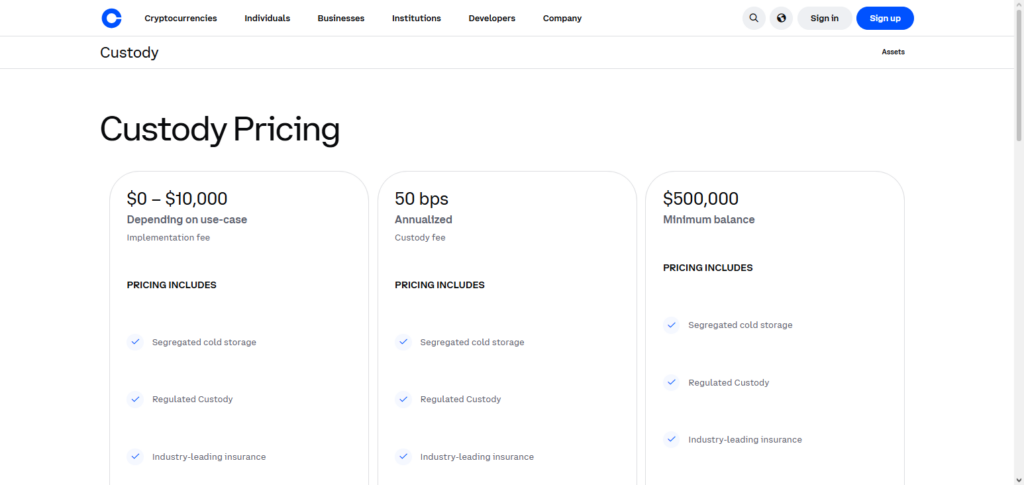
Coinbase Custody includes digital assets insurance, online governance controls, and the option for digital assets to be monitored 24-7. Coinbase Custody clients, as a result of the integrated services, benefit from trading and liquidity separated.
The platform offers clients a diverse range of digital currencies, the option to pledge their coins for rewards, and a form of custody that is compliant with the Coinbase structure. Coinbase Custody is also SOC 2 compliant.
Coinbase Custody Key Feature & Pros & Cons
Key Features
- Regulated institutional custody
- Segregated cold storage
- Digital asset insurance
- Coinbase exchange integration
Pros
- Good regulatory compliance
- Great liquidity through Coinbase
- Good insurance coverage
- Reporting and auditing for enterprises
Cons
- Some competitors are cheaper
- Some regions do not offer services
- No full wallet management services (custody only)
- KYC/AML involved are very strict
2. Fireblocks
Fireblocks is an industry leader in providing institutional grade crypto security and fireblocks customers can rest assure their crypto transfers between exchanges, wallets and counterparties are completely.
safe as, they use multi party computation (MPC) technoloy and eliminate single points of failure, Also, for tokenized assets, customers can utilize private key control, and real time compliance checks, which are required for certain tokens and along with insurance and enterprise level monitioring, hedge funds, exchanges, and institutions can eliminate operational risks with fireblocks, as it removes the risk of using traditional custody and cold storage alternatives. Fireblocks secure wallet solutions supports 500+ tokens and major DeFi wallets.
Fireblocks Key Feature & Pros & Cons
Key Features
- Secure transfer network
- 500+ asset support
- Real-time compliance and risk controls
- MPC key management
Pros
- Great transfer security
- Rapid integration for enterprises
- Great support for assets
- Connectivity to DeFi and exchanges
Cons
- Not great for small firms (expensive)
- No built-in exchange
- High configuration learning curve
- Not great for isolated retail users
3. Anchorage Digital
Anchorage Digital is a crypto custodian that is fully insured, and regulated, meaning it offer industry grade crypto custody along with compliance insitutions grade security. Anchorage Digital incorporates custody services with cold storage and MPC wallet technologies, meaning regulatory tech is in use, ensuring that at no point, under no circumstance are private keys exposed to a single device, or person.
Anchorage Digital is also providing it customers with the ability to stake their tokens govern their tokens in the case of a governance situation and integrated trading, which is the ability to trade in and out of the crypto with a trading platform, and is also compliance SOC 1, and SOC 2, and is insured for breaches, and cyber attacks, which is a wholly endorsed compliant regulatory approach which provides unmatched security, but also operational flexibility and is a great option for institutions in crypto custody.
Anchorage Digital Key Feature & Pros & Cons
Key Features
- MPC + hardware security
- Insured regulated custody
- Support for governance and staking
- SOC compliance
Pros
- Breach insurance
- Full toolbox for institutions
- Client staking revenue
- Proven compliance & vigilance
Cons
- Less versatile tokens than competitors
- There is onboarding
- Minimum amounts are higher
- Not suited for retail investors
4. Ledger Vault
Using hardware security modules (HSMs) and multi-authorization policies, Ledger Vault provides enterprises a safe way to store digital assets. Ledger Vault makes it possbile to have a complete control over private keys all while having a safe control framework for managing assets.
Ledger Vet only provides safe policies, multi-entity approvals, and adaptable workflows, Vault provides flexibility to operational control. Ledger Vault’s design allows for instiutions to manage thousands of crypto wallets and secure access to all crypto trading pairs and audit trails.
Unlike many competitors, Ledger Vault is built to eliminate single points of failure for a secure, hardware-based solution to financial instituions and corporate treasury teams seeking a secure alternative to BitGo.
Ledger Vault Key Feature & Pros & Cons
Key Features
- Security via hardware
- Multiple authorization
- Governance by rules
- Auditing by enterprise
Pros
- Security at hardware key level
- Rules-based flexibility
- Institutions are welcomed
- No single failure point
Cons
- Compliance support is less
- More complex setup
- More managerial overhead
- No default insurance
5. Gemini Custody
Customers of Gemini Custody may include both institutions and individuals. They may also include those involved in cryptocurrency custody. Gemini Custody takes many forms of cryptocurrency.
Customer cryptocurrency funds are protected in two areas: offline cold storage and separate storage accounts. Structuring and storage protection offsets risks of cryptocurrency theft. Protection includes advanced compliance analytics and real-time reporting while protection is also offered for up to $200 million in lost in versus on versus stored versus cyber-assets.
The SOC 1 and SOC 2 Compliance of Gemini Custody also speaks to the rigorous nature of the financial protection on compliance of Gemini Custody. Custody and service protection is also offered through the seamless service and asset transfer from and to the Gemini Trading Platform. They are custodians of choice for many institutions.
Gemini Custody Key Feature & Pros & Cons
Key Features
- Custody by regulations in USA
- Insurance at $200M
- Storage is cold and offline
- Tools for compliance and reporting
Pros
- Insured at a higher level
- Support of an Exchange
- Compliance is thorough
- Integration with Gemini market is a breeze
Cons
- Insurance does not cover every risk
- Geographies
- Fees
- Limited DeFi access
6. Copper Technologies
Copper Technologies employs a hybrid model of custody solution that includes the use of multi-party computation (MPC) and cold storage. Copper Technologies promotes the use of cryptocurrency as it allows institutions to store, move, and control their cryptocurrency holdings without hinderance to operational effectiveness.
Copper Technologies is borderless in nature as it includes the most prominent cryptocurrencies, the most significant tokenized asset and includes as well developments in DeFi and in compliance aligned to the Enterprise level. ClearLoop is a Copper Technologies Protocol that allows for transfer in custody without the risk of revealing a private key- the risk of transferring a private key is that it may expose the key to a breach whether (internal) or (external) to Copper.
In addition to these offers Copper Technologies brings service and cash protection to the level of competition to BitGo but not without the added value of modern and safe scalable custody to Enterprises, Hedge funds, and Crypto Exchanges.
Copper Technologies Key Feature & Pros & Cons
Key Features
- Hybrid cold storage and MPC
- Transfer via ClearLoop
- Tools for compliance at institutions
- Integration via API
Pros
- Superior tech for security and transfer
- Insurance is an option
- Integration for institutions is a breeze
- DeFi via secure pathways
Cons
- Pricing is for enterprises only
- No local possibilities for exchange
- Slow to onboard
- Lacks the adoption that Coinbase has
7. Kingdom Trust
Kingdom Trust is a regulated custodian that focuses on both crypto, and alternative assets, such as real estate, private equity, and commodities. Kingdom Trust as a custodian offers segregated and insured wallets and provides over 30 cryptocurrencies, with advanced multi-signature protection.
Their platform allows institutional and high-net-worth clients governance, reporting, and compliance solutions. Kingdom Trust merged digital assetsʹ and traditional finance’s offerings, enabling institutions to combine crypto holdings with other alternative investments. With SOC 1 and SOC 2 audits, Kingdom Trust custody solution is a flexible option to custody alternatives for diversified portfolio and custody insured assets.
Kingdom Trust Key Feature & Pros & Cons
Main Points
- Alternative assets alongside crypto
- Insured wallets that are segregated
- Security that uses multiple signatures
- Compliance and reporting
Advantages
- Assets under diverse trustee management
- Great multi-sig protection
- Experience in the custody of traditional assets
- Positive for diverse portfolios
Disadvantages
- Crypto features are fewer
- DeFi’s integration is less
- There might be higher fees
- Availability is limited regionally
8. Paxos Custody
Paxos Custody is providing insured and regulated crypto custody solutions for institutions and fintech companies. Paxos Custody offers segregated wallets, compliance monitoring, and secure offline storage for multiple cryptocurrencies and stablecoins.

The platform provides institutional trading and settlement system integrations, allowing clients to manage their digital assets with reduced operational risks. Paxos has custody insurance and includes cyber insurance to protect client funds. Paxos Custody is ideal for clients who require safe, compliant, transparent, and insured custody solutions.
Paxos Custody Key Feature & Pros & Cons
Main Points
- Regulation by the NYDFS
- Support for stablecoins
- Custody that is Insured
- Integrations for settlements
Advantages
- Support for stablecoins
- Strong proven credentials for compliance
- Fintech partners prefer
- Security that is insured
Disadvantages
- Regional licensing is limited
- Price point that is not the lowest
- Less advanced governance features
- DeFi features are limited
9. Curv
Institutional wallet security based on MPC (Multi-Party Computation) technology and absent any traditional private key compromise is offered by Curv, a cloud-native platform.

Curv allows secure transfers, access control, and governance policies to be implemented without a single point of failure. Curv includes trading platforms, DeFi protocols, and hundreds of supported cryptocurrencies.
Curv’s MPC based technology prevents the total exposure of the keys, therefore, the total loss from hacking is limited. Curv is built for modern, scalable custodial solutions, while offering SOC 2 compliance and enterprise-grade monitoring. Curv’s unique features including flexibility and security, positions it strongly against BitGo for digital asset management.
Curv Key Feature & Pros & Cons
Main Points
- Security via cloud location and MPC
- No storage of private keys
- Support for DeFi and Exchanges
- Control of access based on policy
Advantages
- New design for MPC
- Reduction of risk the keys exposure
- Great for enterprises, scales easily
- Control of access is flexible
Disadvantages
- Depends on cloud location
- Beginner’s complexity
- No platform for trading directly
- Optional insurance
10. METACO DAO
METACO has robust custody technology specifically designed for banks and financial institutions in the digital asset custody sector. With METACO DAO, institutional digital asset custody can include secure wallet orchestration, multi-signature approvals, and compliance management of operational regulations
. METACO DAO integrates with banking systems seamlessly and has custody solutions capable of managing tokenized assets, stablecoins, and all major cryptocurrencies. Regulated bodies can benefit from METACO’s focuses on governance, audibility, and operational transparency.
METACO DAO can be deployed in the cloud or on-premise, delivering the flexibility and security required for digital asset custody for financial institutions. METACO DAO is ranked highly for banks seeking enterprise-grade digital asset custody solutions.
METACO Key Feature & Pros & Cons
Main Points• Custody platform for banks
- Tools for governance and compliance
- Deployment on-prem/cloud
- Assets that are tokenized are supported
Pros
- Created for regulated institutions
- Great governance and auditability
- Flexible support
- Tokenization is supported
Cons
- Pricing is enterprise
- Deployment is complex
- Not oriented towards retail
- Integration specialization is needed
Criteria for Choosing a Custody Provider
Selecting an appropriate custody provider for digital assets is of utmost importance, particularly for institutions that work with a huge volume of cryptocurrency. The factors listed below should guide one towards the best provider for a custodian solution:
Security Measures
Without a doubt, the most essential component of a custody provider is what they offer in terms of security. The best security is considered to be multi-party computation (MPC), multi-signature wallets, and cold-storage.
Vendors that offer hardware backed security and stronger security in the form of encryption for the management of private keys should be fully considered, so that assets can be secured and compromised keys can be avoided.
Regulations and Insurance
Compliance with both national and international regulations is to be factors that can be used to assess the reputation of custody providers. The same is to be said of the possession of other certifications, such as the SOC 1 and 2 certifications and NYDFS.
Insurance for the assets that have been stored with the provider is equally important to protect the provider from losses due to a cyber attack, theft, and any operational losses. Always check the provider regarding the scope and limitations of the insurance.
Asset Support & Integration
Custody providers vary in their acceptance of certain cryptocurrencies, stablecoins, and tokenized assets. Therefore, institutions must select a provider according to their portfolio, including as yet unsupported tokens or DeFi assets.
Integration with trading desks, exchanges, and staking protocols can enhance operational efficiency and allow for frictionless movement of assets.
Usability & Enterprise Features
Institutional clients prioritize usability as well as governance, reporting, and auditing controls. Providers must incorporate customizable workflows, role-based access, and monitoring dashboards. Such features enable organizations to effectively manage, monitor, and audit their assets while ensuring compliance.
Cost & Scalability
Lastly, institutions must scrutinize the custody provider’s cost structure, including the costs of implementation, transactions, and ongoing management.
Additionally, the solution must be scalable in order to accommodate the organization’s growing asset base and to allow subsequent expansion into new cryptocurrencies or markets.
Choose a BitGo alternative for custody & security providers is an art, not a science. Here is a practical, straightforward approach to the main choices that need to be made by institutions and investors:
How to Choose a BitGo Alternative: Custody & Security Providers
Get to Know the Security Architecture
How do they protect the private keys and the assets?
Multi-Party Computation (MPC) and Multi-Sig Wallets will have fewer single points of failure.
Cold storage is the best way to protect and secure assets offline.
Hardware Security Modules (HSMs) and cloud-native MPC secure the keys using cryptographic methods. Select a provider whose security strategies are consistent with your risk and operational controls.
Regulatory Compliance and Insurance
Consider regulated custody solutions covering certifications such as SOC 1, 2, and NYDFS:
- Assets are covered by Insurance against breaches and theft. Pick a provider with coverage limits and compliance reports.
Asset Support and Integrations
Align the custody provider with your digital assets:
- Do they hold the cryptocurrencies, tokens, and stablecoins that you need?
- Are there integrations with exchanges, wallets, DeFi protocols, and trading systems? Make sure you have the right operational tools and platform integrations.
Analyze the Governance and Control Features
The governance tools secure the management of access and operations:
- Access and approval workflows based on roles.
- Policies on withdrawals and transfers customizable.
- Compliance reporting and audit logging. Choose a provider that allows the governance and control structures that are in line with your organizational policies.
Usability and Enterprise Features
Evaluate the platform for usability and internal workflows:
- Activity tracking and monitoring dashboards.
- Automation reporting.
- Access for auditors and regulators. High usability increases time savings and minimizes operational friction.
ssssssssss Cost and Scalability
Pricing models must be comparison, i.e., setup costs, transaction costs, asset-under-management costs:
For growing portfolios, scalable pricing is vital.
Enterprise functionalities will be more costly, but cater to institutional requirements. Find a solution that aligns with your financial capacity and growth expectations.
Analyze Support and SLA
For mission-critical custody, your SLO and support should be:
institutional support is available and reliable.
For critical issues, response agility is prioritized.
Account management is assigned. The operational continuity is assured by the support and SLA.
Conclusion
The alternatives to Bitgo vary on factors of security, compliance, asset support, and operational needs, and deciding on one requires weighing each of these for its given needs. For examples, Coinbase Custody, Fireblocks, and Anchorage Digital, as institutional-grade solutions, have best-in-class insurance and are subjected to stringent regulation and control, thus are best for large wallet portfolios.
For less operational oversight and pn superior control of the crypto keys, Ledger Vault and Curv offer best security but cuse either hardware or cloud-based (MPC) controls. Kingdom Trust and METACO DAO are best for institutions with diversified or tokenized portfolios. Ultimately, weighing these options grants organizations strategy-focused, security, custody solutions that are compliant.
FAQ
How do I choose the right provider?
Consider security protocols, regulatory compliance, insurance, asset support, governance tools, usability, and cost. Matching these factors to your operational and portfolio needs ensures the best choice.
What types of assets can these providers store?
They support a wide range of assets, including Bitcoin, Ethereum, stablecoins, tokenized assets, and some emerging cryptocurrencies, depending on the provider.
Are these solutions suitable for retail users?
Most are designed for institutions and high-net-worth clients, offering enterprise-grade security and compliance features. Retail users may find some solutions complex or costly.
Which are the top BitGo alternatives?
Some of the most trusted alternatives include Coinbase Custody, Fireblocks, Anchorage Digital, Ledger Vault, Gemini Custody, Copper Technologies, Kingdom Trust, Paxos Custody, Curv, and METACO DAO.
How scalable are these custody solutions?
Most alternatives are highly scalable, allowing institutions to grow portfolios, integrate new assets, and expand operations while maintaining security and compliance standards.