Ripple Moves XRP to Binance, Triggering Market Speculation
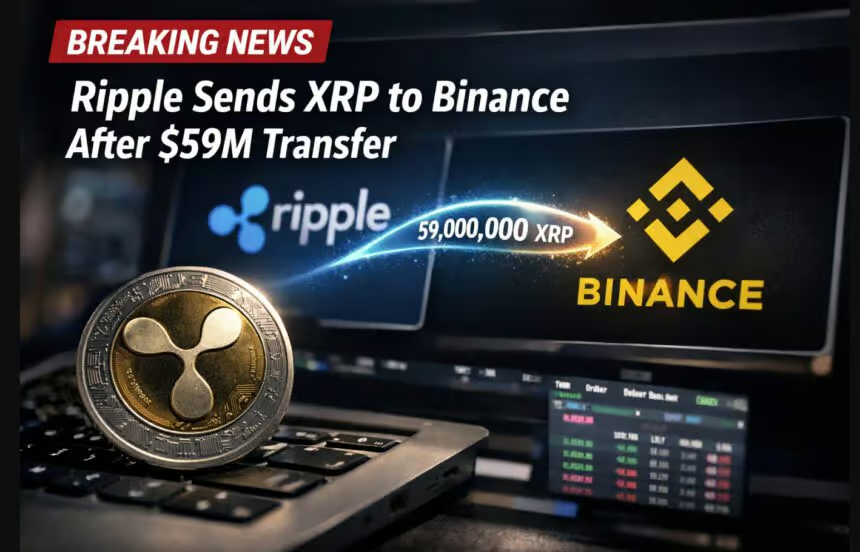
Ripple has once more been active in the cryptocurrency market, moving a significant amount of XRP to Binance. On-chain transaction data shows that 50 million XRP, worth over $59 million, was transferred from a Ripple-controlled wallet. The transaction was originally reported by Whale Alert, a blockchain tracking service that monitors notable cryptocurrency transfers.
With a transfer this large, the XRP investing community was quick to speculate the possibility of Ripple making a sale of a portion of their holdings. Large transfers to exchanges is frequently interpreted as a sale, and can lead to market uncertainty in the short term.
On-Chain Data Reveals Internal Wallet Activity
XRPScan was able to provide a further breakdown of the transaction. The data showed that the XRP was from Ripple’s “Ripple (50)” wallet, and the funds were sent to a subwallet of Ripple’s, identified as raRVLN1. This means that the funds were moved to a different wallet administered by Ripple, and were not sent to an exchange for sale.
Subwallets are internal, and activity was still taking place. Soon after receiving the funds, the subwallet made XRP transfers to other wallet addresses. Most of the transfers were made in 2,000,000 XRP transactions, and were sent to wallet addresses, rBNCyN and rnPpiy.

Binance-Associated Wallets Receive XRP Transfers
Blockchain substantiates that the addresses receiving the transfers are associated with Binance, one of the largest cryptocurrency exchanges in the world.
Traders fear that funds moving to Binance-associated accounts mean there will be less buying pressure and more selling pressure across the market.

Still, some analysts think differently. It is possible that these transfers are related to the way Ripple manages liquidity within the company. The company often moves and facilitates transactions using XRP for Ripple’s On-Demand Liquidity (ODL) systems.
This means that liquidity moves to and from various locations and exchange partners. Because of this, there is a good chance that these transactions are part of normal business practices and not an attempt to sell large quantities of the asset on the market.
XRP Price Increase
Even with the large amount of money moved, the XRP price has shown a lot of strength. In the last week, XRP price is up more than 12% from its low of about $1.05 and is currently trading at $1.16.

For at least the last 24 hours, XRP has traded between $1.14 and $1.18. In that same time frame, trading volume has increased by about 4%. This shows that traders are ready and willing to trade and are closely watching the imminent macroeconomic events, one of which is the upcoming U.S. Consumer Price Index (CPI) inflation report.
XRP Price Prediction
Though the market watch is mostly on the negatively-impacting macroeconomic events, there is some positive sentiment. For example, YoungHoon Kim, the record holder for the highest IQ, stated that it is possible that XRP has entered a new bullish phase and that the price may reach $1.20.
Another analyst, Ali Martinez, drew attention to the $0.90 level on the long-term monthly chart. According to Martinez, the $0.90 level is a long-term support zone. As the market continues to evaluate the potential for app and utility-based long-term growth of XRP, traders should watch this support level closely.
Conclusion
The transfer of 50 million XRP tokens, worth over $59 million, triggered concerns among some investors, especially after the funds were moved to wallets associated with Binance. However, chain data indicate that these funds were not sold off, and instead, the funds were likely moved to manage aspects of liquidity and were used in Ripple’s On-Demand Liquidity services.
Outwardly, XRP has been maintaining strength of price, having recently recovered over 12% from recent lows. It managed to maintain positive price action above $1.16. XRP appears to depend on overall market sentiment, trading volume, and Ripple’s ecosystem to determine near-term price action. Traders will keep an eye on support levels and economic indicators.