The CLARITY Act 2026 Timeline, Main Features, and Implications for Crypto Markets
In 2026, the CLARITY Act becomes a major US policy debate concerning its digital assets framework. It is a major focus for US lawmakers attempting to finalize regulations around crypto assets and digital currencies. Investors seem to be responding to the movement of the bill by shifting the prices of the main cryptocurrencies, so all eyes are on the CLARITY Act’s progress in the Senate.
Where is it currently sitting in Congress?
The CLARITY Act was, in the middle of 2025, passed in the House of Representatives as a bill that received bipartisan support. The Senate, however, was gridlocked this year because of the varying views concerning the yields of stablecoins. There was also a delay in committee markup because of a compromise language negotiation.
Senators, including Cynthia Lummis, have been working with representatives from both the industry and banking sectors to amend the bill. Banking entities have strongly opposed yield-bearing stablecoins due to the belief that interest payments might lead to a decrease in deposits at traditional financial institutions, which, in turn, would restrict those institutions’ abilities to issue loans.
On the other hand, earlier drafts of the bill contained language that was perceived to be too restrictive by crypto exchange platforms. Coinbase, for example, was somewhat reluctant to negotiate. However, it has recently been reported that an agreement on yield provisions has been reached, which increases optimism for future committee approval.
According to Polymarket data, there is an anticipated 68% chance the CLARITY Act will be enacted in 2026, an increase from previous data. The increase is a result of the expectation that Senate and White House advisers have aligned in regard to stability in the regulatory framework for stablecoins.
Timeline for Passage
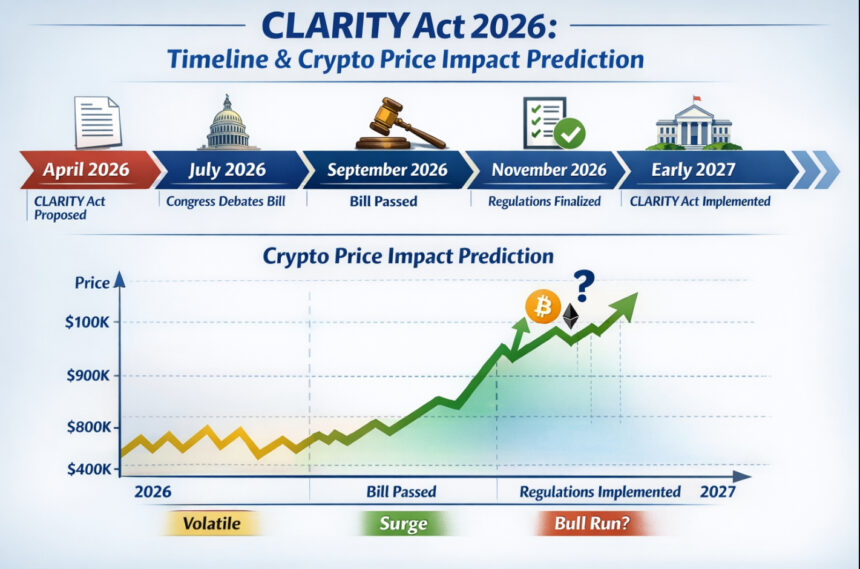
The revised bill is expected to be considered by the Senate Banking and Agriculture Committees in early April. If markup is successful, the bill will proceed to a debate and vote in the full Senate. If things go well, the vote will occur prior to the summer recess, after which the bill will be presented to the President for signature. Legislative scheduling will have the most influence on the timeline.
JP Morgan claims that passage will likely happen by mid-year, causing other nations to adjust their regulations due to it being first come first serve. Many believe that if there are conflicting regulations on decentralized finance, there will be no discussions on the floor, delaying the final go to late 2026.
Until recently, industry insiders believed there was an 80% likelihood of passage by April, however, due to the priorities of an election year, legislative focus will shift. Most believe the CLARITY Act will progress much more now than it did before the last quarter closed.
Key Provisions
The CLARITY Act will be the first to define a digital asset class under federal law and determine whether a token is under the SEC or CFTC jurisdiction. This will set federal standards for the exchanges, brokers, and custodians as well as provide stablecoin issuer compliance guidelines, replacing the current compliance based approach.
A primary focus is the yield prohibition on ‘idle’ stablecoins, and while banks may be able to have stablecoins that pay interest, it will be argued that such balances are “deposits,” and proponents say that, this will eliminate most of the legal ambiguity. Many believe that restricted yields will limit innovation, and as such, will make the stablecoin language a major point of concern for the industry.
Possible Effects on The Market
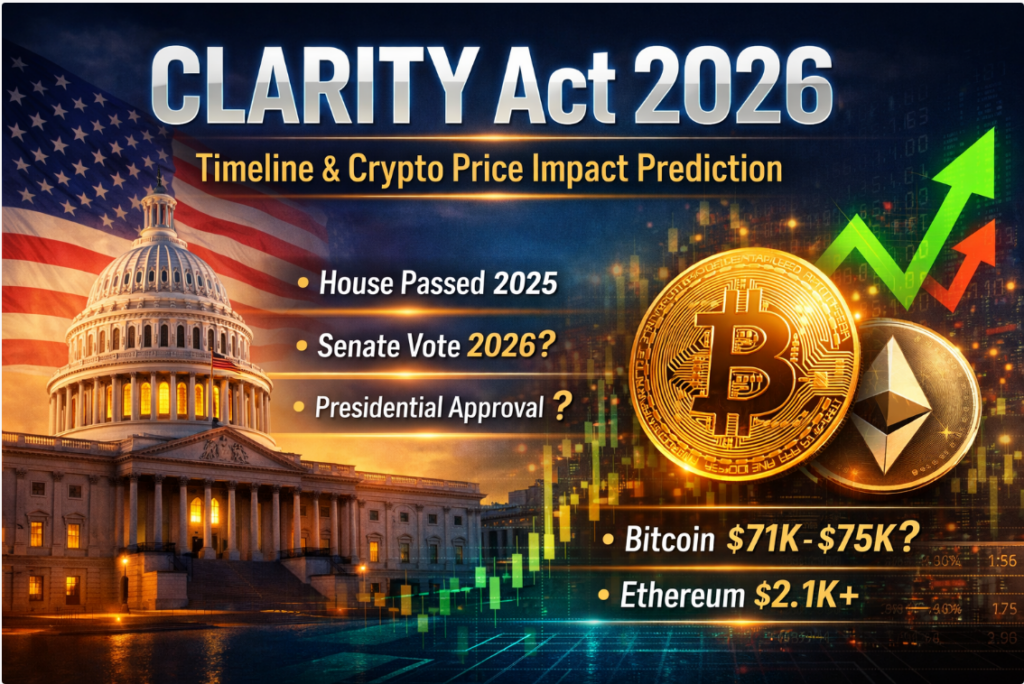
Cryptocurrency markets have always been affected by regulations. The last 24 hours saw a $2.43 trillion total cap on the global digital asset market, and a 0.74% increase, after some recent geopolitical and policy news. Bitcoin is trading above $71,000 and nearing resistance at $75,000, and Ethereum is trading above $2,100. XRP, Dogecoin, Solana, and Cardano are showing very small recoveries.
JPMorgan Chase analysts say institutional capital can be expected with federal regulations. However, some see a lack of market enthusiasm from overly restrictive regulations. Underfunded, unregulated markets are expected to remain volatile. The United States is expected to show a legislative response to short attention spans from investors.
Conclusion
The CLARITY Act 2026 will transform crypto regulation in the U.S. by clarifying classifications of assets and regulations on exchanges and stablecoin compliances. With bipartisan support in the House and a 68% chance of passage this year, the Senate’s agreement on yield provisions shows momentum.
Significant provisions, such as the ban on stablecoin interest and defined SEC vs. CFTC authority, lessen legal ambiguity and address banking trade-offs.
Crypto markets, which are highly sensitive to regulations, have responded to this news positively with Bitcoin priced above $71,000 and Ethereum above $2,100. If passed, the Act will be instrumental in attracting institutional trade, settle crypto trading ranges, and provide greater regulatory certainty for digital assets in 2026.