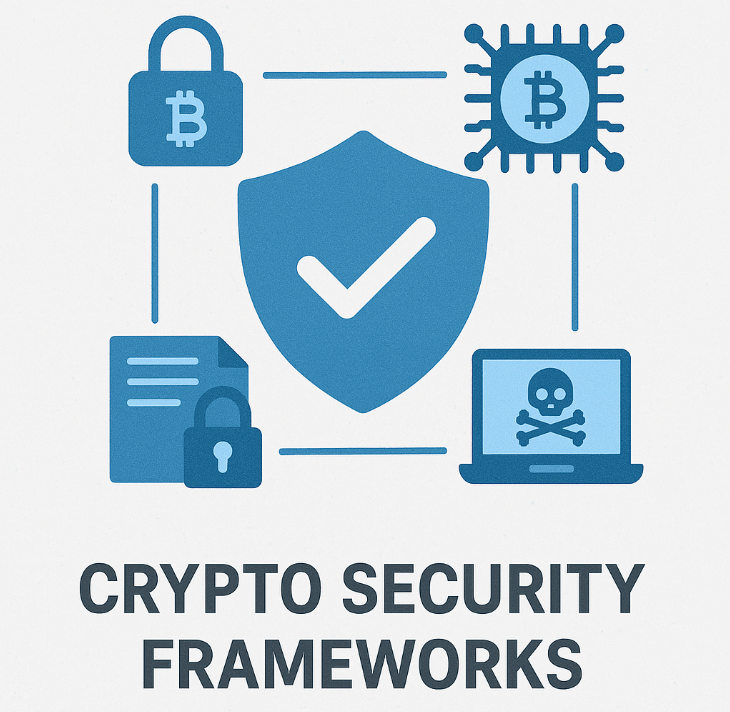
The Crypto Security Frameworks, which are organized systems of rules, procedures, and technology intended to safeguard digital assets and blockchain operations, will be covered in this article.
Wallet security, network security, access control, monitoring, and regulatory compliance are all covered by these frameworks.
By putting them into practice, companies may ensure safe, dependable, and trustworthy cryptocurrency operations in a quickly changing digital environment by preventing hacks, insider threats, and operational failures.
What is Crypto Security Frameworks?
Crypto Security Frameworks are organized systems of rules, procedures, and technologies created to safeguard digital assets and the infrastructure that supports them. They include multi-signature configurations, cold and hot storage, multi-factor authentication, and other security features for wallets, exchanges, and blockchain networks.
In order to guarantee that businesses adhere to regulations like AML/KYC and data protection laws, these frameworks also address network security, threat monitoring, incident response, and regulatory compliance.
Crypto security frameworks protect assets and company reputation in an increasingly complex digital environment by preventing hacks, insider threats, and operational failures through the integration of risk assessment, ongoing monitoring, and employee training.
Crypto Security Frameworks
Step 1: Assess Risks and Identify Assets
- Create an inventory of crypto assets, wallets and services.
- Identify threats: fraud, social engineering, insidious attacks, tech wipeouts.
- Build a risk assessment to help prioritize layers of defense.
Step 2: Secure Asset Storage
- Use cold wallets for crypto HODLing and hot wallets for spending.
- Incorporate multi-signature wallets to add more approvals to every transaction.
- Use trusted custodians if you believe self-custody presents a significant risk or operational burden.
Step 3: Strengthen Network & Infrastructure Security
- Build an infrastructure with firewalls, encryption, and access segmentation.
- Ensure security updates on software, nodes, APIs.
- Use intrusion detection systems (IDS) to detect abnormal behavior.
Step 4: Implement Access Control & Identity Management
- Apply role-based access control (RBAC) to user permission.
- Enforce multi-factor authentication (MFA) on every account.
- Keep audit logs as a control mechanism to monitor user actions.
Step 5: Monitor & Detect Threats
- Scan all transactions, the nodes, and network traffic.
- Create automated response rules for abnormal behavior.
- Implement preventive measures to manage risks using optics tools and outlier detection techniques.
Step 6: Prepare Incident Response Plans
- Identify protocols for security breaches, including containment and communication.
- Assign specific roles and responsibilities for incident response.
- Conduct regular drills and updates to keep the plan effective.
Step 7: Ensure Compliance & Governance
- Follow AML/KYC regulations and data privacy laws relevant to your region.
- Implement internal policies for the soperation and security management.
- Schedule audits and security certifications for accountability and trust.
Step 8: Train Employees & Stakeholders
- Conduct security awareness training to eliminate the possibility of human error.
- Train on the recognition of phishing attacks, secure use of cryptographic keys, and operational procedures.
- Keep teams updated on emerging threats and changes to the operational framework.
Step 9: Review & Improve Continuously
- Regularly reassess risks and strengthen security.
- Develop an analysis framework for incidents and near-misses, and document lessons learned.
- Incorporate best practices and new technologies to strengthen the framework.
Why are crypto security frameworks important?
Safeguard Digital Assets
- Protects wallets, exchanges, and funds from hacking, theft, and operational loss.
Ensure Compliance with Laws
- Support adherence to AML/KYC Regulations, the GDPR, and other relevant laws to avoid fines and lawsuits.
Assist Operational Integrity
- Lessens the chance of disruptions from poor judgement, insider risk, or other operational weaknesses.
Trust from Users and Investors
- Shows a level of commitment, instilling a higher degree of confidence and secure adoption.
Threats can Communicate
- Threats can be communicated to the relevant people. This can be used to prevent forthcoming harm.
Assist the Growth of Business
- Security, when done well, allows a company to develop without risk or non-adherence to policies.
Improves Reputation and Credibility
- Non-Containment of a high level security breach on the company will improve its reputation.
Advantage Of Crypto Security Frameworks
Protects Digital Assets
- Lessens the chances of hacks, theft, and loss of funds.
- Risks, hacks and thefts are the dangers of Digital assets, including loss of funds.
Ensures Regulatory Compliance
- Covers the legal requirements of the firm including, AML/KYC, GDPR, etc.
- Securtiy compliance ensures that the law is followed, including the firm and customer data.
Reduces Operational Risks
- Lessens the chances of human errors and insider system vulnerabilities it.
- Implementing a robust Operational system can diminish the risks of system vulnerabilities.
Builds Trust with Users and Investors
- Shows the level of commitment of the firm, thus makes it trustworthy.
Enables Proactive Threat Detection
- Threat is managed before its damages are felt.
- Before the damages are felt, the threat is managed.
Improves Incident Response
- Enhances the response line, with security breaches, to the line.
- With security breaches, the line is enhanced.
Supports Business Scalability
- Focuses on the system growth and expansion.
- Creating this system shifts the focus on the unique growth.
Enhances Reputation and Credibility
- High, prevents the credibility decays of the system with secure failures.
Encourages Best Practices
- Improves support system, enhances the governance, offers better managed systems.
Best Practices for Implementing a Security Framework
Risk Assessment
- Identify critical assets and vulnerabilities. *Build priority based on risks.
Multi-layered Security
- Use a combination of cold and hot wallets, firewalls, encryption, and access control.
- Don’t rely on one method of security.
Access Controls
- Use role-based access and least privilege.
- Use multi-factor authentication (MFA) on all systems.
Threat Detection and Continuous Monitoring
- Use real-time monitoring on network, transactions, and users.
- Set up reports for abnormal and suspicious activity.
Regular penetration testing and security auditing
- Audit both internally and through a third party on a regular basis.
- Run penetration tests to find exploitable gaps before malicious actors do.
Plans for Incident Response
- Create templates for breach containment and mitigation strategies.
- Assign communication roles to responders.
Awareness and Training of Employees
- Impart training on phishing, crypto, and safe practices, along with social engineering.
- Keep staff updated on new procedures and risks.
Compliance & Governance
- Follow AML, KYC, GDPR, and applicable local regulations.
- Policy and procedure documentation, as well as audit findings.
Updates and Patch Management
- Update software, nodes, APIs, and security tools.
- Evaluate third-party services and libraries for security vulnerabilities.
Case Studies / Examples
Mt. Gox Hack (2014) – Failure Example
- Operational security was weak, resulting in losses of approximately 850,000 BTC.
- Issues include inadequate wallet control, no multisig on control, and bad monitoring.
- Lesson learned: auditing and robust custody solutions are important.
Bitfinex Hack (2016) – Failure Example
- Lost roughly 120,000 BTC. Assailants exploited gaps in the system.
- Issues include exposure of a centralized hot wallet and a lack of intrusion detection.
- Lesson learned: the hot and cold wallets should be segregated, the network security should be strengthened, and monitoring tools should be instituted.
Coinbase Security Measures – Success Example
- Utilizes cold storage, multisig wallets, and digital asset insurance.
- Security audits and penetration testing are routine.
- Lesson learned: The risk is lower and user confidence is earned with a proactive approach toward security and compliance.
Ledger Hardware Wallets – Success Example
- Offline cold storage and secure chip technology for private keys are used.
- Multiple layers of authentication and recovery options are supported.
- Lesson learned: Hardware security and redundancy are important for the protection of everyone’s institutional and individual crypto.
Poly Network Exploit Recovery (2022) – Example of Positive Outcome
- $600M exploit but managed to recover some funds after negotiation.
- Clear example of the benefits of community engagement and having a plan in place to respond to incidents.
- Notable that in the face of a breach, a rapid and structured response, along with clear governance, can reduce the impact of the breach.
Future Trends in Crypto Security

Future Crypto Security Trends are influencing how digital assets will be safeguarded in the years to come. We can anticipate the widespread adoption of AI-driven threat detection, which will facilitate the quicker detection and mitigation of complex assaults.
As decentralized security solutions become more popular, there will be less dependence on centralized custodians and single points of failure. Crypto companies will be forced to implement more stringent operational controls by improved regulatory frameworks and international compliance standards.
Defenses will also be strengthened by developments like quantum-resistant encryption, hardware-based security modules, and ongoing security auditing. In general, proactive, flexible, and robust security frameworks for a quickly changing cryptocurrency environment will be the main focus.
Pros & Cons
| Pros | Cons |
|---|---|
| Protects digital assets from hacks, theft, and operational failures | Can be expensive to implement and maintain, especially for smaller firms |
| Ensures regulatory compliance (AML/KYC, data privacy laws) | Complexity may slow down daily operations if not properly managed |
| Builds trust with customers and investors | Requires constant updates to address evolving threats |
| Provides structured incident response and risk management | Employee training and awareness programs demand time and resources |
| Enables continuous monitoring and proactive threat detection | Over-reliance on tools may lead to complacency if human oversight is weak |
| Supports scalability and growth by creating secure infrastructure | Implementation may require specialized expertise, which is not always readily available |
Conclusion
Protecting digital assets, upholding regulatory compliance, and preserving operational integrity all depend on the implementation of a strong crypto security architecture.
Organizations may drastically lower the risk of cyberattacks, insider threats, and operational failures by combining multi-layered security solutions like secure wallets, network safeguards, access controls, and continuous monitoring with employee training and incident response plans.
Adopting proactive, adaptable, and well-governed security frameworks ensures long-term stability and growth in a highly dynamic ecosystem while safeguarding assets and fostering confidence with partners, users, and regulators.
FAQ
What is a crypto security framework?
A crypto security framework is a structured set of policies, procedures, and technologies designed to protect digital assets, wallets, exchanges, and blockchain infrastructure from hacks, insider threats, and operational failures. It includes asset protection, access control, network security, monitoring, incident response, and regulatory compliance.
Why are crypto security frameworks important?
They safeguard assets, prevent financial loss, ensure regulatory compliance, and build trust with users, investors, and partners. Without a strong framework, crypto organizations are highly vulnerable to theft, fraud, and operational disruptions.
How can businesses implement a crypto security framework?
Step-by-step implementation includes: assessing risks, securing assets, strengthening networks, enforcing access controls, monitoring systems, creating incident response plans, ensuring compliance, training employees, and continuous improvement.
Can crypto security frameworks prevent all hacks?
No framework can guarantee 100% protection, but a comprehensive and well-implemented framework significantly reduces risks and minimizes the impact of potential security breaches.
How often should a crypto security framework be updated?
Regularly—ideally every 6–12 months—or whenever new threats, vulnerabilities, or regulatory changes emerge. Continuous monitoring and improvement are critical for effectiveness.