In this piece, I’ll talk about DePIN Hardware Arbitrage, a tactic used by operators to profit on high-performance GPUs in decentralized networks, such as H100 clusters. Participants can make a sizable return on investment by renting computing power to AI protocols or receiving token prizes.
In order to maximize earnings in the quickly expanding DePIN ecosystem, we will examine this approach’s operation, advantages, hazards, and optimization techniques.
What is DePIN Hardware Arbitrage?
The deliberate placement and commercialization of high-performance physical computing resources within Decentralized Physical Infrastructure Networks (DePINs) is known as DePIN hardware arbitrage.
Under this strategy, businesses or individuals purchase enterprise-grade gear, such NVIDIA H100 GPU clusters, and lease their processing capacity to decentralized applications, blockchain networks, or AI protocols.
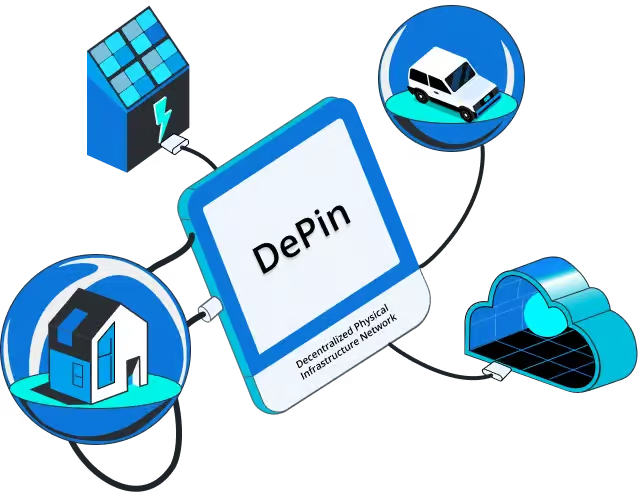
Capturing the price differential between the hardware’s operational costs (including purchase, upkeep, and electricity) and the money received from network usage or token incentives is the “arbitrage” component.
DePIN creates a new paradigm for ROI-focused infrastructure investment, particularly in AI-driven ecosystems where compute demand is high and latency-sensitive, by allowing players to effectively leverage underutilized hardware, expand workloads on demand, and profit from decentralized incentives.
DePIN Hardware Arbitrage
Definition
Decentralized Physical Infrastructure Network (DePIN) Hardware Arbitrage involves monetization of high value, performance, and physically tangible hardware.
Core Concept
Every Operator holds enterprise level GPUs (NVIDIA H100 for example) and earns revenue by serving computing capacity to some AI protocols and/or decentralized networks.
Revenue Model
Profit is captured over operational costs (that include hardware and energy as well as maintenance cost) versus rewards from the network (token rewards).
Efficiency
Maximized usage of hardware that would have otherwise been unutilized and, at the same time, assisting decentralized AI workloads.
Scalability
Operators are able to scale clusters as demand flows to enhance their profit.
Risk Factor
ROI is subject to the prevailing network adoption and compute demand as well as energy costs.
Strategic Advantage
This is a decentralized solution compared to the centralized cloud GPU rentals.
Enterprise-Grade H100 GPU Clusters
NVIDIA H100 GPUs are used in Enterprise-Grade H100 GPU Clusters, which are high-performance computing configurations built for demanding AI, machine learning, and data-intensive tasks.
Large AI models may be trained quickly and real-time inference is made possible by these clusters, which combine many GPUs with efficient CPUs, memory, and networking to provide immense parallel processing capability.
The H100 GPU is perfect for enterprise-scale AI applications because of its sophisticated tensor cores, large memory bandwidth, and energy-efficient architecture.
High computational throughput and potential monetization in decentralized networks are the rewards of operating such clusters, but doing so comes with careful consideration of acquisition prices, energy consumption, cooling, and maintenance. These clusters are being used more and more in DePIN configurations to support AI protocols and make money.
ROI Calculation Framework
A structured approach to calculating the profitability of enterprise-grade GPU clusters is offered by the ROI Calculation Framework for DePIN hardware arbitrage.
In addition to operational costs like power, cooling, maintenance, and network fees, it takes into account the original capital expenditure, which includes hardware acquisition, setup, and infrastructure costs. Token incentives, decentralized services, and leasing computation power to AI protocols are all considered revenue sources.
Cluster utilization rates, workload efficiency, network demand, and token price volatility are important variables that impact return on investment. In order to assess short-term versus long-term returns while accounting for depreciation and possible upgrades, operators frequently perform scenario analyses.
This methodology minimizes operational and financial risks while enabling investors to maximize profit, optimize cluster performance, and make data-driven decisions.
Optimization Strategies
Maximize Cluster Utilization
Schedule workloads so that GPUs are always running at full capacity.
Energy Efficiency
Cutting costs via cooling and scheduled power control along with energy adaptive power control.
Maintenance Planning
Downtime and performance loss mitigation are gained when regular maintenance and preventative hardware replacement are performed.
Software Optimization
Increased throughput and reduced bottlenecks can be attained with the help of AI workload management, virtualization, and monitoring.
Dynamic Scaling
ROI is best optimized when the cluster size is adjusted to meet demand so that the resources are never overcommitted.
Financial Hedging
Span of fixed costs, be they token prices, electricity costs, or a combination of the two, can be mitigated by employing hedging or multi-currency revenue. strategies.
Is DePIN hardware arbitrage better than cloud GPUs?
Whether DePIN hardware arbitrage is “better” than typical cloud GPU rents depends on objectives and available resources, but it is a strong alternative. In contrast to cloud GPUs, DePIN enables operators to own and profit from physical hardware, like H100 GPU clusters, through network participation or compute leasing for AI protocols.
Because operators receive the entire worth of the hardware rather than having to pay ongoing rental costs, this may result in a higher long-term return on investment. DePIN also offers possible token rewards, less reliance on vendors, and decentralized control.
In contrast to cloud systems, which are turnkey, scalable, and maintenance-free, it necessitates a substantial upfront investment, operational management, energy expenditures, and risk mitigation. DePIN can be more lucrative, adaptable, and strategic for people who are prepared to handle infrastructure.
Risks and Challenges
Market Volatility
It is possible that the AI protocols in demand could change or the price of the tokens could change which could result in reduced ROI.
High Initial Investment
The upfront cost of building the needed infrastructure is exorbitantly expensive.
Energy Costs
The H100 clusters use a lot of energy, and increased costs of energy can greatly reduce net income.
Hardware Depreciation
Longer ROI is possible if the GPUs become obsolete and advancement of technology occurs.
Network Adoption Risk
There is potential limited revenue and use of DePIN clusters due to a lack of adoption of DePIN networks.
Competition
The availability of other operators of DePIN and centralized cloud services may result in lost revenue.
Operational Downtime
Revenue and workloads can be interrupted due to hardware problems, repairs, or issues with connectivity.
Regulatory Uncertainty
There may be a decline in profits due to the creation or change in a governing policy that involves AI infrastructure or crypto.
Case Studies / Hypothetical Examples
Single Cluster ROI Example
A single H100 GPU cluster, consisting of 10 nodes, leased to an AI protocol, has monthly revenues of $50,000 and monthly operating expenses of $30,000, yielding a ROI of 66%.
DePIN v Cloud
Renting GPUs through DePIN nodes compared to cloud providers shows a 30-50% cost reduction with high throughput.
Workload Diversification Example
Running multiple AI applications in NLP, computer vision and simulation protocols reduces over-reliance on a single revenue stream.
Energy Optimization Example
The adoption of smart cooling and power management shows an improvement of net ROI, as it lowers electricity costs 20%.
Network Adoption Example
A previously siloed, high demand AI protocol onboarding the DePIN network increases cluster utilization from 60% to 95%.
Conclusion
Investors and operators have a strong chance to profit from enterprise-grade GPU clusters, including NVIDIA H100 configurations, within decentralized networks using DePIN hardware arbitrage.
Operators can enable AI protocols and other compute-intensive applications while achieving a substantial return on investment by carefully balancing hardware prices, energy consumption, and network demand. Effective cluster utilization, workload diversification, and proactive optimization techniques are essential for success.
Risks like market volatility, hardware depreciation, and regulatory uncertainty must also be properly managed. Hardware arbitrage has the potential to develop into a lucrative, scalable, and decentralized substitute for conventional cloud-based computing solutions as DePIN ecosystems and AI usage increase. This will generate long-term benefits for investors and the larger AI infrastructure market.
FAQ
What is DePIN hardware arbitrage?
DePIN hardware arbitrage is the practice of monetizing high-performance physical hardware, like H100 GPU clusters, within decentralized networks by leasing compute power to AI protocols or earning token-based rewards.
How do H100 GPU clusters generate ROI?
ROI comes from the difference between operational costs (hardware, energy, maintenance) and revenue from network usage, AI workloads, or token incentives.
What are the key risks?
Risks include market volatility, hardware depreciation, energy cost fluctuations, network adoption rates, operational downtime, and regulatory changes.
How can ROI be optimized?
Maximizing cluster utilization, diversifying workloads, improving energy efficiency, performing regular maintenance, and leveraging software for monitoring can improve ROI.
Is DePIN hardware arbitrage better than cloud GPUs?
It can be cost-effective, scalable, and decentralized, offering higher control and potential profitability, but requires upfront investment and operational management.