

Financial Risk Management Tools Used by Enterprises assess, evaluate, and mitigate different financial uncertainties affecting their business health.
These platforms offer predictive analytics, robust automation, and artificial intelligence to continuously monitor risks like credit, market, and operational risk exposure.
Designed to incorporate real-time data and predictive modeling, SAS Risk Management, along with SAP GRC and MSCI RiskMetrics allows organizations to make informed decisions, comply with guidelines, and strengthen long term financial strength.
Key Points Table
| Tool | 100% Key Point (What It Does) |
|---|---|
| SAS Risk Management | Provides advanced analytics for credit, market, and operational risk modeling with real-time scenario analysis. |
| OpenPages | Centralizes enterprise risk management (ERM), compliance tracking, and governance workflows in one platform. |
| Risk Management Cloud | Delivers automated risk assessment, internal controls, and regulatory compliance monitoring for enterprises. |
| RiskFrontier / Risk Analytics | Uses credit modeling and default probability analysis to evaluate financial risk exposure. |
| SAP GRC (Governance, Risk & Compliance) | Integrates risk detection, compliance monitoring, and internal audit management across business processes. |
| MetricStream ERM Platform | Enables risk identification, mitigation planning, and regulatory compliance in a unified dashboard. |
| FIS Risk Management Solutions | Supports banking risk analysis, including liquidity risk, credit exposure, and fraud detection. |
| OneSumX Risk Management | Offers integrated financial risk reporting, capital management, and regulatory compliance tools. |
| RiskMetrics Platform | Provides market risk analytics, VaR calculations, and stress testing for investment portfolios. |
| Refinitiv Risk Intelligence | Delivers real-time risk data, screening, and financial crime risk monitoring for global enterprises. |
1. SAS Risk Management
Enterprises implemented SAS Risk Management to anticipate, quantify, and manage financial risks in credit, market, and operational domains. Using sophisticated statistical modeling, predictive analytics, and AI-driven simulations enables organizations to gain insights into the possible losses during situations under various conditions of both the market and availability.

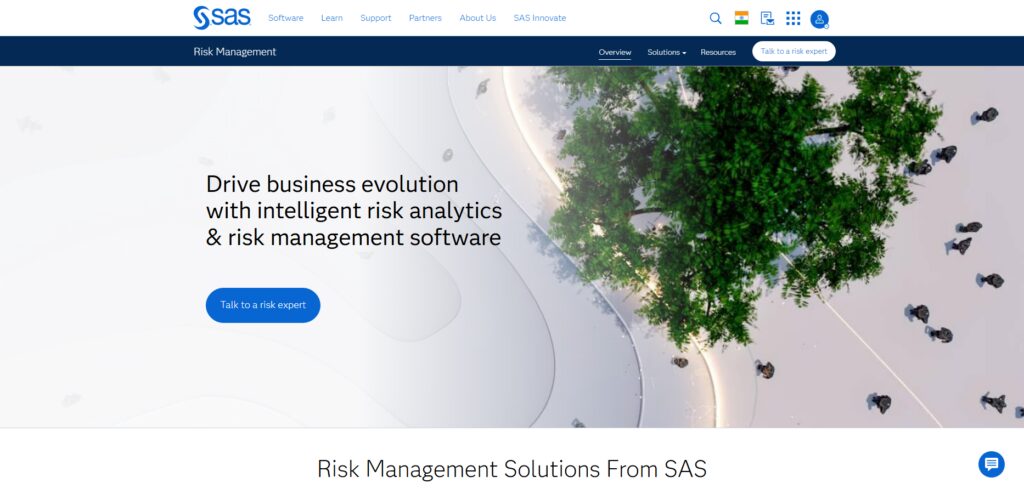
The platform has particular strengths in scenario analysis and stress testing that allow companies to foresee the impact of financial shocks before they occur.
Moreover, it also offers integrated dashboards that aggregate risk data across business units into one view. This is beneficial for risk managers because it optimizes capital allocation, improves decision-making, and keeps them compliant with regulations. Due to its scale and real-time handling of large financial datasets, enterprises use SAS.
What It Does
- Enables enterprises to identify financial, operational and credit risks.
- Employs sophisticated analytics to quantify possible risk exposure.
- Backtesting for future risk scenarios
- Allows stress testing across different market scenarios.
- This is an Enterprise Risk Platform that enables risk visibility across the organization for better decision-making.
Key Features
- Risk prediction using AI and machine learning
- Real-time risk analytics dashboards
- Scenario analysis and simulation tools
- Integrated risk data management system
- Advanced statistical and quantitative modeling
2. OpenPages
IBM OpenPages is an enterprise governance, risk, and compliance (GRC) platform that centralizes all your organization’s risk management activities. It enables organizations to track financial risks, automate compliance processes, and manage internal controls through a single system. Enterprise risk reporting and audit management usage.

Along with that, it incorporates AI and workflow automation for better risk visibility while lowering the manual reporting errors. OpenPages enables enterprises to achieve a better alignment of risk management with business strategy and global regulatory compliance.
What It Does
- Enterprise governance, risk, and compliance (GRC) manager
- Brings together risk data across the functions of the organization.
- Automates compliance and audit processes.
- More importantly, it identifies operational and financial risks.
- Supports regulatory reporting and documentation.
Key Features
- AI-powered risk identification system
- Workflow automation for risk processes
- Centralized compliance tracking system
- Audit management and reporting tools
- Custom risk dashboards and analytics
3. Risk Management Cloud
Oracle Risk Management Cloud offers an integrated solution for monitoring both financial risks and the entity’s internal controls and compliance requirements. It is used to detect anomalies in financial transactions across enterprises and enable continuous risk scoring of business processes.
It also enables automation of control testing and real-time risk notifications across the organisation. Its cloud-based framework is built for scale, employing big company tools ideal for managing intricate financial ecosystems.
What It Does
- Noticed monetary anomalies in enterprise transactions.
- This is monitored for risks and compliance on a real-time basis.
- Prevents fraud through automated controls.
- Supports continuous risk assessment processes.
- Helps organizations meet regulatory requirements.
Key Features
- Cloud-based risk monitoring system
- Automated fraud detection alerts
- Continuous control testing framework
- Risk analytics and reporting tools
- Scalable enterprise architecture
4. RiskFrontier / Risk Analytics
Moody’s RiskFrontier is a credit portfolio modeling tool known as a predictor of credit risk exposure and default probabilities. It allows enterprises and financial institutions to evaluate the risk of lending portfolios and investment structures.
Additionally, it breaks down risks in detail to ensure businesses understand the factors contributing to foreseeable losses. This is an essential instrument for credit risk management and capital adequacy planning.
What It Does
- Evaluates credit portfolio risk exposure.
- Computes the likelihood of default for borrowers
- Helps assess potential financial losses.
- Supports credit decision-making processes.
- Evaluates the structures of investment and lending risks.
Key Features
- Credit risk modeling engine
- Default probability calculation tools
- Portfolio simulation capabilities
- Loss distribution analysis
- Risk segmentation and breakdown
5. SAP GRC (Governance, Risk & Compliance)
SAP GRC: SAP Governance, Risk and Compliance (SAP GRC) is an integrated approach that helps businesses manage governance, risk, and compliance within business processes. All this while also ensuring that financial processes are regulatory compliant, yet remain operationally adequately managing risk.
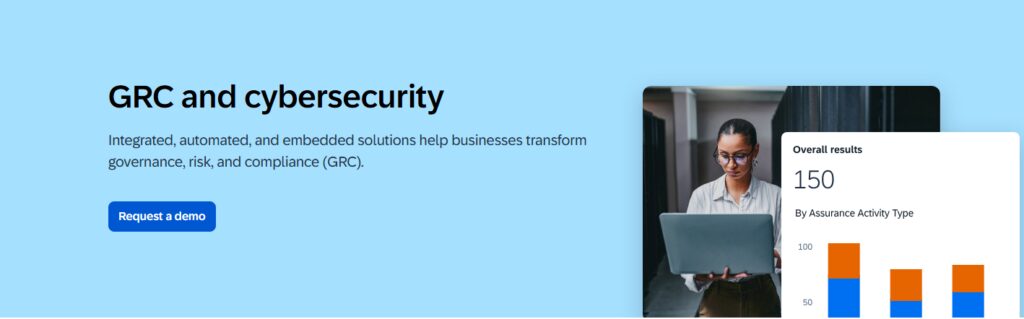
This system also allows real-time monitoring, risk scoring, and automated workflows for compliance. Intrigued: Enterprises apply SAP GRC to employ fraud risk, transparency, and efficiencies in internal audits.
What It Does
- Incorporate processes of risk, compliance, and governance.
- Oversight of enterprise financial and operational risks.
- Ensures regulatory compliance across systems.
- Identifies fraud and internal control issues
- Improves audit and risk transparency.
Key Features
- Real-time compliance monitoring system
- Access control and authorization management
- Automated audit tracking tools
- Risk scoring and assessment engine
- Integrated reporting dashboard
6. MetricStream ERM Platform
The MetricStream Enterprise Risk Management (ERM) platform provides organizations with an approach to identify and manage financial and operational risks. It also allows the ability to aggregate, evaluate, and report risk across functions in an enterprise.
The automated workflows also aid in regulatory compliance and risk mitigation planning. MetricStream businesses rely on robust reporting and centralized risk visibility metrics
What It Does
- Oversees the entire enterprise’s financial and operational risk.
- Centralizes risk identification and assessment.
- Helps organizations comply with regulations.
- Supports risk mitigation planning.
- Improves enterprise risk visibility.
Key Features
- Automated risk assessment workflows
- Centralized ERM dashboard
- Compliance tracking tools
- Incident management system
- Advanced risk reporting analytics
7. FIS Risk Management Solutions
FIS — FIS custom design financial risk management solutions for banks and alternatives. Its focuses are on liquidity forecasting, credit exposure, and fraud detection, as well as market volatility analysis.
The platform is a real-time monitoring and advanced analytics solution for decision-making in high-risk financial environments. It is most commonly used in the worldwide banking systems because of its precise and dependable features.
What It Does
- Risks relating to banking and financial institutions.
- Tracks credit and liquidity exposure.
- Detects fraud and suspicious transactions.
- Monitors market risk fluctuations.
- Supports regulatory reporting requirements.
Key Features
- Real-time risk monitoring system
- Credit and liquidity risk tools
- Fraud detection analytics
- Market risk analysis engine
- Regulatory compliance support
8. OneSumX Risk Management
The full name of this software solution is OneSumX, and it acts as a financial risk and regulatory reporting source for enterprises located in different parts of the world, where it provides capital adequacy & liquidity risks management. The tool unifies risk data from a variety of financial systems for impactful decision-making.
Its great use case is compliance in the global financial regulatory framework, like Basel standards. This helps keep reporting accurate while also minimizing the operational overhead.
What It Does
- Manages regulatory financial risk reporting.
- Tracks capital adequacy requirements.
- Supports liquidity risk analysis.
- Helps banks meet Basel regulations.
- Consolidates financial risk data.
Key Features
- Basel compliance reporting tools
- Capital calculation engine
- Liquidity risk monitoring system
- Integrated financial data platform
- Automated regulatory reporting
9. RiskMetrics Platform
MSCI RiskMetrics: A market risk analysis platform is employed to assess portfolio Variance and Value at Risk (VaR) It assists investment firms in evaluating prospective losses across various market conditions.

Additionally, it offers stress testing & performance analytics, enabling enterprises to fine-tune their investment strategies. It’s used especially in asset management and trading areas.
What It Does
- Portfolio Exposure to Market Risk
- Calculates Value at Risk (VaR).
- Helps manage investment volatility.
- Simulates financial market scenarios.
- Supports asset risk evaluation.
Key Features
- VaR (Value at Risk) modeling
- Stress testing tools
- Market risk analytics engine
- Portfolio simulation system
- Investment risk reporting
10. Refinitiv Risk Intelligence
Refinitiv Risk Intelligence provides risk data in real time and financial crime screening and compliance monitoring tools. It enables enterprises to recognize potentially harmful actions and manage third-party risks efficiently.
It also draws upon global financial data to facilitate risk assessment and regulatory compliance, which is another way in which the platform really shines. It is used by enterprises to improve their anti-money laundering (AML) and fraud detection systems.
What It Does
- Identifies the risk of compliance and financial crimes.
- Screens customers and third-party entities.
- Monitors global regulatory compliance.
- Identifies fraud and suspicious activity.
- Provides real-time risk intelligence data.
Key Features
- AML (Anti-Money Laundering) tools
- Real-time risk screening system
- Third-party risk monitoring
- Global compliance database
- Financial crime detection analytics
Role of technology-driven risk management platforms in decision-making
Technology-powered platforms allow the enterprise to process enormous financial datasets with high speed to assess risk accurately and make quick decisions in uncertain market conditions and complex business environments.
With real-time monitoring of financial risks, these systems enable decision-makers to identify anomalies earlier and take corrective actions before any losses or failures in compliance arise.
Advanced analytics and AI models increase forecasting accuracy and predict future risk for organizations so that they make proactive, data-driven financial planning decisions.
These platforms unify risk information across organizational silos so decision-makers don’t just make consistent, transparent, and informed decisions — everyone throughout the enterprise makes them.
Automated reporting tools not only reduce manual errors but also streamline compliance reporting, enabling timely and accurate decision-making that meets regulatory standards.
Leaders can objectively compare the number of risk outcomes with the tools at their disposal through scenario analysis and simulation, which allow leaders to plan differently in different financial circumstances.
Integration with enterprise systems enables collaboration, providing executives with a single view of risk exposure across the organization to make more informed and balanced decisions.
Conclusion
Enterprise Damage Control: How Financial Risk Management Solutions Are Helping Businesses to Make Better Decisions is published by Sridhar O. Platforms like SAS Risk Management, OpenPages, Oracle Risk Management Cloud, SAP GRC, and MSCI RiskMetrics are proof points of how traditional risk practices are moving from siloed initiatives to dynamic systems driven by real-time data using advanced analytics and AI/ML automation.
These tools enable organizations to identify fraud, manage their risk exposure more effectively, stay within regulatory compliance, and analyze market volatility in a better manner. This, combined with centralized dashboards, predictive modeling, and scenario analysis, provides the enterprises with a consolidated view of risks across all operations.
In summary, technology-oriented risk mitigation platforms help minimize ambiguity, strengthen market stability, and bolster strategic development. With the complexity and increased regulation required in business, these tools have become each other’s best friends for sustainable growth and ensuring financial decisions.
FAQ
What are financial risk management tools used for in enterprises?
Financial risk management tools are used to identify, assess, monitor, and control financial risks such as credit risk, market risk, liquidity risk, and operational risk within enterprises.
Why do enterprises use platforms like SAS Risk Management and OpenPages?
Enterprises use platforms like SAS Risk Management and OpenPages to improve risk analysis, automate compliance processes, and centralize governance and risk data for better decision-making.
How do technology-driven risk platforms improve decision-making?
They improve decision-making by providing real-time data analytics, predictive insights, and scenario simulations that help businesses understand potential risks before making financial decisions.
What role does AI play in financial risk management tools?
AI helps detect anomalies, predict future risks, automate reporting, and enhance accuracy in risk modeling, enabling faster and more reliable enterprise decision-making.
Which industries benefit most from risk management platforms?
Banking, insurance, investment firms, fintech companies, and large enterprises benefit most due to their high exposure to financial, regulatory, and operational risks.