I’ll go over how cryptocurrency exchanges determine maker and taker fees in this post, outlining how traders’ expenses are influenced by order types, trading volume levels, and liquidity incentives.
Readers may choose platforms that meet their tactics and long-term profitability objectives, cut down on needless costs, and make better trading decisions by being aware of these pricing methods.
What is Crypto Exchanges?
A crypto exchange is an online platform that facilitates the buying and selling of cryptocurrencies. Crypto exchanges allow customers to buy and sell cryptocurrencies such as Bitcoin and Ethereum, as well as trade for other digital assets. Exchanges serve as a middle ground to buyers and sellers so that transactions can take place in a safe environment.

There are two types of crypto exchanges; centralized exchanges (CEXs) and decentralized exchanges (DEXs). CEXs are run by companies and provide options like advanced trading, customer support, and high liquidity. DEXs are based on blockchain protocols and don’t have a central authority; traders can exchange crypto directly from their wallets.
Exchanges provide other services such as lending, derivatives, and stake trading but they all charge transaction fees including maker and taker fees. The most important factors to consider when choosing an exchange are regulatory compliance, user experience, and security. These factors all directly impact the cost, speed, and safety of trading digital assets.
How Crypto Exchanges Calculate Maker & Taker Fees
Example:
- You are buying 1 BTC on a crypto exchange at $25,000.
- The fees are Maker fee = 0.10% & Taker fee = 0.20%.
Step 1: Understand your order
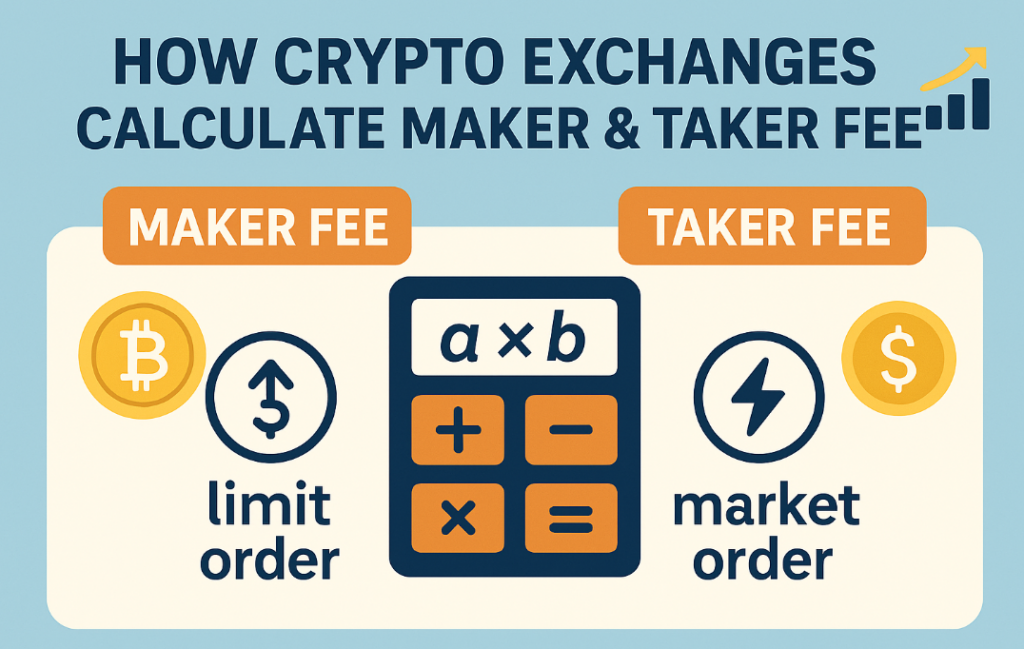
- Example of a Maker order: You add an order that adds liquidity to the order book via a limit order.
- Example of a Taker order: You remove an order that removes liquidity from the order book via a market order.
Step 2: Establish Trade Amount
- In this example, trade amount = 1 BTC × $25,000 = $25,000.
Step 3: Determine the fee.
- Calculating maker fees:$25,000 × 0.10% = $25.
- Calculating taker fees:$25,000 × 0.20% = $50.
Step 4: Determine the overall cost
- The overall cost of a maker order is: $25,000 + $25 = $25,025.
- The overall cost of a taker order is: $25,000 + $50 = $25,050.
Step 5: Establish Impact
- Maker orders cost less ($25) and can earn rebates on some exchanges.
- Taker orders cost more ($50) but execute instantly.
Why Use Crypto Exchange Fees.io?
Consolidation of All Exchanges
- This platform allows you to compare maker, taker, withdrawal, and future fees on all of the major crypto exchanges.
Current Fee Information
- This site helps you make comparisons with less risk of using older fees because it is updated frequently.
Comparisons Made Easy
- Use the tables and filters to find the exchanges that will be the least expensive for you to use based on the trade activities you will be doing.
Discounts on Volume and Tokens
- You can evaluate how the different tiers of fees and native token discounts affect what you will actually pay for trades.
Ease of Use for Beginners
- Because of the design, newer traders can easily grasp the more complicated pieces of the fees.
Exchange Picks Based on Strategy
- Pick exchanges based on your trading activity. This can include scalping, long-term investing, or high-volume trading.
Saves Time and Money
- You will not have to check multiple exchange sites to get the trading fees in one place and you will cut your trading costs.
Learning Materials from the Site
- The site will educate you on the maker/taker fees and how to keep costs lower.
How Exchanges Set Fee Structures
| Factor | Description | Impact on Fees |
|---|---|---|
| Trading Volume | Total amount a user trades in a given period (daily, monthly, 30-day). | Higher volumes often reduce fees via tiered discounts. |
| Order Type | Whether the order is a maker (adds liquidity) or taker (removes liquidity). | Maker orders usually have lower fees; taker orders cost more. |
| Tier System | Exchanges categorize users into levels based on trading activity. | Higher tiers get lower fees; lower tiers pay standard rates. |
| Use of Native Tokens | Paying fees using the exchange’s own cryptocurrency (e.g., BNB, FTT). | Often grants a discount of 10–50% on standard fees. |
| Liquidity & Market Depth | How easily an asset can be bought/sold without price impact. | Highly liquid markets may have lower fees; low liquidity markets can have higher fees. |
| Promotions or Incentives | Limited-time fee discounts or rebates. | Temporarily reduces fees to encourage trading. |
| Regulatory & Operational Costs | Costs of compliance, security, and infrastructure. | Exchanges may adjust fees to cover operational and legal expenses. |
Choosing the Right Platform for Your Strategy
Trading Volume Needs
- Choose an exchange with the volume and fee structure in a range that best fits your trading activity. Frequent traders will benefit especially from the lower fees.
Order Types Offered
- Check the exchange for the types of orders it supports. Some will have limit (maker) and market (taker) orders, and some will have more advanced types.
Liquidity & Market Depth
- Select an exchange with more liquidity. These will give you smoother trades and less slippage, especially when trading large amounts.
Fee Structure Transparency
- Look for a clear breakdown of the maker-taker and withdrawal fees, so you can spot hidden fees more easily.
Token Incentives & Discounts
- Some exchanges offer discounts on trading fees that you can get by holding a token of that exchange. These are often called utility tokens.
Security & Regulatory Compliance
- Use a platform that has strong safety and regulatory practices to keep your money safe.
User Interface & Tools
- Choose the platform with a more user-friendly layout, and more advanced analytics and trade-related tools for more configurable strategies.
Additional Services
- If your crypto strategy includes more complex types of trading.. choosing a platform that offers services like lending, staking, and margin trading can sometimes be helpful.
Do trading volume tiers affect my fees?
Indeed, on the majority of cryptocurrency exchanges, trading volume tiers have a direct impact on your fees by rewarding greater activity with reduced expenses.
Exchanges usually classify you into a tier that establishes your maker and taker rates after calculating your overall trading volume over a rolling period, usually 30 days. You advance into higher tiers as your business grows, where fees can reduce dramatically—sometimes by half or more—in comparison to entry-level rates.
When allocating tiers, some platforms additionally take account balances or holdings of the exchange’s native token into account. Because it promotes liquidity and sustained involvement, this approach is particularly advantageous for market makers, active traders, and organizations that carry out a lot of or regular deals.
Comparing Fee Structures Across Major Exchanges
| Exchange | Spot Maker Fee | Spot Taker Fee | Key Notes |
|---|---|---|---|
| Binance | ~0.10% | ~0.10% | Popular exchange with tiered discounts; pay with BNB for lower rates. |
| Bitget | ~0.01% | ~0.01% | Very low base fees; competitive for Indian traders; also low futures fees. |
| Kraken | ~0.16% | ~0.26% | Higher fees at entry tier, but volume discounts available. |
| Coinbase | ~0.40% | ~0.60% | Generally higher retail fees, especially for casual traders. |
| KuCoin | ~0.10% | ~0.10% | Standard low fees, plus token (KCS) discounts. |
| OKX | ~0.08% | ~0.10% | Competitive base fees with native token (OKB) discounts. |
| Gemini | ~0.20–0.35% | ~0.35–0.40% | Regulated U.S. exchange with a somewhat higher fee structure. |
| Gate.io | ~0.15–0.20% | ~0.15–0.20% | Mid-range fees with token-based reductions. |
Common Misconceptions
Fees Are Standard Across Exchanges.
- Traders think each exchange will charge the same fees without looking at the policies and how trading volume impacts fees.
Maker Fees Are Less Than Taker Fees.
- This is usually true, but some exchanges are running promos where taker fees could be the same or even less.
If Fees Are High, Then Trading Cost is High.
- High fees are a result of deficient trading, but there could be programs offered by the exchange (incentives, tiered rates, token reductions) that can result in lower trading costs.
Fee Discounts are Only Available to Big Traders.
- Small traders can be fee efficient if they use a limit order (maker) or use exchange tokens.
Fees Are Fixed.
- Exchanges can increase or lower fees depending on the situation.
Taker Orders are Always Bad for Profit.
- Taker orders can be essential for an immediate execution, or, to enter a volatile/order book because they are more expensive than maker orders.
Actionable Strategies to Minimize Your Trading Costs

Use Maker (Limit) Orders
- Submit limit orders instead of market orders. This will add market liquidity and also qualify you for lower fees, or even receive a rebate.
Trade During High Liquidity Periods
- Because of higher market activity, slippage will be reduced, and helps you avoid costs that are hidden, in addition to the visible fees.
Increase Your Trading Volume Tier
- Try and consolidate your trading activity to a single exchange. This will allow you to attain higher trading volume tiers and reduce the costs you incur.
Pay Fees With Native Tokens
- Automatically receive a discount on your trading fees by using the exchange’s token (ex. BNB, KCS, OKB) to pay for the fees.
Choose Low-Fee Trading Pairs
- Before you start trading, check to see if any trading pairs have promotional, or lower, fees. Some pairs always have reduced fees, and knowing this can help you save.
Avoid Frequent Small Trades
- There are times when you’re better off making large trades. This helps to avoid numerous small fees that will add up and impact your profits.
Compare Withdrawal Fees
- Trading fees are just a portion of the overall costs incurred. In addition to the low maker/taker fees, large withdrawal fees and high network fees can also add to the total costs.
Set Price Alerts Instead of Chasing Markets
- During volatile trading periods, you can avoid making high market purchases by placing limit orders at your targeted prices. This will allow you to trade less than you otherwise would.
Utilize Promotions
- Look for events like zero-fee trading, referral rebates, and discounts on trading fees.
Examine Fee Reports Every Month
- Analyze reports to understand total fees paid and recalibrate your trading strategy to optimize on a more economical exchange platform.
Conclusion
Knowing how maker and taker fees are determined by cryptocurrency exchanges enables traders to make better informed and economical choices. Users can actively cut expenses and boost overall profitability by understanding how order types, trading volume tiers, liquidity levels, and platform incentives affect fees.
Trading techniques are kept in line with market conditions and long-term financial objectives by selecting the appropriate exchange, utilizing maker orders, and routinely checking cost structures.
FAQ
Why are taker fees usually higher than maker fees?
Taker trades reduce liquidity and require immediate execution, which increases operational costs for exchanges, so they are often charged at a higher rate.
How are maker and taker fees calculated?
Fees are calculated by multiplying the total trade value by the applicable fee rate based on your user tier, order type, and any discounts or incentives.
What is the difference between a maker and a taker?
A maker adds liquidity to the order book by placing a limit order that doesn’t fill immediately, while a taker removes liquidity by executing an existing order, usually through a market order.
Do maker and taker fees apply to all types of trading?
They mainly apply to spot and futures trading, but the exact rates and structures can vary by market, product type, and region.
How can I check the exact fees on my exchange?
Visit the exchange’s official fee schedule or account dashboard, where current maker and taker rates and tier levels are clearly displayed.