By regulating when and How Token Unlock Schedules impact Project finances have a significant impact on the financial stability of a cryptocurrency project.
In addition to defining the liquidity available for development, marketing, and ecosystem expansion, these timelines have an impact on cash flow, investor confidence, and pricing stability.
A well-planned unlock strategy helps match funding needs with market demand, reducing volatility and ensuring sustainable, long-term project value.
How Token Unlock Schedules impact Project finances
The financial robustness and market credibility of a crypto project are significantly affected by its token unlock schedules.
The schedules dictate the rate and manner in which new tokens become available and thus, impact pricing, liquidity, and the actions of stakeholders such as the founders, early backers, and investors in the ecosystem.
The Financing of the Project and the Pricing Mechanism
One of the most noticeable impacts of token unlocks is on price volatility. Almost 90\% of all documented token unlock events are accompanied by a price decrease, and in many cases, sell-offs start as early as 15-30 days prior to the planned token release.
This is termed as an “anticipation phase” where market-actors are affected by the negative speculation of the event and price their expectations for an increase in the supply.
When looking at demand and supply, the event of token unlocks poses negative impacts on price stability. When a significant number of tokens are unlocked, and there is no considerable growth in demand or use, the price is likely to drop.
Following an unlock event, an increase in exchange inflow is observed with many early holders and investors who are incentivized to sell their accounts.
In instances of unlock events where price drops occur, not all unlock events trigger price drops. In projects with clear communication and regular updates, price drops occur prior to the unlock, indicating the market has anticipated the unlock.
This means that once the unlock occurs, the price drop will not be as significant as predicted due to speculative anticipation.
Effects on Credibility and Operation of the Project
Structures of vesting and team incentives and the continuity of the project are intertwined. In blockchain projects that are venture-backed, data shows that in the case of long vesting periods (e.g. multi-year linear vesting schedules).
There is a sustained level of developer engagement and decreased founder outflows of tokens in comparison to projects with short vesting periods or those that are heavily front-loaded with unlocks.
This balance of incentives helps to drive the team’s focus on the long-term vision and product development of the project as opposed to the short-term fluctuations in price.
There is also a direct correlation between transparency and confidence of the investors. Increased investor participation in the project’s governance and staking modules occurs for projects that publicly share their tokenomics and future unlock schedules.
Unlocked tokens are in the hands of the project for operational purposes, i.e. marketing, grants to grow the ecosystem, and improvement to the project’s infrastructure.
However, if the tokens are in the hands of the investors prior to the right operational moment, it will negatively and paradoxically impact the company’s value due to the negative market perception.
How Different Unlocking Schedules Will Affect the Market
Cliff Unlocks: In one date, a large amount of tokens are released. This will cause a large drop in price and the market will become more volatile. In the past few weeks, data shows that the price can drop between 10 – 25 % upcoming to the unlocks.
Linear/Vesting Unlocks: Monthly scheduled releases are likely to create small and predictable price changes, leading to a more stable market.
Emission-Based Unlocks: Network activity metrics, such as staking or mining rewards, dictate these types of rewards, resulting in price changes that are harder to predict and more likely to be influenced.
Mitigation Strategies and Best Practices
To manage and contain new supply, projects are utilizing staking rewards and liquidity programs more frequently. In some cases, placing unlocks in conjunction with supply promotion events, such as new product releases or key partnerships, has resulted in post-unlock prices that are stable or increase. These partnerships with market makers can also minimize the impact of large inflows and reduce the risk of liquidity shocks.
Risk Management and Financial Contingency Planning
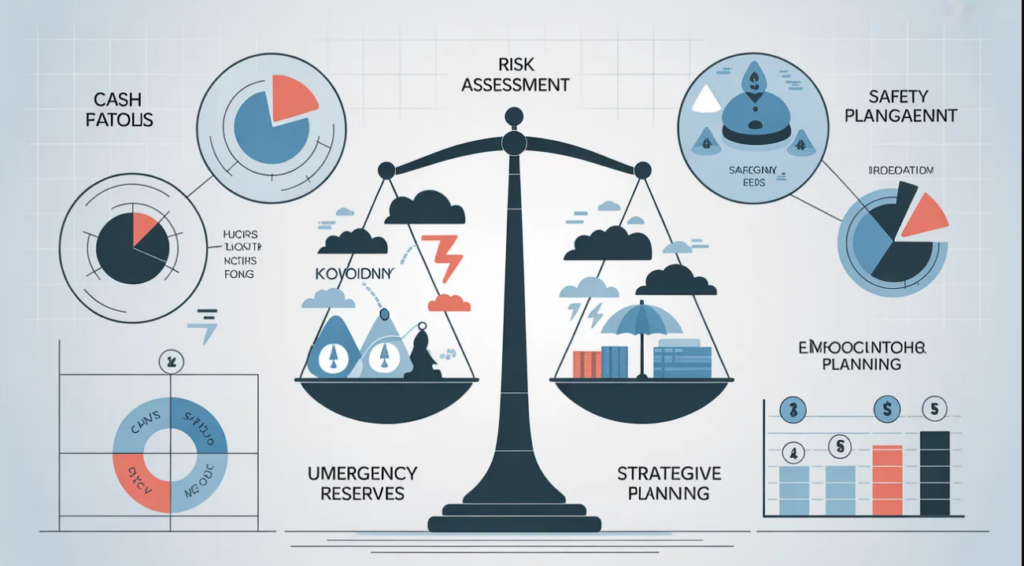
Risk Identification and Assessment: For each of the finance, operations, regulations, and markets the risks need to be identified in the system and evaluated to help configure the mitigation and allocate the resources to critical functions of the risk in operational and provide audits, and re-assess the stakeholders in the collection of the data.
Liquidity and Cash Reserve Planning: To keep revenue shortfalls in the long term and to cover operational expenses in the unplanned periods and to keep the available buffers, the cash, and the credit lines access along with the contingency capitals, tools in the divsified funding sources need to be maintained.
Scenario Planning and Stress Testing: To build and refine the flexible activation strategies and to improve the speed and to improve the position confidence during the crisis in the financial resilience the revenue, stress, and operational costs need to be simulated to target and for these to cover the planning clouds.
Diversification and Risk Mitigation Strategies: More than one revenue, supplier, or market can be used to reduce the reliance on one of the singular revenue streams and risk verticals to be in aligned markets with the investments, and to add, partnerships, and operationally, and to help in the channel in line the to stabilize the cash.
Governance and Monitoring Systems: To enable the leaders to act on financial risks of the emerging in a timely manner the role, and the head of each system in the risk management be set the clear governance and frameworks along the with real-time dashboards that provide operational monitoring updated early indicators in structured reporting per each of the defined key risks.
Insurance and Risk Transfer Mechanisms: Take out insurance, utilize hedging tools, and develop contracts to minimize risk exposure and protect against unanticipated events so that large losses do not derail long-term stability and strategic growth objectives.
Regulatory and Compliance Considerations
Regulatory and Compliance Considerations
All guidelines and regulations play a vital role in the maintenance of financial stability, protection of investors, and preservation of operational integrity in the more highly governed and rapidly renewing industries.
When firms attempt to self-guide their operations to the structure of regulations, they decrease the threat of litigation, gain a more favorable position in the marketplace, and bolster their long-range viability.
Regulatory and Compliance Considerations
There are real time variations of international regulations due to technological and economic changes. Based on compliance benchmarking, companies that operate in multiple jurisdictions tend to have 30 to 50 percent more operational costs due to redundant and overlapping reporting, licensing, and disclosure requirements. Regulatory monitoring and legal counseling are of paramount importance in order to minimize the risk of non-compliance penalties.
Risk of Non-Compliance
Regulatory non-compliance can incur a range of detrimental outcomes. Industry surveys show that operational closures, legal costs, and regulatory penalties can drain 10 percent of revenue per year for firms in violation of the regulations. Financial losses are accompanied by damage to reputation, increased risk of customer defection, and erosion of competitive position in the market.
Data Protection and Reporting Requirements
Integration of automated compliance systems and real-time reporting tools can help organizations reduce manual reporting errors by an estimated 20-40% and boost audit preparedness. As record-keeping, reporting, and monitoring accuracy increases, more trust will be placed by regulators, and stakeholders will more strongly support the organization.
Internal Controls and Governance
Regulatory Compliance now includes data governance and privacy legislation, along with monitoring of transactions and reporting. When companies use automated compliance solutions with real time reporting, manual mistakes are lessened by 20-40%. This results in increased preparedness for audits. Good disclosure and record keeping are essential for stakeholder trust and for keeping regulators satisfied.
Strategic Compliance as a Competitive Advantage
In contrast to more traditional practices, top-tier organizations view compliance more as an opportunity than an expense. Compliance, along with improved transparency, will improve your chances of gaining the interest of institutional investors, will reduce your capital costs, and will enable market entry in more highly regulated jurisdictions.
Case Examples of Unlock Schedule Successes and Failures

Successful Linear Vesting Example: A DeFi protocol launched a system of monthly token releases tied to the growth of platform usage. This approach allowed the protocol to achieve sustained liquidity coupled with sell-off mitigation, token price growth alongside increased long-term staking participation from the investors and the community.
Milestone-Aligned Unlock Success: A blockchain startup simultaneously launched a product and listed it on an exchange partnered with a massive token distribution event. This created a demand spike due to the increasing supply while countering the aggressive sell pressure which positively impacted the tokens price post-unlocking.
Cliff Unlock Failure: A gaming token company unlocked 40% of its token supply at one go which created the event of heavy early-investor sell-off. This led to huge exchange inflows and a plummet in the token price by more than 25% in a couple of days leading to loss of market confidence.
Poor Communication Failure: A project changed its vesting schedule with no notice. This created panic selling, social media backlash, and a trust loss of both retail and institutional investors which in turn created a trust-deficit for the project, loss of liquidity, and increased price volatility.
Staking-Driven Stability Example: A Layer-1 Network encouraged the staking of newly unlocked tokens; meanwhile successfully locking up more than 50% of the released supply, circulating volume stability, and preservation of the price during a prominent unlock period.
Strategic Optimization of Unlock Schedules
Make Unlocks Comply with Demand Milestones: In order to increase user enticement and absorption of available supply decreases, sell pressure and improve price constancy, schedule unlocks of the token with launches of the products and partnerships and with the listings of the exchanges.
Implement Gradual Vesting Models: Introduce predictable supply increments with the potential of cliff unlocks. Result in lower volatility and long-term holding and staking motivation.
Establish Robust Incentive Programs: To promote the newly unlocked tokens to a productive use in the ecosystem, rather than instanlty selling it to the market, provide staking and governance rewards and liquidity unlock incentives.
Establish Transparent and Frequent Communication: To alleviate supply shocks and improve market confidence, gradual estimates of supply changes and unlocked calendars, dashboards, and updates should be provided in order to sustain supply changes.
Enhance Liquidity and Market Depth: Use with liquidity providers and market makers to reduce drastic price changes during supply shocks and to ensure distributed tokens are in order.
Utilize Data Feedback Loops: After every unlock, utilize and analyze the customer growth and on chain data to adjust supply with the current demands of the ecosystem.
Conclusion
Data across numerous crypto marketplaces continually reveals that token unlock timelines are a key influence in influencing price stability, investor trust, and project sustainability. Compared to projects that rely on big cliff releases, those that use clear, gradual vesting structures see less volatility and fewer price declines after unlocking.
Additionally, on-chain measurements show that incentive-driven staking and liquidity programs can absorb a sizable amount of recently released supply, lessening the need to sell right away.
Additionally, timing unlocks to coincide with high-demand events like product launches or significant alliances frequently increases trade volume and market depth, which aids in price stabilization. Overall, a data-driven, adaptive approach to unlock planning enhances financial resilience, protects long-term market value, and supports sustainable ecosystem growth.
FAQ
What is a token unlock schedule?
A token unlock schedule defines when and how locked tokens enter circulation. Data shows predictable, transparent schedules reduce volatility and help investors price in future supply increases more effectively.
How do token unlocks affect price performance?
Market studies indicate nearly 90% of major unlock events are followed by short-term price declines, often beginning weeks before the release as traders anticipate increased circulating supply.
Are gradual vesting models better than cliff unlocks?
Yes. Historical price data shows linear or monthly vesting typically leads to smaller, more predictable price movements compared to large cliff unlocks, which often trigger sharp volatility.
Can staking reduce selling pressure after unlocks?
On-chain metrics reveal that projects offering staking or yield incentives can lock up a significant share of newly unlocked tokens, lowering exchange inflows and stabilizing short-term prices.
How does transparency influence investor confidence?
Projects that publish detailed tokenomics and unlock calendars tend to maintain higher trading liquidity and governance participation, reflecting stronger trust and reduced panic-driven selling.