
This article presents a list of Plaid Alternatives for Crypto Payment Integrations that offer businesses the ability to accept cryptocurrency payments.
These services, which include Wyre, MoonPay, Ramp Network, and Coinbase Commerce, feature developer-friendly, flexible, and scalable options, and provide secure wallet services. These alternatives will make it easy to process crypto payments globally.
Key Point & Plaid Alternatives for Crypto Payment Integrations
| Alternative | Key Point / Feature |
|---|---|
| Wyre | Provides fiat-to-crypto onramps, global bank transfers, and real-time KYC verification for seamless crypto payments. |
| MoonPay | Supports credit/debit card and bank transfers for crypto purchases; integrates easily into apps and web platforms. |
| Ramp Network | Enables fiat-to-crypto transactions with low fees; offers embeddable SDKs for apps and websites. |
| Mercuryo | Multi-currency wallet and payment API with crypto onboarding and compliance tools for global payments. |
| Banxa | Regulated fiat-to-crypto gateway, supports cards, bank transfers, and local payment methods worldwide. |
| Coinbase Commerce | Accepts crypto payments directly in multiple coins; offers integration with e-commerce platforms and API support. |
| Stripe (Crypto Support via API) | While Stripe primarily handles fiat, its API supports crypto payments indirectly via partners and tokenized assets. |
| Fireblocks | Enterprise-grade crypto payment and custody platform, supports secure transfers and programmable settlement. |
| Simplex | Provides fraud-protected fiat-to-crypto payment processing via cards, integrated easily into web and mobile apps. |
| Checkout.com (Crypto API) | Offers global payment processing with crypto integration options via partnerships and API solutions. |
1 Wyre
Wyre is a premier platform for integrating crypto payments, offering business and developer seamless transactions from fiat to crypto. With Wyre, businesses can embed bank account transfers, ACH payment and cross-border payment/remittance capabilities into their apps.

Wyre is a desirable candidate for crypto payment transactions due to its KYC and AML compliance in real time. Wyre’s crypto onramps allows users to seamlessly buy or move crypto in a snap and without leaving a platform. Wyre has a strong API documentation, ensuring the developer community to integrate payment solutions in a secure, scalable and compliant manner.
Wyre Features & Pros & Cons
Features
- API & wallet services for apps and businesses.
- Crypto payment processor & wallet crypto payment reconciliation
- API integrated KYC/AML compliance & secure risk controls.
- Supports debit/credit cards, bank transfers & several blockchains.
Pros
- API integration for apps/wallets/marketplaces (merchant payments) is flexible
- KYC and regulatory compliance is managed by them.
- Multiple payment methods, and blockchains are supported.
- Great for crypto & cross-border payment flows.
Cons
- Complex onboarding for businesses.
- Less documentation & feedback from the community.
- Fee structure & volume may not work for your business.
- Some methods have regional restrictions.
2. MoonPay
MoonPay provides a service that millions of users have utilized to purchase cryptocurrencies using credit or debit cards, as well as bank transfers. With security being incredibly important to MoonPay, they have incorporated KYC and AML throughout their entire operation, regulations concerning fraud and payments, as well as a variety of different cryptocurrencies and tokenized assets.

MoonPay also works with mobile and web platforms, providing a high-quality, easy integration solution for purchasing cryptocurrency for customers. Offering developers streamlined APIs and SDKs, MoonPay enables them to facilitate payments and purchase cryptocurrencies very quickly in any App, Wallet, or Exchange, thus fostering cryptocurrency use around the world.
MoonPay Features & Pros & Cons
Features
- API & widget for on-ramp and off-ramp & global card/bank support.
- Apple Pay, Google Pay & local payment methods.
- KYC, fraud, & compliance detection are built in
- Non-custodial flows go directly to wallets.
Pros
- Easy integration with widget/SDK/API methods.
- Extensive integration of over 160 countries.
- Excellent trust level and transaction volume.
- Excellent multi-method payment (cards, bank).
Cons
- Some countries have limited payout methods.
- Onboarding and KYC verification can take some time.
- Compared to DIY stacks, there is less customization.
- Some alternatives have more transaction fees.
3. Ramp Network
Smooth integration of services for the exchange of fiat and cryptocurrency is a guarantee of the proprietary technology of the Ramp Network. Purchase and payment via bank accounts or cards remains within the comfort of the user’s choice and is unobtrusive.
Simplified payment of exchange service is also available. Security and regulatory compliance with the proprietary technology enable the seamless integration of payment services via cryptocurrency without transferring users to the payment page. An experience that prioritizes payment services and an accessible pricing model attract customers to use the Ramp Network.
Ramp Network Features & Pros & Cons
Features
- Integrated flow of fiat to/from crypto.
- Multiple payment options and supported tokens.
- API and widget developer-friendly for apps and wallets.
- Compliance with primary international regulatory frameworks.
Pros
- Scalable global reach and diversified token support.
- Emphasis on developers and simple embedding widgets.
- Quick payment and improved user experience.
- Fees are transparent with live updates.
Cons
- Some fiat corridors may be unsupported.
- Custom flows require some development.
- Payment methods are region-dependent.
- Basic integrations may be impractical.
4. Mercuryo
Mercuryo is a crypto payment gateway that connects traditional finance with blockchain technologies. Their services include digital wallets, fiat-to-crypto onramps, multi-currency payment services, and global bank and card payment transfers.

With an easy app integration via API and SDK, and with virtual payment compliance outsourcing, crypto payment solutions can be made via real-time KYC and fraud protection. Merchants can convert fiat payments to crypto via Mercuryo.
With excellent documentation and developer tools that simplify the process, Mercuryo is a great option for businesses looking to integrate crypto payments.
Mercuryo\ Features & Pros & Cons
Features
- Fiats to cryptocurrencies and vice versa is supported through SDK/API.
- Integrated fraud protection and compliance.
- Merchant dashboard & analytics.
- Supports multiple card and payment rails.
Pros
- Quick integration with single codebase.
- Broad crypto & payment coverage.
- Useful for wallets, DeFi interfaces & NFT flows.
- Brand customization and tracking
Cons
- Fees competitive but not lowest.
- Some regional limitations apply.
- UX can vary across integrations.
- KYC can still be intensive at higher tiers.
5. Banxa
Banxa is a regulated fiat-to-crypto gateway that focuses on helping businesses integrate crypto payments seamlessly. With the ability to accept payments via credit/debit cards, bank transfers, and local payment methods, Banxa provides services across more than 100 countries.
Emphasizing regulatory compliance, Banxa provides crypto payment services with KYC/AML transaction verifications. Through its API and Widget solutions, businesses can integrate crypto payment flows into their websites and mobile applications. Banxa also provides merchants with Secure Settlement, a solution that allows merchants to accept crypto payments and reduce potential risks.
Thanks to its Global Banking Partner Network, Banxa offers merchants fast and reliable payment processing. With its extensive documentation and user-friendly design, Banxa is the top solution for payment integrations in the crypto ecosystem.
Banxa Features & Pros & Cons
Features
- On‑ramp/off‑ramp services via API + widget.
- Supports 100+ cryptocurrencies & major fiat.
- Licensed in many jurisdictions (45+).
- Developer SDKs & embedded UX options.
Pros
- Extensive global coverage & regulatory licenses.
- Supports many asset types.
- Strong developer documentation.
- Seamless fiat‑crypto trading & settlement tools
Cons
- Higher fees compared to some rivals.
- Not everywhere available due to compliance.
- KYC flows may slow conversions.
- Some payment rails have regional restrictions.
6. Coinbase Commerce
Coinbase Commerce lets merchants receive payments in several cryptocurrencies, including Bitcoin, Ethereum, and stablecoins. They can easily integrate it with their e-commerce platforms like Shopify and WooCommerce, or use custom API alternatives. Since Coinbase Commerce does not store customer funds, businesses have full control over their crypto settlements.

Other features include invoicing, checkout pages, and payment received notifications. Using Coinbase Commerce, businesses enjoy Coinbase’s reputation and security infrastructure. It also features comprehensive developer tools that make managing cryptocurrency payments simple. This makes Coinbase Commerce a top choice among merchants looking to accept cryptocurrency payments.
Coinbase Commerce Features & Pros & Cons
Features
- APIs and plugins for Shopify, WooCommerce, and custom solutions.
- Cryptocurrency settlement or conversion options.
- Merchant dashboard & Analytics.
Pros
- Simple setup & good reputation.
- Extensive cryptocurrency coverage.
- No platform charges other than network fees.
- Easy adoption with e-commerce plugins.
Cons
- No direct fiat payment support.
- Merchant handles blockchain settlement.
- Few preventative measures against chargebacks.
- Transactions are contingent on network confirmations.
7. Stripe (Crypto Support via API)
As Stripe (an originally fiat payment processor) starts offering crypto payments via partnerships and API integrations, they develop their own Indirect Crypto Support. Businesses using Stripe’s APIs can accept payments in both tokenized assets/stablecoins.
Stripe provides developers with the tools and documentation necessary to monitor and manage the payout of crypto. While crypto payments are not supported, Stripe provides legal and regulatory compliance and anti-fraud protections.
Businesses are able to adapt crypto payments to their own processes, and not change anything else in their payment structure. Stripe’s versatility and compliance with financial regulations provides payment solutions for users wanting to implement crypto in their payment processes.
Stripe (Crypto Support via API) Features & Pros & Cons
Features
- Accepting crypto (e.g., USDC) through Stripe APIs/Checkout is possible.
- Utilizes fraud & compliance tools from Stripe.
- Payouts settle in fiat currencies (USD/EUR).
- Options for embedded or hosted on-ramp widgets.
Pros
- It’s straightforward for current Stripe users.
- Stratified fraud and compliance tools.
- Developers have a unified payment system.
- There is no risk of volatility with stablecoin settlement.
Cons
- Support for cryptocurrency is basic.
- Limited support for anything but stablecoins.
- Features tend to lag behind documentation/SDK.
- Availability is restricted by geography or market.
8. Fireblocks
Fireblock is an enterprise-grade platform tailored for large-scale crypto transactional and custody integrations. It offers large institutions self-custodial wallet technology, private key systems, and crypto movement transfer systems.
With Fireblocks, crypto payments, treasury management, and multi-party transfer management, can be embedded into business applications via API. Threat protection and funding security are ensured via proprietary engineering, such as MPC and hardware isolation.
Fireblocks is aimed at larger-scale crypto operations, offering a full-service toolkit for compliance workflows, and audit and regulatory reporting. The protection, adaptability, and engineering Fireblocks offers sets the standard for institutional crypto payment integrations.
Fireblocks Features & Pros & Cons
Features
- Wallet infrastructure using MPC at the enterprise-grade level.
- Compliance and orchestration of stablecoin payments
- Links with banks, exchanges, on/off ramps, PSPs
- Custody, settlement, and treasury APIs.
Pros
- Highest security using MPC key management.
- Scalability for significant payments & stablecoin volumes.
- Flexible stitching over rails & partners.
- Full compliance and built-in policy engine.
Cons
- Small business expensiveness.
- Integration complexity for non-enterprise teams.
- Payment widget is not plug-and-play.
- Deep crypto/ treasury knowledge required.
9. Simplex
Simplex is a fintech firm that provides protection against fraud for transactions where customers exchange fiat for crypto. This platform helps other companies set up processes for customers to pay with debit and credit cards for crypto purchases while controlling fraud through AML and KYC.

Simplex is able to provide a fully compliant and secure purchasing process by using APIs to integrate with a great number of wallets, exchanges, and applications. Through its cross-border payment solutions, crypto adoption at the consumer level is simplified while supporting the use of numerous currencies and payment cards.
Instant settlement and decreased chargeback risk are among the merchant advantages. User-friendly design and regulatory compliance are combined by Simplex, making integration straightforward, and regulatory compliance is combined by Simplex, making it a preferred provider for crypto onboarding solutions.
Simplex Features & Pros & Cons
Features
- Card-to-crypto on-ramp, with fraud protection.
- Widget & API integration.
- Card payments, global coverage.
- Included risk engines, AML/KYC.
Pros
- Solid global coverage for card payments.
- Good partner ecosystem & documentation.
- Many wallets & apps are supported.
- Strong fraud protection.
Cons
- Compared to peers, fewer payment rails.
- Some reviews criticize UI/UX.
- Smaller volumes can result in high fees.
- Focus on on-ramp more than full payments.
10. Checkout.com (Crypto API)
Checkout.com is a worldwide payment processor that allows customers to integrate cryptocurrency payments via API partnerships. Clients can accept cryptocurrency payments and fiat payments at the same time.
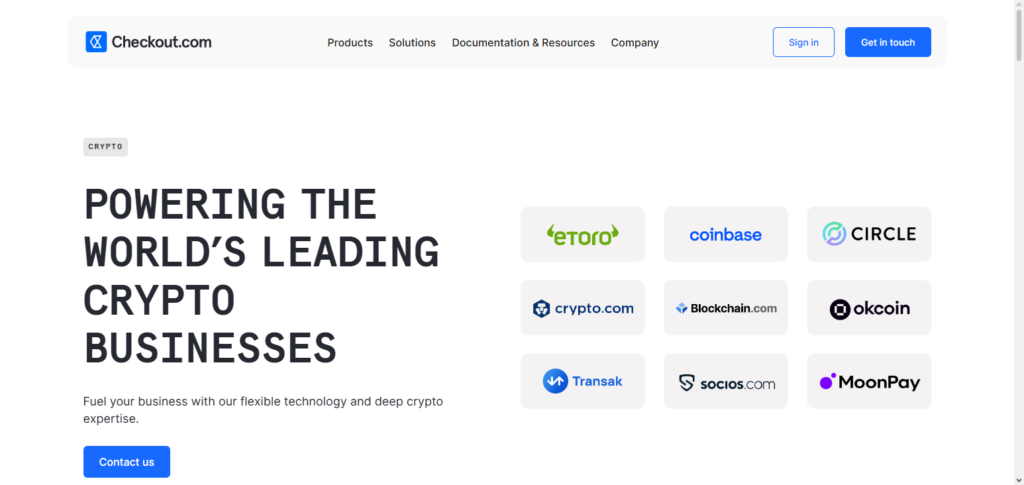
Checkout.com streamlines payment fraud prevention, payment settlement, and ongoing payment fraud monitoring to ensure secure operations. With fraud monitoring tools, Checkout.com offers customers flexible ways to integrate their APIs into their websites, mobile apps, and online stores. Checkout.com allows customers to accept payments from almost any country and currency, offering a broad reach to customers. Robust analytics, comprehensive reports, and easy payment fraud monitoring help customers comply with payment fraud laws.
With innovative fraud analytics, comprehensive reports, and trade compliance incorporated into global payment processing, Checkout.com is a reliable and efficient processor for cryptocurrency payments. With great Global payment processing tools and extensive API documentation, Checkout.com is a great competitor to Plaid.
Checkout.com Features & Pros & Cons
Features
- Payment API for global services with crypto.
- Process fiat and crypto payments.
- Utilize payout and settlement compliance tools.
- Use API and developer tool customization.
Pros
- Infrastructure for payments is strong worldwide.
- Strong analytics and SDKs developer friendliness.
- Multiple currencies and multiple payment methods are supported.
- Combined fiat + crypto flows is this payment solution’s strong suit.
Cons
- Support for crypto is evolving regionally.
- More complicated than pure crypto gateways.
- The settlement method can be different than the way the fees are settled.
- Enterprise onboarding may be required
Criteria for Choosing a Crypto Payment Integration
Security And Compliance
Among providers, the best crypto payments option is the one with the best security compliance using **KYC (know your customer, AML (Anti Illicit Finance) and fraud prevention. Fireblocks and other enterprise solutions offer the best security in crypto payments. Global security compliance adds to best maintained businesses.
Payment Methods And Cryptocurrencies Supported
Different payment providers provide support to varying cryptocurrencies (for example, stable coins, and tokens) Payment methods support can include (bank transfer, card, wallet, or payment via Apple/Google Pay and can also vary to support ranges to provide customers with WorldWide flexibility** doc**.
Area Availability, Global And Regional Limitations
To global operational crypto payment service providers, geo-restrictions apply to a payment service. To which, the use of the payment service, the geography of purpose and compliance with the law, to provide a capsule payment service inside the law. Banxa and Moonpay are other crypto payment providers for other fact.
Integration and API Ease
The provider should allow easy integration into websites, mobile apps, and e-commerce platforms through APIs, SDKs, and widgets. Integration time can be shortened and specific use cases can be tailored through extensive documentation and developer assistance. Ramp Network and Coinbase Commerce are examples of integration and development API leaders.
Settlement Options, Fees, and Flexibility
Analyze the transaction and settlement option fees and rates. Some service providers allow merchants to make settlements in crypto or fiat, which can help control risk and improve flexibility. Take into consideration how scalable the service provider will be when the transaction volume increases. Checkout.com and Stripe (Crypto API) are examples of service providers that are very flexible in settlements.
Provider Speed and UX
Checkout processes that are too lengthy will frustrate customers, and some will abandon the transaction. Providers who offer efficient transaction processing and provide clear and rapid paths to payment should be of focus. AGreat Customer Experience (CX) will greatly improve crypto transaction UX.
Customer Support and Provider Reputation
Evaluate the provider’s customer support, reputation, and history. With the operational risk present with almost all platforms, it will help ensure that the problem will be resolved quickly with excellent and responsive support, like that of Simplex and Wyre.
Why to Choose Plaid Alternatives for Crypto Payment Integrations
Define Business Needs Business needs include integration with e-commerce wallets, on-boarding wallets, and conversions between fiat and crypto. Define target crypto, audience, and transaction volume to narrow provider options.
Evaluate Security & Compliance KYC and AML, custodians, and a fraud prevention system should be in place to ensure the provider’s compliance. Fireblocks and Wyre custodian platforms are compliant and protect users from fraud.
Check Supported Cryptocurrencies & Payment Methods Payment methods and payment methods, including cards, bank transfer, wallets, and stablecoins should be reviewed. MoonPay, Ramp Network, and Mercuryo are best for payment and crypto.
Assess Global Availability & Regional Restrictions Your provider should meet local compliance and restrictions. Banxa and MoonPay have a wide global compliance and payment method that meets local compliance.
Review Integration Ease & Developer Tools See if your platform has APIs, SDKs, or widgets. Ramp Network and Coinbase Commerce have better resources and support in the dev sandbox.
Evaluation of Fees, Settlement Possibilities, and Scalability This entails the analysis of the fees per transaction, any conversion fees, settlement options (international and cryptocurrency), and the ability of the provider to handle an increasing transaction volume. Stripe and Checkout.com support enterprise-level scalability.
Examine User Interaction and Speed of Processes Positive feedback has been reported with a provider having a flexible and easily navigated checkout process where the user is kept informed of their process. This type of user experience encourages the adoption of multiple wallet and app services.
Investigate Trust and Service Responsiveness Assess the trustworthiness of a provider based on available reviews, documented examples, and support response times. Trustworthy service providers, like Simplex and Wyre, have shown an ability to be responsive and supportive when developing critical cryptocurrency payment services.
Conclusion
In order to determine the most suitable Plaid alternative for crypto payment integrations, several criteria must be taken into account, including security and compliance, supported cryptocurrencies and countries, integration fees, and ease of integration. With regards to all of the listed criteria, Wyre, MoonPay, Ramp Network, Mercuryo, Banxa, Coinbase Commerce, Stripe, Fireblocks, and Simplex and Checkout.com all have differing strengths.
For example, Fireblocks stands above the rest in terms of enterprise-grade security, whereas MoonPay and Banxa provide better global coverage. On the other hand, Ramp Network and Coinbase Commerce have a reputation for being a developer and integration-friendly. Thus, assessing different alternatives based on the type of your business (e-commerce, wallets, cross-border payments) will help you aquire a crypto transaction solution that is secure, scalable, and user-friendly.
FAQ
What are Plaid alternatives for crypto payment integrations?
Plaid alternatives are platforms that enable businesses to integrate crypto payments, fiat-to-crypto onramps, and wallet services. Examples include Wyre, MoonPay, Ramp Network, Mercuryo, Banxa, Coinbase Commerce, Stripe, Fireblocks, Simplex, and Checkout.com.
Which Plaid alternative is best for small businesses?
Platforms like MoonPay, Ramp Network, and Coinbase Commerce are ideal for small businesses due to their easy integration, lower setup complexity, and user-friendly dashboards.
How easy is it to integrate these platforms?
Providers like Ramp Network, Coinbase Commerce, and Mercuryo offer developer-friendly APIs, SDKs, and widgets, along with documentation and sandbox environments for seamless integration.
Can these alternatives scale for growing businesses?
Yes, most platforms are designed to handle increasing transaction volumes. Enterprise solutions like Fireblocks and Stripe are particularly suitable for high-volume crypto payments.
How does user experience impact adoption?
A smooth checkout flow, fast processing, and transparent transaction status increase user satisfaction. Platforms like Ramp Network and MoonPay prioritize UX to reduce drop-offs during crypto transactions.