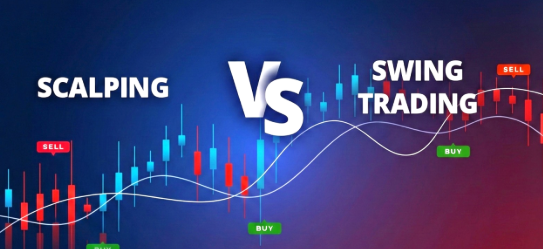
This article will outline Scalping vs Swing Trading and illustrate the major differences between the two methods.
I will break down the fundamentals of each trading technique and list the methods’ individual benefits and risks. Furthermore, I will explain which methods are best for your individual goals, time, and personality. This will help provide your trading with consistent profits.
What is Scalping Forex Trading?
Scalping is a short-term Forex trading strategy that attempts to earn small profit margins from a potentially infinite number of trades executed in a matter of seconds or minutes.
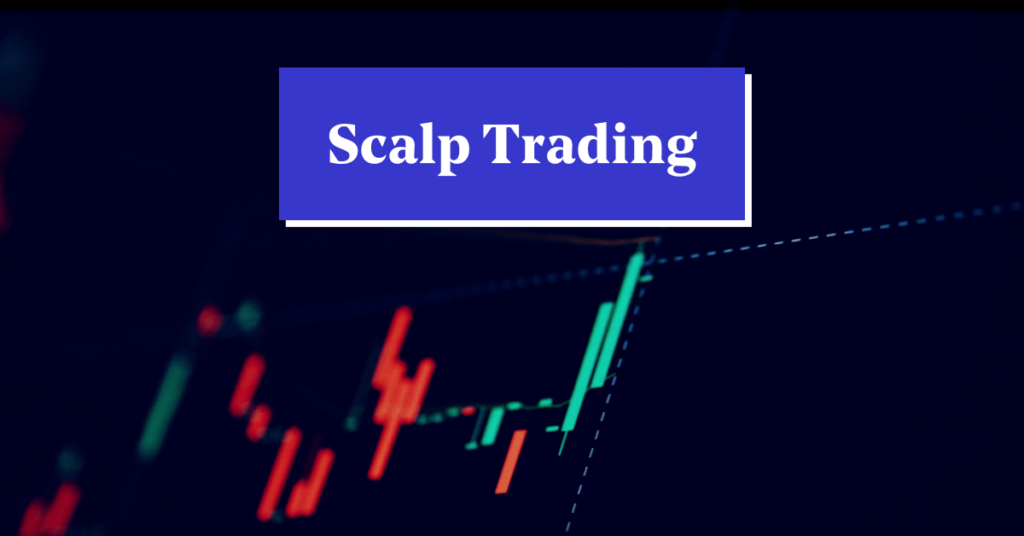
The strategy attempts to profit from the smallest market fluctuations in the most liquid currency pairs while employing the smallest time frames (like the one or five minute charts). Scalpers substantially depend on technical analysis in addition to a very short time window for execution, and a very small window (tight) for spreads.
This strategy requires enormous amounts of focus, strategy, and snap judgment to open and close trades in rapid succession.
While the possibility of generating consistent profits exists, this is offset by the large number of trades and consequently, the increased risk and costs, poor risk management, and lack of a sound trade strategy.
What is Swing Forex Trading?
Swing Forex trading focuses on medium-term movements within currency pairs. Traders aim to capture price changes (swings) over an extended period from several days to several weeks. Instead of rapid trading and capturing small moves in the market, swing traders hold their positions longer in order to take advantage of larger market movements.
They use price action and technical analysis, trend identification, market structure, and support and resistance. They may also use fundamentals to aid their decision making.
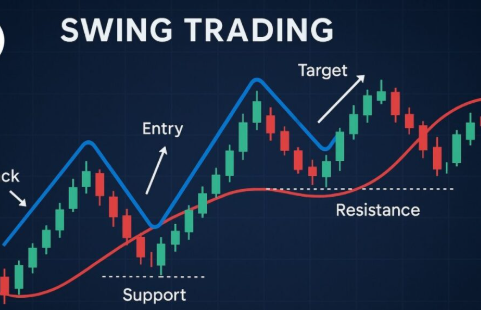
Swing trading involves longer time frames, usually 4 hour and daily time frames, which means less time in front of the trading screen compared to scalpers.
While swing trading offers the potential for larger profits, it does mean there may be more risk involved, especially overnight market movements. Successful swing traders must be patient, disciplined and must have strong risk management.
Scalping vs Swing Trading: Key Differences
| Factor | Scalping Trading | Swing Trading |
|---|---|---|
| Timeframe | Seconds to minutes | Days to weeks |
| Trading Frequency | Very high (dozens of trades daily) | Low (few trades per week) |
| Profit Target | Small profits per trade | Larger profits per trade |
| Risk Exposure | Low (short market exposure) | Higher (overnight & market risks) |
| Screen Time | Requires constant monitoring | Requires less screen time |
| Stress Level | High due to fast decisions | Moderate to low |
| Strategy Focus | Quick price movements | Market trends and swings |
| Tools Used | 1-min/5-min charts, indicators like RSI, EMA | 4H/Daily charts, MACD, Fibonacci, support/resistance |
| Transaction Costs | Higher (more trades = more fees/spreads) | Lower (fewer trades) |
| Skill Level | Advanced (fast execution needed) | Beginner-friendly |
| Capital Requirement | Often needs higher capital for meaningful gains | Can start with moderate capital |
| Best For | Full-time traders who prefer fast-paced trading | Part-time traders or those with limited time |
Which Trading Style is Best for You?
Time Availability
- If you have time to watch the charts the majority of the day, you would be better at scalping
- If you have less time to spend trading, you would be better at swing trading
Personality
- If you are more of a fast, action oriented trader, you would likely do better at scalping
- If you prefer to be more methodical in your trades, you would likely do better at swing trading
Tolerance for Risk
- If you want to take shorter time frame risks with your trades, then you would likely prefer scalping
- If you are okay with taking overnight or gaps in the market risks, then you would likely prefer swing trading
Experience
- You may find swing trading to be easier to learn, especially as a beginner, as less experience is needed
- Scalping is generally for more advanced traders as it requires better skills and ability to execute trades quickly
Stress
- Scalping can be more stressful as this trading style requires you to do rapid trades
- Swing trading requires less stress and is a more relaxed style overall
Profit Potential
- Scalping will typically bring in more frequent, but smaller profits
- Swing trading often aims for more profits, but will take a longer time to get those profits
Amount of Trading Capital
- More trading capital may be needed for scalping to ensure trade costs are covered
- Swing trading can be done with less trading capital
Choice of Strategy
- If you prefer more short-term strategies, then you would choose scalping
- Select swing trading if you are interested in strategies based on following trends.
Tips to Choose the Right Strategy
Identify Objectives
- Determine goals for investing (short term profit vs. long term goals).
- Align financial goals with investing strategy.
Assess Time Available
- Invest time dependent on the trading strategy.
- Time intensive strategies should be avoided.
Determine Risk Appetite
- Assess financial and psychological factors when determining risk as a loss can be difficult to cope with.
- Choose trading strategies with acceptable risks.
Test Strategies in Demo Account
- Determine which strategies work effectively for you without the risk of losing money.
Try Different Strategies
- Test scalping, swing, and position trading strategies (among others).
- Assess variability in comfort and performance.
Master a Single Strategy
- Frequent change of strategies should be avoided as mastery of a single strategy takes precedence over others before further exploration.
Risk Management
- Use risk management strategies such as stop-loss and other profit taking strategies.
- Limit risk to a small fraction when trading.
Key Features of Scalping vs Swing Trading
Key Features of Scalping Trading
- Makes numerous transactions over periods of seconds or minutes
- Focus on smaller price targets for faster gain
- Utilizes lower time frames (charts in the range of 1 minute to 5 minutes)
- Involves continuous observation of the market
- Builds on technical indicators and price action
- Requires quick trade execution and low spread
- Greater trade volume leads to increased transaction costs
- Involves significant concentration, along with discipline and quick action
Key Features of Swing Trading
- Keeps trades for periods of days to weeks
- Focus on larger price targets and longer gaps
- Utilizes higher time frames (charts in the range of 4 minutes to 1 day)
- Requires less observation of the market and lesser screen time
- Utilizes both fundamental and technical analysis
- Involves lower trade volume leads to lesser transaction costs
- Involves greater decision time
- Involves more focus on patience and less on action in a more strategic way
Tools & Indicators for Scalping vs Swing Trading
Scalping Tools & Indicators
- RSI (Relative Strength Index) – Measures speed & change of price movements to determine overbought or oversold situations
- Moving Averages (EMA/SMA) – Indicate short-term trends
- Stochastic Oscillator – Helps to determine entry and exit points
- Bollinger Bands – Measures volatility and price breakouts
- Volume Indicators – Support price movements
- Level 2 Data / Order Book – (for advanced users) Understand market depth
- Fast Execution Trading Platforms – For a rapid placement of your orders
- 1-Min & 5-Min Charts – For fast trade execution
Swing Trading Tools & Indicators
- MACD (Moving Average Convergence Divergence) – Determines the strength of a given trend & the momentum
- Support & Resistance – Key indicators areas to consider entry and exit
- Moving Averages (50, 100, 200) – Indicate long term trends
- Fibonacci Retracement – Measures possible reversal levels
- Channels & Trendlines – Determine which direction the market will go
- Fundamental Analysis Tools – Measure news and events in the economy
- Economic Calendar – Measures which events are deemed to be of significant importance to the market in a given time
- 4H & Daily Charts – Provide information on a larger scale of actions the market took
Common Mistakes to Avoid

Over-trading
- Trading without sufficient analysis.
- Over-trading includes severe costs and losses.
Risk management Ignored
- No stop-loss and bad position sizing.
- Risk management leads to extensive losses in a short duration.
Wrong Timeframe Selection
- Wrong selection of time frame e. g. short in swing trading.
- Wrong selection of time frame reduces the effectiveness of your strategy.
Trading and Emotions
- Be afraid of the losses, or too greedy to realize the losses.
- Trading and emotions are a sure way to lose money.
Trading Plan Absent
- No strategy and trading without clearly defined rules leads to the sure way to lose money.
Not Strategy Testing
- Not back or demo trading increases the sure way to lose money.
Market Conditions are Ignored
- Not adapting your trading to the environment is a sure way to lose money.
Losing Trades Are Held Too Much
- Hoping losses will recover leads to the sure way to lose money.
Pros and Cons of Scalping vs Swing Trading
Scalping Trading Pros & Cons
Pros
- Small and quick profit making opportunities
- Over night risk in the market are reduced
- High amount of trading chances
- Trading decision and feedback are quick
- Liquid market work this way
Cons
- High level of stress due to quick decision making
- Occurs when the screen is all the time
- High transaction cost and trading fees
- Strong discipline and quick execution are needed
- Not beginner friendly
Swing Trading Pros & Cons
Pros
- More relaxed trading strategies
- Less time is needed to watch the trades
- Costs associated with transactions are lower
- Beginners can use this trading strategy
- Larger and more profitable market trends can be captured
Cons
- Weekend and overnight risks can lead to loss
- Strategy requires discipline & patience
- Gain may take a while
- Unpredictable news can cause market fluctuations
- A strong analysis on the fundamentals and trends is needed
Conclusion
To sum up, scalping and swing trading each have their particular benefits, and ultimately your choice comes down to your personality, as well as the time and commitment you want to put in, aligned to your trading goals.
Traders who work fast and are able to put lots of time into constantly watching the market would fit scalping best. Meanwhile, swing trading is more suited to those who want to work slower and capture bigger price changes over longer periods as little as a few days to as much as a few weeks.
Your personality, lifestyle, and commitment to the purpose along with patience are the main things that will determine success and there are no universal templates to that. Reaching that kind of success is a result of applying discipline. Trying those out will help you build something.\
FAQ
What is the main difference between scalping and swing trading?
Scalping focuses on making small profits from quick trades within minutes, while swing trading aims to capture larger price movements over days or weeks.
Which trading style is better for beginners?
Swing trading is generally better for beginners because it requires less screen time and allows more time to analyze trades and make decisions.
Is scalping more profitable than swing trading?
Scalping can generate frequent small profits, but swing trading often targets larger gains per trade. Profitability depends on skill, discipline, and strategy.
How much time is needed for scalping vs swing trading?
Scalping requires constant monitoring throughout the day, while swing trading needs only a few hours for analysis and trade management.
What are the risks involved in both styles?
Scalping carries risks from rapid trades and high costs, while swing trading involves overnight risks and exposure to market news.