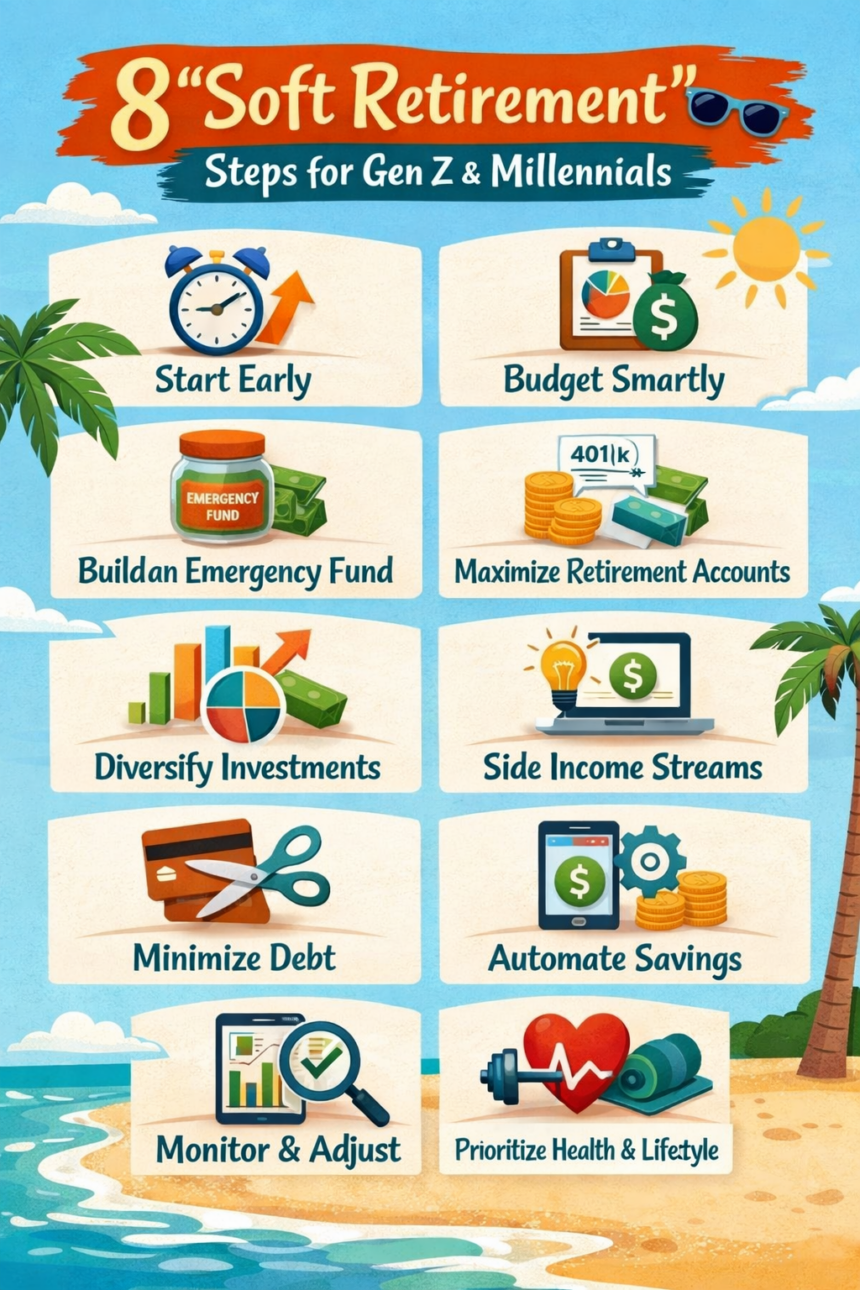
While navigating retirement may seem far away for Gen Z and Millennials, early action is critical to achieving financial independence. “8 “Soft Retirement” Steps for Gen Z and Millennials refers to a gradual tapering of work responsibilities along with the maintenance of a similar lifestyle.
With smart practices — budgeting intelligently, establishing emergency funds, maximizing retirement accounts and having a diversified portfolio — young professionals can set themselves up for flexibility and peace of mind. 8 Actionable Steps for the Next Generation to Retire Comfortably without Sacrificing Their Future Goals Today
What is Soft Retirement?
Soft retirement is a strategy to achieve financial independence, but instead of working full time and completely ceasing work at an arbitrary “retirement” age (it depends on when the government allows you) your motive is simply to work less and manage contract, part-time or flexible roles — sustaining multiple potential sources of income from paid gigs in place of “traditional” employment.
Full early retirement is fundamentally different than soft retirement, which enables Gen Z and Millennials to keep a regular cash flow while exploring personal passions, hobbies, or side projects.
It stresses the importance of financial planning, regular savings, diversified investments, and lifestyle management for long-term security. The plan allows you to enjoy financial independence without compromising your current lifestyle, ultimately easing the transition of retirement while minimizing any stressors.
| Soft Retirement Step | Key Point |
|---|---|
| Start Early | Begin saving and investing in your 20s to leverage compound growth over decades. |
| Budget Smartly | Track expenses, prioritize needs over wants, and maintain a sustainable lifestyle. |
| Build an Emergency Fund | Save 3–6 months of living expenses to cover unexpected costs without debt. |
| Maximize Retirement Accounts | Contribute to 401(k), IRA, or Roth IRA to benefit from tax advantages. |
| Diversify Investments | Spread money across stocks, bonds, ETFs, and alternative assets to reduce risk. |
| Side Income Streams | Develop additional income through freelancing, online businesses, or passive investments. |
| Minimize Debt | Pay off high-interest debts first and avoid unnecessary loans to free future cash flow. |
| Automate Savings | Set up automatic transfers to investment and savings accounts to ensure consistency. |
| Monitor and Adjust | Review financial goals annually and adjust strategies for market and lifestyle changes. |
| Prioritize Health & Lifestyle | Maintain physical and mental health to reduce retirement costs and enhance quality of life. |
1. Start Early
The number one of these most important 8 Soft Retirement steps for Gen Z and Millennials is to start early. If you save and invest in your 20s, you can take advantage of compound interest: Those small contributions now will add up to big bucks later.

Planning early also helps mitigate risks and gives flexibility in retirement options. If you start investing early, you can try out a variety of investment strategies to see what works for you and learn from any mistakes made along the way while creating strong financial discipline.
This strategy for minimizing old-age pressure increases the chances of a comfortable soft retirement later in life through earlier action.
Start Early Key Features
- Start financial planning early in life
- − longer time horizon for growth
- Compounding benefits increase wealth
- More flexibility in risk-taking
Pros
- Maximizes compound interest
- Communities are easier to recover from mistakes
- Builds strong financial habits
- Greater retirement security
Cons
- Requires discipline early on
- Harder for late starters
- Can feel confining in youth
2. Budget Smartly
Budgeting is one of the 8 steps to Soft Retirement for Gen Z and Millennials. Tracking income and expenses ensures you’re living within your means while freeing up money for savings and investments. Budgets help you understand how much money is coming in, but smart budgeting also means putting your needs ahead of your wants, cutting unnecessary spending and directing funds toward financial goals.
Apps or digital tools can make this process easier, allowing younger generations to deal with variable incomes and lifestyle changes. The discipline of working on the budget prevents debt accumulation, consistent contributions are made to a retirement plan, and such base is set for a sustainable soft retirement that also has been checked for stress.
Budget Smartly Key Features
- Track income and expenses
- Allocate funds to priorities
- Prevent overspending
- Adjust for lifestyle changes
Pros
- Improves financial control
- Reduces unnecessary expenses
- Helps achieve goals faster
- Creates awareness about spending habits
Cons
- Time-consuming to maintain
- Requires consistency
- Can feel restrictive
3. Build an Emergency Fund
An essential 8 Soft Retirement step for Gen Z and Millennials is establishing a fund for emergencies. Financial emergencies, such as medical bills, car repairs or job loss, can disrupt retirement planning. If nothing else, 3–6 months living expenses in some liquid high yield account ensures you have enough money to face unexpected expenses without going into high-interest debt.

This fund serves as a buffer for your investments to continue compounding. Regularly reviewing and replenishing the emergency fund is important to ensure it will be enough for changing lifestyles. A good emergency fund helps you prevent stress, stay on a firm financial footing and looks after long-soft retirement plans.
Build an Emergency Fund Key Features
- Dedicated savings for crises
- Accessible liquid account
- Covers 3 – 6 Months Expenses
- Shields against debt reliance
Pros
- Provides financial security
- Reduces stress in emergencies
- Prevents high-interest borrowing
- Encourages savings discipline
Cons
- Takes time to build
- Funds may sit idle
- Expectation to utilize for non-life-threatening situations
4. Maximize Retirement Accounts
If certain 8 Soft Retirement steps are fully understood, contributing consistently to retirement accounts also is one of those for Gen Z and Millennials. Accounts such as 401(k)s, IRAs and Roth IRAs offer tax benefits and, in some cases, employer matching contributions that help build wealth faster.

The earlier you maximize contributions, the more time you have to benefit from compounding over decades. Younger investors are able to take more aggressive approaches because they have longer time horizons.
Limits on contributions should be re-evaluated annually, and investments within the accounts adjusted based on risk tolerance, while diversifying can help people take advantage of growth opportunities.
Making retirement accounts a priority as sources of reliable income in a soft retirement can lower reliance on other fixed incomes (less financial stress).
Maximize Retirement Accounts Key Features
- Tax-advantaged savings vehicles
- Employer contributions possible
- Long-term investment growth
- Structured withdrawal rules
Pros
- Tax savings boost returns
- Free money is added through an employer match
- Ensures retirement readiness
- Encourages consistent saving
Cons
- Limited liquidity
- Penalties for early withdrawal
- Contribution caps restrict savings
5. Diversify Investments
Gen Z and Millennials 8 Soft Retirement steps include diversification as one of its fundamentals. Diversifying your investments can limit your risk while maximizing returns across stocks, bonds, ETFs, real estate and alternative assets.

It shields portfolios from market volatility and economic slumps. Diversification also enables younger investors to offset potentially high-risk, high-reward plays with safer, steady-growth investments.
Continual rebalancing of the portfolio keeps it in line with financial goals and risk appetite. Being well-versed with different types of investments and not over-exposing oneself to a particular asset class allows for gradual wealth generation so that the soft retirement is smooth, predictable, resilient, and responsive to changing market circumstances.
Diversify Investments Key Features
- Spread risk across assets
- Combination of stocks, bonds, real estate
- Reduces volatility
- Enhances long-term stability
Pros
- Protects against market downturns
- Increases potential returns
- Balances risk and reward
- Builds resilient portfolio
Cons
- Requires knowledge to balance
- May dilute high returns
- Can be complex to manage
6. Side Income Streams
Step 8 Soft Retirement for Gen Z and Millennials Freelance work, side businesses, online ventures or passive income streams fast-track contribution to savings and investments. Having multiple streams of income means not relying on one salary as much, which can help pay bills, invest more aggressively, and get to financial independence faster.

Money earned on the side can also pay for experiences, skills or education that increase earning potential long-term. This not only provides a boost to cashflow foryour business, but it also gives you flexibility and resilience to new career moves.
A diversified income portfolio supplements investments, allowing for softer retirement while maintaining a quality life.
Side Income Streams Key Features
- Earnings beyond primary job
- Part-time work, gig or passive income
- Diversifies financial sources
- Scales with effort
Pros
- Extra cash flow
- Reduces reliance on one job
- Builds new skills
- Can grow into full business
Cons
- Time-intensive
- May cause burnout
- Income may be inconsistent
7. Minimize Debt
For Gen Z and Millennials, managing or reducing debt is a critical8 Soft Retirement step. These are high-interest debts, such as credit cards or payday loans, which can greatly halt the accumulation of wealth.

Paying off these debts and avoiding fresh borrowing frees up cash flow for investments and savings. For instance, a strategic debt like a student loan or mortgage should be managed as one of life gets to use more than their capability.
Less debt means less stress and more freedom to work and live how you want. Keeping a debt-light profile will enable younger generations to gain on their way to soft retirement, maximise financial resilience and retain the ability (both financially and mentally) to invest in long-term goals.
Minimize Debt Key Features
- Reduce high-interest obligations
- Focus on repayment strategies
- Avoid unnecessary borrowing
- Improve credit score
Pros
- Lowers financial stress
- Saves money on interest
- Boosts creditworthiness
- Frees income for savings
Cons
- Requires strict discipline
- May limit lifestyle choices
- Make slow sure for huge debts
8. Automate Savings
This brings us to step 8 of automate the process which, for Gen Z and Millennials, means soft retirement! Automating transfers from the bank account to savings accounts, retirement and investment portfolios allows for contributions without using willpower.
Automating your wealth-building plan helps reduce temptations to spend discretionary income. It also helps with financial planning, enabling you to focus on the promotion at work, a side project — or just your own self-development.

Automatically contributing to savings accounts are sage decisions, but you should review them regularly to make sure they’re keeping pace with the planned growth of income and inflation.
Integrating savings and investments into daily finance habits allows younger people to build wealth consistently over time, making soft retirement a predictable and low-stress objective.
Automate Savings Key Features
- Scheduled transfers to savings
- Removes manual effort
- Builds consistency
- Works with budgeting tools
Pros
- Ensures regular saving
- Reduces temptation to spend
- Builds wealth effortlessly
- Supports long-term goals
Cons
- Less flexibility
- Overdraft risk when not planned
- May feel restrictive
9. Monitor and Adjust
Monitoring and recalibrating financial strategies on a regular basis are essential 8 Soft Retirement actions for Gen Z and Millennials. Changes in life, shifts in the market or fluctuations in income can affect retirement plans.

An annual review of your progress, rebalancing investments and updating budgets keeps you on track with meeting goals. Flexibility lets younger investors adapt without derailing long-term goals. Tracking metrics between net worth, savings rate, portfolio performance gives you an idea of progress.
In adapting strategies as situations shift you preserve movement toward soft retirement. This can help ensure that financial plans are realistic, responsive and effective, minimizing surprises and allowing for some confidence in a slow moving transition to retirement.
Monitor and Adjust Key Features
- Regularly review finances
- Adapt to life changes
- Track progress toward goals
- Identify inefficiencies
Pros
- Keeps plan relevant
- Improves decision-making
- Prevents financial stagnation
- Encourages accountability
Cons
- Requires ongoing effort
- Can be overwhelming
- Can result in so many changes
10. Prioritize Health & Lifestyle
The last of the essential 8 Soft Retirement steps for Gen Z and Millennials is shifting towards health and lifestyle. Health in mind and body lowers costs of care and helps productivity, generating wealth more efficiently.
Cultivating healthy habits means avoiding lifestyle-induced expenses while also increasing longevity and allowing for a soft retirement. MeditationAPP helps balance work and other areas of life while staying on the path to achieving financial goals.

Taking care of yourself through preventive health, exercise and meditation means you may not have as many costly surprises.
In prioritizing health, Millennials and Gen Zers not only preserve their retirement savings, avoid long-term expenses associated with poor health, but also embark on a sustainable path toward a more rewarding soft retirement.
Prioritize Health & Lifestyle Key Features
- Invest in physical well-being
- Work-life balance
- Prevent costly medical issues
- Support long-term productivity
Pros
- Reduces healthcare costs
- Improves quality of life
- Boosts earning potential
- Supports longevity
Cons
- It can be expensive to live a healthy lifestyle
- Requires consistent effort
- Benefits take time to show
Explain why Gen Z and Millennials need tailored strategies due to changing work patterns, student debt, and inflation.
Gen Z and Millennials are entering a vastly different financial environment compared to generations before, making custom-fit retirement strategies critical. In contrast to older generations that had stable jobs for years (decades, even), so they could count on a consistent salary and benefits — used in part to help guide retirement planning — most young adults now partake in job-hopping, gig work and other freelance opportunities.
And large amounts of student debt limit our ability to save and invest early on, which places extra pressure on cash flow. To make matters worse, high inflation reduces purchasing power, which means the cost of living and future retirement expenses are greater than expected.
All of these factors combined make for unique, flexible solutions—case in point, early-stage investments, a string of income-generating sources of passive and semi-passive income streams leading to automations of savings transfers from those diverse revenue streams into safe-haven investments born out the hard-learned lessons over millenia about how long-term interest can be navigated smartly using debt.
Conclusion
To sum up, a Gen Z & Millennial soft retirement demand a strategic, proactive and customization approach. By mastering the 10 principles—early starts, smart budgeting, emergency funds, maxing out retirement accounts, diversifying investments, side hustles, debt minimization and automation of savings efforts to stay on track with regular sprints toward their goal—the young adults can tackle the peculiar challenges created by modern work habits, student debts and inflation.
Following these actions over time leads to steady finances, gradual wealth accumulation, and a stress-free transition toward retirement. A soft retirement is not simply a dream; it can be done with discipline, planning, and adaptability.
FAQ
What is a soft retirement and why is it important for Gen Z and Millennials?
A soft retirement is a gradual transition to financial independence rather than full early retirement. For Gen Z and Millennials, it’s important because changing work patterns, student debt, and inflation make traditional retirement planning challenging. Soft retirement allows for flexibility, reduced stress, and lifestyle stability while still building wealth.
Why should I start saving and investing early?
Starting early leverages compound interest, giving your money more time to grow. It also allows you to take calculated investment risks, reduce financial pressure later, and develop long-term financial discipline.
How can budgeting smartly help achieve soft retirement?
Budgeting helps track income and expenses, prioritize needs, and allocate funds for savings and investments. Smart budgeting ensures consistent contributions to your financial goals and prevents overspending that could delay retirement plans.
Why is building an emergency fund crucial?
An emergency fund of 3–6 months’ expenses provides a safety net for unexpected costs like medical bills or job loss. It prevents debt accumulation and ensures your long-term investments remain intact.