

The Web3 Security Auditing Tools for High-Value Smart Contracts will be covered in this article, with an emphasis on how sophisticated analysis, automated formal verification, and ongoing monitoring assist safeguard important blockchain applications.
In order to lower exploit threats, build trust, and guarantee institutional-grade reliability throughout contemporary decentralized networks, you will examine cutting-edge platforms, crucial features, and practical security operations.
What Are Web3 Security Auditing Tools?
We3 security auditing tools are a type of software that evaluate smart contracts and decentralized applications to ensure their security and reliability before and after deployment (put in other words, find vulnerabilities).
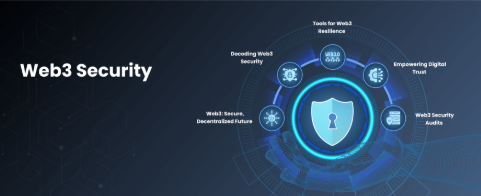
They utilize a variety of needed techniques to find various risks such as, access and control bugs, logic errors, and economic vulnerabilities. Directly for important smart contracts that hold substantial amounts of assets or institutional capital, auditing tools provide more advanced, extra features.
For example, compliance reporting, code coverage metrics, and “streaming,” which, along with other features, “Troubleshoot and real-time” monitoring analysis, tracks and reports on-chain actions. Finally, Web3 security auditing tools are integrated into development environments and third-party audit pipelines to streamline efforts and build a demonstrable trust with users and investors.
Key Threats to High-Value Smart Contracts
Reentrancy Attacks
Malicious contracts call functions repeatedly draining funds and manipulating the state of the contracts.
Access Control Vulnerabilities
Weak roles allow bad actors to call admin or other elevated functions.
Oracle Manipulation
Attackers take control of data feeds which allow for the altering of prices, interest, and liquidation.
Integer Overflow and Underflow
Omitting certain mechanics of the smart contracts cause the system to have incorrect balances and transactional values.
Front-Running and MEV Exploits
Bots reorder or add transactions to take profit from users trades resulting in a loss of money.
Logic and Business Model Flaws
Smart contracts do exactly what they are coded to do, but fail to do what is intended economically.
Flash Loan Attacks
Unsecured loans are taken out to attack liquidity pools or governance in a single move.
Upgradability Risks
With proxy and upgradeable contracts, an attacker is able to take control of the logic of the contract.
Cross-Chain Bridge Vulnerabilities
Poorly built validation and signature schemes allow machines to steal and mint assets cross-chain.
Denial of Service (DoS)
Overly complex contracts and malicious enough inputs block real functions from being executed.
Automated Formal Verification in Web3
Proving mathematically smart contracts are correct – Uses formal models and logic in showing smart contracts act exactly as they are supposed to under all conditions.
Verification Testing – For each smart contract, developers set with business and security rules as formal properties the smart contracts must always satisfy.
Vulnerabilities detection for edge cases – Finds exceptional execution routes that are generally overlooked by testing and audits.
Automation at Scale – Makes it possible to verify extensive, intricate smart contracts with little or no review from the human team.
Integration with CI/CD Pipelines – During the development and deployment phases, the contract’s automated verification systems are employed.
High Assurance for High-Value Contracts – Best suited for systems with DeFi, institutional custody, and governance that deal with large amounts of money.
Reduction of Human Oversight – Cuts down the errors that are the result of oversights or ineffective manual auditing.
Support for Compliance and Regulatory – For the enterprise or institutional customers, it provides proof artifacts and formal documentation.
Compatibility with Major Tools – Functions with Certora, K Framework, and other verification engines based on Solidity.
Verification that continues After Deployment – Ensures that newly added logic conforms to the original specification after contract changes or upgrades to the system.
Essential Features to Look for in Auditing Tools
Static Code Analysis
Reviews the smart contract source code based on prior deployment to find weaknesses or issues, as well as code patterns that might be insecure or contain mistakes.
Dynamic Testing & Simulation
Identifies real time contract openings, as well as other negative behavior that might result from executing contracts in test environments.
Fuzzing Capabilities
Identifies bug logic and flaws associated with edge case by adversarial and random input deriving automation.
Automated Formal Verification
Determines under all execution paths, which contracts are in compliance with specified business and security rules.
Real-Time Monitoring & Alerts
Analyzes on-chain activity post deployment and notifying contracts that are suspicious or anomalous.
CI/CD Integration
Merges with development pipelines to implement security constraints at every phase of a build and release cycle.
Multi-Chain Support
Operates on Ethereum, Layer 2, as well as other varying blockchains to offer full service.
Comprehensive Reporting
Outlines vulnerability reports, summarizes and rates severity, and provides guidance for mitigation.
Compliance & Audit Trails
Compatibly with documentation for institutional, regulatory, and enterprise level.
User-Friendly Dashboards
Displays security status, risk level, and verification result visually for easy understanding.
Top Web3 Security Auditing Tools
Certora Prover
One of the best Web3 security auditing tools is Certora Prover, which integrates formal verification into the production of useful, real-world smart contracts. Certora allows developers to describe exact correctness properties in a formal specification language and then mathematically proves that those properties hold over all conceivable executions, in contrast to standard static analyzers that highlight patterns.
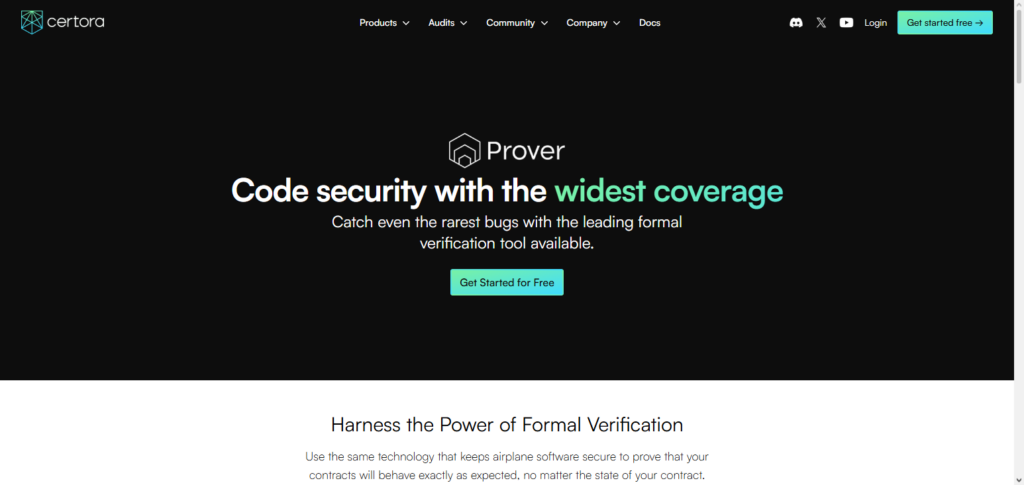
This implies that crucial business logic, such as token issuance rules or invariants in DeFi protocols, can be ensured rather than merely tested. Its power is in eliminating uncertainty; rather than speculating about possible bugs, it rigorously and logically demonstrates their absence. This degree of confidence makes Certora Prover particularly useful for teams creating high-value contracts where even little errors could have disastrous consequences.
Slither
Because it provides quick, thorough, and developer-friendly static analysis designed especially for Solidity smart contracts, Slither is one of the best Web3 security auditing tools. Slither’s capacity to thoroughly examine contract structures, control flows, and inheritance patterns in order to find minute vulnerabilities that more basic scanners could miss is what sets it apart.

It helps developers address problems early in the build process by producing concise, useful reports with comprehensive insights regarding gas inefficiencies, coding anti-patterns, and possible security flaws.
Slither is a sensible option for teams that prioritize continuous security checks without slowing down development because of its modular design, which also enables custom detectors and integrations into CI/CD pipelines. It is a preferred tool for both quick audits and thorough code quality inspections due to its lightweight, accurate analysis.
OpenZeppelin Defender
Because it combines real-time incident response capabilities designed for smart contracts with automated defense mechanisms, OpenZeppelin Defender is a top Web3 security auditing and operations solution.
Instead of concentrating only on pre-deployment analysis, Defender facilitates automated administrative activities, secure multi-sig governance execution, and on-chain monitoring with alerting, all of which assist teams in managing and mitigating risks during the course of the contract.

Its strength is operationalizing security; developers can connect it with current DevOps operations, schedule secure upgrades, and set up automated reactions to questionable transactions.
Defender is particularly useful for high-value contracts that need constant protection and quick response to new threats because of its proactive strategy, strong access limits, and smooth connection with OpenZeppelin’s vast security ecosystem.
Auditing Workflow for High-Value Smart Contracts
Economic Model & Business Goals Alignment– Before engaging with lawyers and auditors, it is critical to rationally structure the business goals and key economic motives of the smart contract and identify critical economic security concerns. With this knowledge, you can communicate more effectively with the auditors, assuring them what to concentrate on.
Draft Contracts & Data Processing Agreements– Once you have completed the previous activity on the economic model, liaise with the lawyers to draft the contracts. Don’t forget to include the Data Processing Agreements, as they will inevitably involve handling personal data, and this is part of the legal obligations that they must include.
Data Protection Impact Assessment– Issue this to the auditors, as they will have to build a strategy to ensure the concepts work within the boundaries of privacy, data ownership, and protection.
Strategy for Data Protection, Data Ownership and Protection, and Privacy– From the previous activity, the auditors will have a strategy to maintain the concepts within the boundaries you’ve outlined, including your Data Protection frameworks, and other protocols within Data Ownership and Protection and Privacy.
Smart Contracts & Audit Terms of Business Delimitation– Lastly, make sure to instruct the auditors on the boundaries within which you’d like them to work.
Benefits of Using Advanced Auditing Tools
Lower Exploit Risk – Vulnerabilities are found before they can be exploited, preventing hacks, loss of funds, and even downtime of protocols.
Better Quality of Code – Best practices are enforced, and secure coding standards are followed throughout the development teams.
Shorter Deployment Cycles – Testing, verification, and audit readiness are sped up through the automation process.
More Investor Confidence – A good and strong security stance is shown to institutions, partners, and users.
Regulations and Compliance – Audit trails and reports are provided for enterprise and regulatory requirements to help with compliance.
Ongoing Security Monitoring – Continued protection with alerts and on-chain monitoring even after the protocol is deployed.
Economic Efficiency – Expensive, time-consuming fixes and emergency audits are avoided.
Scalability Across Protocols – Multiple blockchains and smart contracts can have the same security standards applied.
Better Governance and Clarity – More insight is provided about contract behaviors, and transparency surrounding upgrade impacts is improved.
Proactive Security – Formal verification updates and AI-based threat detection and mitigation adapt to changing threats.
Challenges and Limitations
Advanced Audit Expenses
Formal Verification and other audits can be expensive for more complex and higher valued ecosystems.
Requires Multitude of Skills
Team members need to be proficient in security engineering, formal methods, and blockchain ecosystem architecture.
Overlapping Reviews
Automated reviews tend to identify the same less critical issue, increasing load for developers and more time spent in the reviews.
Vulnerability Gaps
Inadequate coverage, since any tool will be unable to capture any and all vulnerabilities. More overlooked are vulnerabilities related to the economic and governance scope of the tool.
Verification Limitations
Some tools work better than others at scalability in terms of modular contracts and complex code.
Workflow Complexity
A fragmented toolchain can lead to more complex workflows depending on the number of tools used to analyze, test, and monitor.
Cross Chain Support
Some tools do not provide full support to up and coming L2 block chain collaborations.
Specification Limitations
Formal verification has limitations based on rules and security invariants defined by the developers, leading to less accommodating scope.
Unmitigated Risks of Deployment
Active Monitoring can be limited regarding offchain coordination and social engineering mitigation.
Outdated Exploitation Techniques
Exploitations and the ways of getting around defenses tend to be more numerous than the ways and measures to defend against them.
Future Trends in Web3 Security Auditing
Beyond one-time contract evaluations, fully automated, intelligence-driven, and continually adaptive solutions are the way of the future for Web3 security auditing. In order to anticipate such exploits before they happen, AI-powered vulnerability detection will progressively examine coding patterns, economic models, and on-chain activity.
In order to give real-time security feedback during development, formal verification technologies should become more developer-friendly and integrate straight into IDEs and CI/CD pipelines. In the future, cross-chain security platforms will be able to monitor multi-network deployments, bridges, and Layer 2s from a single dashboard.
Furthermore, protocols will be able to respond immediately to threats recognized by on-chain automatic reaction mechanisms like pause functions and governance-driven emergency upgrades, enhancing resilience and confidence throughout decentralized ecosystems.
Conclusion
For high-value smart contracts, Web3 security auditing tools are now essential for long-term success, stability, and confidence. Through the integration of automated analysis, formal verification, and expert-led reviews, these technologies assist companies in identifying weaknesses, bolstering economic reasoning, and guaranteeing adherence to institutional norms.
Continuous monitoring and AI-driven security will be even more important in preventing attacks as smart contracts continue to handle higher capital amounts across multi-chain setups. In addition to safeguarding digital assets, investing in cutting-edge auditing solutions boosts credibility, speeds up adoption, and increases trust among partners, users, and regulators in the developing Web3 ecosystem.
FAQ
What are Web3 security auditing tools?
Web3 security auditing tools are software platforms that analyze smart contracts and decentralized applications to identify vulnerabilities, logic errors, and security risks. They use techniques like static analysis, dynamic testing, fuzzing, and formal verification to ensure contracts behave safely before and after deployment.
Why are high-value smart contracts at greater risk?
High-value contracts manage large amounts of digital assets, making them prime targets for hackers, MEV bots, and economic exploits. Even minor coding or logic flaws can result in significant financial losses and reputational damage.
What is formal verification, and why is it important?
Formal verification mathematically proves that a smart contract follows predefined rules under all possible conditions. It is especially important for institutional and enterprise-grade contracts where failure or manipulation can have large-scale financial and legal consequences.
Can automated tools replace manual audits?
Automated tools greatly improve efficiency and coverage, but they cannot fully replace human expertise. Manual audits are still essential for detecting business logic flaws, governance risks, and complex economic attack vectors.