I’ll go over why cryptocurrency apps have trouble retaining users in this post. Despite their growing popularity, many users abandon these programs due to confusing interfaces, market volatility, and lack of customisation.
Developers must comprehend these issues in order to enhance user experience, foster trust, and put tactics into place that keep people engaged, inspired, and devoted to the platform.
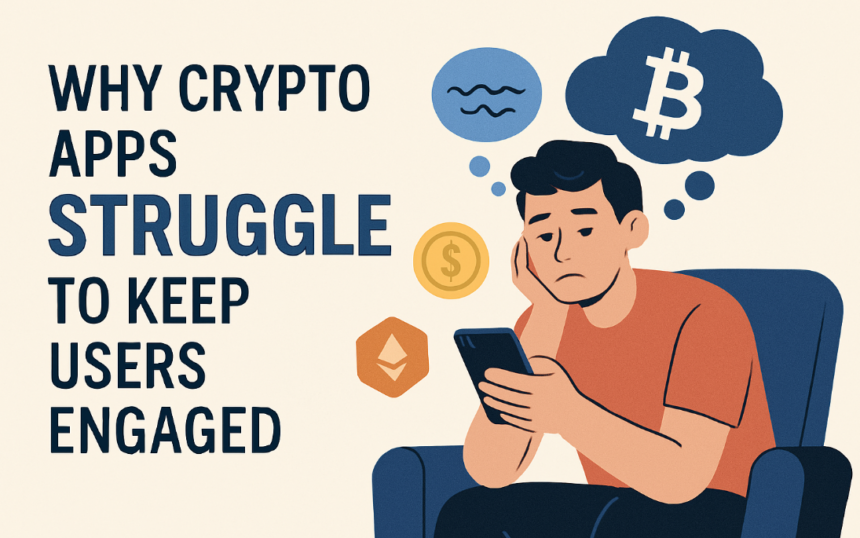
Why Crypto Apps Struggle to Keep Users Engaged
Complex and Overloaded Interfaces
- There is a ton of information available about each coin and many real-time monitoring options available.
- New users are often overwhelmed and choose to leave the app instead of continuing to explore.
Steep Learning Curve
- Users unfamiliar with, or new to, crypto might not understand terms such as wallets, staking, or DeFi.
- Users disengage without simple tutorials and easily accessible information.
Market Volatility Stress
- Users are emotionally drained and stressed after dealing with market fluctuations.
- Users often avoid looking at the app and even uninstall the app after experiencing losses.
Excessive Notifications
- Users can be overwhelmed by the amount of push notifications sent by the app.
- Users are alerted about news in the market, promotions, and price changes.
- Users end up uninstalling the app or muting the alerts to avoid notification fatigue.
Lack of Personalization
- Users, who are actively driving the app’s usage, are not given custom notifications or personalized options.
- Traders, long term holders and casual users are often not considered in the app design.
Low Community Interaction
- There are fewer social options and forums and peer support available in a lot of crypto apps.
- Users feel like they are alone in the space and are less motivated to keep using the app.
Friction Points and Unexpected Costs
- Users dislike slow verification, complicated withdrawals, and step-withdrawals.
- Withdrawal issues, even if they impact users only a little, can lead them to churn.
Rewards and Loyalty Programs
- Users don’t tend to remain active on the platform if they can’t earn rewards, gain a bonus, or play a game within the app.
- Users can be incentivized to switch to competitor apps if they have a rewards system.
Trust and Security Concerns
- Users who have little trust and transparency in the app don’t tend to use the app frequently.
- Users are concerned about lost funds, hacks, or being scammed.
Customer Support
- Unresponsive and unhelpful support teams lead users to be frustrated.
- Users tend to abandon the app when they don’t fix issues quickly.
Advantage Of Crypto Apps Struggle to Keep Users Engaged
Identifying User Pain Points
- User exit pathways assist apps in reducing user friction, thus streamlining the overall experience.
Opportunity to Simplify UX/UI
- Recognizing user exodus as a result of complex app interfaces is a useful motivator to focus on improving user experience.
Targeted Educational Content
- Identifying gaps in user comprehension enables the integration of on-demand instructional materials, support documentation, and contextual help.
Better Personalization
- The engagement of differing user segments is enhanced through tailored features, such as differentiated notifications.
Enhanced Trust & Security Measures
- The recognition of the need for increased security can result in the implementation of more robust security measures and transparency policies.
Improved Reward & Incentive Systems
- The realization of the absence of rewards can stimulate the introduction of enhanced game mechanics, user rewards, bonus incentives, and referral rewards.
Stronger Community Building
- Increased awareness of user isolation may result in the addition of social capabilities, community forums, and collaborative events.
Optimized Communication Strategy
- The recognition of user burnout from excessive notifications should promote the introduction of strategic messaging that is limited in number and is purpose-driven.
Innovative Strategies to Retain Users
Personalized User Experience and Tailored Adaptive Onboarding
- Provide different forms of interfaces for beginners, intermediates, and advanced users.
- Modify each user’s app and design based on their experience and proficiency.
Custom AI Notifications and Alerts
- Provide updates based on each user’s individual trading habits and preferences.
- Alert users only when it is necessary.
Gamification
- Create a points and badges system to reward users for actively engaging and performing actions on the app.
- Users should also be rewarded crypto bonuses for referring others as a part of a loyalty program.
In-App Tutorials
- Create guides and instructional materials for users to understand how to use the app and participate in trading, staking, and DeFi.
- Provide step-by-step guides, videos, and in-app tips to assist alleviate users’ concerns.
Community Features
- Create options for social trading, chat rooms, and forums.
- These elements will help users feel more comfortable and less isolated.
Safety and Trust Assurance
- Provide an overview of the safety features in place on the platform (e.g. multi-factor authentication, insurance, etc.).
- Users will feel more confident in the platform.
User Goal Setting
- Users should be able to set goals for themselves in terms of investment, learning, or trading.
- Observe their success and reward based on goals set to help foster continued use of the application.
Unique Challenges in Crypto App User Engagement
Cognitive Overload
- Users are presented with many charts, prices, and market stats.
- Excessive information can lead to overwhelming and make it difficult to make decisions on what actions to take.
Behavioral Exhaustion
- Users become stressed due to high frequency alerts on price changes and movements.
- Users choose to disengage from the app to prevent the stress overload.
Users’ Expectations Are Not Met
- Apps generally focus on their crypto traders while not meeting the long term holders and casual users.
- Lack of user engagement is a byproduct of the lack of in market customer segmentation.
Users’ Friction
- Users become frustrated due to the lack of transparency regarding the hidden fees and complex processes for withdrawals and payments.
- People become disengaged for the long term when they encounter even the most minor obstacles.
Users’ Friction
- Users become frustrated due to the lack of transparency regarding the hidden fees.
- People become disengaged for the long term when they encounter even the most minor obstacles.
The Effect of Market Volatility on Users
- Fear and frustration cause users to refrain from using apps during times of high market volatility.
- Users screen time avoids potential app use during high volatility.
Trust and Security
- Users become hesitant due to concerns regarding scams, losing funds, and potential hacking on crypto apps.* Absence of trust signals may stop users from engaging with the platform.
Rewards and Gamification Not Fully Leveraged
- Many applications do not take full advantage of achievements, rewards, and streaks.
- Without rewards, users have less motivation to be active.
Challenges Associated with Learning System’s Features
- Education is needed when it comes to system features like lending, staking, and DeFi.
- Users may withdraw from the system when they feel they do not have the proper skills or knowledge.
Ecosystem Fragmentation
- Users are required to use several different apps for wallet management, trading, and NFTs.
- Users lose focus and interest when they have to switch between different applications.
Do rewards and gamification help keep users engaged?
Gamification and rewards are essential for maintaining user interest in cryptocurrency apps. Apps capitalize on users’ innate drive and spirit of competition by providing incentives like referral bonuses, staking prizes, accomplishment badges, or progress streaks.
Gamified elements make learning and trading more pleasurable, encouraging users to explore software features repeatedly. These tactics not only boost user engagement and activity but also cultivate loyalty, increasing the likelihood that users will return frequently and interact with the platform in the long run.
Case Examples
Coinbase – UX is Simplified for New Users
- Users have a high level of retention due to the user interface being simple and providing new user onboarding and tutorial guides.
- Success: New crypto user retention.
Binance-Community and Gaming
- Success: Trading competitions and bonus referrals created a spike in user engagement.
- Users were highly motivated due to the gamification of Binance’s platform.
Robinhood Crypto – Casual User Experience
- Instant cryptocurrency trading and a user-friendly platform makes it appealing to the casual user.
- Fails: Users faced a high level of criticism during high volatility events, which is due to a lack of safety features.
Crypto.com – User Incentives
- Financial incentives are offered as rewards for increased user activity, for referrals, and for the use of their cards.
- Success: More user activity.
Bitfinex – User Interface is Overwhelming
- Users, particularly beginners, lose interest and move on to other options due to feature cognitive overstimulation.
- Fails: Cognitive Overload.
FTX (Before Collapse) – User Trust
- Fails: Due to their lack of transparency, they are unable to gain users’ trust in the long-term. Users disengaged in a large volume.
- Lesson: Without trust, user retention is severely lacking.
eToro – Social Features
- Features that allow users to create social networks by following and trading with each other.* With regard to success: When social interactions and trading were combined, there was an improvement in engagement.
Kraken – Strong Security and Customer Support
- Trust, speed, and support with educational material.
- Success: Concerned users were retained.
Gemini – Niche Focus and Regulatory Compliance
- Attracts investors who are cautious and need to know for sure that there are safe regulations in place.
- Success: Users concerned for their safety were retained.
LocalBitcoins – Engagement via Peer-to-Peer Community
- Users can trade in their area with community reputation and user rating systems.
- Success: Local trading and community social ratings enhanced peer-to-peer engagement.
Future Trends in Crypto App Engagement
Personalization, community-driven features, and the smooth integration of new technologies will shape the future of cryptocurrency app engagement. AI and machine learning will enable apps to give personalized notifications, predictive insights, and goal-oriented experiences, keeping users active without overwhelming them.
Peer-to-peer trading, forums, and gamified challenges are examples of social and collaborative features that will strengthen communities and loyalty. Additionally, integration with DeFi, NFTs, and tokenized rewards will enable new avenues for users to participate and earn, while increased security measures and transparent processes will encourage trust. In order to enhance long-term user engagement, the next generation of cryptocurrency apps will generally concentrate on fusing technology, psychology, and community.
Pros & Cons
| Pros (Opportunities) | Cons (Challenges) |
|---|---|
| Identifying user pain points to improve UX | Complex interfaces overwhelm beginners |
| Opportunity to personalize experiences | Market volatility causes stress and FOMO |
| Chance to build strong communities | Lack of social features reduces engagement |
| Incentive to offer gamification and rewards | Notification fatigue from too many alerts |
| Ability to enhance trust and security | Hidden fees and friction frustrate users |
| Educating users can boost confidence | Steep learning curve for new crypto users |
| Data-driven insights for product improvements | Poor customer support leads to uninstalls |
| Competitive advantage by solving retention issues | Misalignment of app features with user goals |
Conclusion
In conclusion, a number of factors, including complicated user interfaces, market volatility, problems with trust, and a dearth of community or personalization options, contribute to the low user engagement of cryptocurrency apps.
Overcoming these problems requires apps to simplify user experiences, give specialized content, develop trust, and incentivise involvement. By addressing these basic challenges, crypto apps can transform casual users into loyal, long-term players.
FAQ
Why do users leave crypto apps so quickly?
Many users leave due to complex interfaces, overwhelming data, confusing features, and lack of clear guidance, which make the app feel intimidating or frustrating.
Does market volatility affect engagement?
Yes. Sudden price swings can cause anxiety, fear, or FOMO, making users hesitant to check the app regularly.
How important is personalization for retention?
Extremely important. Users engage more when the app offers tailored features, notifications, and content based on their experience level and goals.
Do rewards and gamification help keep users engaged?
Absolutely. Referral bonuses, staking rewards, badges, and gamified experiences incentivize users to stay active and explore more features.
How does community influence user engagement?
Community features like social trading, forums, and peer support create a sense of belonging and trust, increasing long-term engagement.