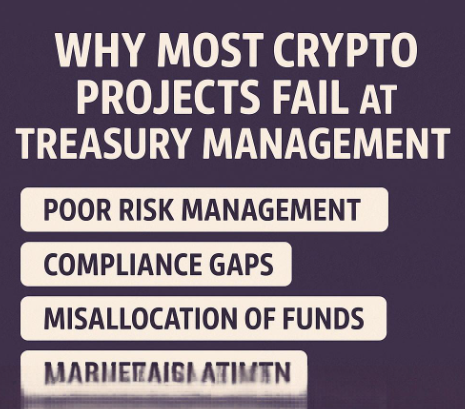
I’ll go over why the majority of cryptocurrency projects struggle with treasury management in this post.
Due to their reliance on manual processes, inadequate risk measures, and lack of automation, many projects have trouble tracking digital assets, managing liquidity, and reducing risks.
Effective treasury management is essential for survival because these mistakes can result in monetary losses, lost opportunities, and diminished investor confidence.
What is Treasury Management?
The process of monitoring, managing, and optimizing an organization’s financial assets, obligations, and liquidity to make sure the business can achieve its operational and strategic goals is known as treasury management, often referred to as corporate or crypto treasury management.
Cash flow management, investment choices, funding, risk reduction, and regulatory compliance are all included in traditional finance. Treasury management in the cryptocurrency ecosystem entails managing digital assets across various wallets, exchanges, and DeFi platforms; making sure there is enough liquidity to meet obligations; strategically allocating funds for yield opportunities or staking; and safeguarding the assets against operational errors, market volatility, and hacks.

Tracking all inflows and outflows, keeping an eye on token values and exchange rates, keeping accurate records for audits and compliance, and putting risk management techniques like diversification, hedging, or stablecoin allocations into practice are all further components of effective treasury management.
It is a crucial role since inadequate treasury management can lead to financial losses, liquidity issues, fines, and eventually the project or business’s demise. Whether in traditional businesses or cryptocurrency initiatives, treasury management is fundamentally the foundation of financial stability, operational effectiveness, and sustained growth.
Why Most Crypto Projects Fail at Treasury Management
Excessive Reliance on Manual Processes
- Most projects manage tracking wallets, tokens, and logging transactions in spreadsheets or some log. This brings about increased the possibility of human error, delays in decision-making, and results in hidden risks that can lead to a misallocation of funds.
Absence of Real-Time Transparency
- Treasury departments that do not have automated dashboards are unable to monitor real time liquidity, token balances, and cash flow in various wallets and exchanges. This delays the ability to respond to market fluctuating or instant cash flow requirements.
Insufficient Risk Mitigation
- There is greatly insufficient risk mitigation in projects that do not spread their holdings and counter against price volatility. A lack of diversification and concentration with high risk tokens or even low quality stable coins puts treasuries at a high risk.
Insufficient Compliance Oversight
- Manually tracking KYC, AML, and reporting obligations results in the increased risk of facing regulatory fines and negligence that causes sets of legal jurisdiction to fail, especially in projects that have cross-border jurisdictions.
Ineffectively Implemented Treasury Strategies
- Many projects undertake insufficiently developed ad hoc investment or staking initiatives that lack data driven strategies, proper forecasting and historical analysis, as well as cash flow planning.
Delayed or Inaccurate Reporting
- Using manual processes can make it difficult to create accurate reports for management or investors in a timely manner. This can ruin a company’s credibility and strategical thinking.
Lack of Automation & Tools
- Manual processes mean that a company’s liquidity, hedging, or yield-generation strategies can’t be optimized, meaning that the treasury becomes slow and reactive instead of proactive.
Poor Audit Trails
- Documentation and workflow tracking being absent means that mistakes can go unnoticed, audits become more complex, and accountability reduces.
Overexposure to Market Volatility
- Without risk-adjusted allocations or hedging mechanisms, crypto treasury funds are more exposed to the downside swings of the market, meaning that smaller crypto treasury funds can be wiped out.
Benefits Of Crypto Projects Fail at Treasury Management
Optimized Liquidity
- Projects with treasury management problems tend to miss out on efficient treasury function provision, failing to optimize investment and boost liquidity.
Reduced Risk Exposure
- Failing treasuries are overexposed to volatile tokens, unstable stablecoins, or market swings, missing the benefit of risk mitigation and hedging.
Accurate Financial Reporting
- Poor processes or systems result in a lack of an efficient manual reporting process that provides timely updates and hinders strategic decision making.
Regulatory Compliance
- Projects risk fines, legal issues, and damage to their reputations by failing to document and track KYC, AML, and tax obligations.
Investor Confidence
- Projects that do not manage their funds properly and lose track of them are unlikely to gain the trust of the investors, partners, and community, and this stops or hampers the project in raising funds.
Operational Efficiency
- When treasury functions are not automated, other finance”” functions that are dependent on treasury functions, such as liquidity management, staking, and funds allocation, are slowed down, which results in frozen opportunities.
Making Decisions Based on the Facts
- Analytics and tools are essential for investment and yield strategy decision-making, particularly objectives, and risk management.
Market Changes (Volatility)
- Inadequate management of treasury exposes projects to the danger of unexpected price drops, liquidity shortages, and exchange freezes that could have been avoided with preemptive action.
Growth and Scalability
- Ineffective treasury practices severely constrain the scaling of operational activities and the expansion of new markets, stifling potential for long-term growth.
Accountability and Audit Trails
- Poor treasury management creates inadequate records, increasing the difficulty of conducting audits and decreasing the level of accountability within the project.
Common Reasons Crypto Projects Fail at Treasury Management
Relying Too Much on Manual Processes and Spreadsheets
- A lot of projects use manual tracking for things like wallets, transactions, and allocation. This leads to more human error, delay in reporting, and difficulty in making real-time decisions.
No Real Time Tracking
- Many treasuries do not have the appropriate dashboards and/or tracking tools for Liquidity monitoring across multiple exchanges, wallets, and DeFi. This causes delays in responding to rapid market changes.
Weak Risk Management
- No temporary hedges or diversification against the treasury’s exposures or stablecoin volatility.
Lack of Reporting and Compliance
- A higher risk of sanctions, fines, or other legal ramifications due to little tracking of all parts of KYC, AML, and other regulations.
Weak, or Unstructured Treasury Strategies
- Unplanned, and uninformed allocation of funds leads to over concentration to a risky asset.
Inaccurate and/or Delayed Reporting
- Increased manual reconciliation leads to reporting delays, and poor decision making.
No Treasury Tools or Automation
- Without the appropriate treasury management software, or automated alerts, teams are unable to optimize their liquidity, staking, or yield strategies.
Thin Audit Trails
- No documented procedures or logs of transactions makes auditing more difficult and lessens the chance of accountability for errors.
Market Volatility Overexposure
- Treasuries without risk-adjusted allocations or hedging strategies can take significant losses during swings in the crypto market.
Underqualified Treasury Teams
- Founders or developers lacking finance or treasury experience often mismanage funds and overlook operational and strategic risk.
Solutions & Best Practices
Use Automation
- Consider using automated treasury management software. It tracks your wallets, balances, and transactions. It is helpful to setup alerts for odd transactions to limit human error and improve your decision making.
Use Dashboards to Track Activity
- Having a centralized dashboard helps your team track liquidity, token distribution, and staking across a variety of DeFi applications in real time.
Create Standard Operating Procedures (SOPs)
- Over time, ensure and document your workflows for distribution of funds, how to hedge, and how to stake and stay compliant.
Don’t Put all Your Eggs in One Basket
- When it comes to holding funds, use a variety of stablecoins, other tokens, staking protocols and instruments that generate yield.
Schedule Reconciliations
- Ensure you and your team schedule weekly or monthly reconciliations across all wallets, exchanges, and transactions.
Use Hedging and Risk Management
- Consider using risk-adjusted allocations, and combination of hedging and scenario planning to protect your treasury from being negatively affected by other investors (bad liquidity) staking in the crypto markets.
Use Compliance Integration
- Make use of automated and territorial adaptable KYC/AML compliance tools so that your company does not run the risk of being on the wrong side of financial crime (non-compliance).
Invest in Treasury Expertise
- Hire or consult with specialists in treasury management, risk mitigation and financial forecasting.
Use Audit Trails and Documentation
- Prepare and keep a detailed, easy to retrieve record of all the movement of funds, the approvals and the decisions made, to streamline the auditing process and create more visibility.
Utilize Analytics for Trend Predictions
- Make data driven decisions regarding investments, liquidity and hedging by using historical data, market analytics, and predictive modeling.
Future Outlook
The evolution of automation, data analysis, and more refined advanced risk management strategies will reshape the future of treasury automation and management. With the increasing complexity of the crypto markets and the deepening of institutional interest, it will lead to the adoption of treasury management systems and AI systems for liquidity management, multi-chain asset management, and predictive analytics of market volatility.
Manual treasury processes will be functions of the past. Treasury automation will excel in resource allocation, compliance scheduling, crypto staking, crypto yield farming, and reporting. Coupled with automation the deflation of complexity will be validated.
There will be increasing market boundary compliance related to the transparency of the crypto treasury processes, the KYC/AML, and the audit trail. There will be the market introduction of diversification strategies and the establishment of extra protect deceptive treasury volatility and the anchoring/de-pegging of stablecoin.
There will be the prediction of convergence of centralized and decentralized treasury solutions and the systematic cross protocol management of funds. Overall, the increasing competition of ecosystems will yield a more sophisticated, more automated, and compliance-driven crypto treasury management practice.
Pros & Cons
| Pros of Effective Treasury Management | Cons / Risks of Poor Treasury Management |
|---|---|
| Optimized liquidity for operational needs | Overreliance on manual processes causes errors |
| Reduced exposure to market volatility | Poor risk management leads to financial losses |
| Accurate, timely financial reporting | Delayed or inaccurate reports reduce transparency |
| Compliance with KYC/AML and regulatory standards | Regulatory fines or legal issues due to poor tracking |
| Increased investor confidence and credibility | Loss of trust from investors and partners |
| Ability to make data-driven, strategic decisions | Missed opportunities due to lack of analytics |
| Efficient fund allocation, staking, and yield strategies | Slow or inefficient operations hinder growth |
| Clear audit trails and accountability | Weak documentation complicates audits |
| Scalable operations for growth and expansion | Limited ability to scale or enter new markets |
| Improved long-term sustainability | Vulnerability to sudden market swings or liquidity crises |
Conclusion
The majority of cryptocurrency initiatives fail at treasury management because they misunderstand the risks and complexity of handling digital assets, not because they lack funding.
Costly mistakes, lost opportunities, and regulatory problems are frequently caused by a heavy reliance on manual operations, poor liquidity visibility, inadequate risk management, and a lack of automation.
Projects find it difficult to maximize funds, guard against market volatility, and preserve investor confidence in the absence of organized workflows, expert monitoring, and contemporary treasury technologies.
The most important lesson is that automation, disciplined procedures, risk-aware tactics, and continuous audits are all necessary for efficient treasury administration. In the extremely unpredictable world of cryptocurrency, projects that adopt these best practices have a much higher chance of surviving, growing sustainably, and prospering.
FAQ
What is treasury management in crypto projects?
Treasury management in crypto projects is the process of managing digital assets, liquidity, risk, and compliance to ensure the project can meet obligations, optimize returns, and survive market volatility. It includes tracking wallets, exchanges, staking, yield strategies, and regulatory reporting.
Why do crypto projects rely on manual processes?
Many projects start with spreadsheets and manual tracking due to limited resources or lack of awareness about treasury tools. However, manual processes are prone to human error, slow decision-making, and poor visibility, which can cause financial losses.
How does poor risk management affect crypto treasuries?
Without proper diversification, hedging, and monitoring, projects can overexpose funds to volatile tokens or unstable stablecoins. This increases the risk of significant losses during market swings or liquidity crises.
Can automation solve treasury management problems?
Yes. Automation tools provide real-time tracking, alerts, analytics, and reporting, reducing human error and enabling faster, data-driven decisions. However, human oversight is still necessary to interpret complex situations.
How often should a crypto project audit its treasury?
Weekly or monthly audits are recommended to reconcile wallets, check balances, review allocations, and detect errors early. Regular audits ensure transparency and investor confidence.