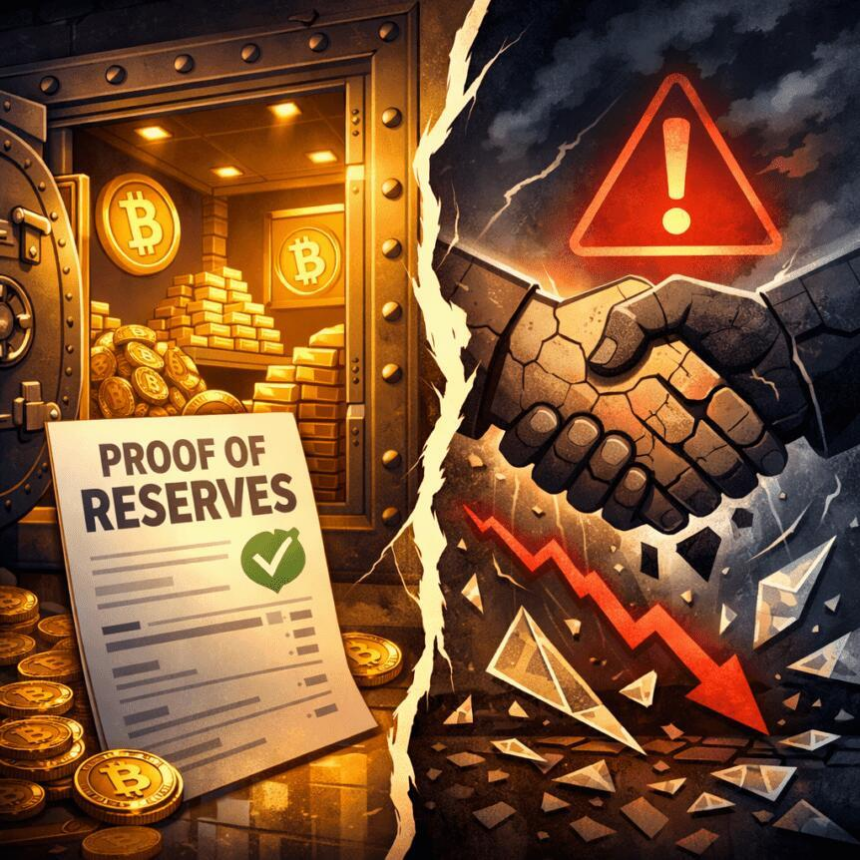
I’ll go over why Proof-of-Reserves doesn’t provide exchange safety in this post. PoR can help confirm that an exchange has sufficient on-chain assets to cover customer balances, but it is unable to reveal operational risks, off-chain liabilities, or hidden loans.
When assessing an exchange’s reliability, users should be aware of its limitations and take additional security, audits, and regulatory compliance into account.
What Proof-of-Reserves?
Cryptocurrency exchanges employ Proof-of-Reserves (PoR), a transparency technique, to show that they have sufficient on-chain assets to cover customer balances. While blockchain data displays the exchange-controlled wallet addresses and asset values, it uses cryptographic techniques, usually Merkle tree structures, to allow users to confirm that their individual account balances are included in a snapshot of the exchange’s overall liabilities.
This procedure is frequently attested to by independent auditors or outside companies, who verify that claimed reserves correspond to on-chain holdings at a particular moment in time. However, because PoR typically ignores off-chain liabilities, internal debts, legal requirements, and operational issues that might still affect an exchange’s capacity to repay user funds, it mostly demonstrates asset presence rather than complete financial soundness.
Why Proof-of-Reserves Doesn’t Guarantee Exchange Safety
Doesn’t Show Liabilities
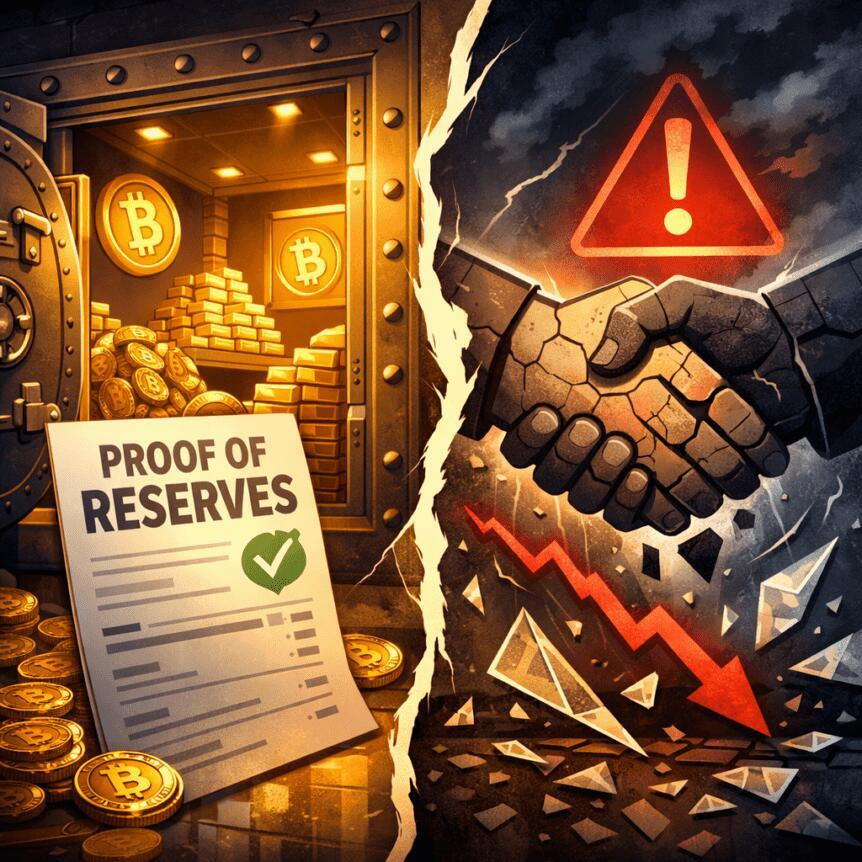
PoR confirms assets held but usually neglects debts, loans, internal requirements, etc. This means that an exchange might look solvent, while in reality it may owe more than it owns.
Snapshot, Not Real-Time Proof
Because audits can only happen in a matter of seconds, exchanges are able to manipulate their funds so that they can pass audits.
No Insight into Fund Usage
Customer assets might be lent, staked, or used as collateral for highly leveraged trades strategies. This is unexposed in PoR.
Custody and Security Risks Remain
Fully reserved exchanges are not safe from hacks, thefts from insiders, bad private key control, etc.
Off-Chain Assets Aren’t Verified
PoR documents do not usually see bank and traditional investment records, nor do they see cards.
Limited Auditor Oversight
If the audit is not comprehensive, the confidence in the thoroughness or accuracy of the confirmation is diminished.
Legal and Regulatory Exposure
Government liens, lawsuits, or bankruptcy can happen even with PoR in place.
No Guarantee of Fund Segregation
Financials can be very stressful. In these situations, an exchange might mix its operational funds with its customers’ assets.
Doesn’t Measure Governance Quality
Weak controls or unethical leadership can collapse an exchange, regardless of reserves.
Transparency Without Accountability
Users see the balances with PoR, but nothing requires the exchanges to act a certain way, putting the responsibility for trust on the users.
Regulatory and Legal Gaps
Different Instructions Across The World: The world being governed by different sets of laws means that protection is not uniform for exchange users.
The Absence Of Auditing Mechanisms: The absence of auditing processes in most countries means that reporting transparency is self imposed, meaning that users only see what the exchange says.
Minimal Protections for the Consumer: Regulation often provides little to no protection to users in the event of mismanagement, fraud, or other loss of users\’ funds.
The Bankruptcy And Insolvency Threat: Proof Of Reserves (PoR) does not protect users’ coins from being frozen or from the exchange going bankrupt, all while the law protects only the creditors, and not the customers.
Loose Regulations Regarding Fund Isolation: The lack of regulation that requires strict compartmentalization of funds means a greater risk of losing or mismanaging funds.
The Slow Response of Regulatory Bodies: The speed of innovation in the blockchain and cryptocurrency world is not followed by regulation, resulting in innovative risks that go unregulated for a long time.
Conflicts of Jurisdiction: The legal framework that governs the operational jurisdictions of a cryptocurrency exchange is likely to create gaps in protection for users.
Insufficient Monitoring of Off-Chain Activities: Even with Proof of Reserves (PoR) disclosures, unregulated loans, leverages, and other off-chain financial activities may risk customer money.
Timing and Snapshot Risk
Single Moment Verification
The PoR audit could show asset balances that, even though they may reflect the audit solvency, could show something different.
Temporary Fund Movement
The audit is performed, and before the audit is complete, the exchange can shuffle assets into its wallets and show it is fully reserved.
No Real-Time Transparency
Since acquisitions are made, a user can not understand the liabilities to be consummated, unless they are able to monitor over hours or days the resources.
Audit Window Manipulation
Even though large portions of the assets are illiquid, in a sustained period of high assets, illiquid portions can be converted.
Delayed Reporting
A time period prism can be generated to show multiple snapshots over the audit period. The more snapshots there are, the more current the position of the user will be.
Hidden Short-Term Risks
After a snapshot, the position may be worse, possibly because of large short-term obligations, an immediate loss, or a sudden withdrawal.
False Sense of Security
An audit snapshot does not guarantee that the operational or financial position is stable.
What Users Should Look for Beyond PoR
Although Proof-of-Reserves (PoR) increases transparency, consumers shouldn’t base their evaluation of exchange safety only on it. To comprehend the exchange’s actual financial health, including debts, loans, and off-chain assets, proof-of-liabilities and complete balance sheet audits are crucial.
Additionally, users should look for robust security measures like multi-signature wallets, cold storage, and third-party insurance protection against theft or hacking. Since they offer legal protections in the event of insolvency or disputes, regulatory compliance, appropriate licensing, and adherence to consumer protection laws are equally crucial.
Furthermore, assessing the exchange’s standing, level of governance, and past performance can draw attention to possible hazards that PoR is unable to identify. Users obtain a more comprehensive understanding of an exchange’s reliability and the actual security of their money by integrating these elements.
Can exchanges manipulate PoR reports?
Indeed, Proof-of-Reserves (PoR) reports may be manipulated by exchanges, particularly if the verification procedure is not rigorous or subject to independent monitoring. An exchange may temporarily transfer money into wallets to seem completely reserved during the audit because PoR usually offers a snapshot of on-chain assets at a particular time.
Furthermore, self-reported audits or attestations from non-independent sources may be deceptive, partial, or biased. An exchange may still be insolvent even though its PoR report is good because PoR typically ignores off-chain liabilities, loans, and internal obligations. For this reason, PoR should not be seen as a guarantee of exchange safety, but rather as a tool for transparency.
Can PoR guarantee my funds are 100% safe?
No, Proof-of-Reserves (PoR) cannot ensure the total security of your money. PoR does not take into consideration off-chain liabilities, internal debts, or continuing operational risks, even though it can confirm that an exchange has a specific quantity of on-chain assets at a given moment in time.
Exchanges may still have legal problems, insolvency, mismanagement, or cyberattacks that jeopardize client money. PoR basically makes things more transparent, but it doesn’t take the place of strong security protocols, legal compliance, or careful risk management. When assessing the safety of an exchange, users should consider it as one of numerous considerations.
Future of Exchange Transparency
Real-time, thorough verification that transcends conventional Proof-of-Reserves (PoR) is the direction of exchange transparency in the future. The goal of emerging technologies like zero-knowledge proofs and ongoing on-chain attestations is to enable exchanges to show asset holdings and obligations without jeopardizing sensitive data.
In order to lower the likelihood of insolvency or fund misuse, regulators around the world are advocating for standardized disclosure criteria, such as proof-of-liabilities, complete audits, and risk reporting.
Furthermore, users may be able to independently and automatically confirm exchange solvency thanks to developments in blockchain analytics and decentralized auditing tools. When taken as a whole, these advancements offer an environment that integrates accountability, security, and transparency, giving traders and investors more assurance about the protection of their money.
Conclusion
Proof-of-Reserves, which gives consumers a means to confirm that on-chain assets exist to cover customer balances, is a useful technique for enhancing transparency in bitcoin exchanges. It is hardly a comprehensive safety precaution, though.
PoR does not take into consideration operational risks, off-chain assets, hidden liabilities, or legal responsibilities. Despite appearing completely restrained, it only offers a moment in time, making exchanges susceptible to financial mismanagement, hacking, or insolvency.
In the end, even if PoR increases confidence, users should consider it as a component of a more thorough evaluation that incorporates security procedures, financial audits, regulatory compliance, and reputation to fully assess exchange safety.
FAQ
What is proof-of-reserves (PoR)?
Proof-of-Reserves is a transparency method that shows an exchange’s on-chain assets match user balances. It uses cryptographic proofs to verify funds but does not assess liabilities or overall financial health.
Can PoR guarantee my funds are 100% safe?
No. PoR only proves that assets exist on-chain at a specific time. It does not cover hidden debts, off-chain liabilities, operational risks, or potential hacks.
Why is PoR considered a “snapshot” verification?
Most PoR audits check balances at a single moment. Exchanges could temporarily adjust funds to pass verification, so it may not reflect ongoing solvency.
Does PoR include off-chain assets like fiat or loans?
Typically, no. PoR focuses on crypto holdings, leaving bank accounts, fiat reserves, or other off-chain assets unverified.
Can exchanges manipulate PoR reports?
Yes. If audits are weak, incomplete, or self-reported, exchanges could misrepresent actual reserves or liabilities.