

Compliance & AML Tools Financial Companies Use are commonly used systems by financial companies to prevent, detect, and manage illegal activities such as money laundering, fraud, or terrorist funding.
This innovative technology controls real-time transactions in order to verify customers and ensure that they adhere to regulations.
As digital banking and cryptocurrency gain traction, so do AML solutions, which are becoming more intelligent (using AI), data-driven, automated — all working together to keep sound security, transparency & trust in global financial networks.
Key Point
| Compliance & AML Tool | Key Point / Core Function |
|---|---|
| Chainalysis KYT | Blockchain transaction monitoring to detect suspicious crypto activity and illicit fund flows in real time. |
| Elliptic | Crypto AML risk scoring and wallet screening to identify exposure to illegal entities and high-risk transactions. |
| NICE Actimize | AI-driven AML transaction monitoring, fraud detection, and regulatory compliance automation for banks. |
| SAS Anti-Money Laundering | Advanced analytics platform for detecting suspicious financial patterns and generating regulatory reports. |
| ComplyAdvantage | Real-time AML screening for sanctions, PEPs (Politically Exposed Persons), and adverse media monitoring. |
| FICO TONBELLER Sirion | Risk-based AML system that identifies suspicious transaction behavior using rule-based and AI models. |
| Oracle Financial Services Compliance Management | Enterprise AML suite for transaction monitoring, customer risk scoring, and regulatory compliance reporting. |
| Refinitiv World-Check | Global database for sanctions, watchlists, and high-risk individuals/entities used for KYC screening. |
| LexisNexis Risk Solutions Bridger Insight | Identity verification and AML screening platform for detecting high-risk customers and entities. |
| Dow Jones Risk & Compliance | Due diligence and sanctions screening tool for global regulatory compliance and third-party risk checks. |
1. Chainalysis KYT
**Chainalysis KYT — Blockchain analysis tool that is omnipresent in banks, crypto exchanges and financial institutions’ marketplace for tracking cryptocurrency asset transactions (real-time). It contributes to finding suspicious wallet behavior, the flow of funds movements across blockchains, and links to illegal entities like ransomware mega-corporation groups or darknet markets. This is particularly critical in crypto compliance frameworks because transactions are transparent to a limited extent.

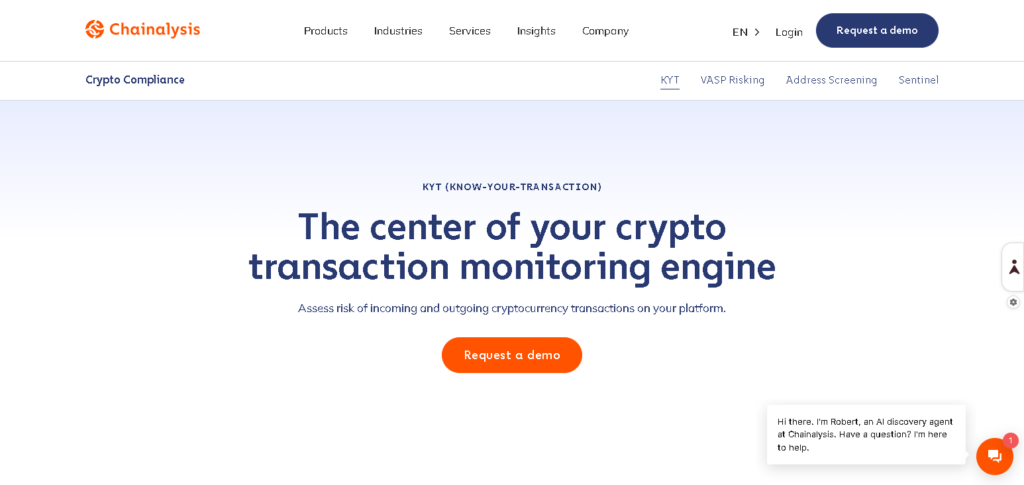
It offers a new risk scoring engine that automatically assigns scores to every transaction based on behavioral patterns, exposure history, and association with higher-risk addresses. With Chainalysis KYT, organizations strengthen their Compliance & AML Tools Financial Companies Use strategy to detect money laundering faster and be more accurate in reporting to regulatory authorities.
Core Functions
- And monitors in real-time cross-chain cryptocurrency transactions
- Uses risk scoring models to flag suspicious wallet activity
- Tracks paths of funds associated with illegal activities
- Flags compliance alerts for AML investigations
Real-World Use Cases
- Crypto-exchanges detect money laundering transactions
- The rise of law enforcement tracking ransomware payments
- Banks tracking customer transactions related to cryptocurrency
- Regulators are looking into the funds of the darknet market
2. Elliptic
**Elliptic — A crypto-centric AML solution that gives institutions the infrastructure to monitor and detect financial crime with digital assets. It examines blockchain data to expose dangerous transactions, sanction evasion and also scammy wallet behavior. It is used by exchanges and fintech firms to comply with regulations in cryptocurrency operations.

It analyzes wallets and transactions against known exposure to illicit activities, including hacking, terror finance or scams; the latter being where this particular research has taken place. Elliptic is included in the book Compliance & AML Tools Financial Companies Use, an industry leader focused on continuous monitoring and compliance with global Money Laundering regulations, ensuring crypto ecosystems remain secure.
Core Functions
- Cryptocurrency Anti-Money Laundering (AML) risk analytics
- (f) Screening wallets and monitoring transactions
- Identifying Sanctions and Illicit Activities
- Crypto Assets and Address Risk Scoring
Real-World Use Cases
- Crypto exchanges are doing KYC on high-risk wallets during onboarding.
- Both financial serving bodies and even potential long-term investors are checking the crypto exposure.
- Compliance teams uncovering links to terrorism financing
- Firms working on preventing fraud in crypto transfers
- 3. NICE Actimize
3. NICE Actimize
The NICE Actimize financial crime prevention platform is an AI-based solution used by many of the world’s largest banks and financial institutions. In October 2023, it delivers cutting-edge transaction monitoring for AML solutions, fraud prevention as well as the automation of compliance with regulations. It is extremely scalable and capable of supporting an enterprise-class financial system.
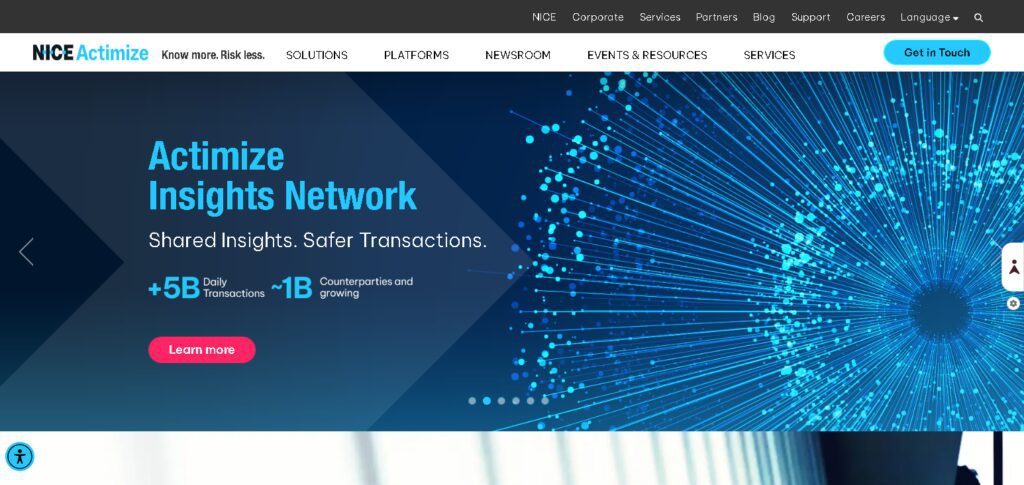
It works on machine learning and behavioral analytics to find out some odd trends in transaction from human behavior. NICE Actimize is a great tool that reduces false positives and speeds up suspicious activity reporting.
Core Functions
- AI-powered AML transaction monitoring
- Using behavioral analytics for fraud detection
- Suspicious activity reporting automation
- Scoring risk on customers
Real-World Use Cases
- Suspicious account transactions detected by major banks
- ∗ insider fraud patterns identified by investment firms
- Financial fraud claims being blocked by insurance companies
- Cross-Border Fraud Watchers Over Payment Networks
4. SAS Anti-Money Laundering
SAS AML is an advanced analytics-driven compliance solution that uses world-class statistical modeling to help organizations identify suspicious financial behaviors. Mainly used by banks and insurance companies for risk detection and regulatory reporting.
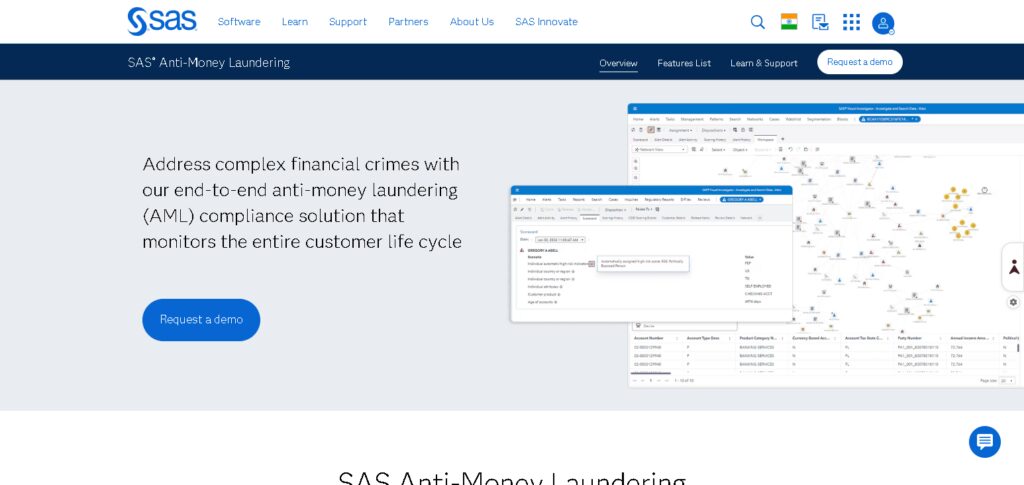
It detects and alerts for possible illegal activities by finding hidden patterns in massive transaction datasets. SAS AML is a business analytics tool under Compliance & AML Tools Financial Companies Use, which uses predictive insight and making decision fast, thereby improving the compliance efficiency of the organisation.
Core Functions
- Advanced transaction monitoring analytics
- Predictive model for risk detection
- Financial Data Pattern Recognition
- Regulatory reporting automation
Real-World Use Cases
- Identification of structured money laundering patterns by banks
- Insurance companies are finding false claims
- Government agencies are examining trends in financial crime
- Credit institutions monitor for suspicious lending activity
5. ComplyAdvantage
ComplyAdvantage is a next-generation financial crime insight platform with an emphasis on AML compliance monitoring. This is extensively used during customer onboarding and monitoring to check sanctions lists, politically exposed persons (PEPs), and adverse media risks.
Utilising artificial intelligence and natural language processing, it constantly updates a global risk database with early warning signals of new threats. It is also one of the Compliance & AML Tools Financial Companies Use, which helps businesses to stay compliant as regulations change over time while reducing manual compliance tasks.
Core Functions
- Screening customers and transactions for AML in real-time;
- Sanction, PEP, and adverse media screening
- AI-based risk database updates
- Continuous compliance risk tracking
Real-World Use Cases
- Instant identity checks for new customers of fintech companies
- PEP-verified banks
- Payment companies that track cross-border transactions
- How crypto platforms could succeed with regulatory onboarding.
6. FICO TONBELLER Sirion
FICO TONBELLER Sirion is a powerful AML and fraud detection tool leveraging rule-based techniques with an AI analytics engine. The tool is capable of detecting underlying suspicious transaction behaviours across various financial modalities, such as banking and payments.
It helps customers and transactions be placed into thearts so that they can engage in risk-based monitoring. Certainly, based on the financial services tools you will find below as part of Compliance & AML Tools Financial Companies Use, Sirion keeps institutions in line with regulations as its solution helps streamline operational efficiency and fraud detection.
Core Functions
- Some are: * AML monitoring on top of rules & AI.
- Risk scoring of financial transactions
- Suspicious activity detection engine
- Life of a Magic (takes) * Customer segmentation for compliance control
Real-World Use Cases
- With banks able to observe where transactions spike,
- Fraud detection networks established by payment providers
- Financial Institution Handling AML Compliance Workflows
- Monitoring of high-risk clients by insurance companies
7. Oracle Financial Services Compliance Management
Oracle Financial Services Compliance Management: An enterprise-grade AML and regulatory compliance solution for global banks. It offers features for transaction monitoring, customer due diligence, and compliance reporting.
They combine data from various banking systems to detect potentially illicit activities and minimize compliance risks. Reporting into Compliance & AML Tools Financial Companies Use, the Oracle application caters mainly to large-scale financial organizations and helps them comply with stringent global AML rules effectively.
Core Functions
- Enterprise AML normalization transaction monitoring system
- Automating the customer due diligence (CDD)
- Tracking of regulation reporting and audit
- Risk-based compliance management
Real-World Use Cases
- Multi-Country AML Compliance by Global Banks
- • Financial institutions creating regulatory reports
- Enterprises working on customer risk profiles
- Cross-border banks identify transactions
8. Refinitiv World-Check
Refinitiv World-Check: A global risk intelligence database for KYC and AML screening. It is data on global sanctions, watchlists, politically exposed persons, and high-risk entities.

Financial institutions utilize it for customer identity verification, particularly during the onboarding process and ongoing monitoring.
Being one of the most common Financial Companies Compliance & AML Tools, World-Check helps to avoid relationships with anyone who is suspicious or high risk.
Core Functions
- ● Sanctions & watchlist screening
- Database of risk intelligence for entities and individuals
- KYC verification support system
- Adverse media and reputational risk screening
Real-World Use Cases
- Onboarding/identity verification (Banks verify customer identity)
- Corporates screening business partners
- Sanction exposure checkers at compliance teams
- Fraud prevention by Fintech companies
9. LexisNexis Risk Solutions Bridger Insight
Bridger Insight is a compliance screening solution that helps organizations enable identity verification and sanctions discrimination AMM risk assessment. Banks, insurers, and fintechs use it to comply with regulatory requirements.
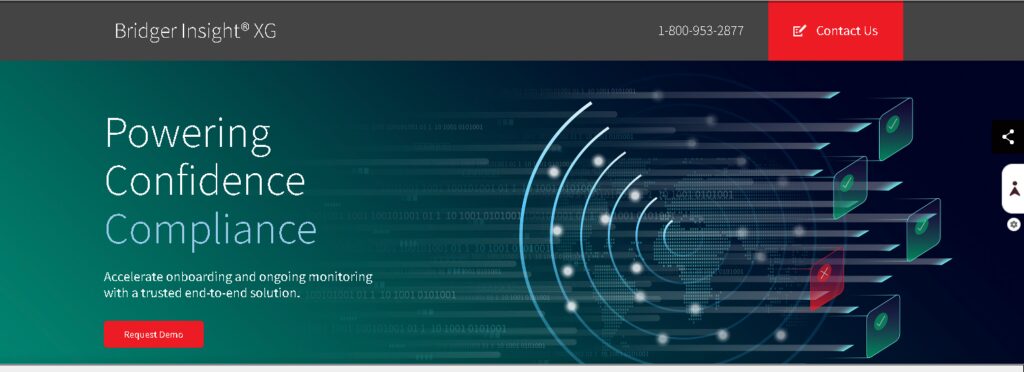
It cross-references customer information with international watch-lists and fraud registries to identify dangerous users. Together with Financial companies, using Compliance & AML Tools, it enhances security during onboarding and minimizes the risk of financial crime.
Core Functions
- Identity verification and screening engine
- AML compliance monitoring system
- Global watchlist matching technology
- Fraud risk detection analytics
Real-World Use Cases
- Banks to Verify Customers During KYC.
- Insurance fraud detection for insurance companies
- FinTech Firms have to vet their high-risk users
- Reduce onboarding fraud at payment companies
10. Dow Jones Risk & Compliance
Dow Jones Risk & Compliance is a due diligence and AML screening solution that offers comprehensive global risk data for individuals, organizations, and transactions. For sanctions screening, KYC verification, and third-party risk.
It combines structured and unstructured data from diverse global sources to detect financial crime. It helps organizations stay ahead of the filthy money and protect their reputational interests. -ID Analyzer Compliant Detection Performs Social Media Analysis, KYC — KNOW YOUR DEEDEE. Did you know that 3% to 4% of $9 trillion (global flows) are involved in illegal activities out there, across various countries.
Core Functions
- Global due diligence and risk intelligence platform
- System for sanction and PEP screening
- Third-party risk assessment tool
- With multi-source aggregation for anti-financial crime data
Real-World Use Cases
- Corporates gatekeeping on whether to pursue specific vendors
- Banks screening high-risk customers
- Financial firms are evaluating the risk profiles of partners
Importance of AML & Compliance Tools
Prevents Financial Crimes
Anti-money laundering (AML) and compliance tools also help prevent money laundering, fraud, or illegal cross-border fund transfers by automatically monitoring suspicious real-time activity, leading to your detection.
Ensures Regulatory Compliance
They aid financial institutions in complying with all the international regulations like KYC, AML laws, and sanctions guidelines on legal fines.
Detects Suspicious Transactions Early
They detect aberrant transaction patterns, helping banks and fintech firms to stop more losses from happening.
Protects Financial Institutions from Risk
AML software minimizes interaction with high-risk clients, fake accounts and networks of illicit finances.
Improves Customer Verification (KYC)
They bolster identity verification processes to make sure that only legitimate customers have access to financial services.
Enhances Trust and Reputation
Financial companies develop trust with customers, regulators and global partners by maintaining robust compliance systems.
Supports Real-Time Monitoring and Reporting
Modern AML tools enable ongoing monitoring and automated reporting, resulting in sped up compliance that is more precise.
Key Technologies Behind AML Tools
Artificial Intelligence (AI)
AI assists in automating the detection of suspicious financial behavior by analyzing high volumes of transactions and uncovering hidden patterns associated with fraudulent behaviors or money laundering activities for AML systems.
Machine Learning (ML)
ML models never stop learning: they use historical data to detect risks, which means fewer false alerts and better results on future ones.
Big Data Analytics
AML solutions analyze large volumes of data from banks, fintech platforms, and international payments to detect patterns in financial crimes or suspicious behavior.
Blockchain Analytics
Primarily employed in crypto compliance, this tool enables the detection of high-risk or illicit transactional activity by tracing the movement of digital assets across wallets.
Natural Language Processing (NLP)
NLP also helps to spot the adverse media risk (negative news), sanctions updates and hidden compliance threats by letting you scan through all your unstructured data in seconds.
Cloud Computing
Moreover, cloud-based AML systems allow for real-time monitoring and faster data processing across borders in the global financial networks while also being more easily scalable.
Risk Scoring Algorithms
These are algorithms that analyze customers and transactions to determine risk levels based on behavior, location or historic activity to assist in compliance decision-making.
Future of AML & Compliance Tools
Fully AI-Driven Compliance Systems
The use of AI in AML tools allows for automatic detection of complex money laundering patterns with lesser human involvement.
Real-Time Global Transaction Monitoring
Next-generation systems will allow real-time monitoring of cross-border transactions allowing financial activity to be flagged more rapidly on a global scale.
Predictive Risk Detection
Utilizing analysis of historical and behavioral data, AML tools will anticipate financial crimes before they happen rather than react to fraud.
Stronger Blockchain Integration
As crypto scales, AML tools will embed blockchain analytics as a core part of their strategy to follow digital assets through decentralized networks.
Hyper-Automated Regulatory Reporting
Regulatory reporting will be 100% automated, leaving practically no manual work involved with the process, and reports will be submitted to the authority within a few seconds.
Unified Global Compliance Networks
The AML systems that link financial institutions with regulators will facilitate faster information exchange and coordinated action.
Digital KYC 2.0: Auto Advanced ID verification
Biometrics, AI identity checks, and digital ID incorporated into future tools will speed up the verification process for customers while making it safer and resistant to fraud.
Conclusion
This made AML and compliance tools an important backbone of the modern financial system to help institutions in identifying, preventing & responding effectively to various types of financial crimes.
These systems lower the essential risks such as money laundering, fraud, and illicit transactions in the banking sector, along with maintaining optimum compliance to global regulatory framework requirements for fintech or crypto players. They improved transparency and operational security by processing large-scale financial data in real-time.
As AI, machine learning, blockchain analytics, and predictive modeling have advanced to the point where these tools are no longer just reactive monitoring systems but a proactive risk prevention engine.
Over the next few years, AML and compliance technology will only grow more automated, more intelligent—and even globally integrated—so that financial companies can outpace ever-more complex networks of financial crime.
FAQ
What are AML and compliance tools in financial companies?
AML (Anti-Money Laundering) and compliance tools are software systems used by financial institutions to detect illegal financial activities, monitor transactions, and ensure regulatory compliance with global laws. They help prevent money laundering, fraud, and financial crimes.
Why do financial companies use AML tools?
Financial companies use AML tools to identify suspicious transactions, reduce financial risks, comply with regulations, and protect themselves from penalties and reputational damage caused by illegal activities.
Which technologies power modern AML systems?
Modern AML systems use technologies like Artificial Intelligence (AI), Machine Learning (ML), Big Data Analytics, Blockchain Analytics, Natural Language Processing (NLP), and cloud computing to detect and prevent financial crimes efficiently.
How do AML tools detect suspicious transactions?
They analyze transaction patterns, customer behavior, risk scores, and historical data to identify unusual activities that may indicate money laundering or fraud, then generate alerts for further investigation.
What is the role of KYC in AML compliance?
KYC (Know Your Customer) is used to verify customer identities during onboarding. It ensures that only legitimate users access financial services and helps AML systems track and monitor risk levels effectively.