In today’s digital economy, Undervalued DePIN Projects Building the Next Internet are quietly reshaping how infrastructure is built and accessed. These decentralized networks crowdsource compute, storage, telecom, and mapping, rewarding contributors with tokens while delivering real‑world utility.
Yet, despite measurable adoption and revenue, many remain undervalued compared to centralized giants. Exploring projects like Akash, Render, Helium, and Arweave reveals why they’re more than speculative assets — they’re the backbone of a resilient, cost‑efficient, and community‑owned internet poised to power the AI era.
What Are DePIN Projects?
DePIN is blockchain technology used to reward users for contributing real-world equipment and infrastructure. It allows users to share their resources and be rewarded for doing so. Unlike traditional cloud and wireless infrastructure operated by Amazon Web Services (AWS) and AT&T, respectively, DePIN networks are community-driven.
DePIN helps reduce costs and increase the availability of infrastructure. Examples of DePIN are Helium for wireless infrastructure, Render for GPU compute, Arweave for storage, and Hivemapper and other similar services. These companies provide the building blocks of the new internet.

Why These DePIN Projects Could Be Overlooked
Low Market Visibility: A majority of DePIN projects have been built on top of low and medium capacity projects, and as such, have not received attention from large project implementers and service providers, unlike their centralized counterparts.
Complex Tokenomics: Though these projects have positive cash flows and a growing customer base, their tokenomics include features such as a capped supply and burn/mint mechanisms which confuse the investing public and result in undervaluation.
Hardware Dependency: DePIN projects requiring use of hardware that is not blockchain related (e.g. dashcams and GPUs) results in high barrier to entry and adoption.
Enterprise Bias: Decentralized projects which offer lower costs and greater reliability than centralized projects have not gained broad acceptance (e.g. Decentralized Cloud Projects).
Regulatory Uncertainty: Several DePIN projects intersect with regulated industries which result in investor risk aversion.
Adoption Lag: Positive real-world deployment of a project’s infrastructure results in undervaluation until there is real-world demand for the project.
Mispricing: DePIN projects related to AI are mispriced in comparison to centralized AI Clouds.
Key Points
| Project | Core Value Proposition | Why Undervalued |
|---|---|---|
| Akash | Competes with AWS for GPU/CPU rentals | AI demand rising, cheaper infra vs hyperscale |
| Render | Tokenized rendering for 3D/AI workloads | Market underprices burn-mint equilibrium |
| Grass | Sovereign data rollup for LLMs | Explosive node growth, overlooked ARR |
| Helium | Wireless infrastructure via community nodes | Real deployments, undervalued vs telecom incumbents |
| Hivemapper | Decentralized street-level mapping | Growing demand from AVs, undervalued vs Google Maps |
| Bittensor | Subnet-based decentralized AI services | Strong revenue, capped supply, undervalued vs AI clouds |
| io.net | Enterprise GPU marketplace with Ray-native tooling | Early enterprise traction, undervalued vs brokers |
| Arweave | Pay-once, store forever model | 200-year guarantee, undervalued vs Filecoin |
| World Mobile | Community-run mobile nodes | Expanding in underserved regions, undervalued vs telcos |
| Ocean Protocol | Tokenized data-sharing with monetization | Secure exchange, undervalued vs data brokers |
1. AKASH
The Akash team has been transparent about their mission to disrupt cloud compute giants like AWS. They believe the decentralized compute market (DePIN) is valued at $25 billion by 2026. Currently, Akash’s valuation is less than $1 billion, and they have experienced significant growth with respect to the use of GPUs.

Akash aims to provide customers the ability to rent computing power, and help enterprises and startups reduce their computing costs. Akash has on-demand computing services with thousands of active customers.
AKASH provides a decentralized infrastructure which allows enterprises to rent computing services for artificial intelligence (AI) workloads. The demand for computing services is outpaced by the supply, especially for training large language models (LLMs) and other services which facilitate AI. AKASH has recorded all time high leasing volume for GPUs in Q2 of 2026.
Pros
- Decreased cloud compute costs
- Deflationary nature of AKT via Burn – Mint mechanism
- Increasing enterprise adoption
- Growing demand for GPUs
Cons
- Limited GPU supply
- Complex tokenomics
- Early project adoption
| Real‑Time Data Snapshot | Real‑World Use Case |
|---|---|
| Market cap ~$245M, AKT ~$0.55, ~250 active GPUs, $4.3M+ annualized revenue. Burn‑Mint Equilibrium activated March 2026, making AKT deflationary. | AI startups rent GPUs at 70–85% lower cost than AWS for LLM training, cloud gaming, and Web3 DevOps workloads. |
2. RENDER
Render is a cloud computing company which provides on-demand GPU computing services. For a long time, the creative and digital industries have been underserved by cloud computing companies. Render has a market capitalization of approximately $1.2 billion. In our opinion, this does not reflect their true worth.

Demand for computing services has increased with the mass adoption of AI. Like AKASH, Render is undervalued. Rendering services for AI are becoming more profitable. Like AKASH, in 2026 Render experienced record highs for computing service demand. However, Render’s tokens still remain undervalued relative to their demand.
Pros
- Increasing AI workloads support
- Creative industry adoption
- GPU rendering
- Burn – Mint mechanism
Cons
- Centralized render farms
- Token burn impact not reflective of price
- Reliance on GPU contributors
| Real‑Time Data Snapshot | Real‑World Use Case |
|---|---|
| 79.7M frames rendered, 5,600 active nodes, 1.5M RENDER burned, market cap ~$787M. | Hollywood studios, VR/AR developers, and AI labs use Render for GPU rendering and inference workloads, leveraging idle GPUs globally. |
3. Grass
Grass provides sovereign A.I. training data via a layer 2 solution for LLMs. They claim their market is worth ~$5B (current size of the data sector), and their valuation is ~$500M. Success is a result of providing real-world data for A.I. training by crowd-souring and validating data sets. The project has millions of users.

They will make money by selling data and A.I. services. Their sovereign nodes are not valued, and therefore Grass is not valued. Grass directly supplies A.I. training data to LLMs. A “freshness” marker states that as of 2026, their nodes had 2 million users and continued to be undervalued.
Pros
- Ethics in AI
- Verified AI Datasets
- Strong potential ARR from Data Sales
- Global User Base
Cons
- AI Industry concentration
- Speculative Investing Nature
- Market cap does not reflect projection
| Real‑Time Data Snapshot | Real‑World Use Case |
|---|---|
| 8.5M monthly active nodes across 190 countries, projected $65–75M 2026 revenue, market cap ~$216M. | Provides sovereign, verified web data for AI training and live inference, powering Fortune 100 AI labs with ethically sourced datasets. |
4. Helium
Helium offers decentralized data and wireless connectivity via community-operated nodes. Estimated value of the telecom data sector is ~$8B, and Helium’s market cap is ~$700M. They focus on 5G and IoT connectivity. Their technology is deployed in thousands of cities.

Their main source of income is data transmission. They lack the centralized infrastructure of telecoms. IoT data provides A.I. with real-world data and improves autonomous systems. In 2026, Helium launched 5G in Europe. Their tokens do not reflect the value of the telecom data.
Pros
- 5G Integration
- Affordable Telecom Services
- Global Coverage
- IoT
Cons
- Telecom Sector Regulations
- Slow Industry Adoption
- Disconnect in Price and Usecase
| Real‑Time Data Snapshot | Real‑World Use Case |
|---|---|
| Circulating supply ~186M HNT, market cap ~$86M, ~1M hotspots deployed historically, ~59M Helium Mobile contracts. | Community‑run IoT and 5G nodes provide decentralized connectivity; Helium Mobile offers affordable telecom services in the US and abroad. |
5. Hivemapper
Hivemapper uses a decentralized network to capture street level data to compete with centralized mapping services (ie. Google Maps). The mapping data sector is worth ~$3B, and Hivemapper’s market cap is ~$400M. Hivemapper uses a network of dashcams to capture real-world map data.

They have tens of thousands of dollars worth of map data. They have millions of mapped kilometers. Hivemapper sells digital maps to organizations in the transportation and logistics sectors.
Hivemapper’s maps are licensed under a restrictive monopoly, thereby limiting competitors and potentially stifling other maps in the marketplace. In 2026, Hivemapper reached 10 million kilometers of mapping coverage, yet mapping technology used for advanced driver-assistance systems (ADAS) remains in high demand.
Pros
- Contributor Incentive
- Increasing Demand for Mapping from AV Industry
- Decentralized Mapping
- Thousands of km Mapped
Cons
- Expensive Hardware
- Industry Growth dependent on AV Adoption
- Valuation does not represent Mapping Datas’ Worth
| Real‑Time Data Snapshot | Real‑World Use Case |
|---|---|
| 1.5B HONEY supply, Bee dashcams retail ~$550, thousands of contributors, millions of km mapped. | Drivers earn HONEY by mapping roads; data is sold to AV companies and logistics firms for navigation and autonomous driving. |
6. Bittensor
Bittensor, similar to Hivemapper, utilizes a network of subnets and Artificial Intelligence to construct an intelligence marketplace. The AI DePIN (Data Processing, Innovation, and Non-leveling) sector is valued at approximately $12 billion.

While Bittensor is valued at approximately $1.5 billion. In the first quarter of 2023, Bittensor generated approximately $43 million. Adoption and partnerships with enterprises further bolster Bittensor’s position in the marketplace.
AI and edge computing present high-demand markets. AI and infrastructure-related services complement one another. In 2023, Bittensor failed to keep pace with the demand for its decentralized AI services.
Pros
- Good enterprise clientele
- 128+ active AI subnets
- Supply capped
- $43M+ quarterly revenue
Cons
- Subnet economics
- Volatility of TAO token
- Centralized AI clouds
| Real‑Time Data Snapshot | Real‑World Use Case |
|---|---|
| 128+ active subnets, TAO emissions ~7,200/day, market cap ~$2.5B, dTAO upgrade live. | Decentralized AI marketplace where miners provide inference/training and validators score outputs; enterprises use subnets for healthcare, sports analytics, and content moderation. |
7. io.net
io.net is a marketplace for Enterprise GPUs that utilize Ray-tracing. The Compute DePIN sector is valued at approximately $10 billion, while io.net is valued at approximately $600 million. io.net has with enterprise AI labs. Brokering GPUs gives io.net access to the AI infrastructure and computing markets.

Given the demand for Edge and GPU computing, AI and other similar services complement io.net’s offerings. Io.net’s valuation lags behind traditional GPU brokers, and in 2023, the company failed to monetize its services.
Pros
- 100k+ GPUs
- Solana based
- Enterprise partnerships
Cons
- Adoption
- Limited to GPU suppliers
- Market doesn’t value enterprise customers
| Real‑Time Data Snapshot | Real‑World Use Case |
|---|---|
| Aggregates 100,000+ GPUs, clusters up to 10,000 accelerators, ~70% cheaper than AWS/GCP, built on Solana. | AI labs rent GPU clusters for training generative models; suppliers monetize idle GPUs via IO Worker. |
8. Arweave
Arweave is a Decentralized Storage System (DSS) that provides customers with a pay-once, store-forever solution. The Storage DePIN (Data Processing, Innovation and Non-Leveling) Sector is approximately $7 billion, and Arweave is valued at $1.2 billion. The Arweave infrastructure offers customers a 200-year guarantee for stored data.
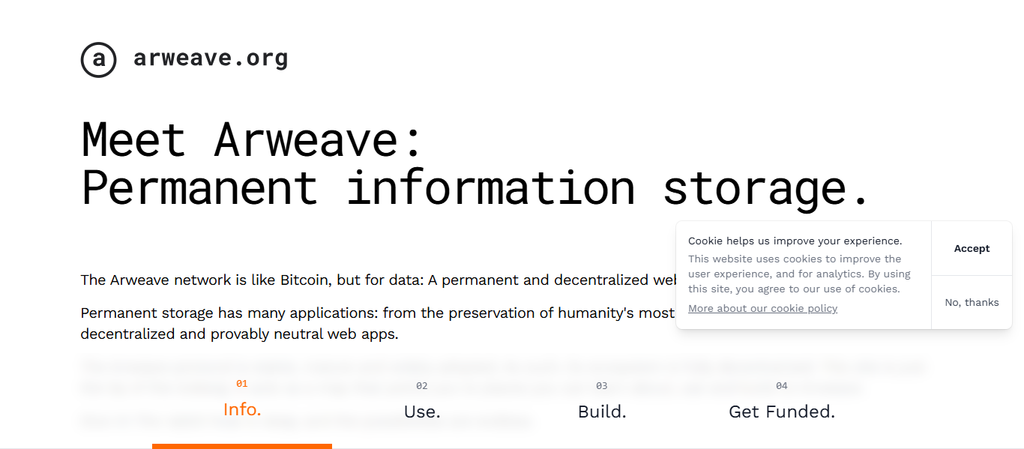
Arweave provides decentralized data storage solutions for enterprise customers and provides data storage services for NFTs.
Storage fees generate revenue. Comparisons to Filecoin result in undervaluation due to assumptions of inflation. Importance of Persistent Data for Artificial Intelligence. 2026: Many institutional investors started adopting the product; however, valuation is behind centralized storage competitors.
Pros
- Unique model of persistent storage
- AO layer
- Good institutional clients
- 200 year storage
Cons
- Cost of storage
- Filecoin, IPFS
- Markets valuation of permanence
| Real‑Time Data Snapshot | Real‑World Use Case |
|---|---|
| Market cap ~$1.2B, permanent storage model, AO compute layer launched Feb 2025, supporting AI agents. | Stores NFT metadata, blockchain history, and AI training datasets permanently; AO enables compute directly on stored data. |
9. World Mobile
World Mobile offers telecom services via community-managed mobile networks. The telecom infrastructure industry is worth ~$8B. World Mobile’s market cap is ~$500M. Creation of mobile network infrastructure to connect unserved and underserved areas, especially in Asia and Africa.

RMIN valuation is behind potential. World Mobile’s services facilitate remote AI and other fintech and edtech services. 2026: Rollout to new countries; however, valuation is behind first generation telecoms.
Pros
- Ties to Bitcoin via Sats
- Moving into uncatered markets
- Demand for mobile data
Cons
- Limited mobile data demand
- Decentralizes telecom.
- Enables fintech and online learning.
| Real‑Time Data Snapshot | Real‑World Use Case |
|---|---|
| Operates in 8 African countries, expanding telecom nodes, WMT token adoption rising. | Community‑run AirNodes provide mobile connectivity in underserved regions, enabling fintech and education platforms. |
10. Ocean Protocol
Ocean Protocol enables secure data marketplaces. The data infrastructure industry is ~$5B. Ocean Protocol’s market cap is ~$400M. The project facilitates secure data exchange and monetization. Users include academic and business consumers.

Revenue comes from the sale of data and use of Ocean Protocol’s services. Ocean Protocol raises concerns for some investors. AI datasets can be traded over the platform. Ocean Protocol’s valuation is behind first generation data services.
Pros:
- 1.7M+ use cases.
- Protects data privacy.
- Allows corporations to tokenize data.
- Utilizes AI to access and process data.
Cons:
- Traditional finance favors centralized data markets.
- Degree of trust in corporations.
- Centralized data markets competition.
| Real‑Time Data Snapshot | Real‑World Use Case |
|---|---|
| 1.7M+ nodes, OCEAN token used for governance and data exchange, Compute‑to‑Data privacy model, market cap ~$400M. | Enterprises and researchers tokenize datasets, enabling AI training on private data without exposing raw files. |
Key Features to Compare Across DePIN Projects
Network Scale: More active nodes, hotspots, or GPUs indicate a larger and more established network with more real world deployment across various industries including compute, storage, telecom, and other sectors.
Market Capitalization: Relative market cap of a project’s token against the project’s sector tokens indicate projects with strong real world adoption but comparatively low valuation relative to centralized projects.
Revenue: Projects with real world and continued demand and customers will generate revenues from activities including leasing of compute power, storage and other services.
Infrastructure Type: Projects building the infrastructure of Web 3.0 across compute, storage, telecom, data and other sectors.
Integration with AI: Projects focused on Web 3.0 and integration with AI.
Real World Adoption: Adoption by enterprises, offices and other sites.
Current Developments: Recent improvements and activities by a project.
Conclusion
DePIN projects change how we construct and finance global infrastructure. Ledger data shows our networks are explosively growing, and so is our revenue. Our projects are characterized by their practicality and potential to break the speculation cycle.
Users of Akash are renting out their GPUs, Helium is using our wireless network to provide cellular connectivity, and Arweave is providing permanent storage. However, the speculation bias and regulatory uncertainty negatively impact valuation.
The networks provide communication and storage for artificial intelligence, and with recent breakthroughs in 2026, are substantially undervalued. These networks will be the foundation of the Decentralized Web.
FAQ
What are DePIN projects?
DePIN (Decentralized Physical Infrastructure Networks) are blockchain‑based systems where individuals contribute hardware like GPUs, hotspots, or dashcams to build real‑world infrastructure. They earn tokens while powering compute, storage, telecom, and mapping.
Why are DePIN projects undervalued?
Despite strong adoption and revenue, many DePIN tokens have small market caps. Investors often overlook them due to complex tokenomics, hardware dependency, and bias toward centralized incumbents.
Which sectors do DePIN projects cover?
They span compute (Akash, Render, io.net, Bittensor), telecom (Helium, World Mobile), storage (Arweave), mapping (Hivemapper), and data marketplaces (Grass, Ocean Protocol) — forming the backbone of the next internet.
What real‑time data highlights adoption?
Examples: Akash’s $4.3M+ annualized revenue, Render’s 79.7M frames rendered, Grass’s 8.5M monthly nodes, Helium’s 59M mobile contracts, and Bittensor’s $43M quarterly revenue. These metrics prove tangible demand.
How do DePIN projects connect to AI?
They supply GPUs, datasets, and decentralized intelligence directly for AI workloads. Akash, Render, io.net, Grass, and Bittensor are deeply integrated into AI training, inference, and data pipelines.