


Digital assets industry is changing rapidly especially now that the pressure is on Best Crypto Enterprise Identity Verification Tools user onboarding while combatting with the strict KYC and AML regulations.
Compliance, fraud prevention, and trust building are all attributes that center on the id verification across the many exchanges, wallets, and web 3.0 platforms.
The most optimal solutions provide a spacious fraud dialtion, global coverage, adjustable crypto workflows, and native features that aid businesses to scale.
What Is Identity Verification Tools?
Identity verification tools are digital solutions that provide businesses with means to validate users and make sure they are who they say they are by checking their personal details, their govt. issued documents and biometrics via facial recognition or liveness tests.

In the crypto and fintech industry, the tools are able to assist companies to comply with KYC and AML regulations, fraud and identity fraud prevention, onboarding users with minimum risk of losing money, and offering the users a pleasant experience.
Key Point
| Tool Name | Key Points |
|---|---|
| Sumsub | Full-stack global identity verification platform offering KYC, KYB, AML screening, document verification, biometric checks, and transaction monitoring. Widely adopted by crypto exchanges and fintech enterprises. |
| iDenfy | AI-powered identity verification solution with advanced document verification, biometric authentication, liveness detection, and strong fraud prevention across global markets. |
| Onfido | Enterprise-grade digital identity verification platform providing document analysis and biometric verification to reduce fraud and accelerate user onboarding. |
| Trulioo | Global electronic identity verification API with coverage in 100+ countries, enabling regulated crypto businesses to meet international KYC and AML compliance requirements. |
| Veriff | Real-time AI-driven identity verification solution supporting thousands of government-issued documents worldwide with biometric and fraud detection capabilities. |
| Persona | Highly customizable identity verification and orchestration platform designed for enterprises with complex compliance workflows and scalable KYC/KYB needs. |
| Alloy | Identity decisioning and risk management platform that aggregates multiple data sources to automate KYC, KYB, fraud detection, and AML screening. |
| Socure | AI-driven identity risk engine that maximizes auto-approval rates while preventing identity fraud using advanced machine learning and behavioral analytics. |
| Microblink | AI and computer-vision powered identity verification solution optimized for crypto onboarding, offering fast document capture, OCR, and fraud detection. |
| Bynn | Crypto-focused identity verification platform providing KYC/AML compliance, biometric liveness checks, document verification, and real-time fraud prevention for Web3 businesses. |
1. Sumsub
Sumsub is a well-known company in the cryptocurrency field that works with customer verification for all of the three major business processes: Know Your Customer (KYC), Know Your Business (KYB), and Anti-Money Laundering (AML) with the establishment of adjustable business processes.
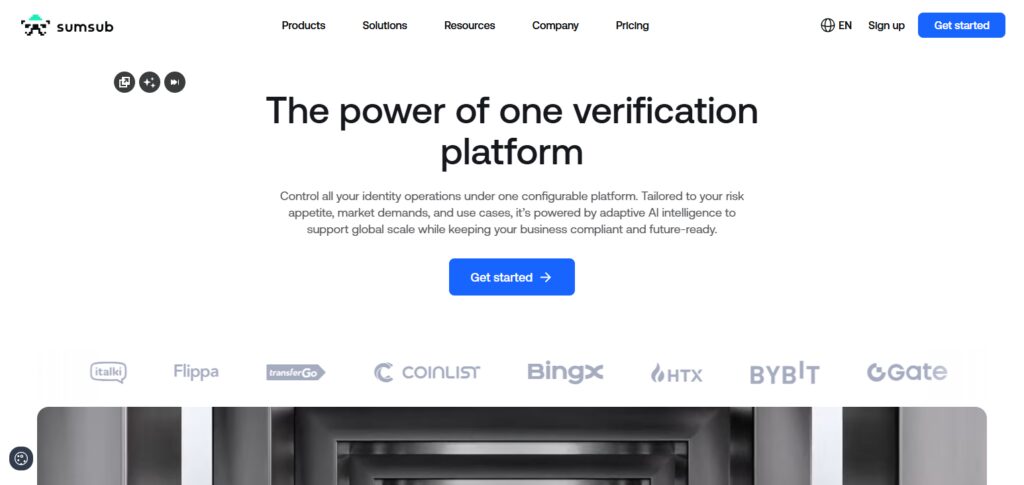
Customer charges are $1.35 for each verification with a minimum monthly payment of $149 and $1.85 per verification for those businesses that are regulated. Business licensing is based on a subscription with an enterprise custom plan.
Its main focus is streamlining the process for cryptocurrency exchanges, DeFi platforms, and global Fintechs.
Sumsub
- End-to-end workflows for KYC compliance, KYB, and AML.
- Risk scoring and monitoring of crypto transactions.
- Global coverage support in over 220 countries.
- KYC credits that are reusable.
- Verification flows are customizable and can be integrated via API.
- Robust fraud detection and liveness detection.
Sumsub
| Pros | Cons |
|---|---|
| Comprehensive KYC, KYB, AML coverage | Pricing can be high for startups |
| Global reach across 220+ countries | Integration may require developer resources |
| Strong fraud prevention & liveness detection | Complex workflows may overwhelm small teams |
| Customizable compliance workflows | Costs scale quickly with volume |
2. iDenfy
IDenfy works with the process of identifying an individual through the use of AI and ID documents and biometric verification systems. Its price is $1.20 for each verification and it operates on a pay-per-success business model.
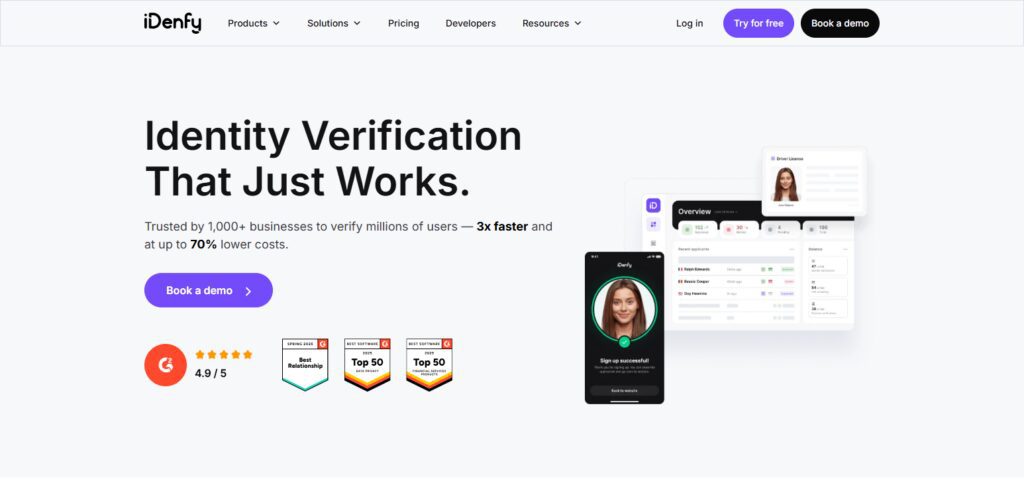
IDenfy has a flexible license with an API for start-up and enterprise systems. Its primary focus area is on identification systems for crypto wallets, payment gateways, and mid-tier crypto exchanges, for which it provides the most affordable identification service.
iDenfy
- Fictional pricing for AI-powered document and biometric verification.
- Real-time fraud detection and liveness checks.
- API integration that’s simple for both startups and enterprises.
- Multi-language document verification support.
- Focus on budget compliant solutions.
iDenfy
| Pros | Cons |
|---|---|
| Affordable pay-per-success pricing | Smaller global coverage footprint |
| Real-time fraud detection | Limited advanced compliance features |
| Easy API integration | Less enterprise-grade customization |
| Multi-language support | May lack depth in AML monitoring |
3. Onfido
Onfido focuses on the area of AI and biometric verification with the use of documentation. Onfido provides customized plans for each enterprise. In Onfido, business licensing for each enterprise is done individually.
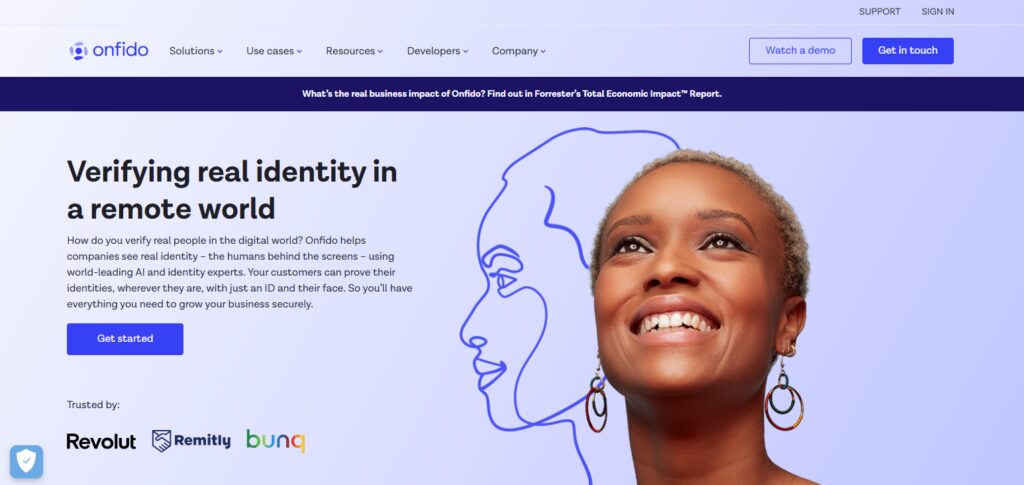
Best for crypto applications, NFT marketplaces, and fintech startups that need quick onboarding and fraud prevention. Its main selling point is synthetic identity detection and deepfake prevention, which helps secure onboarding in sensitive crypto environments.
Onfido is particularly noted for its adaptable fraud analytics which has earned the trust of numerous crypto businesses expanding internationally.
Onfido
- AI-powered document and biometric verification.
- Detecting synthetic identity and deepfakes.
- Enterprise-level scalable API.
- Fraud risk and monitoring on the Fraud analytics dashboard.
- Flexible workflows for crypto applications and fintechs.
- Onboarding at scale while keeping it securely.
Onfido
| Pros | Cons |
|---|---|
| Advanced synthetic identity & deepfake detection | Pricing is custom and expensive |
| Scalable API for enterprises | AML screening may need external tools |
| Strong fraud analytics dashboard | Best suited for larger firms |
| Flexible workflows for crypto apps | Setup complexity for startups |
4. Trulioo
Trulioo is the most prominent name in the industry for global identity verification, spanning over 5 billion records in 195+ countries. Given their per annum pricing which commences at $39,000, they only appeal to large enterprise clientele.
They maintain an enterprise-only license with an API-first integration. They are industry best for global cryptocurrency exchanges and banks, particularly when high geographical regulatory compliance is necessary.

They lead the industry in cross border KYC/KYB, allowing cryptocurrency companies to onboard users in any jurisdiction legally under regional and FATF AML guidelines, which is Trulioo’s main strength at cross border KYC.
They are the most prominent enterprise players in global business verification and in cross border crypto.
Trulioo
- Global identity network. Coverage of over 195 countries.
- KYC coupled with business verification (KYB).
- Enterprise-level API integration that’s API-first for businesses.
- Compliance with FATF cross-border standards.
- Watchlist checks and AML screening.
- Best suited for large crypto banks and exchanges.
Trulioo
| Pros | Cons |
|---|---|
| Global coverage in 195+ countries | High annual cost (enterprise focus) |
| Supports both KYC & KYB | Less accessible for startups |
| Strong compliance with FATF standards | Integration requires technical expertise |
| Enterprise-grade API-first design | Overkill for small crypto firms |
5. Veriff
Veriff provides the most prominent name for AI powered identity verification and is industry best for 6 second verification, one of the industry’s most rapid offers. Pricing and more can be confirmed for $229 per month with an option for discounted pricing based on volume.
They operate in an enterprise model and or at the company level with a subscription model based enterprise license.
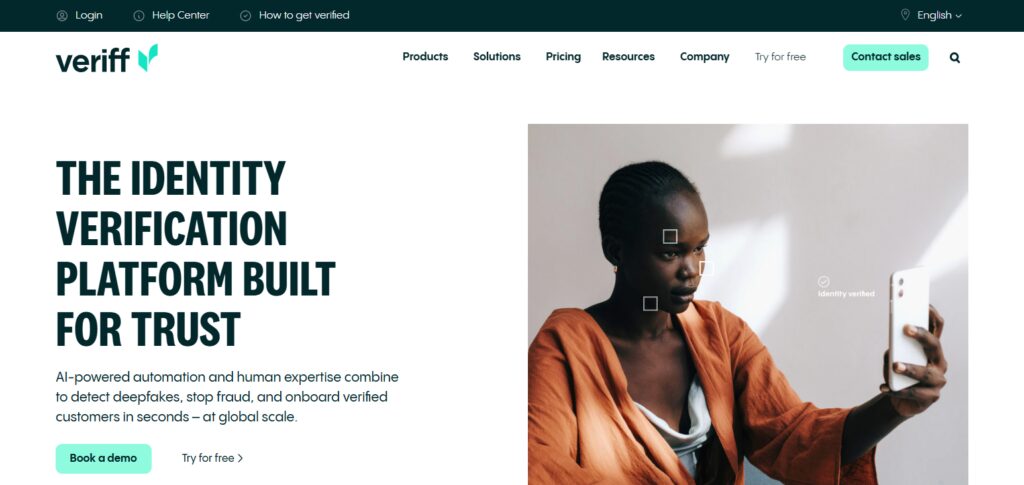
They are industry best in terms of speed and scalability for crypto startups, NFT marketplaces and exchanges. Their main domain or priority lies in compliance; more specifically, the prevention of fraud.
Veriff is best known for quick verification and fraud detection, which is why it is particularly suited for high-growth crypto companies.
Veriff
- Identity verification powered by AI in under 6 seconds
- Device fingerprinting for fraud detection
- Enterprise options are available for subscription-based pricing
- Onboarding tailored to the needs of startups and exchanges
- Support for multiple platforms (web, mobile, and apps)
- Emphasis on speed and user experience
Veriff
| Pros | Cons |
|---|---|
| Extremely fast verification times | May lack deep compliance customization |
| Strong fraud prevention | Subscription cost may rise with scale |
| Flexible pricing for startups | Better for mid-size firms than banks |
| Multi-platform support | Limited KYB features |
6. Persona
Persona offers KYC/KYB modular integration and enterprise identity verification solutions. Pricing is set for custom enterprise, including some flexible licensing.
For crypto platforms needing tailored compliance flows, and particularly those focusing on user experience and regulatory balance compliance, it is best. Persona is focused on workflow customization, fraud detection, and compliance automation.
Among others, it is ideal for onboarding demands with complex enterprise needs. Persona wins on modular and developer-friendly API, and for crypto firms, it is suitable for fast adaptation to regulatory changes.
Persona
| Pros | Cons |
|---|---|
| Highly modular & customizable workflows | Pricing is custom and scales quickly |
| Developer-friendly API | Requires technical expertise |
| Strong fraud detection | May be complex for small teams |
| Compliance automation | Setup time can be long |
Persona
- Workflows for identity verification that are modular
- Compliance flows that are customizable for enterprises
- Automation and fraud detection
- Integration that is developer-friendly for the API
- Support for KYC, KYB and AML
- Excellent for stripping crypto firms of their tailored onboarding
7. Alloy
Decisioning and identity verification, Alloy combines fraud prevention and compliance automation. Pricing is custom enterprise, and licensing is set for financial institutions. For real-time risk management, it is best for crypto exchanges and fintechs.

With automated decisioning, fraud scoring, and AML compliance, Alloy is sustainable for high volume enterprise transaction management.
With fraud risk and compliance, Alloy combines the best integration with various data sources, and for crypto firms, it is ideal to comply and reduce fraud.
Alloy
- A decisioning platform for the verification of identities
- Real-time control of fraud and risk with scoring
- Compliance workflows that are automated
- A variety of data sources for integration
- Custom pricing for financial institutions
- Best suited for crypto exchanges that are high volume
Alloy
| Pros | Cons |
|---|---|
| Real-time fraud scoring & decisioning | Focused more on banks than crypto-native firms |
| Automated compliance workflows | Enterprise-only pricing |
| Integrates with multiple data sources | May be costly for startups |
| Strong risk management | Requires dedicated compliance staff |
8. Socure
Using predictive analytics and AI, Socure designs trust platforms for digital identity and fraud detection.
Pricing is determined on a custom enterprise basis and is based on the volume of verifications completed. This is best suited for large scale crypto trading platforms and banking institutions with the need for high volume onboarding capabilities.
The primary focus is on detection of synthetic identities, fraud scoring, and automated compliance, therefore this is best for organizations that are exposed to a great deal of fraud.
Socure is best known for accuracy and fraud prevention, a trait that needs to be present for crypto companies to be able to onboard clients without any security issues or to be able to do so on a large scale.
Socure
- Uses predictive analytics and AI to prevent fraud
- Advanced fraud detection for synthetic identities
- Digital Scores that assess the risk of identity fraud
- Pricing for enterprises based on volume
- Excellent for large crypto exchanges and banks with high volume onboarding
Socure
| Pros | Cons |
|---|---|
| Industry-leading fraud prevention accuracy | Custom pricing can be expensive |
| Predictive analytics for synthetic identity | Primarily designed for large enterprises |
| Scales well for high-volume onboarding | May be overkill for startups |
| Strong compliance automation | Integration complexity |
9. Microblink
Pricing is on a per verification basis, and Microblink specializes in AI scanning of documents and electronic verification of identities. The API-based licensing can fit both startups and enterprise companies.
It is best suited for cryptocurrency wallet and payment service provider applications desperate for instant document verification.
They concentrates most in fraud detection and document scanning with the use of optical character recognition (OCR), making Microblink the best option available for organizations that need to be responsive and have a high level of accuracy. Microblink is recognized for having fast verification and minimal integration.
Microblink
- Scanning of documents using AI-based OCR
- Offers quick verification of identity using document capture
- Simple API integration for startups
- Real-time alerts on fraud detection
- Emphasizes on speed and accuracy
- Ideal for cryptocurrency wallets and payment applications
Microblink
| Pros | Cons |
|---|---|
| Fast OCR-based document scanning | Limited advanced compliance features |
| Lightweight API integration | Focused mainly on document capture |
| Affordable for startups | Less robust AML/KYC workflows |
| Real-time fraud alerts | Not ideal for large enterprises |
10. Bynn
Bynn is another identity verification tool that is crypto centric which also offers the service of KYC, AML, and fraud detection. Bynn also offers custom enterprise structures, where the pricing and licensing of the Bynn service is directed to the crypto companies.
It also best suits Web3 start-ups and mid-tier cryptocurrency trading platforms that have a need for reasonable cost compliance.
The primary focus lies on compliance in the realm of crypto and detection of fraud, making this service best for companies that are situated in decentralized frameworks.
Bynn’s strength lies in its focus on the specific compliance needs of crypto, enabling enterprises to adapt to changing regulatory frameworks while scaling with assurance.
Bynn
- Crypto-native identification verification services.
- Has support for KYC, AML, and fraud detection.
- Custom enterprise pricing for crypto companies.
- Centered on Web3 and decentralized ecosystems.
- Compliance options at a reasonable cost for new ventures.
- Best suited for Web3 projects and medium-sized exchanges.
Bynn
| Pros | Cons |
|---|---|
| Crypto-native compliance focus | Still an emerging player |
| Affordable for Web3 startups | Limited global coverage |
| Tailored for decentralized ecosystems | May lack enterprise-grade features |
| Strong fraud prevention for exchanges | Smaller support network |
What Are The Benefits Of Identity Verification Software?
Fraud Prevention, The software provides advanced biometric verification, document verification and AI based risk analysis which combats identity theft, account take overs and fraudulent activities across crypto, fintech and digital platforms.
Faster User Onboarding Time taken for user onboarding is of great importance. Automated verification processes provide faster approvals, better user experience and higher conversion rates without compromising security or compliance.
Improved Customer Trust The user is always kept informed as to how their data is being protected and the fraudulent activities of the digital financial systems are being controlled.
Global User Coverage Companies must adhere to regulatory and compliance requirements in the specified geographical area. The software helps to perform such regulatory compliance worldwide.
Operational Cost Reduction Multiple manual reviews, human errors and operational burdens of the compliance, fraud and customer support teams are removed through automation.
Compliance Infrastructure That Grows with You Identity verification tools integrate with your business on more than one level. They sustain high verification volumes while keeping performance and speed, as well as adherence to regulations.
Risk Decisions Optimized Instant decision making for approved, low-risk users, while high-risk users get flagged for more comprehensive reviews, splits the paradox of added security/efficiency with the AI-driven risk score.
Conclusion
To sum up, the top tools for enterprise-grade identity verification in crypto businesses offer the most optimal mix of global compliance coverage, fraud mitigation, scalability, and effective cost structures.
Tthese tools are critical to crypto exchanges, wallets, and Web3 providers, who are trying to balance the tough requirements of KYC/AML regulations. Among the major solutions, Sumsub and Trulioo are the best at global reach and enterprise level compliance. Onfido and Socure are best at fraud detection and synthetic fraud/identity prevention.
For more complex problems, Persona and Alloy have great custom solutions, in contrast to Veriff, iDenfy, and Microblink, who offer great speed and cost-effectiveness for younger businesses.
Newer companies, especially Bynn, offer compliance to crypto native businesses so that decentralized ecosystems can stay safe. businesses need to make their priorities clear.
Are they most focused on global reach, fraud resiliency, and cost efficiency for early-stage companies? Most businesses are balanced and need to meet all these goals.
FAQ
What are crypto enterprise identity verification tools?
These are platforms that help crypto exchanges, wallets, and fintechs verify user identities through KYC (Know Your Customer), KYB (Know Your Business), and AML (Anti-Money Laundering) checks. They prevent fraud, ensure compliance with regulations, and enable secure onboarding.
Why do crypto businesses need identity verification?
Crypto enterprises face strict global regulations (FATF, EU MiCA, US FinCEN). Identity verification tools help them comply with laws, reduce fraud, and build trust with users. Without them, exchanges risk fines, reputational damage, and regulatory bans.
Which tools are best for global coverage?
Sumsub and Trulioo are leaders in global identity verification, covering 195+ countries and offering both KYC and KYB. They are best for large exchanges and banks operating internationally.
Which tools are most affordable for startups?
iDenfy, Veriff, and Microblink provide cost-effective solutions with flexible pricing models. They are ideal for crypto startups, wallets, and mid-size exchanges that need compliance without high overhead costs.
Which tools focus on fraud prevention?
Onfido and Socure specialize in synthetic identity detection, deepfake prevention, and predictive fraud analytics. They are best for enterprises dealing with high-risk environments and large user bases.