The modern digital world is fully immersed in connectivity. It brings numerous advantages and equally numerous cyber threats. Threats have the potential to disrupt business continuity, runaway with sensitive data, and cause irreversible trust damage.
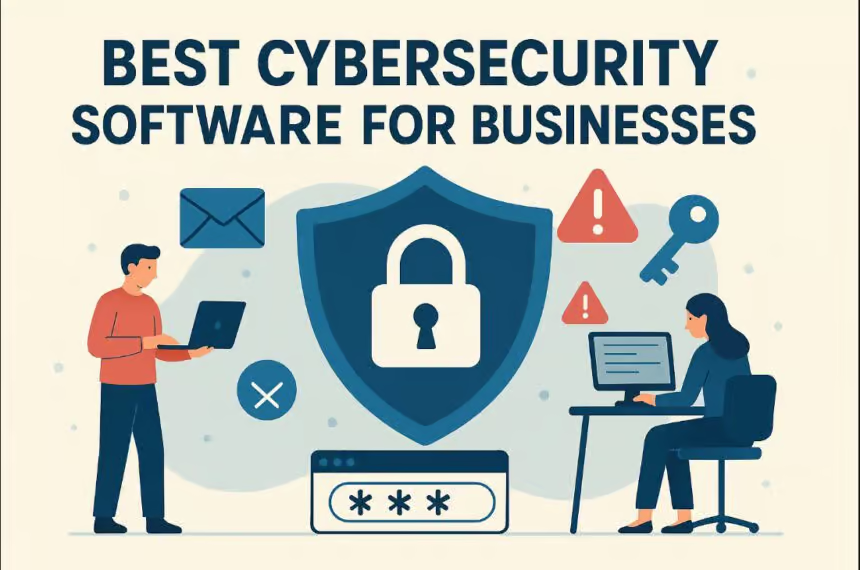
Businesses now have to integrate Best Cybersecurity Software for Businesses solutions in their operations. Failure to do so will result in missed opportunities. Smart software systems will protect from breaches and phishing attacks. Advanced systems ensure regulatory compliance and enhance business resilience.
What Is Cybersecurity Software?
Cybersecurity software is a collection of tools and programs that assist businesses in defending their networks, digital systems, devices, and data from ransomware, malware, phishing, unauthorized access, and other cyberthreats.
Cybersecurity software and solutions come in a variety of forms, such as intrusion detection systems, firewalls, antivirus software, encryption tools, and vulnerability scanners.

| Platform | Key Point |
|---|---|
| CrowdStrike Falcon | Cloud-native endpoint protection with AI-powered threat detection and response across global enterprises |
| SentinelOne Singularity | Autonomous, AI-driven XDR platform delivering machine-speed prevention, detection, and response across endpoints, cloud, and identity |
| Microsoft Defender for Endpoint | Enterprise-grade endpoint security integrated with Microsoft ecosystem, offering prevention, detection, investigation, and automated response |
| Palo Alto Networks Cortex XDR | AI-driven extended detection and response with prevention-first approach, proven in MITRE ATT&CK evaluations |
| Trend Micro Vision One | Integrated XDR with attack surface management, optimized prevention, detection, and response for endpoints, servers, and cloud workloads |
| Sophos Intercept X Endpoint | Deep learning malware detection plus anti-ransomware and exploit prevention for comprehensive endpoint protection |
| ESET PROTECT Advanced | Multilayered endpoint protection against ransomware and zero-day threats, with vulnerability and patch management |
| Zscaler Internet Access | Cloud-native zero trust platform ensuring secure, fast internet and SaaS access for all users and apps |
| Bitdefender | GravityZone platform delivers unified, AI-powered protection with dynamic hardening to reduce attack surfaces |
| Norton 360 Deluxe | All-in-one consumer security suite with antivirus, VPN, and password manager for complete device protection |
1. CrowdStrike Falcon
CrowdStrike Falcon is the most effective cloud-based endpoint protection platform that uses machine learning to identify and prevent breaches in real time. It contains behavioral analytics with proactive threat detection to protect enterprise environments.
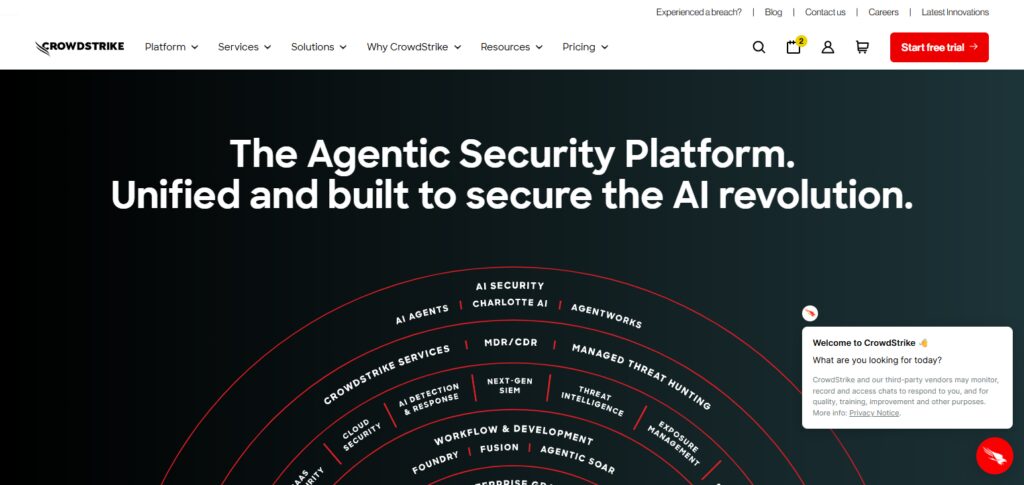
As one of the Best Cybersecurity Software for Businesses, Falcon has lightweight agents, is highly scalable, and is rapidly deployable with little to no IT infrastructure.
Falcon prevents ransomware, malware, and sophisticated breaches while providing global visibility across all endpoints. Because of its speed, accuracy, and low dwell time during cyber incidents, CrowdStrike Falcon is trusted by enterprises.
CrowdStrike Falcon Features
- Cloud-based endpoint security
- Threat detection and response using artificial intelligence
- Threat intelligence
- Lightweight performance monitoring system
- Endpoint visibility
CrowdStrike Falcon Pros & Cons
Pros
- Minimal system impact, cloud-native, and lightweight.
- Uses AI for threat detection and response.
- Has a global threat intelligence system.
- Can scale and deploy rapidly.
- Good at preventing malware and ransomware.
Cons
- Pricing is high compared to other companies.
- Needs a good and stable internet connection.
- Small businesses without an IT team may find it complex.
- Limited protection when offline.
- Advanced features costs extra.
2. SentinelOne Singularity
SentinelOne Singularity is the most advanced autonomous cybersecurity platform that integrates endpoint, cloud, and identity protection into a single extended detection and response (XDR) solution. It uses machine learning to automate the detection, prevention, and remediation of threats at lightning speed with little to no human interference.
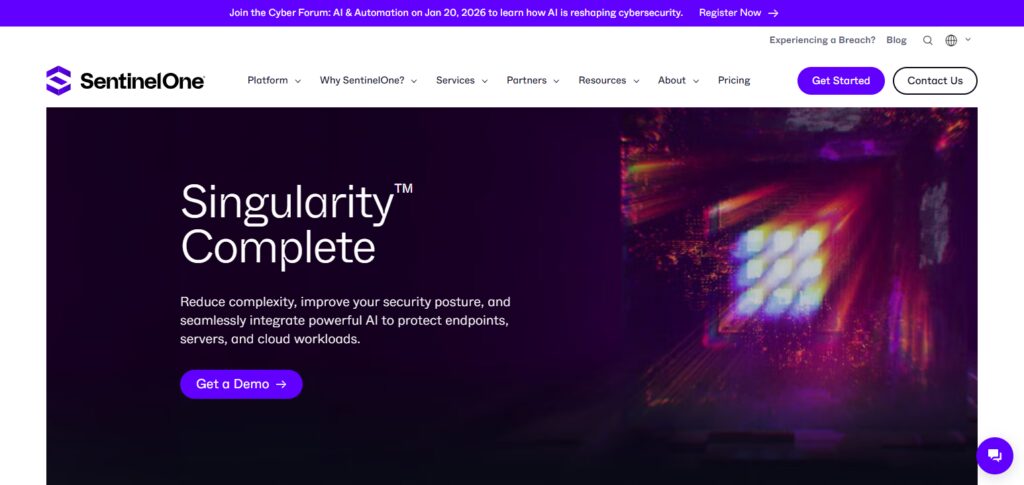
As one of the Best Cybersecurity Software for Businesses SentinelOne is superior in providing real-time protection against ransomware, exploits, and advanced persistent threats.
Endpoint security technology has improved significantly, especially in the areas of autonomous response, which allows endpoints to self heal. This minimizes downtime and the operational risks associated with downtime.
Endpoint security is felt by companies to be scalable, easy to deploy, and results in positive evaluations in the MITRE ATT&CK framework. As a result, it has earned the title of being “most valued” in the industry.
SentinelOne Singularity Features
- XDR (eXtended Detection and Response) platform with machine learning
- Real-time detection, prevention., and remediation
- Endpoint self-healing
- Endpoint, cloud, and identity protection
- Endures MITRE ATT&CK evaluations
SentinelOne Singularity Pros & Cons
Pros
- Uses AI to autonomously drive detection and response.
- “Self-healing” endpoints reduce downtime, and self-heal.
- Protection is unified among endpoint, cloud, and identity.
- Good MITRE ATT&CK evaluation results.
- Minimal human intervention is needed for machine speed remediation.
Cons
- Added cost for the entire XDR suite.
- New users have a higher learning curve.
- Can be resource heavy in some environments.
- Compared to other vendors, 3rd-party integrations are few.
- Small IT teams may be overwhelmed with alerts.
3. Microsoft Defender for Endpoint
Defender is suitably integrated with the Microsoft stack, and offers endpoint detection and response (EDR) along with automated threat investigations and threat remediation built on Microsoft’s global threat intelligence. Its seamless integration with Microsoft programs has earned it the accolade of “Best Cybersecurity Software for Businesses.”
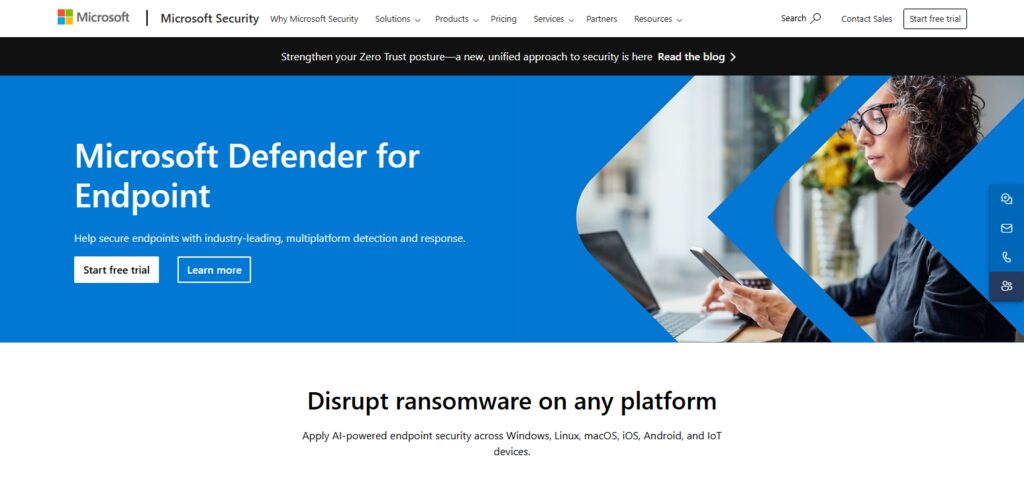
Defender has also proven to be especially valuable for companies using Microsoft’s Office 365, Azure, and Windows. Its advanced capabilities include, but are not limited to, attack surface reduction, behavioral blocking, and vulnerability management.
Defender’s ability to provide security at all levels (devices, identities, and applications) is most powerful and simplifies IT functions on security management.
Microsoft Defender for Endpoint Features
- Integrable with Microsoft products (Windows, Azure, Office 365)
- Endpoint detection and response (EDR) capabilities
- Response and investigation automation
- Threat and attack surface management
- Advanced threat behavioral blocking
Microsoft Defender for Endpoint Pros & Cons
Pros
- Integration with Microsoft products is seamless.
- There are automated investigations and remedies in Microsoft Defender.
- Endpoint detection and response (EDR) is strong.
- If you are a Microsoft 365 customer, it will save you costs.
- Attack surface reduction and vulnerability management
Cons
- Primarily applicable for Microsoft-dependent ecosystems
- Setup may be difficult at first
- Limited additional features (availability only Microsoft stack)
- Older devices may be affected
- IT staff required for configuration and management
4. Palo Alto Networks Cortex XDR
Cortex XDR by Palo Alto Networks is an extended detection and response, prevention-first platform that fuses endpoint, network, and cloud for comprehensive security. It employs AI to simplify threat detection and analysis.
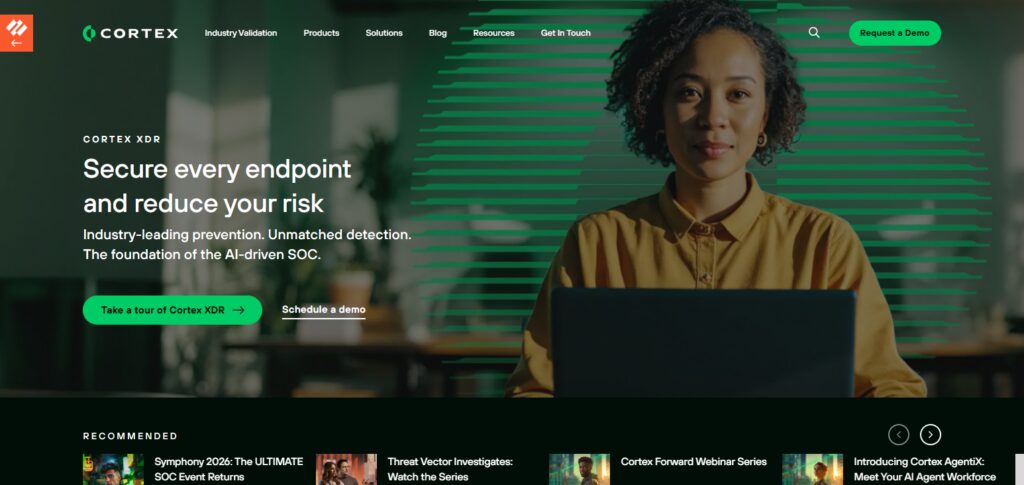
One of the Best Cybersecurity Software for Businesses, Cortex XDR, is praised for minimizing false positives and having great visibility throughout the entire attack cycle. Cortex XDR’s prevention-first approach blocks threats before they can escalate.
In addition, it scoring highly in the MITRE ATT&CK evaluations adds to its prestige. Cortex XDR is known for being one of the few enterprise products providing fully scalable and unified solutions for emerging disruptive cyber threats.
Palo Alto Networks Cortex XDR Features
- Extended detection and response
- Advanced AI analytics for threat detection
- Endpoint, cloud, and network visibility
- Advanced correlation for reduced false positives
- Sturdy MITRE ATT&CK evaluations
5. Trend Micro Vision One
Integrated XDR platforms like Trend Micro Vision One enable visibility and control across endpoints, servers, email, and cloud workloads. It combines attack surface management, advanced threat detection, and automation to respond to threats in real-time.
Vision One is named one of the Best Cybersecurity Software for Businesses because it reduces threats and identifies weaknesses in organizations. Inter and intra layer data correlation is one of its strongest features.
With artificial intelligence (AI) and cloud service integration, it analyzes data to quickly protect organizations from cyber threats.
Trend Micro Vision One Features Pros & Cons
Pros
- Risk visibility and attack surface management
- Rapid detection and response driven by AI
- Unified management console
- Advanced threat and risk identification
Cons
- Primarily applicable for Microsoft-dependent ecosystems
- Setup may be difficult at first
- Limited additional features (availability only Microsoft stack)
- Older devices may be affected
- IT staff required for configuration and management
6. Sophos Intercept X Endpoint
With the integration of advanced threat, anti-ransomware, and malware detection, Sophos Intercept X Endpoint focuses on threat prevention, ensuring advanced threats are stopped before impact.
For one of the Best Cybersecurity Software for Businesses, interceptions X offers layered protection which includes endpoint detection and response (EDR) and managed threat hunting. Its specialized feature is smarts crypto guard which blocks any ransomware from encrypting files.
Sophos also integrates with its broader ecosystem, offering patented synchronized security across devices and networks. Clients appreciate its Zero Intercept automation and how it relieves the workload from IT Teams.
Sophos Intercept X Endpoint Features
- Malware detection via deep learning
- Anti-ransomware with CryptoGuard
- Exploit mitigation for zero-day vulnerabilities
- Endpoint detection and response (EDR)
- Synchronized security across devices and networks
Sophos Intercept X Endpoint Pros & Cons
Pros
- Detection of malware using deep learning
- Ransom-ware protection via CryptoGuard
- Zero-day attack protection by exploit prevention
- Threat hunting managed through EDR
- Security aligned across different devices.
Cons
- Resource cheap on endpoints.
- Advanced features need higher-tier licenses.
- Integrations limited to only Sophos.
- Alerts might bombard small IT teams.
- Sophisticated setup and enterprises.
7. ESET PROTECT Advanced
ESET PROTECT Advanced comes with multilayered endpoint protection with robust ransomware, phishing, and zero-day exploitation. It combines exploitation with some of the best vulnerability and patch management, encryption, and advanced threat detection.
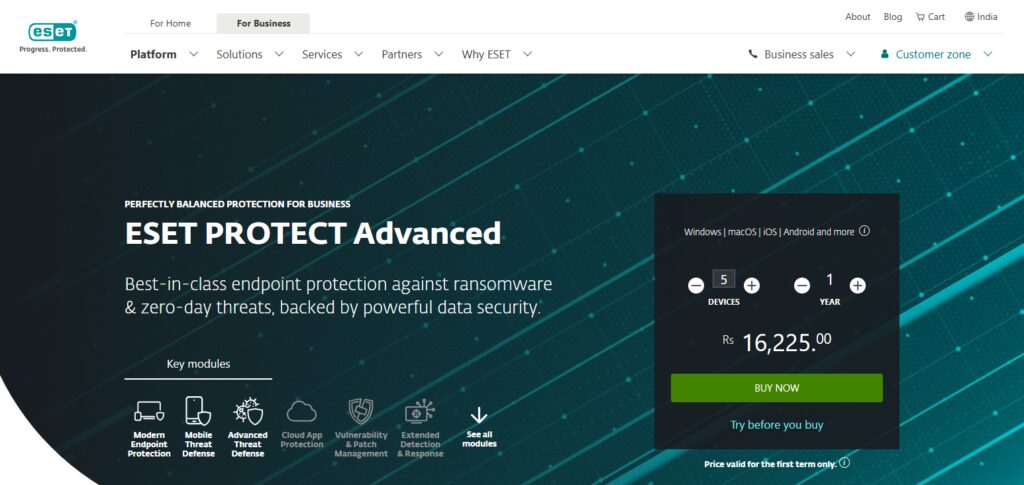
Among the Best Cybersecurity Software for Businesses, ESET PROTECT Advanced is also lightweight and one of the best solutions for enterprises who want reliable security with low system resource consumption.
It offers an equally responsive and management center of endpoints, servers, and mobile devices. ESET is also unique in its cost-efficient security and service compliance and flexibility to counter modern cyber threats while maintaining system speeds and usability.
ESET PROTECT Advanced Features
- Multi-layered protection for endpoints
- Strong defenses against ransomware and phishing
- Patch and vulnerability management
- Performance impact is lightweight
- Console management for enterprises
ESET PROTECT Advanced Pros & Cons
Pros
- Barely noticeable and lightweight performance
- Excellent ransomware and phishing protection.
- Patch and vulnerability management.
- Managing enterprises through a centralized console.
- Cheaper than other competitors.
Cons
- Threat advanced feature hunting is limited.
- Compared to leaders, the ecosystem is smaller.
- Limited visibility of cloud workloads.
- Lacks driven automation by AI.
- Best results require manual tuning.
8. Zscaler Internet Access
With Zscaler Internet Access, enterprises get a cloud-based zero-trust solution for securing users’ connections to the Internet and SaaS services.
It removes the necessity for conventional VPNs by implementing secure access restrictions everywhere. As one of the Best Cybersecurity Software for Businesses, Zscaler provides rapid, safe, and flexible scalability while minimizing potential attack surfaces.
Its architecture inspects traffic inline, and, in the case of malware, phishing, and data theft, it provides blocking and real-time data leakage protection.
Companies optimize network security, simplify it, work remotely, and deliver consistent protection across borders, which is why Zscaler is a leader in the secure access service edge (SASE) solution.
Zscaler Internet Access Features
- Security with zero trust and cloud-native
- Secure access to the Internet and SaaS applications
- Malware and phishing inline traffic for inspection
- Eliminates the need for classic VPNs
- Protection expands to remote employees
Zscaler Internet Access Pros & Cons
Pros
- Security of zero trust that is cloud-native.
- No more need to use legacy VPNs.
- Inline malware/phishing inspection that analyzes traffic.
- Allows for scalability for remote workers.
- Elevated protection for internet access and SaaS.
Cons
- Enterprise deployments may have premium pricing.
- Dependable broadband is a must.
- Difficult to transition from legacy VPNs.
- Visibility of on-premises systems is lacking.
- Some areas may have latency.
9. Bitdefender
Bitdefender provides GravityZone, a single security solution that integrates endpoint protection, detection, and response with AI analytics. To tackle and avert sophisticated threats, it delivers dynamic hardening.
As one of the Best Cybersecurity Software for Businesses, Bitdefender has excellent malware detection and a lightweight architecture with centralized management, making it a top firm. Its various security levels include risk analytics, patch management, and ransomware mitigation.
Companies recognize and appreciate the scalability and security of the solution as it protects hybrid environments, spanning from cloud work and on-premises to cloud workloads. Bitdefender is a highly trusted firm for international companies with the expectation of reliability and innovation.
Bitdefender Features
- GravityZone- Unified Security Platform
- AI-Driven detection and analytics
- Dynamic hardening reduces exposed attack surfaces
- Centralized management for hybrid systems
- Strong detection for malware with minimal performance impact
Bitdefender Pros & Cons
Pros
- Unified security platform GravityZone
- AI detection and analytic grades
- Dynamic hardening measures attack surfaces
- Good detection for malware
- Good speeds with management done from one place
Cons
- Additional fees for extra features
- Fewer apps than top competitors
- Limited visibility into identity/cloud threats
- Can be complicated for small businesses
- Support response times vary by region
10. Norton 360 Deluxe
Norton 360 Deluxe is an integrated security suite for consumers and includes an antivirus, VPN, password manager, and parental controls.
It offers comprehensive protection for devices and personal information. Even though it is mainly targeted for individuals, it is still viewed as one of the Best Cybersecurity Software for Businesses for small office or home office use.
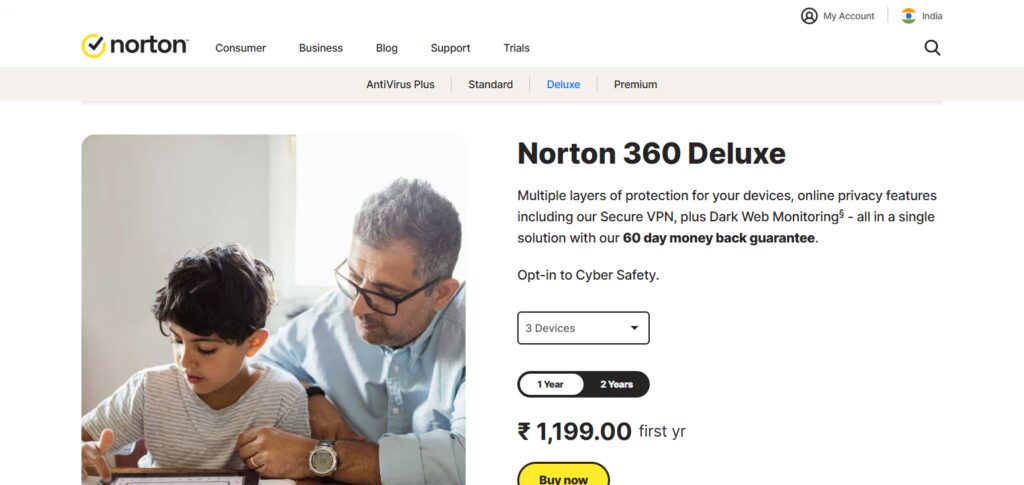
Norton’s best feature is the simplicity and affordability, plus the broad coverage for non-enterprise users. It protects users against malware, phishing, identity theft, and offers safe browsing. Norton 360 Deluxe is still a preferred option for users who prefer all-in-one complete cybersecurity.
Norton 360 Deluxe Features
- Complete Consumer Security Suite
- Includes VPN, Antivirus and password manager
- Parental controls and identity theft protection
- Phishing protection and secure browsing
- Designed for ease of use for home and small office
Norton 360 Deluxe Pros & Cons
Pros
- One product covers all consumer protection needs
- Antivirus and VPN included with a password manager
- Offers identity theft protection and parental controls
- Simple and user-friendly
- Price fits home and small office budgets
Cons
- Focused on consumers, not enterprises
- Does not have sophisticated threat detection
- VPN is not as fast as others
- Can slow down older systems
- Not ideal for large businesses
Why is Cybersecurity Important?
Safeguarding Important Information
The cybersecurity of an business, personal or financial data secures the unauthorised access providing compliance of the global data mediums to the privacy and protection trust.
Preventing Financial Impac
People and organisation may suffer devastating financial and reputational impacts due to the lack of strong cyber security that may lead to fraud, data and breaches.
Ensures Growth of the Business Continuously
An organization is able to function with cyber security and serve its customers with uninterrupted service and it is able to protect productivity and growth.
Business Reputation
With strong Cyber security an system is able to protect all its customers and business data from malicious software and business remains safe.
Building the trust of the Customers
When organization’s implement strong Customer security, they gain the trust and the loyalty of the customers by protecting them from all the cyber theft.
Conclusion
Modern day businesses depend on Cybersecurity mainly as business agility is driven by risk and trust management. As businesses have to protect themselves against digital risks which have been evolving and becoming more sophisticated, a business will need to protect trust and managing operational continuity.
Each of the platforms we have interacted with—CrowdStrike Falcon, SentinelOne Singularity, Microsoft Defender for Endpoint, Palo Alto Networks Cortex XDR, Trend Micro Vision One, Sophos Intercept X Endpoint, ESET PROTECT Advanced, Zscaler Internet Access, Bitdefender, and Norton 360 Deluxe—have their unique tailored strengths for different environments.
CrowdStrike, SentinelOne, Palo Alto, and Microsoft Defender are all enterprise-grade solutions that are also scalable which have advanced analytics, and driven by automation powered by AI. So, they are most suitable for large enterprises. ESET, Sophos, and Trend Micro are more of an appealing bounded rationality to the mid-sized companies as they have balanced the cost with the operational efficiency.
Zscaler is the best at zero trust and at support for remote access, Bitdefender is the best for hybrid protection, and Norton 360 Deluxe is the best all-in-one suite for small businesses and home office environments.
FAQ
What makes CrowdStrike Falcon stand out?
CrowdStrike Falcon is a cloud-native endpoint protection platform that uses AI-driven threat detection and global intelligence. It’s lightweight, scalable, and excels at preventing ransomware and advanced attacks.
How does SentinelOne Singularity differ from others?
SentinelOne Singularity is autonomous, meaning it detects and responds to threats at machine speed. Its self-healing endpoints can roll back ransomware damage, making it one of the most advanced XDR platforms.
Why choose Microsoft Defender for Endpoint?
Microsoft Defender integrates seamlessly with the Microsoft ecosystem (Windows, Azure, Office 365). It offers strong EDR, automated remediation, and attack surface reduction, making it cost-effective for Microsoft-centric businesses.
What is unique about Palo Alto Networks Cortex XDR?
Cortex XDR provides prevention-first extended detection and response, combining endpoint, network, and cloud visibility. Its AI-driven analytics reduce false positives and deliver deep forensic investigation capabilities.
What does Trend Micro Vision One offer?
Trend Micro Vision One is an integrated XDR platform that correlates data across endpoints, email, servers, and cloud workloads. It provides attack surface management and proactive vulnerability detection.