To help novices understand how to trade cryptocurrency futures securely and confidently, I will go over the Binance Futures Trading Guide in this post.
On Binance Futures, you’ll discover important ideas, order kinds, risk management techniques, and necessary tools. Even beginners may begin trading wisely and reduce risks in the erratic cryptocurrency market by using our information.
What Are Binance Futures?
Without actually owning the underlying assets, traders can speculate on cryptocurrency values using the Binance Futures platform. Futures trading allows you to take long (buy) or short (sell) positions to profit from price increases or decreases, in contrast to spot trading, where you purchase and hold coins.
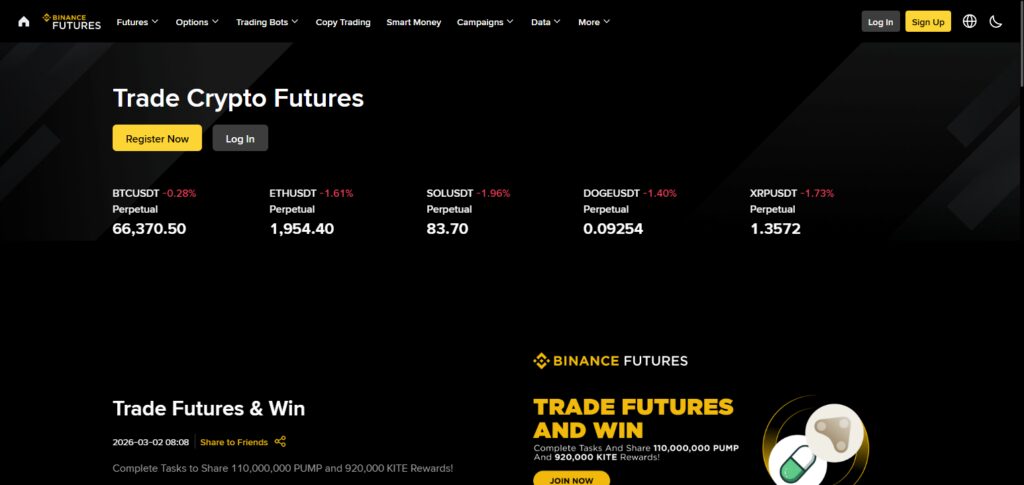
Leverage, which Binance Futures provides, allows traders to manage bigger positions with less money, raising the possibility of both gains and losses.

It provides a range of order types, extensive risk management features, including contracts that are coin-margined and USDT-margined. It is crucial to comprehend these fundamentals in order to trade safely and intelligently.
Getting Started on Binance Futures
Open a Binance Account
- To open a futures trading account, sign up on Binance and finish the KYC verification.
Activate Futures Trading on Your Account
- Go to the Futures section and consent to the terms and conditions in order to activate your account.
Select a Type of Contract
- USDT-M Futures: for beginners. It is easier because the margin is USDT, which is stable.
- COIN-M Futures: for advanced users because the margin is cryptocurrency.
Make a Deposit
- Make a safe transfer of USDT or crypto from your spot wallet to futures wallet.
Familiarize Yourself With the Interface
- Get to know how the charts work, the types of orders, and how to set your leverage and check your balance.
Start With a Small Amount
- To minimize risk, learn by starting with even less leverage and taking small positions.
(Optional) Use the Testnet to Practice
- Before trading in the real market, use the Binance Futures Testnet to practice trading with fake money.
Key Concepts for Beginners
Leverage
- Make bigger profits with little money. More leverage = more potential profit and more potential risk.
Margin
- A money requirement to open a futures position. It is your collateral for your trades.
Long and Short PositionsLong
Buy to make profit if price goes up.Short: Sell to make profit if price goes down.
Liquidation
- If your margin goes below a certain point (maintenance level), Binance will close your position so you do not lose more than your margin.
Funding Fees
- Payments (made by the long and short traders) to keep the futures contracts priced close to the actual spot price.
Risk Management
- Stopping your losses and keeping your money safe with a stop-loss, take-profit, and keeping a small position.
Types of Binance Futures Orders
Market Orders
- They are guaranteed to execute immediately, but may have low priority, especially if price fluctuations occur almost instantaneously.
- Market Orders are quite speedy entries, but may miss the intended price.
Limit Orders
- These give you the most control as you are able to place orders at the price you choose.
- If the price you set at the order is not reached, the order will not execute.
Stop-Limit Orders
- These trigger a limit order when a certain “stop” price is hit.
- They are mostly used to limit the potential negative impacts of an order.
Take-Profit and Stop-Loss Orders
- These close your position at a specified profit or loss which you have set.
- These are essential when maintaining control over your funds.
Trailing Stop Orders
- As the price moves, so does the order which allows you to take profit at the intended price.
- Stops are able to continue with the price and still take profit as long as the price is continuously moving.
Risk Management Tips
Use Stop-Loss Orders
- Ensure that a stop-loss is set for each trade to minimize possible losses.
Set Take-Profit Levels
- Ensure that a price is established for each trade to secure a profit.
Limit Leverage
- Use little leverage for a lower risk of liquidation (2x – 5x)
Trade Small Positions
- Ensure that a position is not over-risked. Create multiple positions to spread out risk.
Avoid Emotional Trading
- Stick to the plan. Avoid trades that result in loss chasing and loss of focus on the plan.
Keep a Trading Journal
- Ensure that a record of trades, strategies, and outcomes is kept in order to evaluate and improve the record.
Stay Updated on Market News
- Ensure that in case news is released, the record does not become outdated due to a price change.
Tools and Features on Binance Futures
User Interface
- Easy to understand and use. Users can see their required charts, the different types of orders available, their open order positions, and their current balances.
- Users accessing the trading interface can do so through the mobile or desktop versions of Binance Futures.
Charts
- For analysis, users can use multiple tools provided by a third party. Charts can be set to candlestick type, specify trend lines, and utilize a variety of different drawing tools.
Market Analysis
- Analysis can be performed using a variety of tools provided by a third party, market analysis can be performed using indicators such as the RSI, MACD, and Bollinger Bands.
Adjustable Leverage
- Users can set their trading risk on each individual trade.
Order Customization
- Users can place a variety of market and limit orders, as well as stop-limit and take-profit orders. Users can also place trailing stop orders to set automatic stop orders.
Automated Risk Management
- Users can set automated risk management controls such as setting a stop loss, take-profit, or setting a margin alert.
Mobile Trading and Alerts
- Users can trade using the Binance Futures mobile application, and can receive alerts to their mobile device.
Practice Trading
- Users can practice their trading strategies and skills using the Binance Futures trade system to trade virtual currencies.
Common Beginner Mistakes to Avoid
Position Over-Leveraging
- When you use too much leverage, it can cause a liquidation and a significant loss very quickly.
No Planning
- Exiting a trade impulsively can lead to you making a lot of errors.
Risk Management Ignored
- Not setting stop losses and take profits can result in avoidable losses.
Loss Recovery Trading
- Trying to reclaim losses quickly often leads to larger errors.
FOMO and Emotional Trading
- The fear of missing out can lead you to make a trade at a very bad time.
Lack of Market Analysis
- Trading without spending time on trends, news, and technical indicators leads to poor decisions.
Excessive Trading
- Trading without a plan can lead to excessive mistakes and increased fees.
Ignoring Funding and Fees
- Trading fees and funding costs add up over time and can lead to you losing out on a lot of profit.
Pros & Cons
| Pros | Cons |
|---|---|
| Opportunity to profit in both rising and falling markets through long and short positions. | High risk of losses, especially with high leverage. |
| Flexible leverage allows trading with smaller capital. | Leverage can amplify losses, leading to liquidation. |
| Multiple order types for precise trading (Limit, Market, Stop-Limit, Take-Profit). | Complex interface can be confusing for beginners. |
| Advanced charting tools and technical indicators for better analysis. | Trading fees and funding rates can reduce profits if ignored. |
| Practice on Testnet before risking real funds. | Emotional trading and overtrading are common pitfalls. |
| Access via mobile and desktop for trading on-the-go. | Requires continuous learning and monitoring of market trends. |
Conclusion
Whether markets rise or fall, Binance Futures provides traders with exciting prospects to profit from changes in cryptocurrency prices. It’s crucial for novices to comprehend fundamental ideas like leverage, margin, and order types. Long-term success depends on starting small, managing risks, and refraining from emotional trading.
You can trade with confidence and safety by making use of Binance’s resources, like as the Testnet, technical indicators, and sophisticated charting. Keep in mind that trading futures entails a lot of risk, therefore your best friends on the road to becoming a proficient trader are perseverance, self-control, and ongoing education.
FAQ
What is Binance Futures?
Binance Futures is a trading platform that lets you speculate on cryptocurrency prices using contracts, without owning the actual coins. Traders can go long (buy) or short (sell) to profit from price movements.
Can beginners trade Binance Futures safely?
Yes, beginners can trade safely by starting with small positions, low leverage, and using risk management tools like stop-loss and take-profit orders.
What is leverage in Binance Futures?
Leverage allows you to control a larger trade size with a smaller amount of capital. Higher leverage increases potential profits but also increases risk of losses.
How do I manage risk in Binance Futures?
Use stop-loss and take-profit orders, limit leverage, trade small positions, avoid emotional decisions, and keep a trading journal.
Can I practice trading before using real funds?
Yes, Binance Futures offers a Testnet where you can trade with virtual funds to learn strategies safely.