
The Top Alternative Investment Platforms that let investors diversify beyond conventional equities and bonds will be covered in this post.
These platforms give users access to special resources like premium wine, art, startups, real estate, and private equity. Investigating these platforms can assist in creating a diverse portfolio with the potential for greater returns, regardless of your level of experience as an investor.
Key Point & Best Alternative Investment Platforms
| Platform | Key Point |
|---|---|
| Yieldstreet | Provides access to alternative investments like real estate, legal finance, and private credit with relatively low minimum investment requirements. |
| Fundrise | Popular real estate crowdfunding platform offering diversified eREITs and eFunds for long-term property investing. |
| CrowdStreet | Focuses on commercial real estate investments with direct access to institutional-quality property deals. |
| AngelList Venture | Allows investors to invest in startups and venture funds through syndicates and rolling venture funds. |
| EquityZen | Provides access to shares of late-stage private companies before they go public. |
| Masterworks | Enables fractional investment in blue-chip artworks by famous artists as an alternative asset class. |
| Vinovest | AI-powered platform that helps investors build portfolios of fine wine as an alternative investment. |
| RealtyMogul | Offers both REITs and private real estate deals for investors seeking passive income. |
| Moonfare | Gives high-net-worth individuals access to top-tier private equity funds usually reserved for institutions. |
| iCapital Network | Technology platform connecting advisors and investors with hedge funds, private equity, and alternative assets. |
1. Yieldstreet
Yieldstreet is one of the top-rated alternative investing platforms, allowing customers to diversify into investments other than stocks and bonds. The platform gives users the ability to invest in private credit, real estate, finance of art, marine finance, and legal finance.
Yieldstreet focuses on institutional-grade investments that were once only available to large investors and hedge funds. Many of the offerings are curated and managed so that investors can participate in the more complicated areas of investing with less direct management.

The platform also offers analytics, educational resources, and performance tracking. For customers interested in alternative investing with structured investments and little data transparency, Yieldstreet is the right investing ecosystem.
Yieldstreet Features, Pros & Cons
Features
- They offer investment opportunities in real estate, art, private credit, and legal finance.
- They offer marketplace investment opportunities at the level of accredited investors.
- Minimum investment is usually about $10,000 and can vary based on each deal.
- They offer diversification funds and structured portfolios to allow all investors to partake.
- They offer dashboards, and reports on portfolios to provide updates on performance and income.
Pros
- Private market investments are unique to YieldStreet.
- Compared to traditional assets, there is the possibility of significant returns.
- Strong portfolio diversification across multiple asset classes.
- User-friendly investment dashboard and analytics tools.
- Some investments available through self-directed IRAs.
Cons
- Compared to most platforms, the minimum investment is substantially larger.
- Many opportunities are only available to accredited investors.
- Investments can be illiquid with long holding periods.
- There may be management and fund fees.
- There are specialized alternative assets which increase the investment risk.
2. Fundrise
Fundrise is first on the list of the Best Alternative Investment Platforms as it allows you to participate in real estate crowdfunding and invest in properties for the long-term. This platform gives investors the chance to co-own a diversified portfolio of real estate through eREITs and eFunds that aim to generate income and possible appreciation.
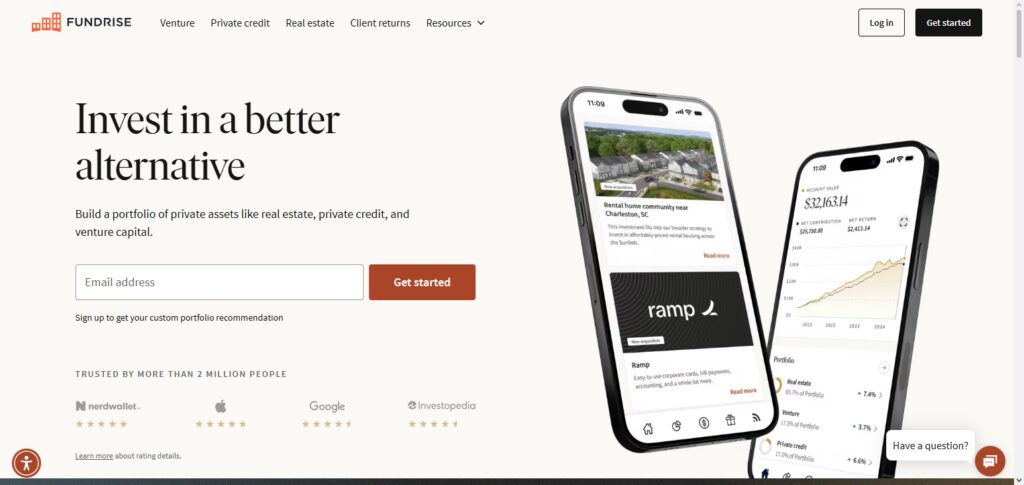
Fundrise focuses on developing and renovating both residential and commercial properties throughout the United States and offers a much lower price point for investors compared to what is available in the market for direct real estate ownership. It offers a user-friendly dashboard that displays properties, dividends, and projected growth.
The platform emphasizes the long term and offers the real estate investors the option of choosing a strategy whereby the investor is either income-focused, balanced growth, or aggressive growth. Therefore, for investors wanting a hands-off approach to real estate without having to buy a property, Fundrise is a convenient option.
Fundrise Features, Pros & Cons
Features
- Fundrise offers real estate crowdfunding through eREITs and eFunds.
- Compared to traditional real estate investments, Fundrise has lower minimum investments.
- Fundrise offers automated portfolio strategies for income or growth.4. Property analytics and insight tools on a digital platform.
- Real estate investment diversification throughout various U.S. markets.
Pros
- Extremely easy to grasp investment platform.
- Minimal investment limits.
- Income generation without active participation through dividends and appreciation of properties.
- Real estate investment diversification.
- Intuitive dashboards on mobile and website.
Cons
- Limited liquidity on investments.
- Potential returns are primarily reliant on the fluctuations of the real estate market.
- Certain fees are associated with the management of the fund.
- Ability to invest in each individual property is not available to all investors.
- Required time frame for investment is extensive.
3. CrowdStreet
CrowdStreet earns its place in the list of Best Alternative Investment Platforms due to its ability to provide investors with direct access to the sale of institutional-quality commercial real estate.

The platform facilitates connections between investors and real estate developers and sponsors with opportunities in office, apartment, industrial, and mixed-use developments. The marketplace design also provides investors the ability to select real estate opportunities of their choice.
This marketplace design also provides investors the ability to target specific commercial developments, as opposed to less desirable options that might be available in a pool fund. The ability to select specific developments provides experienced investors with the most direct access to real estate opportunities, making CrowdStreet a very specialized platform as an investment opportunity.
CrowdStreet Features, Pros & Cons
Features
- A platform that allows for investment in physical commercial real estate.
- Property oportunidades of institutional quality.
- Analysis of the deal and information about the sponsor.
- Investment options in commercial real estate of diversified offices, apartments, and industry.
- Tools for portfolio management and report on the investment.
Pros
- Invest directly in specific real estate projects.
- Quality commercial real estate.
- Investment data and predictions are available.
- Real estate investments have the potential for good returns.
- Experienced property owners.
Cons
- Many projects have a high minimum investment requirement.
- Most available projects are only for accredited investors.
- Real estate investments have no immediate resale option.
- Fluctuations in the market will determine the returns.
- Your investment along with the real estate will require thorough examination.
4. AngelList Venture
AngelList Venture has earned recognition as one of the Best Alternative Investment Platforms for Startup and Venture Capital Investing. The platform offers AngelList users a unique way to fund startups through venture syndicates, rolling funds, and venture capital funds managed by professional investors.
Through AngelList, investors get the opportunity to fund early-stage startups across multiple industries, including, but not limited to, fintech, artificial intelligence, SaaS, and biotechnology. AngelList Venture streamlines the venture investing process by taking care of the legal framework, fund administration, and management of the individual investments.
Users can even invest alongside specific venture capitalists by joining their syndicates. By providing exposure to the startup and high-growth company ecosystem, AngelList Venture is a one-of-a-kind platform.
AngelList Venture Features, Pros & Cons
Features
- Provides a platform to invest in startups and venture funds.
- Invests in venture syndicates.
- Investments in technology companies in their early stages.
- Rolling venture funds under management from professional investors.
- Views portfolio dashboards and insights on deals.
Pros
- Invest in startups with high potential for growth.
- Track venture capital investors with experience.
- Venture funds management made easy.
- Increased exposure to new and developing industries.
- Access to a well-developed startup ecosystem.
Cons
- Investment in startups carries considerable risk.
- Extended periods for investments before exits.
- Limited options for liquidity until an IPO or acquisition.
- Many deals are only available to accredited investors.
- Potential returns are unpredictable.
5. EquityZen
One of the best alternative investment platforms for obtaining shares of private companies prior to their public offering is EquityZen. The portal focuses on unicorn businesses and late-stage firms without an IPO. Before a public offering, investors can buy shares from early workers or current shareholders who require liquidity through EquityZen.

This gives investors the chance to get involved in businesses that are in their late stages of growth. The platform facilitates private market investing by handling the transaction procedure, legal documentation, and compliance. EquityZen provides an organized and transparent marketplace for investors looking to gain exposure to high-growth digital businesses in the pre-IPO stage.
EquityZen Features, Pros & Cons
Features
- Pre-IPO private company shares marketplace.
- Investors purchase shares from early employees or shareholders.
- Late-stage startup companies.
- Investment funds to diversify exposure to private companies.
- Compliance, legal structuring, and management of deals.
Pros
- Invest before companies public IPO.
- Access to rapidly developing technology companies.
- Investment process that is structured.
- Investment opportunities that are curated.
- Diversification in the private market.
Cons
- High minimums for investment.
- Limited liquidity until the company exits.
- Deals are restricted to accredited investors.4. Transparency may be compromised.
- Long-term commitment.
6. Masterworks
One of the top alternative investment platforms for investing in fine art as an asset class is Masterworks. The platform buys expensive works of art from well-known artists and lets investors purchase fractional interests in these works.

Everyday investors who would previously need millions of dollars to buy such pieces can now reach the art market thanks to this strategy. Masterworks manages the purchase, storage, insurance, and final sale of artwork.
Through the platform’s analytics and market data, investors may monitor the possibility for artwork appreciation. Art is a desirable diversification alternative because it has historically showed little association with conventional financial markets. A traditionally closed investment market gains openness and liquidity thanks to Masterworks.
Masterworks Features, Pros & Cons
Features
- Shares of ownership in blue chip artwork.
- Artificial intelligence analysis of the art marketplace.
- Acquisition of artwork and professional management.
- Trade and secondary market share of art.
- Tools for tracking art portfolios.
Pros
- Invest in art with lower amounts of capital.
- Diversify beyond the traditional financial markets.
- Strong returns are historically evidenced in the art markets.
- Management of art is done professionally.
- Ownership of alternative assets is possible.
Cons
- Investments in art may be illiquid.
- Potential platform fee.
- Demand for art dictates the return.
- With the artwork, limited diversification is possible.
- Long investment periods are possible.
7. Vinovest
Vinovest is an award-winning wine investing platform. Alternative Investments is their specialty. Using technology and expert analysis, they help investors create wine collections that will appreciate. Vinovest sources their wine from premier vineyards and handles the authentication, storage, insurance, and resale.

The investors have access to a digital dashboard where they can view the performance of their portfolio and get recommendations from Vinovest based on their forecasted wine market trends.
Fine wine, being a luxury asset, has historically performed well and oftentimes, during market volatility, remains resilient. Vinovest combines technology, data analysis, and expert wine curation to provide wine investing that is professionally managed and accessible to the masses.
Vinovest Features, Pros & Cons
Features
- Portfolios of investment in fine wines.
- AI recommends portfolios.
- Authentication of wine and professional storage.
- Premium vineyards and global wine sourcing.
- Tracking of portfolio performance.
Pros
- Investment in a luxury asset is possible.
- Insurance and wine storage are managed.
- There is low correlation with stock markets.
- Analytics and curation by experts is provided.
- Potential appreciation exists.
Cons
- Compared to stocks, liquidity is limited.
- The prices of wine are driven by collector demand.
- Management fees exist.
- A prolonged holding period is expected.
- Knowledge of the market is a prerequisite.
8. RealtyMogul
RealtyMogul for many years has provided users access to commercial real estate investments and REITs. This makes RealtyMogul one of the Best Alternative Investment Platforms listening to the needs of new retail investors.

RealtyMogul gives users the ability to invest in professionally managed real estate portfolios or directly in specific real estate deals. RealtyMogul primarily deals with income-producing commercial real estate investments (like retail, office, and multi-family buildings) which means users of the app can earn positive cash flow from monthly distributions and also earn a profit via real estate’s appreciation over time.
RealtyMogul has a rigorous due diligence process and also makes real estate investment reports, portfolios, and investment pitch slides available to users prior to starting a deal. RealtyMogul gives users one of the most comprehensive real estate investment opportunities without having to manage the real estate directly.
RealtyMogul Features, Pros & Cons
Features
- Crowdfunding for real estate.
- Investment in REITs.
- Possible direct investments into properties.
- Earn from investing in commercial properties.
- Access to reports for investments.
Pros
- Get income without doing work.
- Possible income from real estate.
- Less work for you when you hire professional managers.
- Provides good information about the deals.
- Good for the future.
Cons
- Risk is involved for real estate.
- Your investment is tied up for a long time.
- Illegality is a limitation.
- For some investments, there is a required amount.
- Some investments can only be available to some people.
9. Moonfare
One of the Best Alternative Investment Platforms is Moonfare, providing access to exclusive private equity funds that other investors can only dream of. The platform enables qualified investors to connect to private equity managers of the highest caliber in the fields of technology, healthcare, and infrastructure.

Moonfare helps investors navigate the intricacies of documentation and compliance, and provides tools for portfolio management. Investors can allocate capital to multiple funds, and, in the process, acquire analytics and insights from professional analysts.
The platform prioritizes private company growth funds and private equity funds aimed at long-term wealth construction. For investors seeking high quality private equity investments that target institutional investors, Moonfare provides easy and clear access to investment options.
Moonfare Features, Pros & Cons
Features
- Provides access to leading private equity funds.
- Investment opportunities of an institutional grade.
- Portfolio analytics & reporting.
- Investment diversification across international funds.
- Insights on investments from professionals.
Pros
- Provides access to premier private equity funds.
- Excellent prospects for long-term growth.
- Investment opportunities at the institutional level.
- Investment management at the institutional level.
- Investment diversification on a global scale.
Cons
- Minimum investments are high.
- Lengthy lock-up periods.
- Low liquidity.
- Mainly for high-net-worth investors.
- Private Equity is a complicated structure.
10. iCapital Network
One of the top alternative investment platforms, iCapital Network was created mainly for institutional investors and financial advisors. A variety of alternative assets, such as hedge funds, private equity, structured investments, and private credit, are accessible through the platform. Additionally, iCapital provides cutting-edge technological solutions for reporting, analytics, compliance management, and portfolio construction.

The platform makes managing alternative investments easier by fusing digital infrastructure with investment goods. iCapital is used by wealth managers and advisors to offer their clients diversified portfolios that go beyond traditional markets. It is a top platform in the alternative investment sector thanks to its integration of fintech innovation and investment access.
iCapital Network Features, Pros & Cons
Features
- Hedge funds and private equity marketplace.
- Offers portfolio analytics & wealth management.
- Integrates with financial advisers.
- Alternative investment management via technology.
- Access to numerous private market opportunities.
Pros
- Extensive selection of different investment products.
- Sophisticated investment infrastructure based in fintech.
- Available to wealth managers and other institutions.
- Opportunities to diversify your portfolio.
- Reporting and analytic systems of high quality.
Cons
- Mostly created for institutional and advisor use.
- Minimum investments are often very high.
- Investment products are complicated.
- Access to retail investors is often restricted.
- Financial knowledge is required.
Conclusion
Investors can receive opportunities that are outside of the typical stock and bond investments when they select the right alternative investment platform. Investments in real estate, startups, private equity, the art market, and even fine wine can be made through Yieldstreet, Fundrise, CrowdStreet, and AngelList Venture.
Online real estate investing through RealtyMogul, Masterworks and Vinovest art and wine investments, and Even equity investments in pre-IPO companies through EquityZen are examples of these platforms giving you access to previously locked investment markets. Moonfare and iCapital Network also offer simplified access to private equity and alternative funds through proprietary investment strategies.
Best Alternative Investment Platforms offers investors the possibility to access new asset classes, manage risk, and, in a nutshell, construct a diversified portfolio. Based on your financial goals, risk appetite, and the duration of your investments, you can select a platform to enjoy new investment options.
FAQ
What are alternative investment platforms?
Alternative investment platforms are online services that allow investors to access non-traditional assets such as private equity, venture capital, real estate, art, collectibles, or private credit. These platforms simplify the process of investing in assets that were historically limited to institutional or high-net-worth investors. They also provide tools for portfolio tracking, reporting, and risk analysis to help investors manage alternative assets more efficiently.
Why should investors consider alternative investment platforms?
Investors use alternative investment platforms to diversify their portfolios beyond stocks and bonds. Alternative assets often have low correlation with traditional markets, which can reduce portfolio risk and provide opportunities for higher returns. Additionally, these platforms provide access to unique assets like startups, private companies, and collectibles that are not typically available in public markets.
What types of assets can be found on alternative investment platforms?
Alternative investment platforms offer a wide variety of assets including real estate, venture capital, private equity, hedge funds, art, wine, commodities, and collectibles. Some platforms specialize in specific sectors such as startups or luxury assets, while others offer diversified investment opportunities across multiple asset classes.
Are alternative investment platforms risky?
Yes, alternative investments can involve higher risks compared to traditional investments. Many assets are illiquid, meaning they cannot be easily sold, and some investments may require long holding periods. Additionally, valuation and transparency can sometimes be limited because these assets often operate in private markets.
Who should invest in alternative investment platforms?
Alternative investment platforms are generally suitable for investors who want to diversify their portfolios and have a long-term investment horizon. They are particularly attractive to experienced investors or high-net-worth individuals who can tolerate higher risk and limited liquidity in exchange for potentially higher returns.