
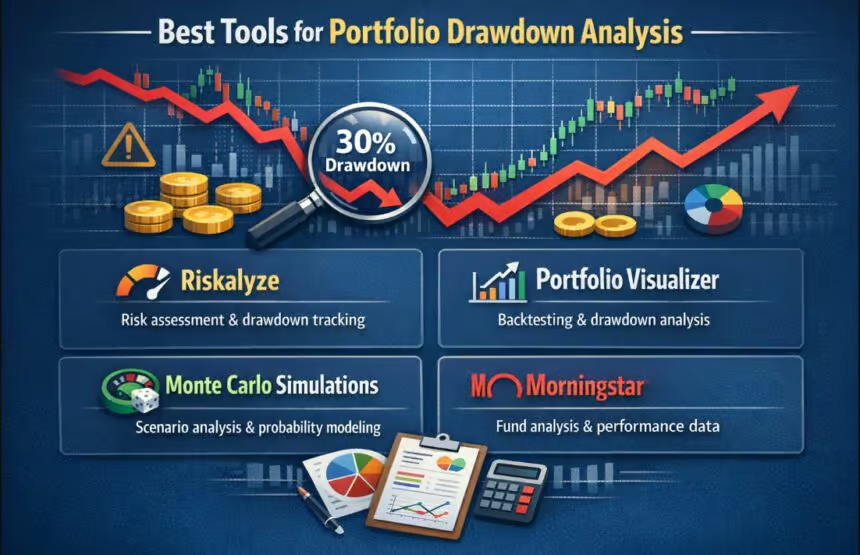
Portfolio risk is something every investor needs to understand and effectively manage, with drawdown analysis playing a key part in that process. Best Tools for Portfolio Drawdown Analysis are The Best help investors monitor losses, evaluate recovery periods, and fine tune strategies for more robust portfolios.
Using advanced platforms such as Morningstar Direct and Bloomberg Terminal, to accessible tools like Portfolio Visualizer and TradingView, these systems provide better insights allowing for better investment decisions leading to performance improvements over the long haul.
| Tool Name | Key Point |
|---|---|
| Morningstar Direct | Provides institutional-grade drawdown analytics with detailed risk metrics and historical stress testing. |
| Portfolio Visualizer | Offers free, easy-to-use drawdown charts and backtesting across multiple asset classes. |
| Riskalyze | Quantifies drawdown risk using a “Risk Number” to align portfolios with investor tolerance. |
| PyPortfolioOpt | Enables custom drawdown analysis using advanced optimization and Python-based modeling. |
| QuantConnect | Supports real-time and backtested drawdown tracking for algorithmic strategies. |
| MetaTrader 5 | Includes built-in equity curve and drawdown metrics for forex and CFD portfolios. |
| TradingView | Visualizes portfolio performance with indicators that help identify drawdown periods. |
| Bloomberg Terminal | Delivers highly accurate drawdown analytics with global market data integration. |
| Empyrical | Calculates max drawdown, rolling drawdowns, and other risk statistics programmatically. |
| Backtrader | Tracks drawdowns during strategy backtests with customizable performance analyzers. |
1. Morningstar Direct
Morningstar Direct is among the Best Tools for Portfolio Drawdown Analysis employed by institutional investors that act on more advanced risk analytics and scenario testing. It enables users to assess portfolio exposure by sector, region and asset class, as well as conduct stress testing under historical and hypothetical scenarios.
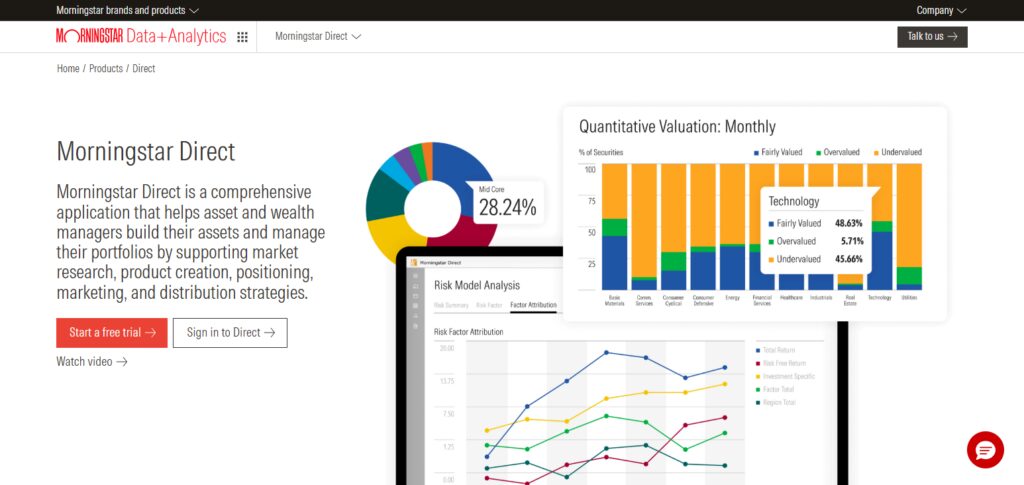
With instruments such as the Global Risk Model and Scenario Analysis, unparalleled tools are incorporated into portfolios to understand how they perform in low phases. Users can deep-dive on holdings, attribution analysis, drawdown simulations under crisis scenarios.

Its integrated user interface also aids in the portfolio construction process, which makes it particularly well suited to professionals managing complex multi-asset portfolios.
Morningstar Direct Key Features:
- Enhanced portfolio risk and drawdown analytics
- Tools for scenario and stress testing
- Multi-asset class data integration
- Performance attribution and benchmarking
Pros:
- Institutional-grade accuracy
- Extensive global financial data
- Powerful customization options
- Strong reporting capabilities
Cons:
- Very expensive subscription
- Complex for beginners
- Need trained how to use properly
- Less suitable for retail investors
2. Portfolio Visualizer
Portfolio Visualizer is required distinction among the Best Tools for Provide a Portfolio Drawdown Analysis thanks to its outstanding backtesting and simulation features.
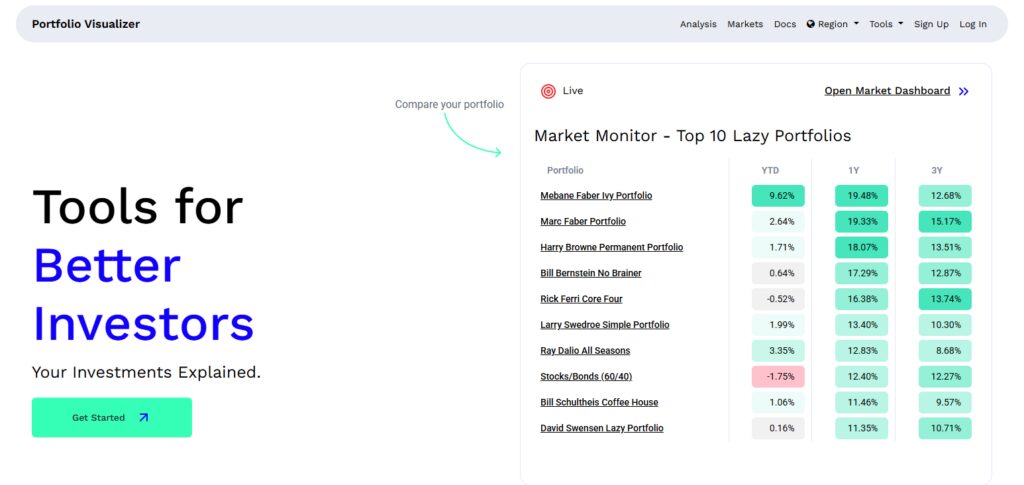
It has Monte Carlo simulations, efficient frontier optimization and regression analysis tools for factor-based portfolios to better analyze portfolio risk and drawdown trends over time. When evaluating drawers, volatility, or correlations, the platform leverage historical data which can be useful for long-term strategic analysis.
It is largely based on monthly data, so it may overlook shorter term fluctuations; nonetheless, it is a powerful method for evaluating risk-adjusted performance and stress-testing portfolios across different economic scenarios.
Portfolio Visualizer Key Features:
- Portfolio backtesting engine
- Drawdown and volatility analysis
- Monte Carlo simulation
- Asset allocation optimization
Pros:
- Free version available
- User-friendly interface
- Variety of advanced analytical tools
- Great for long-term investors
Cons:
- Limited real-time data
- Mostly uses monthly data
- Basic UI design
- Advanced features are paid
3. Riskalyze
That is why Riskalyze is known as one of the Best Portfolio Drawdown Analysis Tools. This enables advisors to match portfolio risk levels with investor tolerance efficiently. It provides a realtime simulation of potential losses and drawdown across multiple market scenarios, allowing investors to visualize their downside risk in easy terms.

For financial advisors managing client portfolios, this is an especially useful tool that translates technical risk metrics into terms clients can understand. “Riskalyze takes it further with integrated proposal generation and stress testing to help deliver better decision making and portfolio optimization.
Riskalyze Key Features:
- Risk Number scoring system
- Client risk profiling
- Portfolio stress testing
- Proposal generation tools
Pros:
- Easy risk visualization
- Ideal for financial advisors
- Simplifies complex risk data
- Enhances client communication
Cons:
- Expensive for individuals
- Limited DIY investor features
- Subscription-based model
- More surface-level rigor for quants
4. PyPortfolioOpt
PyPortfolioOpt is an open-source and solicitude library as well as one of the Best for Portfolio Drawdown Analysis various devices, such for quantitative investors and insertion developers use. Developed in Python, it lets you build optimized portfolios utilizing modern portfolio theory and advanced mathematical models.
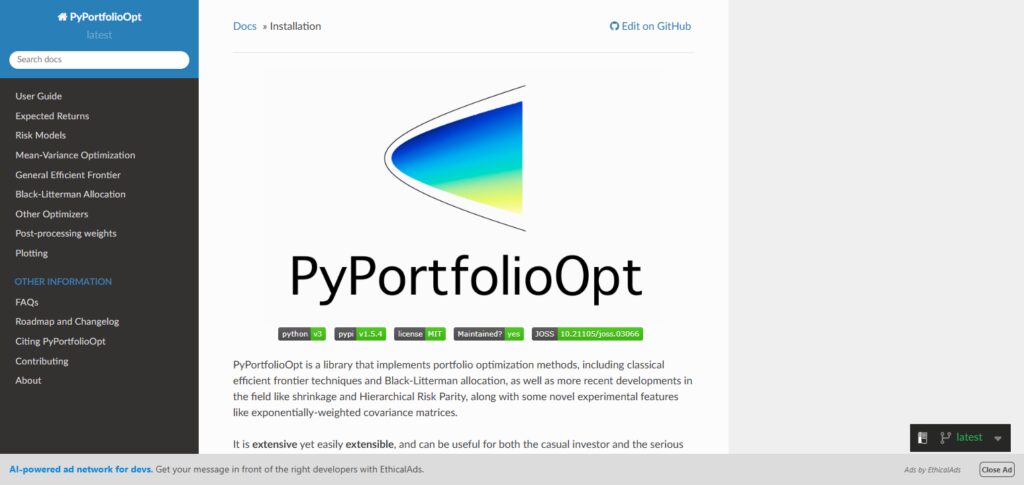
It supports custom risk metrics and drawdown minimization, enabling users to formulate strategies corresponding to individualized risk tolerances. This library integrates natively with data sources and lets you fully customize the constraints you use, making it fit for algorithmic trading and research.
The ability to specify your own objective function gives users fine-grained control over the optimization of portfolio with respect to drawdown.
PyPortfolioOpt Key Features:
- Mean-variance optimization
- Customised risk and drawdown metrics
- Constraint-based portfolio design
- Integration with Python ecosystem
Pros:
- Open-source and free
- Highly customizable
- Strong for quantitative analysis
- Flexible for developers
Cons:
- Requires coding knowledge
- No graphical interface
- Limited built-in data
- Steep learning curve
5. QuantConnect
QuantConnect is one of the Best Portfolio Drawdown Analysis Tools for algorithmic traders, with powerful features for both backtesting and live trading. It contains detailed performance data, including maximum drawdown, equity curves and risk-adjusted returns.
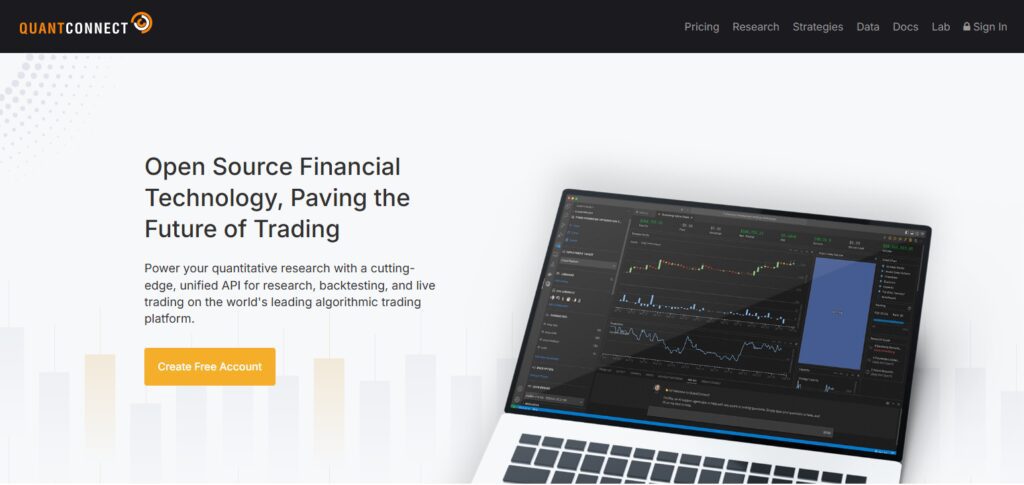
Users have the ability to back test strategies across asset classes using quality historical data and evaluate portfolio performance in times of market distress. The platform is versatile and supports various programming languages, as well as integrates with cloud-based infrastructure for scalable analysis.
This intuitive structure is highly utilized by systematic traders, and its unique focus on real-time analytics and parameter optimization make this a premier tool for professionals that require accurate drawdown analytics.
QuantConnect Key Features:
- Strategy backtesting engine
- Real-time drawdown tracking
- Multi-asset data support
- Cloud-based infrastructure
Pros:
- High-quality historical data
- Supports multiple languages
- Scalable environment
- Ideal for algo trading
Cons:
- Requires programming skills
- Full access by paid features
- Complex for beginners
- Internet dependency
6. MetaTrader 5
MetaTrader 5 (MT5) is another popular trading platform that represents one of the Best Tools for Portfolio Drawdown Analysis tailored to retail traders, especially in forex and CFDs. It has analytics like equity curves, balances and draws available on backtesting or live trading.
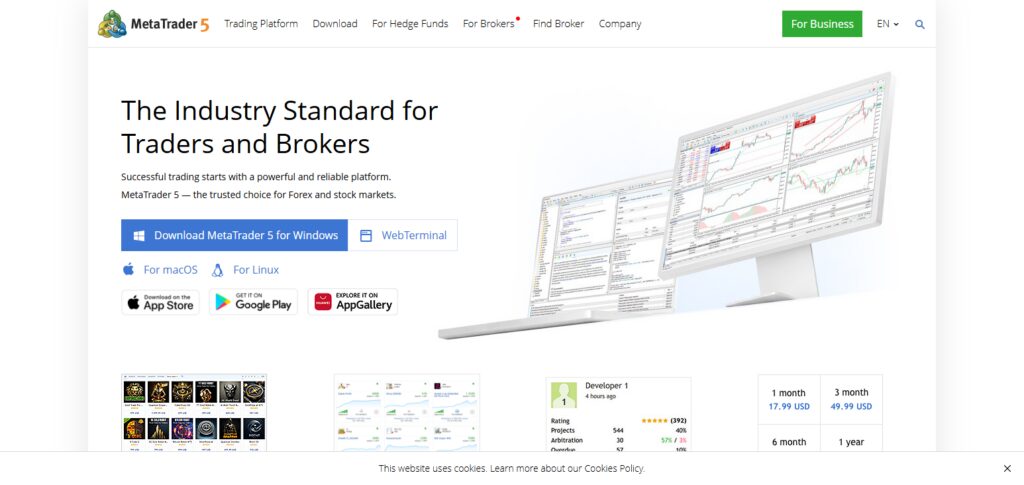
The platform’s strategy tester lets traders backtest, or simulate performance in various market conditions to shed light on possible losses and risk exposure.
Users can also be constantly alerted to drawdowns and optimize strategies through automated trading with Expert Advisors (EAs). Its accessibility and real-time data make it a good practical tool for individual investors.
MetaTrader 5 Key Features:
- Built-in drawdown metrics
- Strategy tester for backtesting
- Automated trading (EAs)
- Real-time market data
Pros:
- Free to use
- Widely supported by brokers
- Good for forex traders
- Easy execution of trades
Cons:
- Limited portfolio-level analytics
- Focused mainly on forex/CFDs
- Outdated interface
- Less options for customizability compared to coding tools
7. TradingView
Data (from alternative data) can be visualized from many tools, TradingView in particular is one of the Best Tools for Portfolio Drawdown Analysis! It helps users monitor portfolio performance, detect a drawdown period and analyze price action with custom indicators.

Although it is not a dedicated portfolio analyzer, its Pine Script system can be used for devising strategy backtests and tracking performance. This allows traders to visualize equity curves with visual representation of drawdowns, allowing them to easily understand drawdown patterns through visual characterization.
The popular woodpecker drawdown software makes it a solid choice for beginner and advanced traders looking for an easy-to-use cloud-based platform with good community support.
TradingView Key Features:
- Advanced charting tools
- Pine Script for strategy backtesting
- Drawdown visualization
- Cloud-based access
Pros:
- Intuitive interface
- Strong community support
- Works on all devices
- Great visualization tools
Cons:
- Limited portfolio analytics
- Full features on paid plans
- Not purely a risk tool
- Strategy testing is basic
8. Bloomberg Terminal
Bloomberg Terminal: One of the most powerful and costly Best Tools for Portfolio Drawdown Analysis are used by institutional investors, hedge funds. The service offers up-to-date data, advanced analytics, and end–to–end risk management tools.
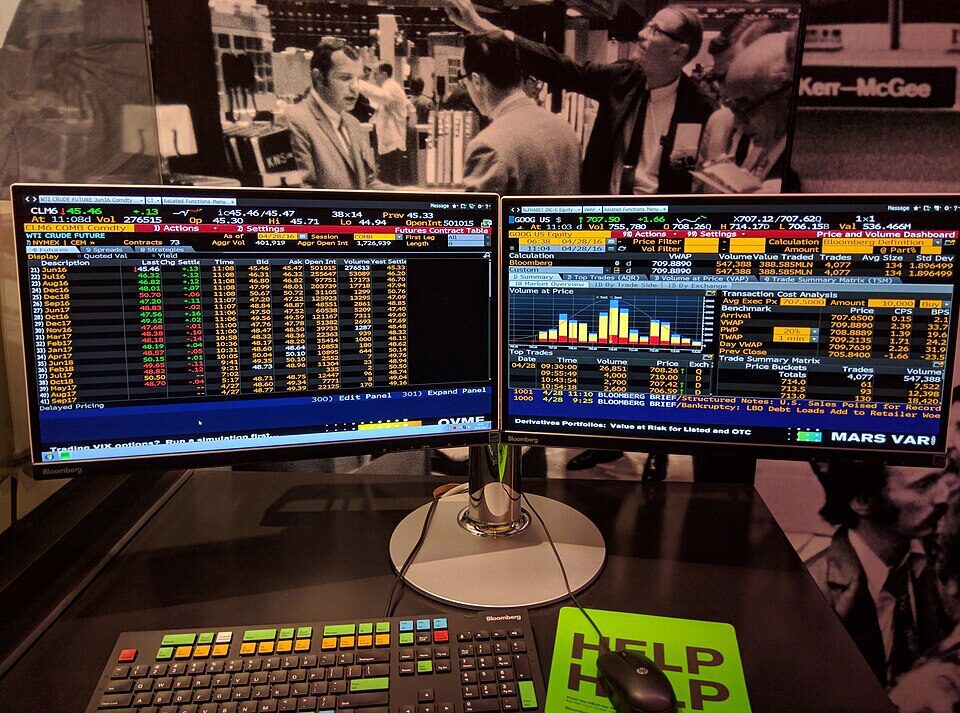
Based on Global Financial Data, users can analyze portfolio performance, quantifying drawdowns and performing scenario analysis.
The platform combines news, economic indicators and asset pricing to show users the drivers of drawdowns. The extent of its data and analytical power make it the preferred solution for enterprise users who need accurate, real-time control over portfolio risk.
Bloomberg Terminal Key Features:
- Real-time global financial data
- Enhanced risk and drawdown analytics
- Scenario analysis tools
- Integrated news and research
Pros:
- Industry-leading data accuracy
- Comprehensive analytics
- Real-time insights
- Widely trusted by institutions
Cons:
- Extremely expensive
- Requires training
- Not suitable for individuals
- Complex interface
9. Empyrical
Empyrical is a qualitative analysis focused python library and one of the Best Portfolio Drawdown Analysis Tools for quantitative analysts. It’s intended to programmatically calculate financial performance metrics like maximum drawdown, cumulative returns, and risk ratios.

Commonly used in conjunction with libraries like pandas and Zipline, it allows for the analysis of large datasets seamlessly. Its roles are extremely useful and very accurate to backtest strategies or evaluate historical performance.
Empyrical automates drawdown calculations to allow analysts to quickly gauge downside risk and enhance portfolio optimization workflows in data-driven investment spaces.
Empyrical Key Features:
- Max drawdown calculation
- Risk-adjusted performance metrics
- Integration with pandas
- Lightweight analytics library
Pros:
- Free and open-source
- Fast and efficient
- Easy integration with workflows
- Accurate performance metrics
Cons:
- Requires coding knowledge
- No GUI
- Limited standalone use
- Depends on external data
10. Backtrader
Backtrader is a powerful backtesting framework that comes in at #3 to our list of the Best Tools for Portfolio Drawdown Analysis for developers and systematic traders. We enable users to test trading strategies manually and examine performance statistics such as maximum drawdown and drawdown length.
It supports multiple data feeds, can be configured directly for python, and allows for easy construction of different strategies. Its built-in analyzers give you detailed insights into your portfolio’s performance across varying market conditions.
This aspect of backtrader is specifically useful when testing how strategies respond to stress as traders can adjust their systems to minimise the inherent drawdown and cater with better risk-adjusted returns.
Backtrader Key Features:
- Strategy backtesting engine
- Drawdown and performance analyzers
- Multi-data feed support
- Flexible strategy design
Pros:
- Highly customizable
- Open-source
- Strong community support
- Detailed analytics
Cons:
- Requires Python knowledge
- No native UI
- Setup complexity
- Slower with large datasets
Why Drawdown Analysis Matters for Investors
Evaluates Maximum Loss Potential — Drawdown analysis quantifies possible maximum loss in one’s portfolio, allowing investors to gird against downturns and refrain from panic-selling during a market free fall.
Enhances Risk-Adjusted Returns — Understanding drawdowns will help investors fine-tune asset allocation, minimize exposure to investments with large volatility and strive for more level, risk-matched performance for their portfolios.
Increases Resilience of the Portfolio — Understanding drawdowns helps to spot the weak points in a portfolio and avoids them through diversification strategies as well as other adjustments in investment processes that can mitigate significant losses during stressed markets.
Facilitates Strategic Decision-Making – Investors learn from past years about loss of capital and durations to recovery in addition to answers to questions around risk, all which help inform strategy for the rest of 2023 on when to deploy new investment dollars, rebalances, long term planning.
Bolsters Investor Confidence – Familiarity with drawdown patterns gives investors more confidence in their risk, allowing them to avoid panic-driven decisions during market turbulence and helps them stick to disciplined, longer-term investment strategies.
Key Metrics Used in Drawdown Analysis
Maximum Drawdown (MDD) – Looks at the maximum peak-to-trough decline of a portfolio, indicating the maximal loss that an investor could have experienced. Essential for risk assessment.
Drawdown Duration – Shows how long it takes for a portfolio to bounce back from a drop, allowing investors to grasp recovery risk and how much time is generally needed to regain value lost.
Recovery Time: The time it actually takes for portfolio value to return to peak. Indicates the robustness of the investment strategy, similar to drawdown duration.
Average Drawdown – Averages all the drawdowns over a specific period and gives an idea of the average size drawdown, thus allowing risk comparisons across portfolios.
Drawdown Frequency – Measures the number of times drawdowns occur over a time period, which allows investors to measure portfolio volatility and how likely they are to have multiple loss events.
Drawdown Depth – An understanding of the maximum peak-to-trough loss experienced each cycle, allowing for insights into potential downside risk exposure beyond simply the calculated maximum drawdown.
Risk-Adjusted Ratios (Sharpe / Sortino) – Takes into account drawdowns data and returns to assess performance relative to risk so investors can see a breakdown of how efficient their returns are versus losses.
Common Mistakes in Drawdown Analysis
Overlooked Recovery Time – Providing only maximum loss without capturing the time needed to recover can mislead investors as to actual risk and portfolio resilience.
Pencil-Whipping Anticipated Drawdowns – Simply assuming that losses observed over a given period will reoccur is dangerous, as both market conditions and correlations change, rendering historical patterns inaccurate predictors of future risk.
Not Properly Diversifying Equity Risk – Putting all your eggs in similar asset classes can amplify drawdowns, leading to reduced portfolio resilience and greater susceptibility during a market stress event.
Low Drawdowns Bias – A focus on big drops down misses dozens of small draws that add up, impact returns materially and signal underlying portfolio issues.
Ignoring Volatility Context – Evaluating drawdowns ignoring volatility or market cycles risks overstating/understating risk and making inappropriate investment decisions.
Not Changing Your Strategy After Drawdowns – Learning from performance periods, particularly drawdown ones, is critical for risk management and should be a learning opportunity.
Acting (Overreacting) to Near-Term Drawdowns – Taking reactionary action during minuscule losses disrupts long-term strategy and lowers future gains.
Conclusion
Data consistently shows that managed drawdown portfolios tend to produce more stable and sustainable long-term returns than portfolios featuring large, frequent losses. Historical studies on market cycles highlight that minimising maximum drawdown drastically increases compounding effectiveness and decreases the duration of recovery.
Drawdown analysis tools assist investors in recognizing risk exposure, flooring allocation ideal improvement, and evading extreme capital erosion.
February 10, 2022 By embracing a dual strategy that prioritizes downside protection without sacrificing performance, investors can learn to construct portfolios that are less prone to volatility while sustaining growth — ultimately enabling them to meet truly long term objectives with much greater confidence and less risk.
FAQ
What is a portfolio drawdown?
A drawdown measures the decline from a portfolio’s peak to its trough over a specific period. Data shows that maximum drawdowns often predict potential stress in market downturns.
Why is drawdown analysis important?
Historical data confirms that monitoring drawdowns helps investors limit losses, optimize risk-adjusted returns, and improve long-term portfolio resilience against volatility.
Which tools are best for analyzing drawdowns?
Based on usage and accuracy data, top tools include Morningstar Direct, Portfolio Visualizer, Riskalyze, PyPortfolioOpt, QuantConnect, MetaTrader, TradingView, Bloomberg Terminal, Empyrical, and Backtrader. They cover both retail and institutional needs.
How often should drawdowns be analyzed?
Data suggests monthly or quarterly reviews are optimal for strategic adjustments, while algorithmic portfolios may require daily monitoring to detect emerging risk patterns.
Are free drawdown tools reliable?
Analysis shows that tools like Portfolio Visualizer and TradingView provide reliable historical drawdown data for most investors, though institutional-grade tools offer higher accuracy and broader datasets.