
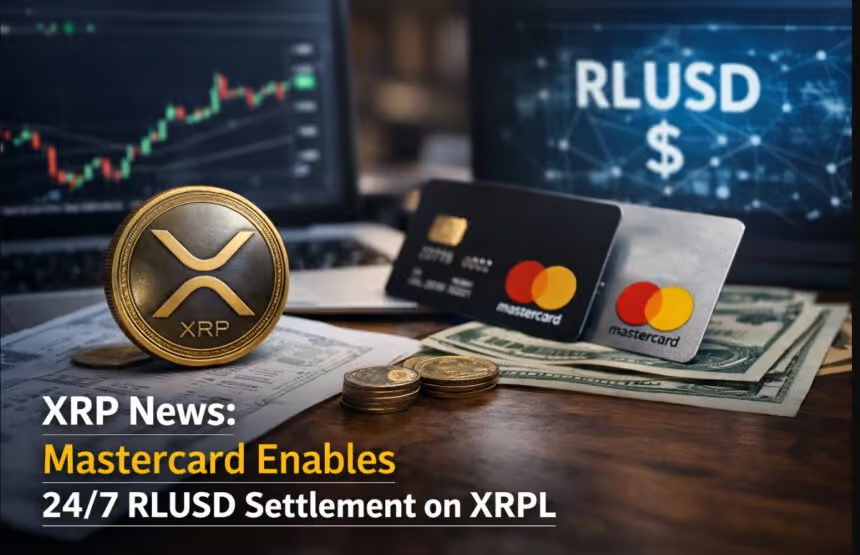
RLUSD Stablecoin Joins Mastercard Settlement Network, Driving Adoption of XRP Ledger
Mastercard’s June 3rd announcement added Ripple’s RLUSD stablecoin to a settlement network for global transactions. Fully automated settlement in frameworks supported by stablecoins facilitates rapid transaction clearances across multiple blockchains. This announcement added momentum to a rapidly evolving industry and continues progress for the XRP ecosystem.
Mastercard’s settlement framework is supported by additional regulated stablecoins. Mastercard mentioned RLUSD, USDC, and SoFi issued stablecoins, as well as some associated with the Paxos and USDP projects. The flexible settlement framework enables issuers and acquirers to conduct card operations on any day of the week, even on holidays.
Mastercard’s newly developed settlement framework achieves greater flexibility for financial institutions. Current settlement frameworks leave payment settlement bound by banking hours and holidays in the corresponding payment country. By utilizing stablecoins, the blockchains used by Mastercard’s settlement framework will remove those restrictions.

Mastercard has built a settlement framework that supports stablecoins on multiple blockchains. The blockchains of Arbitrum, Base, Canton, Ethereum, Polygon, Solana, Tempo, and the XRP Ledger enabled stablecoins will be integrated into the framework. The XRP community will take special interest in this announcement, as it highlights Ripple’s increasing involvement with institutional payment solutions and the improvement of customer operations.

The first rollout of the stablecoin settlement service will be available to select payment providers and financial institutions, including ARQ, CBW Bank, Cross River, Lead Bank, and Nuvei. Mastercard specified the first phase will target the U.S. and Latin America, with a larger rollout to the rest of the world slated for later this year.
Mastercard’s Executive Vice President of Blockchain and Digital Assets, Raj Dhamodharan, noted that the next step for stablecoin adoption will involve a great deal of pragmatism. He explained that the speed, liquidity, and efficiency of settlement will impact the businesses and financial institutions involved, and thus, settlement is heavily prioritized.
This move is a part of Mastercard’s strategy to innovate and expand their digital assets and blockchain payments. Mastercard has been extending their initiatives in crypto, including new partnerships with Ripple, Binance, Circle, Gemini, PayPal, and Paxos, all a part of Mastercard’s Crypto Partner Program.
The announcement is also in line with Mastercard’s recent move to strengthen their established BitLicense with the New York Department of Financial Services (NYDFS) and reinforce their regulatory position for digital assets. This regulatory approval helps Mastercard’s long-term projects on supporting stablecoins and tokenized financial assets on their settlement systems.
For Ripple, RLUSD now being a part of Mastercard’s settlement network is an important step towards Ripple’s mission of connecting traditional finance to blockchain. Ripple’s Senior Vice President, Jack McDonald, explained that RLUSD is a response to the market demand for on-ledger, regulated stablecoins that have real-world use cases.
This builds on another momentous occasion pertaining to JPMorgan, Ripple, Mastercard, and Ondo Finance circulating via the XRPL. These organizations ran a successful test transaction exemplifying the real-time, cross-border settlement ability of the XRP Ledger coupled with the tokenization of U.S. Treasuries beyond the confines of the traditional banking system.
The evolution of stablecoins away from merely a crypto trading tool to settlement assets, coupled with the adoption of the RLUSD liquidity settlement via Mastercard, illustrates the merging of the traditional banking system with that of FinTech. The adoption of the RLUSD not only further reinforces the XRPL’s standing as a foundational component, but also as a backbone for a new and improved global settlement layer for payments and digital assets.
Conclusion
Ripple, RLUSD, and the XRP Ledger ecosystem reached a notable new stage for Ripple and RLUSD with the announcement that Mastercard went a step further by adding RLUSD in the Mastercard global settlement networks.
Mastercard’s settlement networks will facilitate 24/7 on-chain settlements across different blockchains. Mastercard is interested in the next level of real world settlement of Regulated Stablecoins of which RLUSD is the first.
This also illustrates the confidence of blockchain technology in the capabilities of the new payment technologies. Along with the numerous XRP Ledger projects already underway with banks and Mastercard’s development, these elemens are also indicating that Ripple is paving the way for new and faster payment systems.