
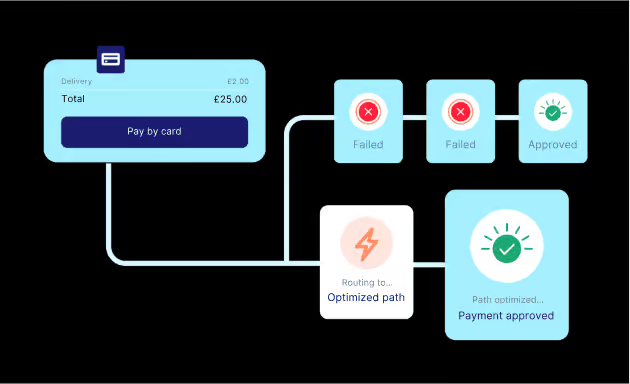
In this article, I am going to talk about the Leading Platforms for Dynamic Payment Routing Decisions that would help businesses refine their bleeding transaction success, reduction in payment declines and enhancing global checkout performance.
Dynamic payment routing for merchants allows the automatic selection of the optimal payment processor using live data leading to better authorization rates, lower costs and a continued payment experience across different regions and forms of payments.
Key Point & Best Platforms for Dynamic Payment Routing Decisions
| Platform | Key Points |
|---|---|
| Adyen | Unified commerce platform with smart payment routing, real-time authorization optimization, global acquiring coverage, AI-driven risk management, and detailed payment analytics. |
| Stripe Payment Orchestration | Flexible payment routing rules, multi-PSP management, strong developer APIs, automated retries, global payment method support, and real-time performance monitoring. |
| Checkout.com Orchestration | Intelligent gateway switching, advanced routing logic, localized acquiring, fraud optimization tools, high authorization focus, and customizable payment flows. |
| Gr4vy | Cloud-native payment orchestration, no-code routing configuration, multi-provider integrations, token portability, low vendor lock-in, and scalable infrastructure. |
| Spreedly | Secure payment vaulting, multi-gateway routing, PCI compliance support, global payment connections, transaction failover routing, and strong API flexibility. |
| ACI Worldwide | Enterprise-grade payment orchestration, real-time fraud prevention, omnichannel payment support, bank-grade infrastructure, global transaction processing, and advanced analytics. |
| Worldpay BIN Insights (FIS) | BIN-level routing intelligence, issuer performance insights, authorization optimization tools, cost-efficient routing decisions, global acquiring network, and payment analytics dashboards. |
| Cybersource | Visa-powered payment management, smart routing capabilities, fraud detection integration, tokenization services, global payment acceptance, and enterprise security compliance. |
| BlueSnap | All-in-one payment orchestration, intelligent routing optimization, global payment methods, subscription billing tools, unified reporting dashboard, and embedded payments support. |
| Rapyd | Global fintech payment platform, local payment method access, dynamic routing across regions, payout and collection management, API-first infrastructure, and worldwide coverage. |
1. Adyen
Adyen is one global payment platform that makes complex payment ecosystems feel simple with customized smart routing and real-time optimization. It allows businesses to route transactions dynamically based on geography, card design and the performance of each issuer to an optimal acquiring bank.
With the help of machine learning, Adyen achieves better authorization rates, fewer payment failures, and lower processing costs. Consolidated reporting, fraud protection and omnichannel payment capabilities make life easy for merchants.

Among the winners in “Best Platforms for Dynamic Payment Routing Decisions, Adyen combines acquiring, gateway and analytics by creating one ecosystem — reducing dependency on multiple providers while increasing payment optimization globally.
Adyen — Key Features
| Feature | Description |
|---|---|
| Unified Commerce Platform | Combines online, mobile, and in-store payments in a single infrastructure for seamless routing decisions. |
| Intelligent Payment Routing | Uses real-time data, issuer behavior, and machine learning to route transactions to the best acquirer. |
| Global Acquiring Network | Direct connections to local banks worldwide improve authorization rates and reduce cross-border costs. |
| Advanced Risk & Fraud Tools | Built-in risk management and fraud detection integrated with payment optimization workflows. |
| Real-Time Analytics Dashboard | Provides deep performance insights, approval tracking, and routing optimization metrics. |
Adyen Pros & Cons
Pros
- Online + POS + mobile (Unified commerce platform).
- Advanced AI-based smart routing optimization.
- Excellent global acquiring network coverage.
- Real-time payment analytics and insights.
- Robust fraud prevention with built-in risk engine
Cons
- Enterprise-focused pricing structure.
- Complex onboarding for small businesses.
- Requires technical implementation expertise.
- Not as flexible compared to a dedicated orchestration layer.
- Regional limitations apply to support response.
2. Stripe Payment Orchestration
Stripe Payment Orchestration, helps businesses control how payments flow as they can orchestrate across multiple processors and regions, rather than being a country-and-processor-specific solution. Businesses can formulate a rule-based routing strategy based on performance data, transaction value, customer location, or preferences for payment methods.
Stripe also automates retries and failover routing, along with deep API customization for developers. A merchant’s decision-making around routing can also be a process in real time through analytics that helps continually optimize those decisions.
Voted as one of the Best Platforms for Dynamic Payment Routing Decisions, Stripe enables fast-growing enterprises to implement scalable orchestration, providing rich integrations and global methods across over 135 currencies to boost authorization success within a flexible operational environment.
Stripe Payment Orchestration — Key Features
| Feature | Description |
|---|---|
| Multi-Processor Routing | Automatically routes payments across gateways and processors based on performance rules. |
| Smart Retries | Optimizes failed payment retries using AI-driven timing and issuer behavior analysis. |
| Developer-First APIs | Flexible APIs enable businesses to customize routing logic and payment flows easily. |
| Global Payment Methods | Supports cards, wallets, bank transfers, and regional payment methods worldwide. |
| Unified Reporting | Centralized dashboard consolidates transaction data across all payment providers. |
Stripe Payment Orchestration Pros & Cons
✅ Pros
- Developer-friendly APIs and documentation.
- Dynamic, rich automation for retries and routing
- Wide payment method ecosystem.
- Custom billing, subscriptions and fraud tools.
- Digital business fast global scalability
❌ Cons
- At scale, transaction fees are often higher.
- Not as customizable as standalone orchestration tools
- Dependency on Stripe infrastructure.
- Less multi-acquirer control vis-a-vis the specialists.
- Advanced features require technical knowledge.
3. Checkout.com Orchestration
Checkout. Gen Orchestration with an emphasis on the best payment acceptance rates through intelligent gateway switching and localized acquiring strategies. Based on the issuers’ responses and transaction patterns, the platform intelligently routes payments to a channel with higher approving probability.
Businesses have more control over routing logic, compliance and fraud optimization while providing a frictionless checkout experience. Actionable insights into performance enable ongoing optimization of payment flows. Today, Checkout. com technology orchestrates buyers, allowing global merchants to reduce cross-border friction, interchange costs, and optimize customer conversation — informed by data.
Checkout.com Orchestration — Key Features
| Feature | Description |
|---|---|
| Intelligent Routing Engine | Routes transactions dynamically based on geography, BIN data, and performance analytics. |
| Real-Time Optimization | Adjusts routing decisions instantly to maximize authorization success rates. |
| Modular Payments Stack | Allows businesses to integrate only required payment services. |
| Global Acquiring Coverage | Offers local acquiring capabilities in major international markets. |
| Advanced Reporting Tools | Provides detailed payment performance and routing analytics dashboards. |
Checkout. com Orchestration Pros & Cons
✅ Pros
- High authorization optimization capabilities.
- Strong global acquiring coverage.
- Real-time payment performance analytics.
- Flexible routing rules engine.
- Enterprise-grade payment infrastructure.
❌ Cons
- Designed mainly for large merchants.
- Pricing transparency varies.
- Requires integration effort.
- Smaller ecosystem than Stripe.
- Limited SMB-focused onboarding tools.
4. Gr4vy
Gr4vy A cloud-native payment orchestration stack designed for eliminating vendor lock-in and providing full control to merchants on their payment infrastructure. Seems that organizations could utilize it, launch their own payment orchestration instance and own the data securely and switch providers easily.
Routing rules are configurable by the business without extensive development work as multiple PSPs and fraud tools are integrated into one unified platform. Long-term scalability through token portability and a modular architecture.
Recognized in the category for Best Platforms to Make Dynamic Payment Routing Decisions, Gr4vy is particularly well-suited for enterprises looking to achieve independence, resilience and rapid experimentation with local routing strategies; enabling businesses a flexible approach for their payment routing decisions across regions and providers.
Gr4vy — Key Features
| Feature | Description |
|---|---|
| Cloud-Native Infrastructure | Runs payment orchestration in dedicated cloud instances for scalability and security. |
| Vendor-Independent Routing | Enables merchants to switch gateways without rebuilding integrations. |
| Dynamic Payment Decisioning | Applies rules based on performance, region, or cost optimization. |
| Token Management | Centralized token vault ensures secure payment data portability. |
| Low-Code Configuration | Simplifies orchestration setup through configurable workflows. |
Gr4vy Pros & Cons
✅ Pros
- Cloud-native orchestration architecture.
- Full gateway independence.
- Easy multi-processor switching.
- Strong data ownership and control.
- Fast deployment through APIs.
❌ Cons
- Requires payment expertise to configure.
- Smaller market presence.
- Limited built-in acquiring services.
- Needs external fraud/payment tools.
- Best suited for mid-large merchants.
5. Spreedly
Spreedly is an expert in payment orchestration (in addition to secure card vaulting and universal gateway connectivity). Its platform provides merchants with a secure storage for payment tokens, while routing transactions via tens of thousands of gateways and processors around the globe.
Whether it is with smart failover routing, allowing businesses to automatically recover transactions when primary processors go down. PCI compliance is simplified and provides flexible API integration for companies.
Spreedly, one of the Best Platforms for Dynamic Payments Routing Decisions offers merchants the opportunity to optimise authorization performance without changing payment relationships, realising its ideal target audience with businesses managing complex multi-gateway environments.
Spreedly — Key Features
| Feature | Description |
|---|---|
| Gateway Agnostic Platform | Connects to hundreds of payment gateways and services globally. |
| Universal Tokenization | Stores payment credentials securely for cross-gateway usage. |
| Intelligent Failover Routing | Automatically reroutes payments when a processor fails. |
| Payment Flexibility | Supports subscriptions, marketplaces, and complex payment ecosystems. |
| PCI Compliance Support | Reduces compliance scope through secure data handling infrastructure. |
Spreedly Pros & Cons
✅ Pros
- Gateway-agnostic payment vault.
- Supports hundreds of payment providers.
- Excellent tokenization and PCI compliance tools
- Excellent failover routing support.
- Well suited for subscription and SaaS models.
❌ Cons
- No native payment acquiring.
- Requires third-party processors.
- Complex configuration for beginners.
- Limited built-in analytics.
- Added cost layer in payment stack.
6. ACI Worldwide
ACI Worldwide provides enterprise-grade payment orchestration designed specifically for banks, financial institutions, and large multinational merchants. Its platform combines real-time payments processing, fraud prevention and advanced routing intelligence into a scalable infrastructure. Businesses can dynamically route transactions based on the issuer’s performance, transaction risk scoring, or resolution tendencies per region.
ACI’s analytics tools give granular visibility into authorization trends and payment behavior. ACKNOWLEDGEMENT – Named in the Best Platforms for Dynamic Payment Routing Decisions category of this year’s list, ACI Worldwide continues to enable high transaction volumes across its solutions while ensuring regulatory compliance, operational resilience and enhanced payment success rates online and in-store.
ACI Worldwide — Key Features
| Feature | Description |
|---|---|
| Enterprise Payment Orchestration | Designed for banks, processors, and large enterprises handling high transaction volumes. |
| Real-Time Payments Support | Enables instant payments and real-time authorization routing. |
| Fraud & Risk Management | Integrated fraud monitoring enhances routing decisions. |
| Omnichannel Payment Processing | Supports digital, mobile, and in-branch transactions. |
| High Availability Architecture | Ensures resilient payment routing with minimal downtime. |
ACI Worldwide Pros & Cons
✅ Pros
- Enterprise banking-grade infrastructure.
- Advanced real-time payment routing.
- Robust fraud and risk management capabilities.
- Global payment scheme connectivity.
- Highly scalable for large institutions.
❌ Cons
- Legacy system complexity.
- Longer deployment timelines.
- Higher operational costs.
- Requires specialized technical teams.
- Not the best for startups or SMEs.
7. Worldpay BIN Insights (FIS)
Woldpay BIN Insights (FIS)_ Payment routing optimization with Bank Identification Number analysis This allows the platform to consider issuer behaviour, approval patterns and regional performance data when informing more intelligent point-of-sale routing decisions. Merchants understand which acquiring paths perform best, and minimize declines due to issuer or cross-border limitations.

Real-time dashboards provide actionable intelligence for payment optimizers. As one of the **Best Platforms for Making Dynamic Payment Routing Decisions in 2023, Worldpay BIN Insights enables enterprises to make more data-informed routing decisions that optimize authorization rates while also helping businesses control transaction costs and enhance their worldwide customer payment experience.
Worldpay BIN Insights (FIS) — Key Features
| Feature | Description |
|---|---|
| BIN-Level Intelligence | Uses card issuer and BIN data to optimize routing strategies. |
| Authorization Optimization | Identifies approval patterns and recommends routing improvements. |
| Issuer Performance Analytics | Provides insights into issuer acceptance behavior globally. |
| Cost Optimization Tools | Routes payments to minimize interchange and processing costs. |
| Detailed Reporting | Offers deep analytics for payment success benchmarking. |
Worldpay BIN Insights (FIS) Pros & Cons
✅ Pros
- Deep BIN-level payment intelligence.
- Improves authorization success rates.
- Data-driven routing optimization.
- Strong enterprise acquiring network.
- Useful decline analysis reporting.
❌ Cons
- Limited orchestration flexibility alone.
- Enterprise onboarding process.
- Requires integration with Worldpay ecosystem.
- Complex analytics for new users.
- Less developer-focused tooling.
8. Cybersource
Cybersource, a Visa company, provides an entire payment management ecosystem—including fraud protection, tokenization, and dynamic routing features. Businesses can also route payments across multiple acquirers according to risk levels, geographic location or payment performance metrics.

Its global reach allows for a broad range of currencies and payment methods, while complying with rigorous standards. Cybersource also provides powerful analytics to track payment success trends. Best for Dynamic Routing and Payment Decisioning — Cybersource is perfect for scale=up/scale-out enterprises needing secure/safe routing solutions powered by a globally trusted payments framework.
Cybersource — Key Features
| Feature | Description |
|---|---|
| Global Payment Acceptance | Supports multiple currencies and international payment methods. |
| Smart Transaction Routing | Selects optimal acquirer based on risk and approval likelihood. |
| Fraud Management Suite | Combines fraud detection with payment optimization tools. |
| Tokenization & Security | Advanced tokenization enhances data security and flexibility. |
| Enterprise Integration | Seamlessly integrates with enterprise commerce systems. |
Cybersource Pros & Cons
✅ Pros
- Backed by Visa global infrastructure.
- Powerful fraud detection tools.
- Multi-gateway routing support.
- Enterprise security and compliance features.
- Strong cross-border payment capabilities.
❌ Cons
- Interface can feel outdated.
- Integration complexity.
- Pricing could be elevated for smaller merchants.
- Requires technical configuration.
- Steep learning curve for configuration of advanced routing.
9. BlueSnap
BlueSnap is an all-in-one payment platform that encompasses gateway services, subscription billing and smart routing optimization. Its orchestration tools automatically route transactions to the most optimal processor, helping to increase approval rates and lower processing costs.
Business also gain global acquiring, localized payment methods, and unified reporting dashboards. BlueSnap provides a way to do all of that from one platform — making international expansion, compliance and currency management easier.
Rated as one of the Best Platforms for Dynamic Payment Routing Decisions BlueSnap empowers growing companies to integrate payment operations without compromising conversion performance across several markets and customer segments.
BlueSnap — Key Features
| Feature | Description |
|---|---|
| All-in-One Payment Platform | Combines gateway, acquiring, and orchestration capabilities. |
| Intelligent Routing | Dynamically routes transactions to improve approval rates. |
| Global Payment Coverage | Supports international currencies and localized payment methods. |
| Subscription Billing Tools | Built-in recurring payment and billing management features. |
| Unified Commerce Analytics | Provides consolidated reporting across payment channels. |
BlueSnap Pros & Cons
✅ Pros
- All-in-one payment orchestration platform.
- Built-in global acquiring network.
- Subscription billing support.
- Smart routing improves approval rates.
- Simplified merchant onboarding.
❌ Cons
- Smaller ecosystem compared to Stripe.
- Limited deep customization.
- Enterprises had less sophisticated reporting tools
- Regional availability differences.
- Not the best for highly complex routing logic.
10. Rapyd
Rapyd is a global fintech platform that combines payment acceptance, payouts and financial services through dynamic routing technology. It links merchants to hundreds of global and local payment methods while optimizing the processing path.

Rapyd’s API-first architecture enables businesses to create unique routing strategies by geography, currency or transaction type. Cross-border commerce and embedded finance capabilities are also supported by the platform.
As one of the Best Platforms for Dynamic Payment Routing Decisions, Rapyd enables businesses to go global, increase payment success rates and deliver local payment experiences without having to manage separate providers.
Rapyd — Key Features
| Feature | Description |
|---|---|
| Global Fintech Network | Supports payments, payouts, wallets, and local payment methods worldwide. |
| Local Payment Routing | Optimizes transactions using regional acquiring connections. |
| Embedded Finance APIs | Enables businesses to embed payments and financial services easily. |
| Cross-Border Payment Optimization | Improves acceptance rates in emerging and international markets. |
| Unified Payments Platform | Central dashboard manages global payment operations efficiently. |
Rapyd Pros & Cons
✅ Pros
- Strong local payment method coverage.
- Excellent cross-border routing options.
- A single API for both payments and payouts.
- Supports emerging markets well.
- Built for global expansion strategies.
❌ Cons
- Documentation learning curve.
- Pricing structure varies by region.
- Enterprise support preferred.
- Requires configuration for optimization.
- Laggards have less mature analytics than leaders.
Conclusion
Dynamic Payment Routing Decisions: Selecting the Most Effective Platforms Adyen, Stripe, Checkout. com, Gr4vy, Spreedly, ACI Worldwide, Worldpay BIN Insights, Cybersource, BlueSnap and Rapyd help merchants route their transactions intelligently; real-time data gets analyzed in a whir through the cloud.
Dynamic Routing solution to boost authorization rates and reduce regional payment failure. Choosing the right platform is really based on company size, global expansion goals, technical flexibility and performance optimization needs. Smart routing technology can set you up for long-term success, maximizing revenue recovery and resilience in your payment infrastructure.
FAQ
What are Dynamic Payment Routing Decisions?
Dynamic payment routing decisions refer to automatically directing payment transactions to the best payment processor, acquiring bank, or gateway based on real-time factors such as location, card issuer performance, currency, and authorization success rates. This helps improve payment approvals and reduce transaction failures.
Why are Dynamic Payment Routing platforms important for businesses?
These platforms help businesses increase authorization rates, lower processing costs, reduce failed transactions, and improve checkout experiences. They allow merchants to optimize payments globally without manually switching between payment providers.
Who should use Dynamic Payment Routing platforms?
E-commerce businesses, SaaS companies, subscription services, marketplaces, fintech companies, and global enterprises processing high transaction volumes benefit most from dynamic payment routing solutions.
How do Dynamic Payment Routing platforms improve authorization rates?
They analyze transaction data in real time and route payments through the acquiring bank or processor with the highest likelihood of approval. Features like smart retries, failover routing, and BIN-level intelligence significantly reduce declines.