
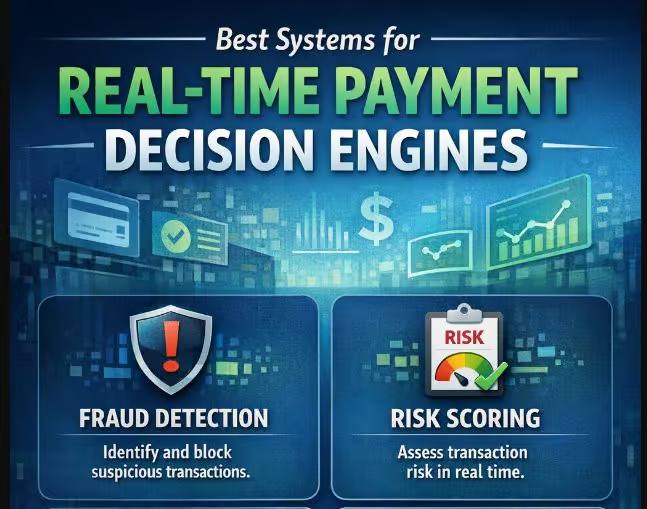
In this article, I will be covering the Best Systems for Real-Time Payment Decision Engines that aid banks, fintech platforms and businesses to process payments instantly with intelligent decision-making.
These advanced systems also provide real-time authorization, fraud detection, automate settlement and facilitate seamless fund movement that enables organizations to boost transaction speed while reducing risks and delivering efficient digital money experiences on a global scale!
What Are Real-Time Payment Decision Engines?
These are advanced financial systems that can instantly vet and approve or deny transactions in real-time. “By analyzing payment data in milliseconds using a mix of artificial intelligence, machine learning, fraud detection rules, and risk scoring models.
These engines examines factors like user behavior, transaction history, location, device information and spending patterns to decide if a payment is valid or potentially fraudulent.

Their split-second decisions assist financial institutions, banks, and fintech platforms in minimizing fraud, increasing security, and facilitating seamless customer experiences without time delays.
They can make a huge impact on these processes, especially in industries like digital banking, e-commerce payments and card processing systems where precision and speed are important.
Key Point & Best Systems for Real-Time Payment Decision Engines
| System | Key Point |
|---|---|
| FIS Real-Time Decision Engine | Provides instant payment authorization, fraud detection, and transaction decisioning using advanced analytics and banking integration. |
| ACI Worldwide Real-Time Payments | Enables banks and financial institutions to process real-time account-to-account payments with high scalability and regulatory compliance. |
| Routable Instant Payouts | Automates business payments and enables fast payouts through integrated financial workflows and approval automation. |
| Optimus AI Reconciliation | Uses AI-driven automation to match transactions, reconcile payments instantly, and reduce manual financial operations workload. |
| Zelle (Early Warning Services) | Offers real-time peer-to-peer bank transfers directly between U.S. bank accounts with immediate fund availability. |
| Worldpay Real-Time Settlement | Supports instant merchant settlement and payment processing across multiple global payment networks and channels. |
| Adyen Real-Time Payments | Delivers unified commerce payments with instant authorization, risk evaluation, and global real-time payment connectivity. |
| Stripe Treasury + Connect | Enables platforms to embed banking, payouts, and real-time fund movement capabilities directly into applications. |
| FedNow (Federal Reserve) | U.S. instant payment rail allowing financial institutions to send and receive payments 24/7 with immediate settlement. |
| Visa Direct | Facilitates real-time push payments to cards, bank accounts, and digital wallets globally for payouts and disbursements. |
1. FIS Real-Time Decision Engine
FIS Real-Time Decision Engine; enables banks and financial institutions to assess transactions in real time by applying intelligent risk checks and authorization controls. Its platform unifies real-time analytics, fraud prevention, payment orchestration and compliance monitoring on a single infrastructure.

Among the Best Systems for Real-Time Payment Decision Engines powers high-volume payment environments including card payments, account-to-account transfers and digital wallets.
For financial institutions: automated decision workflows, reduced exposure to fraud, and quicker customer payment experience. Its scalable architecture easily integrates with core banking systems to help organizations efficiently modernize legacy payment operations.
FIS Real-Time Decision Engine Features
- Fraud detection and risk scoring powered by AI
- Authorization and monitoring of transactions in real-time
- Machine learning-based behavioral analytics
- Integrated with banking core system seamlessly
Pros
- Highly accurate fraud prevention
- Reduces false declines significantly
- Strong enterprise-level scalability
- Operates on different payment channels
Cons
- Implementation and maintenance cost high
- Need very large historical data to perform well
- Small business becomes too complex to integrate
2. ACI Worldwide Real-Time Payments
ACI Worldwide Real-Time Payments provides enterprise-level payment processing built for instant funding and around-the-clock transactional access. The platform provides banks access to local and international instant payment networks as well as regulatory compliance and operational resilience.
Named one of the Best Systems for Real-Time Payment Decision Engines, ACI powers real-time clearing, settlement, liquidity management and fraud monitoring. Its modular architecture enables account-to-account payments, bill payments and merchant transactions.
ACI’s technology helps financial institutions minimize settlement latencies, build customer confidence and deliver 24/7 banking experiences in fast-changing payment ecosystems.
ACI Worldwide Real-Time Payments Features
- Adheres to global real-time payment schemes (FedNow, RTP, SEPA)
- End-to-end payment orchestration platform
- In-built fraud detection and liquidity management
- 24/7/365 instant payment processing
Pros
- Very scalable for banks and PSPs
- Effective and global interoperability
- High reliability and uptime
- Processes multiple payment types in a unified system
Cons
- Enterprise-focused, not SME-friendly
- Complex setup and configuration
- Needs technical skills to use fully
3. Routable Instant Payouts
Routable Instant Payouts targets automating business payment workflows and speeding up vendor or partner disbursements. It marries approval workflows, invoice management and automated processing of payouts.
Recognized as one of the Best Systems for Real-Time Payment Decision Engines, Routable helps companies simplify their accounts payable process into easy-to-follow steps to allow immediate execution of payment once approved.
Businesses benefit from better financial visibility, quicker settlements with vendors and less time manually reconciling accounts.
Its API-first architecture enables enterprises to embed on-demand payouts instantly into operational stacks, improving efficiency for marketplaces, SaaS platforms and other digital-native organizations with high payment volume.
Routable Instant Payouts Features
- API-driven instant payout system
- Supports ACH, RTP and international transfers
- Integration of payee onboarding and compliance automation
- Bulk payout processing
Pros
- Fast integration for developers
- Ideal for marketplaces and gig platforms
- Overcome slow payouts and low user experience
- Extensive automation in the compliance and tax workflows
Cons
- Not as much banking infrastructure as bigger networks
- Not good for traditional Banking ecosystems
- Coverage is limited to support rails
4. Optimus AI Reconciliation
With the ability to automatically match transactions and payments, AI is used in Optimus AI Reconciliation for financial reconciliation as well. It uses payment data from various sources to quickly identify discrepancies and automatically address mismatches.
The solution has also been recognized among the Best Systems for Real-Time Payment Decision Engines helping organizations reach real-time financial accuracy and operational transparency.
This helps companies close financial records more quickly while minimizing operational risk by reducing manual reconciliation workloads.
Outcomes with Optimus AI optimize the payment process through increased audit preparedness, reduced human error and allowing finance teams to spend time on providing strategic insight rather than reconciling data.
Optimus AI Reconciliation Features
- Intelligent transaction matching and reconciliation
- Real-time financial data syncing
- Automated exception handling
- Multi-source payment data aggregation
Pros
- Reduces manual accounting work
- Enhances accuracy and transparency of financial data
- Speeds up end-of-day reconciliation
- Superior levels of automation for finance departments
Cons
- Limited use case (specific to reconciliation only)
- Must provide clean structured data
- Not a complete payment processing system
5. Zelle (Early Warning Services)
Zelle, a service owned by Early Warning Services that allows for immediate peer-to-peer payments between participating U.S. bank accounts. Transfer times, which are normally seconds, have improved the time it takes to send money for consumers and small business owners.
Zelle is part of the Best Systems for Real-Time Payment Decision Engines, as it connects directly with banking apps and does not require third-party wallets.

The platform provides immediate payment confirmation and strong bank-level security controls, empowering the customers to engage with you.
Zelle helps financial institutions stay competitive in digital payments, in offering customers speed, security and frictionless money transfer capabilities.
Zelle (Early Warning Services) Features
- Bank-to-bank real-time payments network
- Built into bank apps in all 50 states
- Instant transfer through email/phone number
- Early Warning Services Fraud Monitoring
Pros
- Extremely fast peer-to-peer transfers
- Widely adopted by US banks
- Most users won’t need a separate app
- Low or no transaction fees
Cons
- US only banking ecosystem
- No international payments
- Less buyer protection than cards
6. Worldpay Real-Time Settlement
Worldpay Real-Time Settlement expedites fund availability to merchants and financial institutions in real-time, as soon as transactions are successfully processed.
Allows cards, digital wallets and alternative payment networks Recognized as one of the Best Systems for Real-Time Payment Decision Engines, Worldpay enables cash flow management by eliminating livelihoods delays linked with payment processing.
They get real-time reporting, automated reconciliation as well as access to global payment networks. Its infrastructure provides secure transaction processing at scale, allowing merchants to optimize liquidity in real-time while offering faster access and improved operational efficiency that can cross borders.
Worldpay Real-Time Settlement Features
- Merchant settlement and payment processing in real time
- International acquiring and payment gateway services
- Tools for risk prevention and fraud
- Multi-currency transaction support
Pros
- Strong global merchant coverage
- Reliable settlement infrastructure
- Supports large-scale enterprise merchants
- Tools for risk and fraud integration
Cons
- Fees also high for small merchants
- Complex onboarding process
- Less flexible for startups
7. Adyen Real-Time Payments
Adyen Real-Time Payments is part of a unified commerce platform that brings together payment acceptance, fraud prevention, and real-time transaction processing. Merchants can process online, mobile, and in-store payments from a unified system and facilitate instant authorization decisions.

Adyen is recognized as one of the best systems for real-time payment decision engines that provide global acquiring and smart risk scoring through machine learning.
There are better approval rates for businesses, quicker settlements, and smoother customer checkout. Real-time data insight on the platform helps companies to optimize their core payment performance and grow internationally without managing multiple payment providers or fragmented infrastructures.
Adyen Real-Time Payments Features
- Unified global payment platform
- Real-time authorization and settlement
- Advanced risk management system
- Support for multiple payment channels (online, POS, application)
Pros
- Excellent global payment reach
- Very strong developer APIs
- Fast settlement and reporting
- Highly scalable for enterprises
Cons
- Expensive for small businesses
- Requires technical integration effort
- Public non-enterprise users have no way to customize
8. Stripe Treasury + Connect
Stripe Treasury + Connect: Platforms and marketplaces can embed financial services in their applications. The company offers programmable APIs that allow businesses to create accounts, instantly move funds and manage payouts in real time.
Best System for Real-Time Payment Decision EnginesStripe easily powers sophisticated financial workflows like instant payout to sellers, automated revenue sharing and embedded banking experience.
This allows developers to enjoy flexible integration tools and businesses access scalable payment infrastructure. By combining payments, treasury services and compliance features into a unified real-time financial ecosystem, the solution supports modern fintech innovation.
Stripe Treasury + Connect Features
- Integrated in-app financial accounts and payouts
- Movement of funds In real time Using banking APIs
- Marketplace payment splitting (Connect)
- Management of balance in digital wallets
Pros
- Easy integration for developers
- Perfect for Needles and Marketplaces
- Strong ecosystem and documentation
- Fast payout capabilities
Cons
- Not universal real-time bank settlement
- Availability varies by region
- Fees can increase at scale
9. FedNow (Federal Reserve)
FedNow is the Federal Reserve’s payment infrastructure designed for instant payments that can be sent and received by financial institutions 24/7 with immediate settlement. FedNow, designed to modernize U.S. payment rails, supports account-to-account transfers that settle in real time and with confirmation that is immediate and secure.
One of the Best Systems for Real-Time Payment Decision Engines, delivering enhanced liquidity management and minimization of settlement risk to banks. The network enables institutions to provide instant payroll, bill payments and business disbursements.
This Federally backed network allows for transacted funds to react instantly and seriously propagates the importance of banks being regulated while creating a simplified, efficient system that upholds banking innovation.
FedNow (Federal Reserve) Features
- Instant payment rail funded by the US government
- 24/7/365 real-time settlement
- Direct bank-to-bank transfers
- Standardized payment infrastructure
Pros
- Extremely secure and regulated
- Instant settlement guaranteed
- Not dependent on card networks
- Strong financial system stability
Cons
- Limited to US banks only
- Requires bank participation adoption
- No internal business user interface or auxiliary tools
10. Visa Direct
Visa Direct facilitates real-time push payments to global debit cards, bank accounts and digital wallets. It supports payments to gig economy workers, insurance claims and payouts, remittances and merchant settlements.
Best Real-Time Payment Decision Engines for Visa DirectVisa Direct: Powered by Visa’s global payment services network, it enables fast and secure money movement across borders. Businesses get reduced payout times, an enhanced customer experience, and more efficient finance operations.
Its immediate distribution capabilities, an extensive network, and strong fraud controls make it the go-to solution for any organization that needs to distribute payment on a large scale and instantaneously.
Visa Direct Features
- Push-to-card real-time payouts
- Migrated List: Global money movement across Visa network
- Allows for debit card and bank transfer
- Transaction fraud and risk monitoring systems
Pros
- Very fast payouts (near-instant)
- Global acceptance network
- Easy integration for businesses
- Ideal solution for gig and payout use cases
Cons
- Fees higher than ACH rails
- In many instances not bank-to-bank settlement
- Dependent on card eligibility and networks.
Why Businesses Need Real-Time Payment Decision Engines
Real-time payment decision engines enable organizations to detect and prevent fraudulent transactions in real time, minimizing financial losses and safeguarding customer accounts from unauthorized or suspicious behavior.
Secondly, they increase transaction approval speed thanks to its ability to analyze payments in a matter of milliseconds — ensuring smooth and frictionless customer experiences during checkout and for other digital payments.
These systems leverage a continuous stream of data, using AI-powered scoring models to score customer behavior (how often customers interact with new orders, etc.), device data, transaction patterns and more in real time — improving risk management.
Automated decision-making leads to lower levels of manual review a reduction in casework volumes for fraud prevention and compliance shared services teams, resulting in improved operational efficiency for businesses.
They increase revenue by reducing false declines — approving legitimate transactions while eliminating unnecessary rejections that could otherwise cost brands a purchase.
By continuously monitoring transactions against rules and regulations, real-time engines help ensure compliance with financial regulations, by flagging suspicious activities for further investigation.
They ease the flow of large volumes of transactions without any delays, which makes scalable handling important for growing businesses and a necessary component in modern digital payment ecosystems.
Key Features of Real-Time Payment Decision Platforms0
Instant Transaction Processing
Solutions that offer real-time payments decisions make these verdicts in milliseconds, allowing customers to have seamless payment experiences and ensuring the last leg of checkouts are friction-free.
AI-Powered Fraud Detection
These tools leverage artificial intelligence and machine learning models to spot suspicious patterns, unusual behavior, and potential attempts at fraud in real time.
Dynamic Risk Scoring
Such platforms continue to assign risk scores (based on location, device, spending habits and historical behavior data points) to each transaction.
Behavioral Analytics
They also analyze shifts in customer behavior over time to differentiate between authentic users and potentially fraudulent activity more effectively.
Rule-Based Decision Engines
Businesses can create their own specific rules (such as blocking transactions from countries deemed high risk or limiting the amount of money per transaction) that automatically facilitate a decision to approve or reject.
Scalable Architecture
They can process millions of transactions per second, making them appropriate for banks, fintech applications and global e-commerce platforms.
Seamless API Integration
These platforms have the ability to use API, for seamless deployment with payment gateways, banking solutions, and e-commerce platforms.
Regulatory Compliance Support
They assist businesses in adhering to financial regulations by surveilling transactions, issuing alerts, and tracking down audit-ready logs.
Benefits of Using Real-Time Payment Decision Systems
Faster Transaction Approval
Real-time systems confirm payments in real-time, which can help to reduce checkout wait times and enhance the overall customer experience for both in-store and online transactions.
Reduced Fraud Losses
They identify suspicious activities in milliseconds, allowing businesses to block unauthorized transactions and substantially decrease the monetary loss incurred due to fraud.
Improved Customer Experience
When false declines and unnecessary verification steps are minimized, these systems allow real customers to complete payments in a frictionless manner.
Higher Revenue Conversion
Better decision-making, which results in fewer legitimate transactions being blocked, translates to higher sales and better conversion rates for businesses.
Better Risk Management
Advanced analytics and an artificial-intelligence engine enable companies to more accurately evaluate transaction risks in real time, resulting in better-informed financial decisions.
Operational Efficiency
How Automation in Transaction Monitoring is Saving Time and Operational Costs for Fraud & Compliance TeamsAutomation minimizes manual review of transactions to avoid time-consuming processes while keeping operational costs of fraud teams low.
Scalability for Growth
These systems are highly scalable, capable of processing massive numbers of transactions simultaneously – making them great fits for companies in the fast-paced fintech sector or international e-commerce companies.
Regulatory Compliance Support
They assist enterprises in complying with financial regulations by creating audit trails, tracking transactions in real-time and compiling compliance reports automatically.
Conclusion
Real-time payment decision engines are evolving the future of financial ecosystems, integrating instantaneous transaction processing with smart risk-based data for a globalised & seamless flow of money.
The solutions introduced by FIS, and ACI Worldwide, and the likes of payment systems like Adyen and Stripe, along with networks such as FedNow and Visa Direct show that innovation is delivering in terms of speed, security, and operational efficiency.
These systems enable banks, fintech platforms and enterprises to provide always-on payment experiences while minimizing frauds and settlement delays. As digital commerce bends complements everywhere, real-time decision engines will be the virtuous cycle of infrastructure behind financial inclusion, customer satisfaction and scalable payments innovation.
FAQ
What are Real-Time Payment Decision Engines?
Real-Time Payment Decision Engines are technology platforms that instantly authorize, analyze, route, and settle payments. They use automation, analytics, and fraud detection to approve or decline transactions within seconds while ensuring compliance and security.
Why are real-time payment systems important for businesses?
They improve cash flow, reduce payment delays, enhance customer experience, and enable instant settlements. Businesses benefit from faster payouts, lower operational costs, and improved financial visibility.
Which industries use real-time payment decision engines?
Banks, fintech companies, e-commerce platforms, marketplaces, gig economy platforms, insurance providers, and global merchants widely use these systems for instant payments and payouts.
What is the future of real-time payment decision engines?
The future includes AI-driven decision automation, embedded finance, cross-border instant payments, and advanced data analytics that enable smarter and faster financial transactions worldwide.
Can businesses integrate real-time payments easily?
Modern platforms like Stripe Treasury + Connect and Adyen offer APIs that simplify integration into apps, marketplaces, and financial systems.